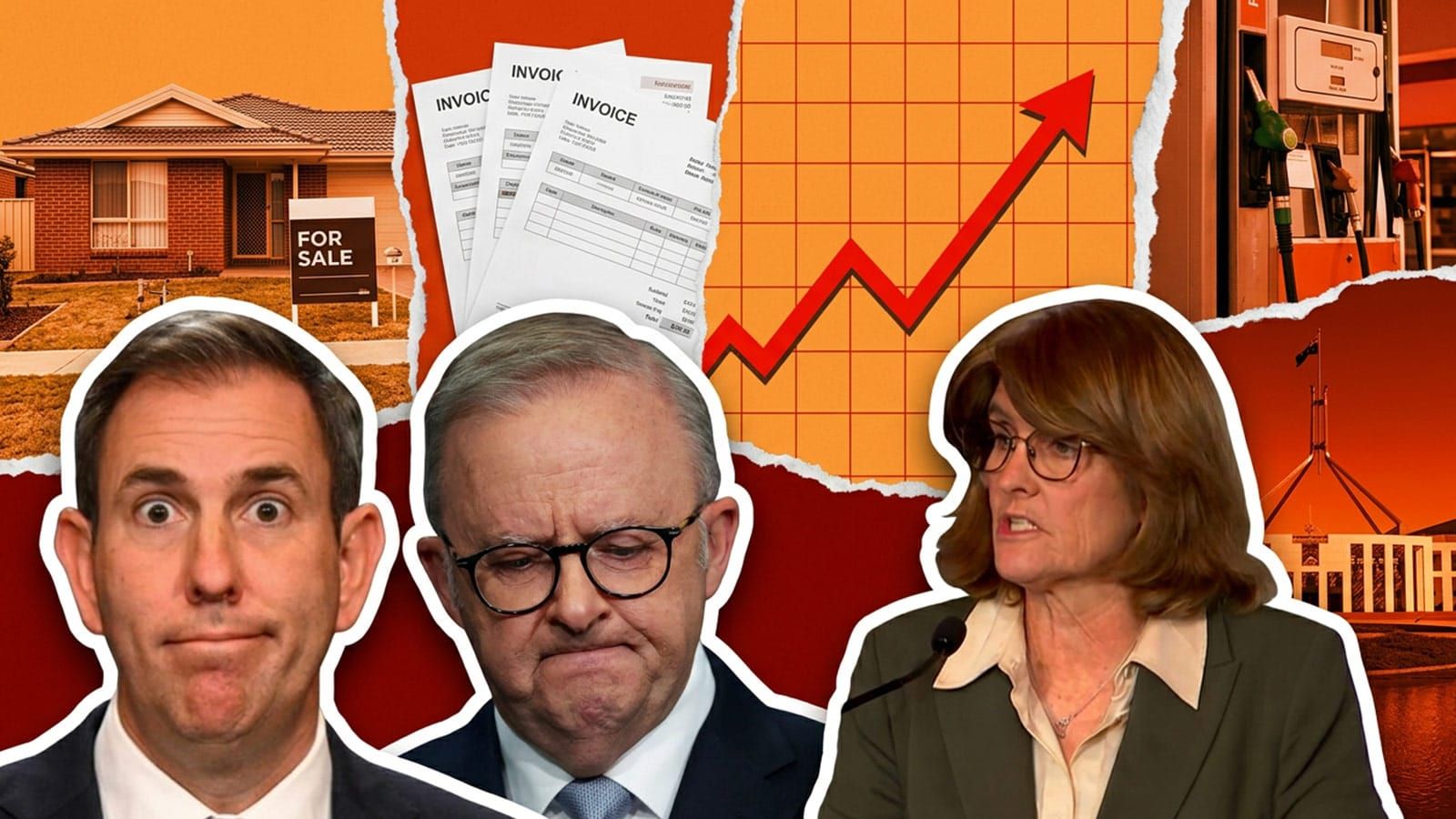
Reserve Bank governor Michele Bullock announces the board's decision on interest rates at 2.30pm today. Economists expect her to hold the cash rate at 4.35% while keeping a fourth rise this year on the table. The cash rate is the interest rate the Reserve Bank sets for the whole economy, and it feeds straight into what the banks charge on a home loan. It has already been lifted three times this year, from 3.60% in February to 4.35% by May.
Anthony Albanese has blamed the Middle East war all year for the squeeze on households, warning of economic shocks that will be with us for months. The economists advising the country's biggest banks and funds told the Australian Financial Review this week that the inflation keeping rates high was made in Canberra. Most of it comes from a government that kept spending while the Reserve Bank fought to bring prices down. The war landed one genuine blow, the petrol shock, and it hurt as badly as it did because Labor and Liberal governments spent 20 years letting Australia's fuel manufacturing die. Both sides were warned exactly what a war would do.
A hold at 4.35% today still leaves a rise to 4.6% live for November
Underlying inflation, the measure the Reserve Bank trusts most because it strips out the wildest price swings, rose to 3.6% in the June quarter. The bank's target is 2 to 3%, so prices are still climbing faster than it says they should. Money markets rate it a one in two chance the cash rate reaches 4.6% by the end of the year. Nobody is pricing a cut before late 2027.
All four major banks, CBA, NAB, ANZ and Westpac, expect a hold today. The traders who had bet on a rise this week dropped those bets within a day of the June inflation number landing softer than the bank feared.
Judo Bank economist Matthew De Pasquale said markets may be underpricing the risk of another rise. "We maintain that the board should be tightening policy further but will likely hold until it has further data. We expect the tone and accompanying forecasts to remain hawkish, keeping the option of further tightening firmly on the table," he said.
Independent economist Justin Fabo went further, saying "hiking a little more now is a very attractive option" because Australia has an inflation problem "that is unlikely to be resolved soon". Barrenjoey chief economist Jo Masters expects the rise to come in November. A quarter point rise adds roughly $100 a month to repayments on a $600,000 mortgage.
Labor's spending, a 4.75% wage rise and flat productivity are driving the price rises
Prices rise when the country spends money faster than it can produce the things the money buys, and the biggest spender in the country is the government.
Shadow Treasurer Tim Wilson put it bluntly on News24 last month, saying of Labor, "they cannot stop their spending addiction. They're inflation junkies, and that's why the Reserve Bank governor has been forced into this position." We covered that charge when Bullock put the fourth rise on the table in July. Wilson's point is that the government keeps stimulating the same economy the bank is trying to cool, so rates stay higher for longer than they otherwise would.
Wages are rising faster than the economy can pay for them. From 1 July the Fair Work Commission, the tribunal that sets minimum and award pay, lifted award wages 4.75%. Masters says that flows quickly into the price of eating out, a haircut, the dentist and the vet. A pay rise is only free of inflation when workers produce more for each hour worked, and that isn't happening. Productivity grew 0.3% over the past year against a long run average of 1.7%, which is why Bullock says the economy "can't grow strongly without putting pressure on inflation".
On top of that sits a building boom in data centres, the warehouses of computers that run artificial intelligence. Billions are being spent putting them up in an economy already running flat out, competing for the same tradies and materials as housing. The server racks being shipped in helped hand Australia its first trade deficit in eight years. The share of people in work is near record highs and household savings are solid, so spending keeps flowing even at 4.35%.
The inflation arrived years before the war Labor blames it on
The war didn't cause Australia's inflation, and the numbers prove it. The petrol spike was real, but it landed on top of price rises that were already years old. Underlying inflation hasn't touched the Reserve Bank's 2.5% target midpoint since September 2021, five years ago. It was already 3.5% in the March quarter, and Iran only shut the Strait of Hormuz, the narrow waterway that carries about a fifth of the world's oil, at the end of February.
Bullock herself said in July that "elevated underlying inflation is consistent with ongoing capacity pressures in the domestic economy", meaning the pressure pushing prices up comes from inside the Australian economy. Wilson called it "a problem that existed before Iran, it continues during the Iran crisis, and it will continue if Iran ended tomorrow". And Fabo told the AFR that households and businesses have now largely adjusted to the shock, which means the war can't carry the blame for what the June quarter numbers show.
Albanese has leaned on the war all year anyway, including in Question Time, where a question about migration got an answer about the Iran war and fuel security. The war explains the worst weeks at the bowser. The inflation was running above the target for years before it, and for the past four of those years Labor has been the one writing the budgets.
Nine refineries became two while Liberal and Labor governments watched
The part of this crisis the war does own, the petrol shock, hit Australia harder than it needed to, and both major parties spent two decades letting that happen.
Australia had nine operating refineries in 2000 and has two today, Viva Energy's plant in Geelong and Ampol's Lytton plant in Brisbane. Shell closed Clyde in Sydney in 2012, Caltex closed Kurnell in 2014, BP closed Bulwer Island in Brisbane in 2015, and in 2021 BP closed Kwinana in Western Australia and ExxonMobil closed Altona in Melbourne. Labor held office for the first of those closures and the Coalition for the rest. Neither side moved to keep the industry alive until 2021, when the Morrison government started paying the last two refineries to stay open.
The result is a country that pumps plenty of oil and can't turn it into petrol. Most of the crude Australia produces is exported because it fetches a better price overseas. Roughly 90% of the fuel Australians use starts offshore, either as imported petrol and diesel or as imported crude. The refined fuel in Australian tanks comes mostly from plants in Singapore, South Korea and Japan, and their crude comes through the Strait of Hormuz. When Iran shut the strait, Australia found out what depending on that supply chain costs.
Australia has been breaking the 90 day fuel rule for a decade and Albanese knew
As a member of the International Energy Agency, Australia is meant to hold 90 days worth of fuel imports in reserve for exactly this kind of emergency. It has been in breach of that obligation for more than a decade. Albanese knew, and said so, in 2020. As opposition leader he told the ABC that Australia was "significantly in breach" of the 90 day rule and that "any particular international incident, be it military conflict or other issues, will mean that we run out of fuel."
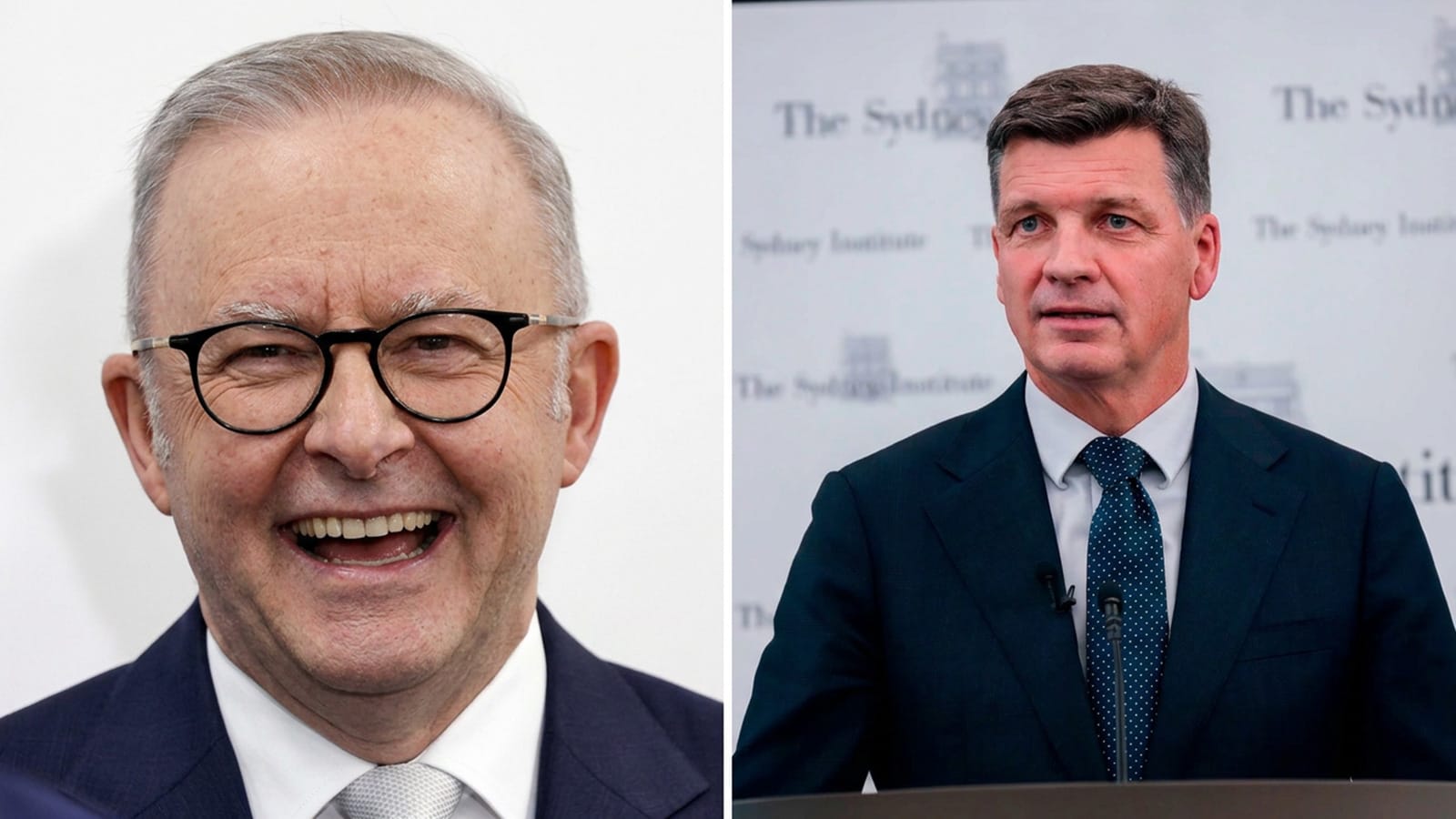
The Coalition's contribution was to sell the only reserve Australia had. The Morrison government bought 1.7 million barrels of cheap crude in 2020 and stored it in America's strategic reserve. Energy Minister Angus Taylor sold every barrel in March 2022, in the months before the election the Coalition lost. Albanese took office with the reserve gone and his own 2020 warning on the record, and four years later it still hasn't been bought back.
Then the war he had warned about arrived. When the strait closed in February, Australia was holding 36 days of petrol, 32 days of diesel and 29 days of jet fuel. Much of that was on tankers still at sea rather than in storage on Australian soil. The government scrambled into a halved fuel excise and an emergency import plan. By late July the buffer had only rebuilt to 42 days of petrol, still less than half of what the 90 day rule requires.
Five months into the war, the fix on offer is a $4 million study
Albanese flew to Karratha in July and announced his government would spend $4 million on an early feasibility study for a new refinery in Western Australia, which would be the country's first since 1965. He also signed a fuel cooperation deal with Singapore. "The longer war in the Middle East goes on the greater the impact on Australia will be," he said. A refinery costs billions and takes years to build, and the study was announced five months after the strait closed.
The study also runs into everything else Labor has been doing since it took office. It signed Australia up to net zero emissions by 2050, its safeguard rules cut the emissions limits on the biggest industrial polluters, both remaining refineries included, by 4.9% every year, and its vehicle standards are written to move Australians into electric cars. Then petrol got expensive and the same government halved the fuel excise to make petrol cheaper for the drivers it has been trying to move off petrol. Now it's paying to study a petrol plant that only pays for itself if Australians keep filling up for decades. Labor has told Australians for four years that the petrol age is ending, and its answer to the fuel crisis is to look into building a new petrol refinery.
The two refineries still standing aren't safe either. The Australian Institute of Petroleum, the peak body for the fuel industry, warned in March that "the survival of refining is not assured" even after Energy Minister Chris Bowen made the subsidies easier to access.
Chris Bowen is the minister writing them subsidy cheques to stay open and the minister whose emissions rules squeeze them tighter every year. That is one man running both sides of the same argument out of the same portfolio. One Nation has pressed the fuel security case since the strait closed, arguing the reserves should have been built long before the war started and net zero should be scrapped for good.
So the board meets today with underlying inflation at 3.6%, a wage rise flowing into services prices, Labor still spending, and a fuel supply that still depends on tankers from Singapore. Whatever Bullock announces at 2.30pm, none of that changes this afternoon, and the 90 day reserve Australia promised the world it would hold still doesn't exist.