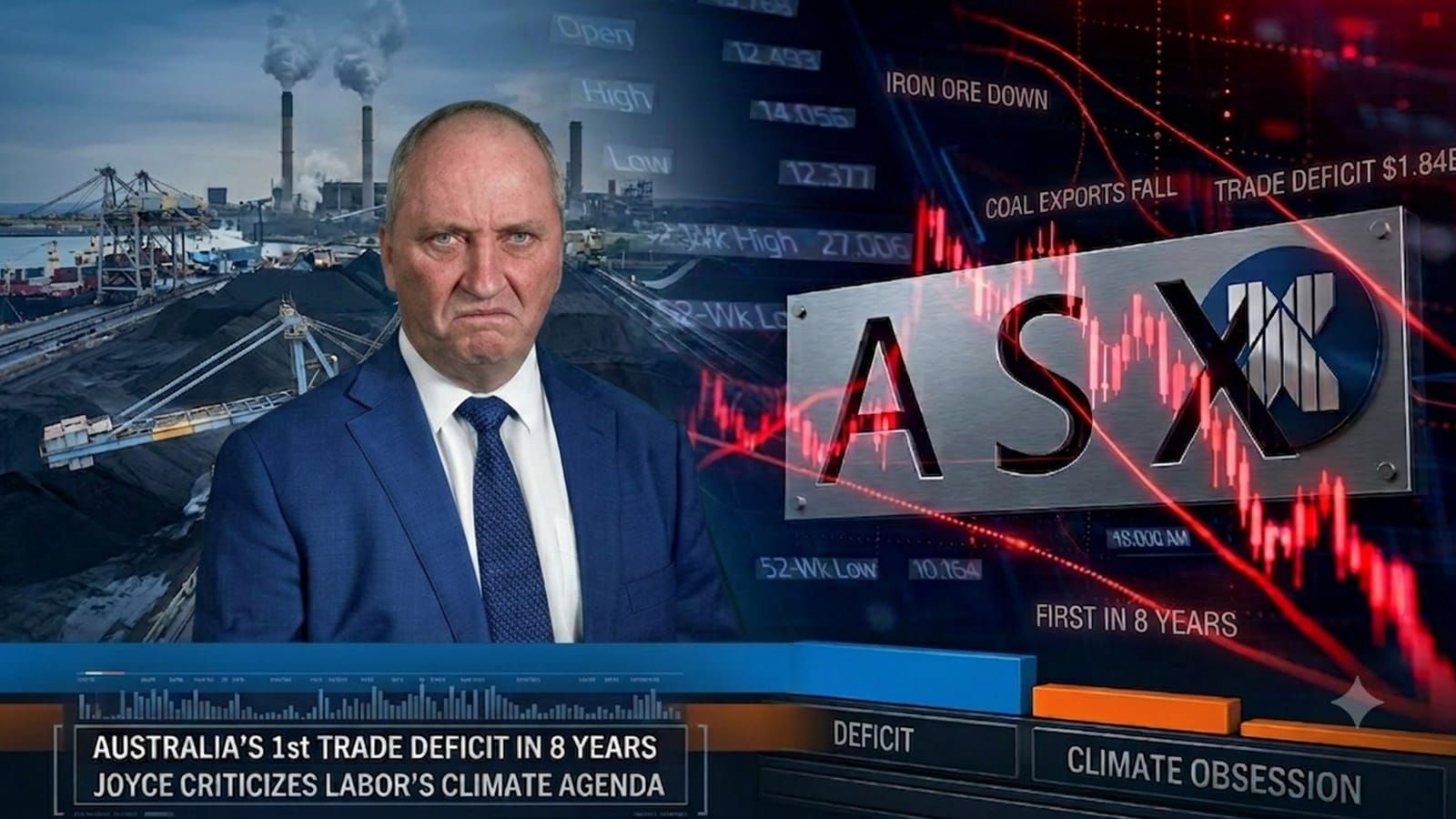
Australia has recorded its first trade deficit in more than eight years, and One Nation MP Barnaby Joyce says the country isn't fulfilling its potential under a government too distracted by its climate agenda to notice.
New data from the Australian Bureau of Statistics shows the country posted a goods trade deficit of $1.84 billion in the March quarter, the first deficit since December 2017 and a significant fall from the $5 billion surplus the quarter before.
Speaking on Sky News, Joyce, the New England MP who left the Nationals for One Nation in December last year, said the figures showed Australia wasn't fulfilling its potential despite its abundant resources, and laid the blame at Labor's feet for what he called the government's climate obsession.
The drivers behind the deficit line up with the One Nation critique. Exports of goods and services fell 1.2% in the March quarter, with iron ore and coal both down. Tropical Cyclone Koji in North Queensland and Cyclone Mitchell in parts of the Northern Territory and Western Australia disrupted shipments. Iron ore exports to China also fell on the back of a weaker Chinese real estate market.
The government had already forecast iron ore export revenue to fall from $116 billion in the 2025 financial year to $97 billion by the 2027 financial year.
On the imports side, ABS head of international statistics Jonathon Khoo said the biggest drivers were data centre equipment, fuels and lubricants.
"Equipment imports reached historic highs, led by bulk imports of artificial intelligence server racks amid continued data centre infrastructure investment in New South Wales and Victoria," Mr Khoo said in a statement.
Iran's closure of the Strait of Hormuz, which has disrupted global oil supply, has lifted prices and pushed Australia's import bill higher.
"Crude oil and refined petroleum product prices rose significantly as the closure of the Strait of Hormuz lifted oil prices and tightened global supply," Mr Khoo said.
A 1.3% fall in services exports was driven mainly by a slump in international student numbers and education related travel.
Australia's current account deficit widened to $27.1 billion from $23 billion the previous quarter. The ABS expects the fall in exports to subtract 0.8% from GDP in the first quarter, with the full figures due Wednesday. Government spending was flat and made no contribution to growth, leaving business investment and household consumption to carry the quarter.
The Reserve Bank has lifted interest rates three times this year, in February, March and May, taking the cash rate to 4.35% and fully reversing last year's cuts. The RBA expects growth to slow to 1.9% by the second quarter and 1.3% by the end of the year as policy tightening and the Iran shock filter through.
For first home buyers trying to build a deposit, the picture is bleak from every angle. Interest rates are back at 4.35%, inflation hit 4.6% in March, the ASX has spent the year volatile rather than reliable, and national home prices have flatlined. The asset classes a young Australian was meant to lean on to get into the market aren't doing the lifting they should be doing.
For One Nation, the numbers feed a long running argument. The party has consistently called for resources policy to put export earnings ahead of emissions targets, and Joyce, the only One Nation MP in the House of Representatives, says today's trade data is the proof.
Sources:
- https://www.skynews.com.au/business/economy/australia-records-first-trade-deficit-in-more-than-eight-years-as-mining-exports-sink-data-centre-and-fuel-imports-lift/news-story/
- https://www.abs.gov.au/statistics/economy/international-trade
- https://www.sbs.com.au/news/article/barnaby-joyce-confirms-he-will-join-one-nation/nvkvf3r7t