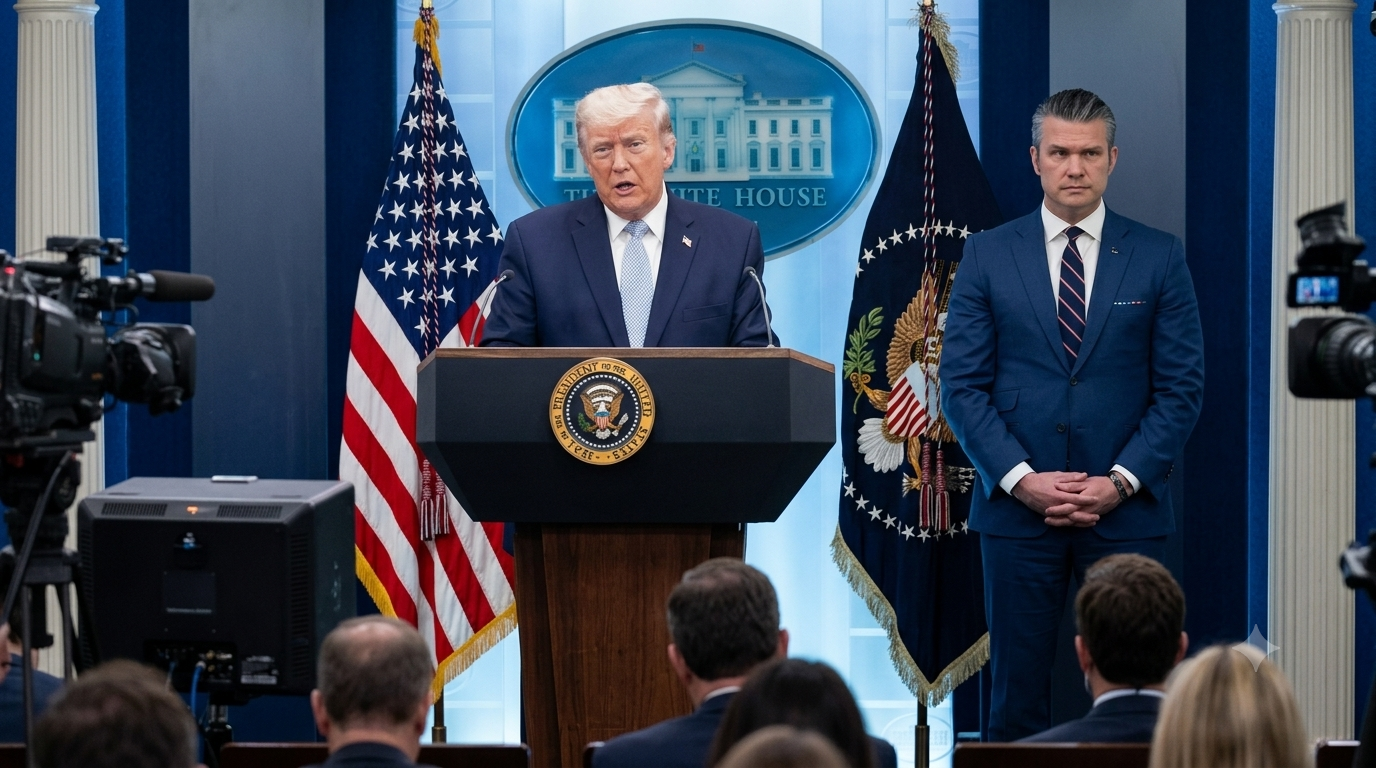
Donald Trump says he "may keep going" after US warplanes struck nearly 20 targets inside Iran on 10 June, a wave of attacks that Iranian reports say damaged a telecommunications tower in the country's south. He's also named what comes next on his list: Iran's power plants and bridges.
"I may keep going. They had a chance to sign a deal and survive," the US President told Fox News correspondent Trey Yingst, saying he was "getting closer" to ordering strikes on Iranian infrastructure.
One News Australia is tracking every confirmed strike and statement on our US and Iran conflict live blog.
🔴UPDATE, 6:45pm AEST 11 June:
He kept going. A second wave of strikes hit Iran overnight, with explosions reported in six locations: Bandar Abbas, Qeshm Island, Hengam Island, Sirik, Minab and Kangan, the last of which sits at the heart of Iran's South Pars gas operations. Defense Secretary Pete Hegseth flagged the attacks in advance, promising they would be "strong and clear" and warning "if we need to negotiate with bombs, we will negotiate with bombs." The IRGC responded by declaring the strait closed to all vessels, a claim CENTCOM publicly fact-checked within hours, posting that commercial ships were continuing to transit. Trump has since told Fox News that Iranian officials contacted him directly asking him to stop the bombing, and that it would stop shortly. Iran's state media denies any contact was made.
What was hit, and why
US Central Command said American forces struck Iranian air defence systems, ground control stations and surveillance radar sites near the Strait of Hormuz, in response to the downing of a US helicopter. Nearly 20 targets were hit, and Washington says nearly all the missiles and drones Iran fired back were intercepted.
Iran's Revolutionary Guard says the strikes damaged a telecommunications tower in the coastal town of Sirik and destroyed two concrete water reservoirs in the town's Bamani district. Tehran is leaning hard on the water claim, framing the strikes as attacks on civilian infrastructure. The Pentagon hasn't confirmed those details and describes the targets as military sites selected to reduce Iran's ability to threaten shipping.
The strikes were retaliation for the downing of a US Army Apache helicopter over the Strait of Hormuz a day earlier. Both crew members were rescued, plucked from the water by a US Navy Corsair drone boat operated by Task Force 59, the first known drone rescue at sea by the American military. Trump told Fox News the Iranian drone that brought the aircraft down "got lodged between the two pilots" and called their survival a miracle.
Iran denies shooting the helicopter down. Foreign Minister Abbas Araghchi blamed "human errors, plain accidents".
Trump defended the scale of the response in an interview with ABC News: "I believe the response should be very strong, very powerful, and that's what this one is."
"Now they will have to pay the price"
Trump's stated grievance is the pace of negotiations. On Truth Social he wrote: "They've taken too long to negotiate a deal that would have been great for them, now they will have to pay the price!!!" In separate comments he has called Iran's military "a complete and total mess" and described Tehran as "all talk and no action".
The target list he's flagged is specific. Power plants and bridges, he told Fox News, accusing Tehran's negotiators of "tapping the United States along" in talks that have produced little.
The secret Iran found out about on live TV
While Tehran was claiming the strait was sealed, Trump revealed the US has spent weeks quietly moving oil through it. In a Truth Social post following his Oval Office remarks, the President announced a covert military operation had escorted more than 100 million barrels of oil and over 200 commercial ships through the Strait of Hormuz, under Iran's nose and without its knowledge.
"I can say it now. Something you didn't know," Trump told reporters. "You know who doesn't know about it? Iran. Until right now." He said he was only revealing the operation because Iran had "just figured it out", and credited a night raid that took out 22 Iranian ships, "late at night, with no lights, 'cause they don't have any radar, 'cause we blasted the crap out of it."
The convoy numbers aren't just Trump's. Defense Secretary Pete Hegseth confirmed the operation at CENTCOM headquarters, saying the US has been "protecting commercial shipping going through the Strait of Hormuz, as the president announced, to the tune of over 100 million barrels that have moved through and more in the middle of the night protected by the United States in a way that Iran can't stop." The 22 ships figure remains Trump's alone, with no separate CENTCOM confirmation yet.
The reveal lands a double blow. It tells global markets the chokepoint was never as choked as Tehran claimed, which is part of why oil sits near $90 instead of the $250 doomsayers predicted. And it tells Iran that for weeks, its blockade of the world's most important oil artery existed mostly in its own press releases.
So when? Reading the timeline
No new deadline has been announced, and that's worth noticing, because public deadlines have been Trump's signature move in this conflict.
In March he gave Tehran 48 hours to fully open the Strait of Hormuz or the US would "hit and obliterate their various POWER PLANTS". Twelve hours before that deadline expired, he postponed the strikes by five days, citing productive talks that Iran insisted didn't exist. Three days later he delayed again, by 10 days to 6 April. The ceasefire followed on 8 April.
This week the strikes resumed without any public clock at all, which may be the point. The deadlines were warnings. These are consequences.
Diplomacy hasn't stopped. A senior White House official told Fox News Digital "the talks still continue", and Qatari mediators arrived in Tehran on 10 June to try to salvage a deal, with Iran's Foreign Ministry confirming the delegation's talks. Trump said earlier in the week an agreement could be done in "two or three days". He has made the same prediction before.
Iran isn't waiting quietly. The Islamic Revolutionary Guard Corps launched drones and missiles at US positions in Bahrain, Kuwait and Jordan, claiming 21 American air and naval bases were targeted and that its drone attack on the US Fifth Fleet headquarters in Bahrain was direct payback for the Sirik strikes. Jordan said it intercepted all five missiles fired toward the Al-Azraq area, and no damage to US facilities has been confirmed. Iran's Foreign Ministry accused the US of violating the ceasefire and claimed "heavy damage" to American bases, a claim Washington rejects.
What it means for Australia
The Albanese government backed earlier US action against Iran while stressing that Australian personnel took no part in any offensive operations, limiting its contribution to a defensive deployment of 85 personnel, an E-7 Wedgetail and air defence missiles to the UAE. The Prime Minister has said he wants "the possibility of Iran getting a nuclear weapon removed once and for all".
For households, the conflict shows up at the bowser. About 20 per cent of the world's oil trade moves through the Strait of Hormuz, and shipping through it has collapsed during the war, forcing the government into a halved fuel excise, suspended heavy vehicle charges and a National Fuel Security Plan to shore up imports. Australia sources about 80 per cent of its refined fuel from overseas, and Albanese has warned the economic shocks "will be with us for months".
One Nation has pressed the fuel security case throughout, arguing the war exposed Labor's failure to build strategic fuel reserves and that the excise cut it called for should not be a temporary measure.
The bigger picture, as One News has reported in depth, is that the strait is also China's problem. Beijing takes nearly 38 per cent of everything that moves through Hormuz, and transits have collapsed from 95 vessels a day to just 10.
Australia signs on to call out Iran "on our soil"
The pressure isn't only military. On 10 June, Australia joined 21 other nations in a joint statement released by the US State Department condemning what it called "lethal plotting and other malign actions in Europe, North America and Australia" by Iranian intelligence and security services.
The statement named Iran's Islamic Revolutionary Guard Corps Intelligence Organisation, the Quds Force and the Ministry of Intelligence and Security, and identified Iranian dissidents, journalists and Jewish communities among the targets. It said the relationship between Iranian security services and "international and local criminal groups" is long standing, and called Tehran's use of those groups "deplorable".
"Attempts to kill, kidnap, harass, intimidate, or otherwise attack people on our soil, undermines national sovereignty and international norms. These actions must stop immediately," the statement said.
The signatories include the US, the UK, Canada and New Zealand alongside 17 European nations. Iran denies engaging in these activities in foreign countries.
Where it stands tonight
The choice Trump put to Tehran was sign, or watch the target list grow. Overnight the list grew, from radar and air defences to ammunition depots, command nodes and the edge of Iran's gas heartland. Now Trump says Iranian officials have rung him asking for it to stop, and Iran says no such call was made. One of those claims will be tested within days. If the bombing pauses, the call was real. If it doesn't, the power plants and bridges are still on the list, and this time there's no deadline to extend.
Sources:
- US State Department: Joint Statement on Iranian State Threat Activity in Europe, North America and Australia
- AAP: Allies condemn Iran plotting in US, Europe, Australia
- One News Australia: US and Iran conflict live blog
- CBS News: Trump says he "may keep going" with strikes
- Fox News: live coverage, 10 June 2026
- Euronews: Iran will "pay the price" for stalled peace talks
- The Times of Israel: Trump says Iran taking too long to negotiate
- 10 News: Trump claims Iran will pay the price
- Iran International: live blog on US strikes
- CBS News: Trump's April deadline on power plants and bridges
- PBS News: Trump extends deadline for Iran to reopen oil route
- SBS News: Albanese says US action was unilateral
- NRMA: fuel price updates and the war in Iran
- One Nation: fuel security crisis exposes energy policy failures