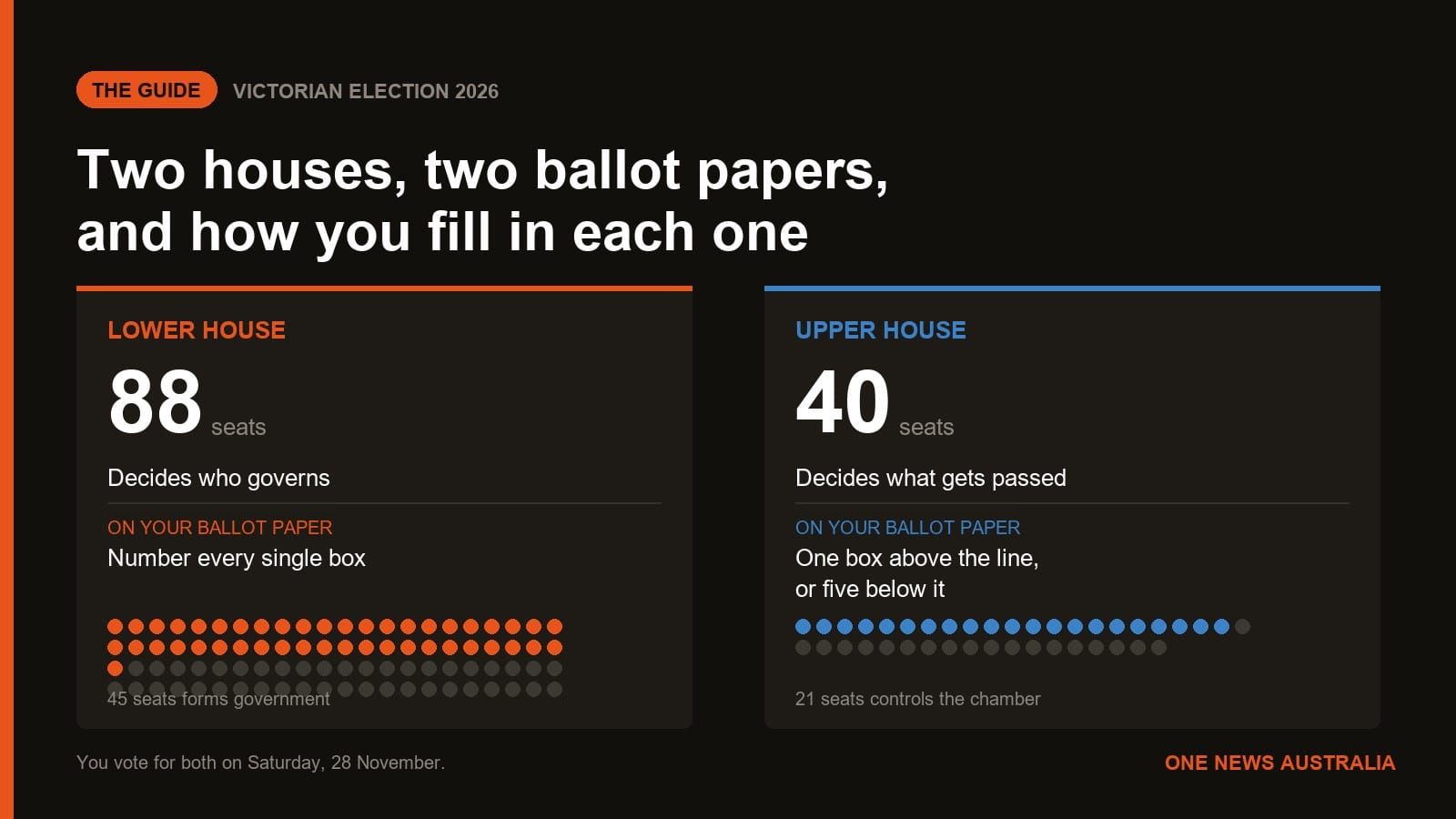
Victorians pick a premier on 28 November, and then on a second piece of paper they decide who that premier will have to bargain with to get a law passed. A government needs 21 of the upper house's 40 seats to legislate on its own. The Coalition was the last to manage it, winning 21 at the 2010 election, and it lost them again in 2014, so for the past twelve years every bill has been a negotiation. What the second paper really sets is the price, and whether that price is a phone call or a fortnight of horse trading.
Those 40 seats also come out of a system forgiving enough that One Nation won one of them in 2022 on 2.04% of the statewide vote. The chamber is called the Legislative Council. This is our running preview of the fight for it: what it does, the 8 regions being contested, how the ballot paper works and who is standing where.
What the upper house is, and why the crossbench matters
The upper house, whose formal name is the Legislative Council, is the reviewing half of the Victorian parliament. It doesn't decide who becomes premier, because that is settled in the lower house next door, formally the Legislative Assembly. What the upper house does is scrutinise, amend, pass or block the laws a government wants, and hold that government to account through its committees.
All 40 members face the voters every 4 years, on the same day as the election that decides government. The members who belong to neither big party are known as the crossbench, and when a government falls short of 21 a handful of them can shape four years of policy. We have set the two houses side by side below, with what each one does and how you vote for it.
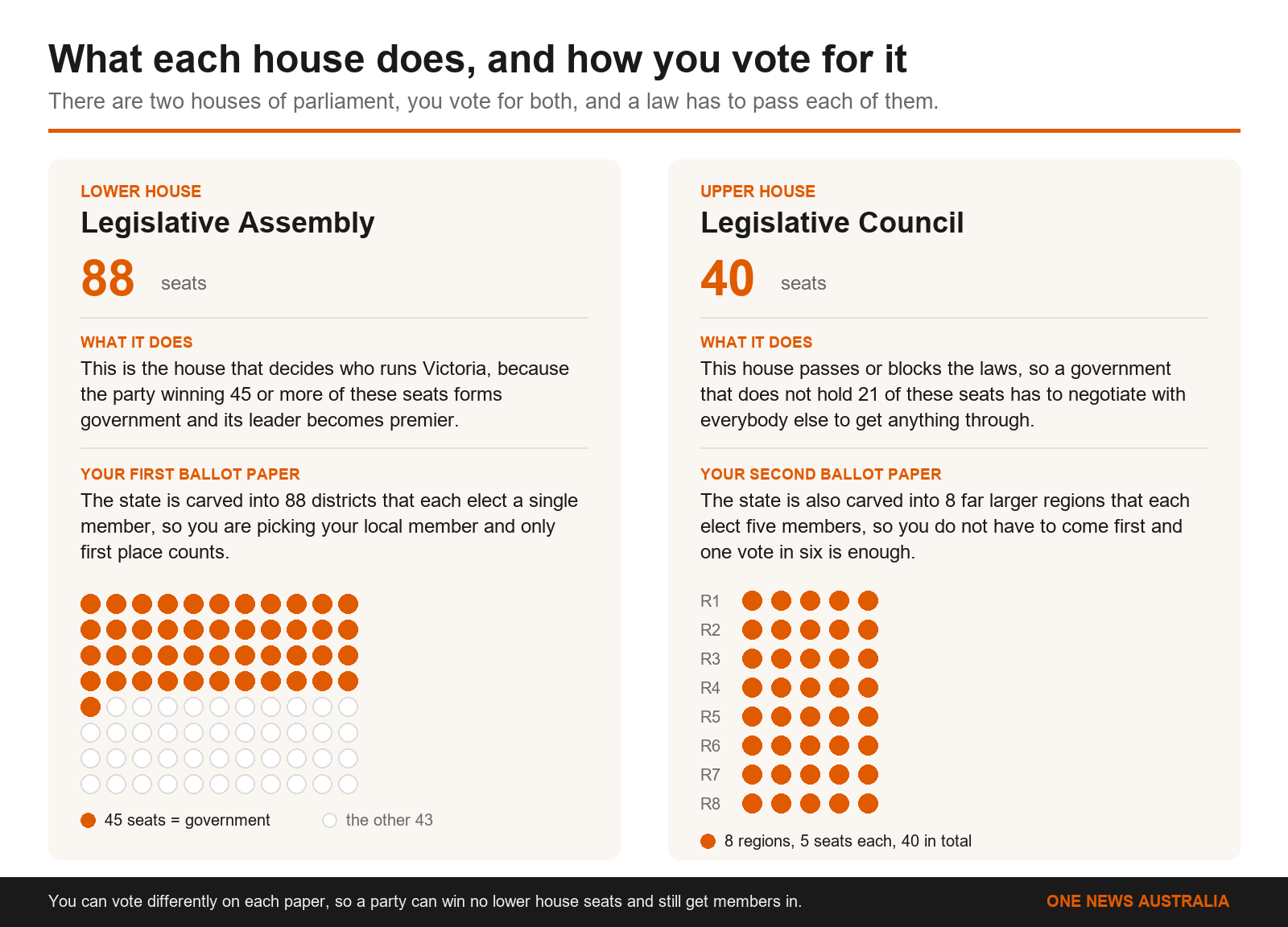
To explain how the upper house voting system works, say you live in Pakenham. On election day you're handed two ballot papers, and they cover completely different patches of Victoria. The first one lists only the candidates standing in Pakenham, so you are choosing a single local MP, and only the winner goes to parliament while everybody else goes home with nothing. The second paper covers Pakenham plus the 10 electorates around it, which together are called Eastern Victoria. That whole area elects five MPs at once. The five are shared out to match the way people voted, so a party winning about a fifth of the votes across the region picks up one of them.
Victoria has 88 local electorates for the lower house, and grouping them 11 at a time gives you the 8 upper house regions, five of them entirely metropolitan and three covering the country. Because a region fills five seats instead of one, a candidate there doesn't need to come first. Winning about a sixth of the vote across the region is enough to take one of the five, and that way of handing out seats is called proportional representation.
Find your region, and the One Nation candidate standing in it
| Region | What it covers | One Nation candidate |
|---|---|---|
| Eastern Victoria East Vic | Point Nepean on Port Phillip Bay across to the New South Wales border, taking in all of Gippsland and the Latrobe Valley, plus the Dandenongs, Pakenham and the southern Mornington Peninsula. | To be announced |
| North-Eastern Metropolitan NE Metro | Both sides of the Yarra, from Mill Park in the north down to Glen Waverley and east to Eltham and Warrandyte. Called Eastern Metropolitan until the 2020 redistribution pushed it north. | Natalie Adams |
| Northern Metropolitan North Metro | A narrow corridor from Melbourne and Richmond north to Kalkallo, taking in Brunswick and Northcote. Labor and Greens heartland. | Mark Nicholson |
| Northern Victoria North Vic | The Murray from Mildura through to Wodonga, down through Bendigo and out to Macedon, Yan Yean and Eildon on Melbourne's fringe. | Rikkie-Lee Tyrrell |
| South-Eastern Metropolitan SE Metro | Bounded by Mordialloc, Frankston, Cranbourne, Berwick and Rowville. | Colleen Harkin |
| Southern Metropolitan South Metro | Along the bay from Port Melbourne down to Mentone, and north to Kew. | Aaron Sanford |
| Western Metropolitan West Metro | Sunbury down to Williamstown and south west to Werribee. | Fiona Lopez |
| Western Victoria West Vic | The South Australian border through Ballarat to Greater Geelong, including Melton on Melbourne's edge. | Chris Burson |
One Nation has named a lead candidate in 7 of the 8 regions, with Eastern Victoria yet to be announced. That is the region containing Pakenham, where the party's state president Warren Pickering is contesting the lower house seat. Our profiles of all eight candidates are in meet the team.
One thing to watch for on the ballot paper itself: the party changed its registered Victorian name on 3 August. Pauline Hanson's One Nation is now registered with the Victorian Electoral Commission as One Nation Victoria, abbreviated to One Nation, with a new logo. That's the name and logo voters will be looking for above the line.
The upper house is where the numbers favour One Nation
One Nation is contesting both houses in force. Pauline Hanson has said the party has candidates locked in for up to 76 of Victoria's 88 lower house seats, on top of the upper house regions listed above. What the arithmetic above changes is where that effort pays off soonest, because a region is a much shorter road than winning a local electorate outright, and the party already holds a seat in this chamber to defend.
Where the parties stand moves from poll to poll. Rather than freeze a figure here, we keep every Victorian and federal poll, with its pollster, sample size and field dates, in our poll tracker, which is updated as each new poll lands.
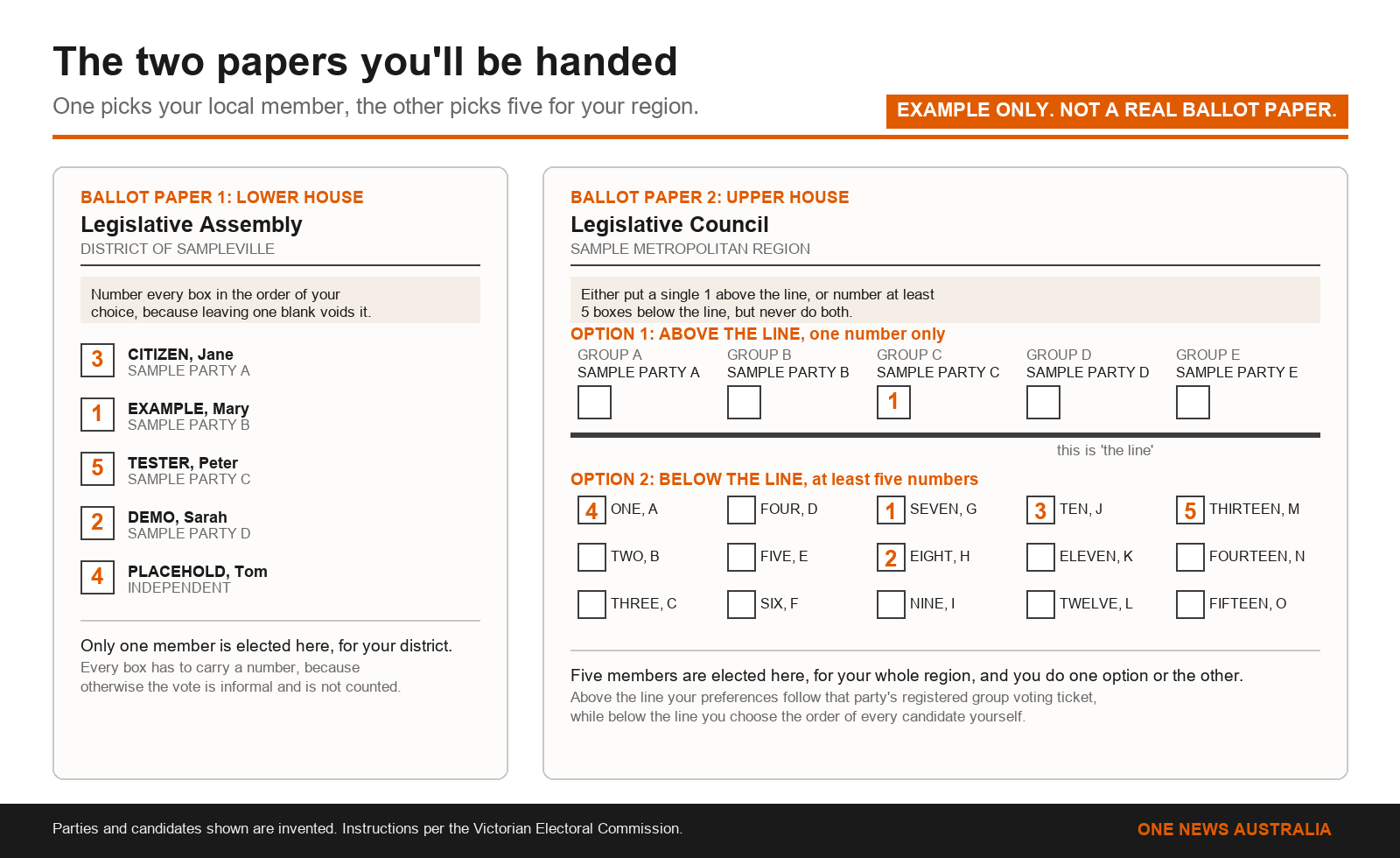
Most people will do whatever the how to vote card in their hand tells them, and for this paper that almost always means putting a single 1 above the line. The overwhelming majority of Victorians vote that way, and it is a perfectly good vote.
What it does mean is that the party you picked decides where your vote goes after them. Every party lodges a list with the electoral commission before polling day setting out that order, and your ballot follows it.
If you would rather decide that yourself, ignore the card and vote below the line, numbering at least 5 candidates in whatever order you like. It takes longer and it is the only way to control where your preferences end up. Neither option is wrong, and both count.
One warning if you have voted in a federal election. You may be used to numbering several boxes above the line, and that does not work in Victoria. Here only the first number above the line is counted and everything after it is thrown away. Our full voting guide walks through both papers.
The rules for this ballot paper might change before you vote
There is also a real chance the upper house ballot works differently by the time you fill it in. Parliament is part way through scrapping group voting tickets. If it finishes the job, you will be able to number several parties above the line and have those preferences count, rather than handing them to whoever your first choice has done a deal with.
Two facts from the parliamentary debate explain why MPs of every stripe want them gone. Two candidates were elected to the Victorian upper house in 2018 on less than 1% of the vote. Brunswick MP Tim Read told parliament that seats in the chamber had been bought for as little as $50,000 by manipulating the tickets.
None of that has happened yet. The change passed the lower house on 29 July and is now sitting in the upper house, so until it clears that second vote the ballot paper works exactly as described above. We will update this the moment it changes.
What the last five elections tell you about this one
Victoria has now held five upper house elections under the current system, and only once has either side walked away with control of the chamber. The Coalition managed it in 2010 with 21 seats. Every other time the government of the day has had to deal with somebody to pass a law.
The clearest trend is the growth of everyone who is not Labor, the Coalition or the Greens. That crossbench held a single seat in 2006 and none at all in 2010, then jumped to 5 in 2014, peaked at 10 in 2018 and settled at 7 in 2022. Over the same stretch Labor fell from 19 seats to 15 and the Coalition from 17 to 14, so the chamber has been drifting away from the majors for most of two decades.
One Nation is already part of that story. Rikkie-Lee Tyrrell won Northern Victoria in 2022 to become the party's first MP in Victoria, and she is recontesting the same region in November. This time she has seven colleagues standing alongside her instead of none.
Key dates between now and 28 November
Postal vote applications open on 4 November and close on 25 November, early voting runs from 18 to 27 November and needs no reason to use it, and election day is Saturday, 28 November.
By noon on 11 November every party has to lodge with the Victorian Electoral Commission the exact order its preferences flow to every other party, and the commission then publishes those lists. If the reform hasn't passed by then, that is the day you can look up where an above the line vote for any party ends up. It is the only way to find out before you cast it.
This preview will be updated as nominations close, group voting tickets are lodged and the regions firm up.