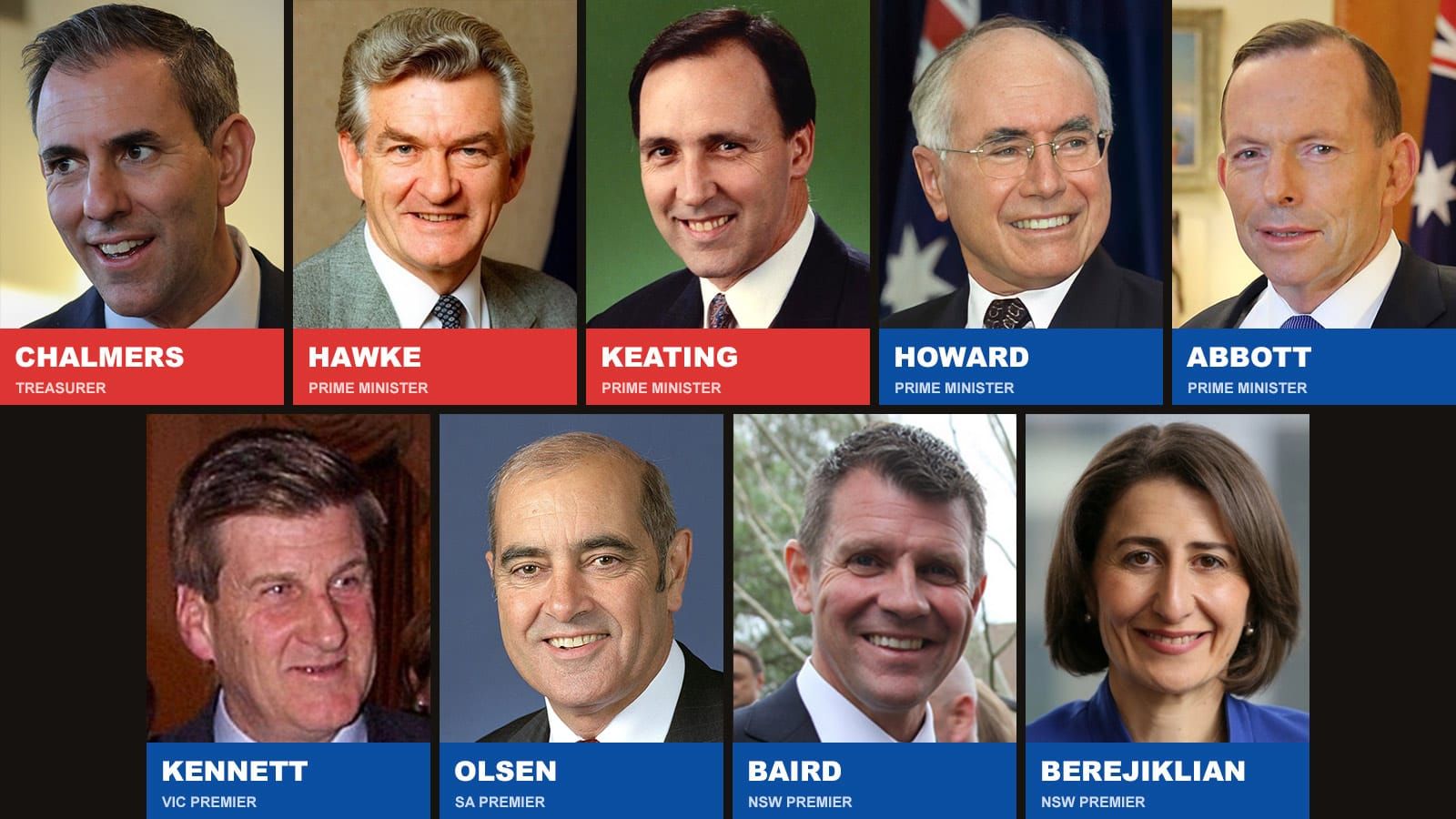
Labeling Jim Chalmers Australia's trillion dollar debt man is completely accurate. The grim milestone landed squarely on his watch right after he stood in parliament bragging about fiscal restraint. Honest reporting demands calling out what neither Labor nor the Coalition will ever admit. Both major parties built this trillion dollar mountain over two decades of reckless management. Both systematically sold off the revenue generating assets that should be paying it down today.
This is the raw unfiltered ledger. It exposes every administration's debt additions, the exact price tags of our sold public infrastructure, the billions in gas wealth funneled offshore, and alternative proposals from minor parties like One Nation and People First. Every number comes straight from official budget papers, debt agency logs, and OECD records.
Two Decades of Bipartisan Betrayal: The $1 Trillion Spending Frenzy
The AOFM ledger destroys every political excuse. John Howard walked out in 2007 leaving $58 billion in gross debt. Kevin Rudd and Julia Gillard blew that up to $257 billion during the global financial crisis. The Coalition then took the wheel and spiked debt to $542 billion by 2019 without a single crisis to blame, before driving it to $868 billion through COVID. Labor has now pushed the total past $1,000.8 billion, with its own budget locking in $1,249 billion by 2030.
Chalmers took to Facebook claiming most federal debt was racked up by the Liberals and Nationals between 2013 and 2022, boasting they doubled the debt before COVID hit. On the raw numbers, that is true. The Coalition added $611 billion in nine years and blew past $542 billion before any pandemic arrived. But his post hides the other side of the ledger. Labor's budget adds another $381 billion by 2030 without a pandemic or financial crisis, runs deficits every single year until the budget returns to balance in 2034-35, and smashes straight through the $1.2 trillion legal debt cap along the way.
His second post pushes spin past breaking point. "Debt is $200 billion lower this year than what the Coalition left us," he bragged. The Coalition left $867.7 billion of real debt in June 2022, and the total today sits $133 billion higher. That $200 billion figure exists purely as a paper fantasy measured against Coalition forecasts, and even on that rigged scale, his own budget paper lists the reduction at $173 billion. That leaves his Facebook boast $27 billion short of his own government's documentation.
The chart in Jim Chalmers’ video plots gross debt against a forecast the Coalition made in 2022, never against the debt itself. The AOFM ledger the video skips: $867.7 billion inherited in June 2022, $1,000.8 billion now, and his own budget paper puts the saving against that forecast at $173 billion, not $200 billion.
Divided among Australia's 28 million citizens, the Commonwealth's debt was $2,800 per person when Howard walked out the door in 2007. Today, every single Australian carries a $35,700 debt sentence on their head, a massive thirteenfold spike that lays bare two decades of bipartisan reckless spending. Not one single administration since 2007 has handed the keys back with a smaller national debt bill than it inherited.
The Privatisation Scam: How Labor and Liberal Traded Infinite Income for One Off Cash
The Commonwealth Bank was flogged off between 1991 and 1996 for a total of $8.1 billion. Just last week it reported a monstrous $10.9 billion annual profit, meaning private shareholders now pocket more cash in a single year than taxpayers received for the entire bank.
Telstra was stripped and privatised for $45 billion. CSL was dumped in 1994 for $299 million and now stands as an ASX powerhouse.Qantas was cleared out for $2 billion, Medibank for $5.7 billion, and our airports were handed off on long term private leases.
State governments joined the feeding frenzy. Victoria dumped its power grid for $23.5 billion, South Australia handed ETSA to a foreign billionaire consortium for $3.5 billion, and New South Wales leased out its poles and wires for $34.1 billion. Every power bill in those states now includes a guaranteed cut for private and foreign owners. The sell offs keep going: Treasury advice recently categorized Labor's Melbourne Water restructure as partial privatisation.
Governments of all stripes traded permanent public wealth for a one off hit of quick cash, blew the money, and stuck taxpayers with the tab. Income tax is now forced to do the heavy lifting those cash cows once handled, sitting at a crushing 18.6% of GDP.
Howard used his proceeds to clear debt and parked the rest in the Future Fund, locking those earnings away for public servant pensions instead of the budget. NSW recycled its infrastructure money into roads and rail, while Victoria used its power sales to pay off state debt.
Not one government replaced those money making assets with new income streams. Manufacturing was abandoned next, culminating in the last Australian built car rolling off the line in 2017. Selling an asset clears debt once, but the dividends disappear forever. Every future deficit must be covered by borrowing because the earning side of the balance sheet was gutted. Gross debt is now 17 times higher than when Howard left. A household that sells its rental property to clear a credit card and keeps spending ends up with a maxed out card and zero rental income.
| Sold by | What taxpayers received (approx) | Who profits now |
|---|---|---|
| Labor, Bob Hawke and Paul Keating Commonwealth Bank, 1991 to 1996 | $8.1bn | $10.9bn profit in 2025-26 alone |
| Labor, Paul Keating Qantas, 1992 to 1995 | $2.0bn | dividends to private shareholders |
| Labor, Paul Keating CSL, 1994 | $0.3bn | one of the biggest companies on the ASX |
| Coalition, Jeff Kennett in Victoria Victorian electricity, 1995 to 1999 | $23.5bn | returns built into every power bill |
| Coalition, John Howard Telstra, 1997 to 2006 | $45.0bn | dividends to shareholders since 2006 |
| Coalition, John Olsen in South Australia ETSA electricity lease, 1999 | $3.5bn | returns to its Hong Kong owners |
| Coalition, Tony Abbott Medibank, 2014 | $5.7bn | premiums flowing to shareholders |
| Coalition, Mike Baird and Gladys Berejiklian in NSW Poles and wires leases, 2015 to 2017 | $34.1bn | network charges on NSW power bills |
| Labor sales total | $10.4bn | |
| Coalition sales total | $111.8bn | |
| All sales | $122.2bn |
Red rows are Labor governments and blue rows are Coalition, in order of sale. The Commonwealth Bank's first two tranches were sold by Keating in 1991 and 1993 and the final tranche was completed under Howard in 1996. Proceeds as reported at the time by the RBA, the Parliamentary Library, the ABC and the NSW Government.
Qatar collects $56 billion a year from gas, Australia collects only $9.6 billion
Gas is Australia's third largest export, pulling in over $67 billion a year. Yet the Petroleum Resource Rent Tax, designed specifically to capture public revenue from our finite resources, raised a pathetic $1.98 billion last year. Treasury forecasts expect that figure to collapse to $1.45 billion by 2028-29. Around 70% of LNG ships out of Commonwealth waters completely royalty free, with no state or federal charges applied outside the North West Shelf.
The Australia Institute laid bare the scale of this economic surrender in its Qatar comparison. Qatar exports almost the exact same volume of LNG as Australia. Yet the Qatari government extracts around $56 billion a year from its gas, while Australia scrapes together just $9.6 billion. Qatar forces companies to hand over roughly 67% of export value, while Australia settles for a miserable 12%. That $46 billion annual gap alone would completely wipe out the entire interest bill on Australia's $1 trillion national debt.
Four separate governments across both major parties built this broken system. Hawke's Labor government drafted the PRRT back in 1987 for oil fields. The government's own reviews admit the tax was never designed for LNG, which is why most massive gas projects will not pay meaningful PRRT until deep into the 2030s. Howard locked in the first massive China contract in 2002, signing off on a 25 year supply deal for the North West Shelf. Federal and Queensland Labor then rubber stamped east coast export terminals from 2010 without a domestic reservation requirement, ignoring the basic protection Western Australia put in place in 2006.
When Chalmers finally touched the PRRT in 2023, he capped deductions at 90%, projected to raise a meager $2.4 billion over four years. That four year windfall represents barely a fortnight of what Qatar collects from its gas.
Debt Slavery by Design: Government Debt Outsourced to Your Mortgage
Chalmers loves dodging accountability by pointing to international debt comparisons. Sure, Australia's federal debt looks smaller on paper than bigger, more broken foreign economies. But grading Australia against massive global administrations that failed worse excuses political incompetence and fixes nothing.
The crushing debt burden forced onto everyday Australians exposes the true disaster. Household debt has exploded to a staggering 177% of disposable income on the Reserve Bank's measure. That ranks as the fifth worst debt trap among the OECD's 38 member nations on the OECD Household Debt Survey, more than double the ratio recorded in the early 1990s. That massive mortgage strain directly fuels the $10.9 billion annual profit of the Commonwealth Bank, an income machine sold off by the government for a meager $8.1 billion.
The next financial squeeze is already crashing down on working families. The budget's negative gearing and capital gains overhauls are collapsing property sales and wiping out stamp duty revenues. Meanwhile, Treasury's absurd $2 a week rent claim is disintegrating in real time as market rents skyrocket across the country. Chalmers is flagging even more tax overhauls ahead, and this brutal ledger is the exact record his policies land on.
National Wealth Surrendered: How Norway and Singapore Built Dynasties While Australia Sold Out
Norway struck oil in 1969 and chose economic independence over short term political slush funds. It slapped a brutal 78% tax on petroleum profits and funneled every single cent into a sovereign wealth fund. Today, Norges Bank Investment Management oversees a fund that has surged past US$2.2 trillion, making it the undisputed largest single investor on Earth, holding roughly 1.5% of every listed company on the planet. With a population of just 5.5 million people, Norway stacked up roughly US$400,000 in underlying wealth for every citizen and acts as a global net lender while Australian politicians scramble to fund basic services.
Singapore refused to run a corporate fire sale altogether. Through its state holding vehicle, Temasek Holdings, the government held onto crown jewels like Singapore Airlines, Singtel, and DBS Bank. According to the Temasek Review, its net portfolio value stands at S$518 billion. The returns generated on those state reserves fund approximately 20% of Singapore's entire national budget year after year as a core revenue line. Those are the exact type of infinite dividend streams Australian parliaments surrendered for $122 billion in quick, one off payments.
Neither country possessed magic solutions Australia lacked. Both constructed massive financial fortresses across the exact same decades Australian politicians spent stripping our public balance sheet bare. The single closest Australian policy proposal on the table today is One Nation's equity stake model, which borrows heavily from the Norwegian structure to claw back the wealth both major parties gave away.
| Country | What it did with its wealth | Where it ended up |
|---|---|---|
| Norway | Taxed petroleum profits at 78% and banked the money in a sovereign wealth fund | A US$2.2 trillion fund, about US$400,000 per citizen, and a government that lends instead of borrowing |
| Singapore | Kept its airline, telco and bank in state hands through Temasek | An S$518 billion portfolio with investment returns funding about 20% of the national budget |
| Australia | Sold $122 billion of income producing assets and takes about 12% of gas export value | $1 trillion of Commonwealth debt and an interest bill of $81 million a day |
Sources: Norwegian Petroleum Directorate, Singapore Ministry of Finance, Temasek, the AOFM and the Australia Institute.
The Minor Party Battleground: One Nation and People First Challenge the Ledger
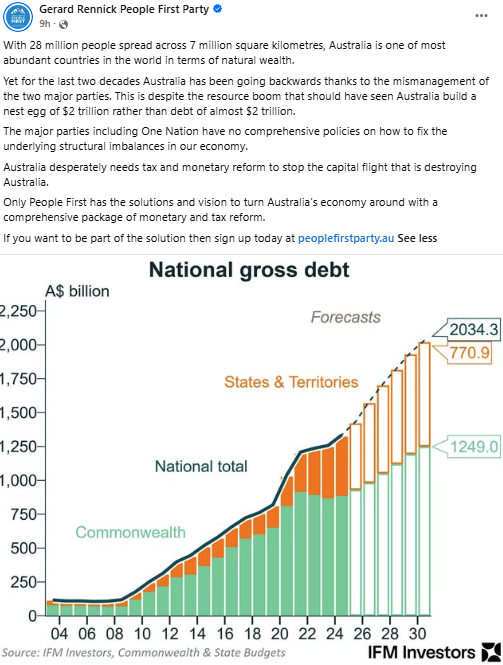
Gerard Rennick's People First claimed national debt is heading for almost $2 trillion, asserting that major parties and One Nation lack comprehensive solutions to fix the structural deficit. Only the first statement holds up: Parliamentary Budget Office figures show combined federal and state debt blowing past $2 trillion by 2029-30. The second claim ignores the public record, as One Nation's Gas Policy lays out a direct blueprint to capture resource revenue.
That policy establishes the Australian Natural Wealth Investment Corporation, a sovereign wealth vehicle securing up to a 30% Commonwealth equity stake in new gas projects alongside a 30% exploration rebate. It replaces the broken PRRT on new developments with a direct royalty on wellhead value, mirroring the high yield model Qatar uses to extract national dividends. One Nation frames this as the first genuine public ownership stake in Australian natural resources, paired with scrapping net zero targets and the Safeguard Mechanism. Hanson has similarly targeted retirement savings reform in her economic platform.
People First's platform focuses on tax cuts, raising the tax-free threshold to $45,000 for singles and $90,000 for couples, making superannuation voluntary, and creating public banking and insurance infrastructure. However, the party publishes no fiscal costings against the national debt, leaving its financial blueprint unverified.
One Nation's full costings remain the key metrics to watch, as its gas framework stands as the only published proposal targeting the revenue streams major parties surrendered. The underlying ledger is clear: Labor and the Coalition built the $1 trillion debt, sold off over $120 billion in income generating assets, and let resource wealth flow overseas while Australian households carry the fifth highest debt load in the developed world.