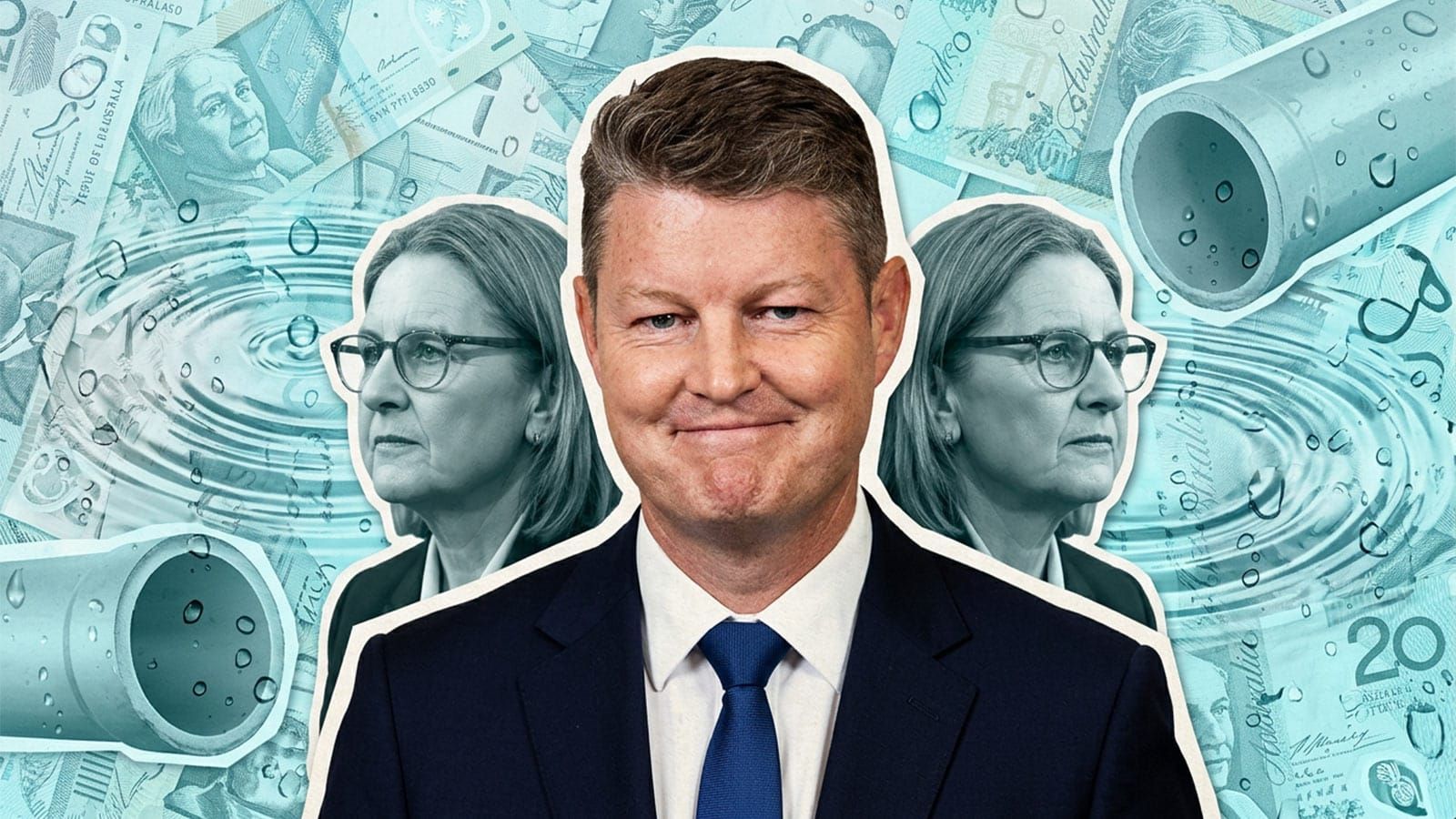
Victorian Premier Ben Carroll wanted Labor's secret plan to bring private investors into Melbourne Water kept alive when his own water minister tried to stop it, according to the only public account of where he stood.
In February 2025, water minister Gayle Tierney moved to kill the plan, which Treasury had codenamed Project Nerva. The Australian reports, citing sources familiar with the cabinet discussions, that Mr Carroll, then deputy premier, "supported continuing work on the proposal", as did then treasurer Jaclyn Symes. That's support for keeping the investigation running rather than for signing a deal, and it's the only thing anyone has said about where he stood. He lost that round. Jacinta Allan backed her minister and the plan was shelved, and it came back anyway 14 months later when Ms Tierney lost the portfolio.
Mr Carroll is the premier now, and his government says he "did not support privatising Melbourne Water". Project Nerva recommended a joint venture rather than an outright sale, though Treasury's own starting point in 2021 was what the documents call partial privatisation of Melbourne Water. Labor used the same structure in 2022, handing two super funds and Macquarie the right to run Victoria's car registration and licensing system for 40 years while the state kept the asset on paper.
So the premier denies a privatisation nobody proposed and says nothing about what was actually on the table. He hasn't ruled out a joint venture, a long term lease or a securitisation, he hasn't explained why he wanted the work continued, and when a list of questions went to his government it replied with that one sentence and nothing else.
Victoria's net debt is heading for $199 billion by 2030, when the interest alone reaches $32 million a day. The transaction was worth $3 billion to $4 billion, or roughly 2% of that. Labor spent five years working out how to hand over 40 years of a water monopoly for a number that doesn't fix the problem it was meant to fix.
What Project Nerva does to the bill that arrives at your house
Melbourne Water is the wholesaler. It treats the water, runs the sewage plants at Werribee and Bangholme, and sells in bulk to Greater Western Water, South East Water and Yarra Valley Water, who send you the bill. Prices are capped by the Essential Services Commission, which approved up to $7.3 billion of capital spending to 2031 and let prices rise 4.1% on 1 July. Owner occupier bills go up by roughly $62 to $92 this year depending on the retailer.
Those rises are locked in and have nothing to do with ownership, and a private operator couldn't lift the capped charges at will either. The harm sits where the cap doesn't reach.
Labor's own submission spells it out where Melbourne Water earns money outside the regulated cap, and those commercial earnings have helped hold household bills down. Ministers were warned in writing that private investors could eat into exactly that, so the bill goes up without anybody putting the price up, because the money quietly subsidising you leaves and turns into somebody's return.
Then there's what a private owner gets paid for. Regulated returns are earned on capital invested while maintenance comes straight off profit, so the incentive is to build plenty and maintain little, and to fight the regulator on every determination for 40 years with lawyers a state utility can't match. Economist Saul Eslake told the Australian Financial Review that any government trying this "would immediately be inundated with stories of what a disaster Thames Water has been in the UK". Thames supplies more than 16 million people and is facing collapse under its debts, 37 years after England privatised water outright.
Three Labor projects blew out by $15.5 billion, and your water business is being asked to cover it
The cabinet submission blames the pandemic. The state's own auditor has been counting what else went wrong.
The Victorian Auditor General found the estimated cost of more than 100 state projects rose by $11.66 billion in a single year, after $11 billion the year before and $11.2 billion the year before that. The Parliamentary Budget Office has since found the Suburban Rail Loop's first two stages will cost $9 billion more to build and maintain than budgeted, and another $7.5 billion to run across 50 years. On three of the biggest projects alone, the gap between what Labor said they would cost and what they cost now looks like this.
| Project | Labor said it would cost | Latest estimate | Blowout |
|---|---|---|---|
| West Gate Tunnel | $5.5 billion | $10.2 billion | +$4.7 billion |
| Metro Tunnel | $11 billion | $13.5 billion | +$2.5 billion |
| Suburban Rail Loop, stage one | $26.2 billion | $34.5 billion | +$8.3 billion |
| These three projects | $42.7 billion | $58.2 billion | +$15.5 billion |
Source: Victorian Auditor General and Parliamentary Budget Office figures.
The May 2026 budget puts net debt at $165.3 billion this year and $175.6 billion next year, with interest climbing from $8.9 billion a year to $11.8 billion by 2030.
That's what Victorians are being asked to pay for. A decade of projects came in billions over what the government said they would cost, on top of the pothole state those projects were meant to fix, and the water business is now lined up to cover a hole Labor's own construction program dug. The proceeds wouldn't build anything either. Officials set out three uses for the money: reducing debt, topping up the Victorian Future Fund, or funding other government priorities.
Labor already sold 40 years of VicRoads to super funds, and this is the same deal
In 2022 Labor sold the right to run Victoria's car registration and licensing business, covering about five million drivers and six million vehicles, to a consortium of Aware Super, Australian Retirement Trust and Macquarie Asset Management for $7.9 billion. They run it until 2062. Nobody had to call it a privatisation because the state still owned VicRoads on paper. It just stopped operating the part that collects money from you. The Department of Treasury and Finance says more than 75% of the consortium's funding came from Australian superannuation funds.
That's the template Project Nerva recommends for Melbourne Water, and the buyers aren't anonymous offshore raiders. Aware Super and Australian Retirement Trust are industry super funds, and both are shareholders in IFM Investors, the infrastructure manager owned by a group of funds that also includes AustralianSuper, Cbus, HESTA, Hostplus, Rest and CareSuper. IFM already holds pieces of Ausgrid, Australian airports and ports, and Southern Cross Station. Its chair Cath Bowtell spent years as a senior industrial officer at the ACTU. The chair before her was Greg Combet, who ran the ACTU from 2000 to 2007, sat in the Rudd and Gillard cabinets, and now chairs the Future Fund, which is one of the owners of the Port of Melbourne.
The three parties to a deal like this do very differently out of it.
| Who | What they pay | What they get paid |
|---|---|---|
| Aware Super, Australian Retirement Trust and Macquarie | $7.9 billion, once, in 2022 | Every registration and licence fee paid in Victoria until 2062 |
| The Victorian government | Every registration and licence fee it would have collected for 40 years | $7.9 billion, once, in 2022 |
| Victorian households | Every registration and licence fee, every year, until 2062 | Free online learner tests, and 25% off licence renewal for safe drivers |
The fees Victorian households pay are the same fees the consortium collects. The government took $7.9 billion of that stream up front and gave away the next 40 years of it. The 2022 VicRoads deal is the model Project Nerva recommends for Melbourne Water.
Nobody pays $7.9 billion expecting $7.9 billion back. The gap between what that consortium paid and what it collects by 2062 is the part that used to belong to the public, and it is the whole reason a fund bids for something like this.
The consortium paid $7.9 billion for 40 years, which is $197.5 million a year just to get the money back, before a cent of return. No fund invests to break even, so whatever it collects has to run above that every year until 2062. What it actually collects has never been published, and neither has the split between the state and the joint venture.
Nor has anyone independently checked. The Auditor General has only now scheduled its first performance audit of the deal, four years in. Its notice says service targets for user satisfaction and timely customer service "were reduced for the first years of the agreement and actual performance has been mixed", and that it wants to look at how Victorians' personal data is being handled, because the consortium can access government systems and data to build other products.
There's a plainer way to describe what this does. Selling 40 years of fee income for a payment up front is, in money terms, the same as borrowing that money and repaying it out of the fees, and the difference is that a loan shows up as debt while this doesn't. Asked about doing exactly that to Melbourne Water's revenue stream, economist Saul Eslake told the Australian Financial Review it would be "a sort of accounting trick where they could bring forward 10 years of revenue". The state isn't being rescued by anybody here. It's taking money it would have collected anyway, years early, and the cost of taking it early is recorded nowhere.
Compulsory super takes 12% of what you earn, and federal Labor has spent the past year tightening its grip on where that $4.5 trillion sits. You pay 100% of the fee as a household and get back a fraction of the return, spread across millions of members, and only if you happen to be in one of those funds. You might be paying a Yarra Valley Water bill while the return lands in somebody else's Hostplus balance.
Labor wrote the constitutional loophole itself, on the same day it wrote the protection
Everyone reporting this has said Melbourne Water is protected by the Victorian constitution and that a full privatisation needs 60% of both houses. That's true and it's beside the point.
The protection is Part VII of the Constitution Act 1975, put there by the Bracks Labor government in 2003. It says a public body has to stay responsible for delivering water, and stay answerable to a minister. It does not say that public body has to actually run the service.
The same Act spells out who can. Section 97(3) lets the water authority hand the running of the service to a private company under contract, and section 18(6) then exempts that exact kind of deal from the 60% rule. Labor wrote the protection and the way around it into the same Act, on the same day.
Labor's own lawyers found the same thing. The cabinet papers say private investors could come in without touching the constitution, as long as Melbourne Water stayed the responsible authority on paper. A 60% vote would have forced Labor to argue for this in public, and a referendum would have meant asking Victorians directly, so the exemption removes both and the first anyone heard of Project Nerva was a leaked cabinet document.
The cabinet papers predicted Victorians would hate it, and the work continued anyway
The submission told ministers this would cost them if it got out. "The Victorian public is likely to have a strong general view that sources of water and related infrastructure are public assets," it states. "It is likely that the Victorian public may be critical of any private sector involvement contemplated for the sector."
Officials suggested that structuring it as a VicRoads style joint venture would "mitigate these concerns". So the people served by keeping it quiet were the ministers running it, and the answer to a predicted backlash was better presentation rather than putting the question to the people who would be paying.
Treasury started the work in October 2021, approaching the environment department to examine partial privatisation of Melbourne Water, and hired KPMG as commercial adviser and Clayton Utz as legal adviser. Cabinet approved $6.15 million for the full business case in 2024, on a submission sponsored by then treasurer Tim Pallas and then water minister Harriet Shing. Ms Tierney lost water in April this year, Ms Shing took it back, and EY was engaged to look at options on privatising wastewater services, which was first reported by the Australian Financial Review in late July.
Labor locked the SEC into the constitution in 2024 and left your water out of it
While Project Nerva sat inside Treasury, Labor amended the same Constitution Act to insert Part IX. Section 104 requires the state to always hold a controlling interest in the State Electricity Commission, and section 103 was added to the entrenched list so it can't be repealed without that 60% majority.
The guarantee went where Labor needed the votes. The SEC was the 2022 election centrepiece and it got a lock a future parliament can't undo, while Melbourne Water, which was never on a campaign poster, got nothing at all.
Ben Carroll can end this with one sentence, and he hasn't
Since Jacinta Allan resigned in July, the people left holding the file are the ones who wanted it. Gayle Tierney isn't in the new cabinet and isn't contesting the election, and Harriet Shing resigned, while Jaclyn Symes, who wanted the work continued, stayed in cabinet and now holds energy, environment and the State Electricity Commission. Under the ministry Mr Carroll announced on 4 August, Colin Brooks is treasurer and Michaela Settle takes water.
Labor's answer to being caught was to demand a promise from somebody else. "The One Nation-Liberal Coalition needs to come clean: will they rule out privatising Melbourne Water?" the government spokesperson said. There is no such coalition. Angus Taylor ruled one out on 27 July and said the Liberals' coalition is with the Nationals, and Pauline Hanson has said for months she won't enter one and will offer confidence and supply instead.
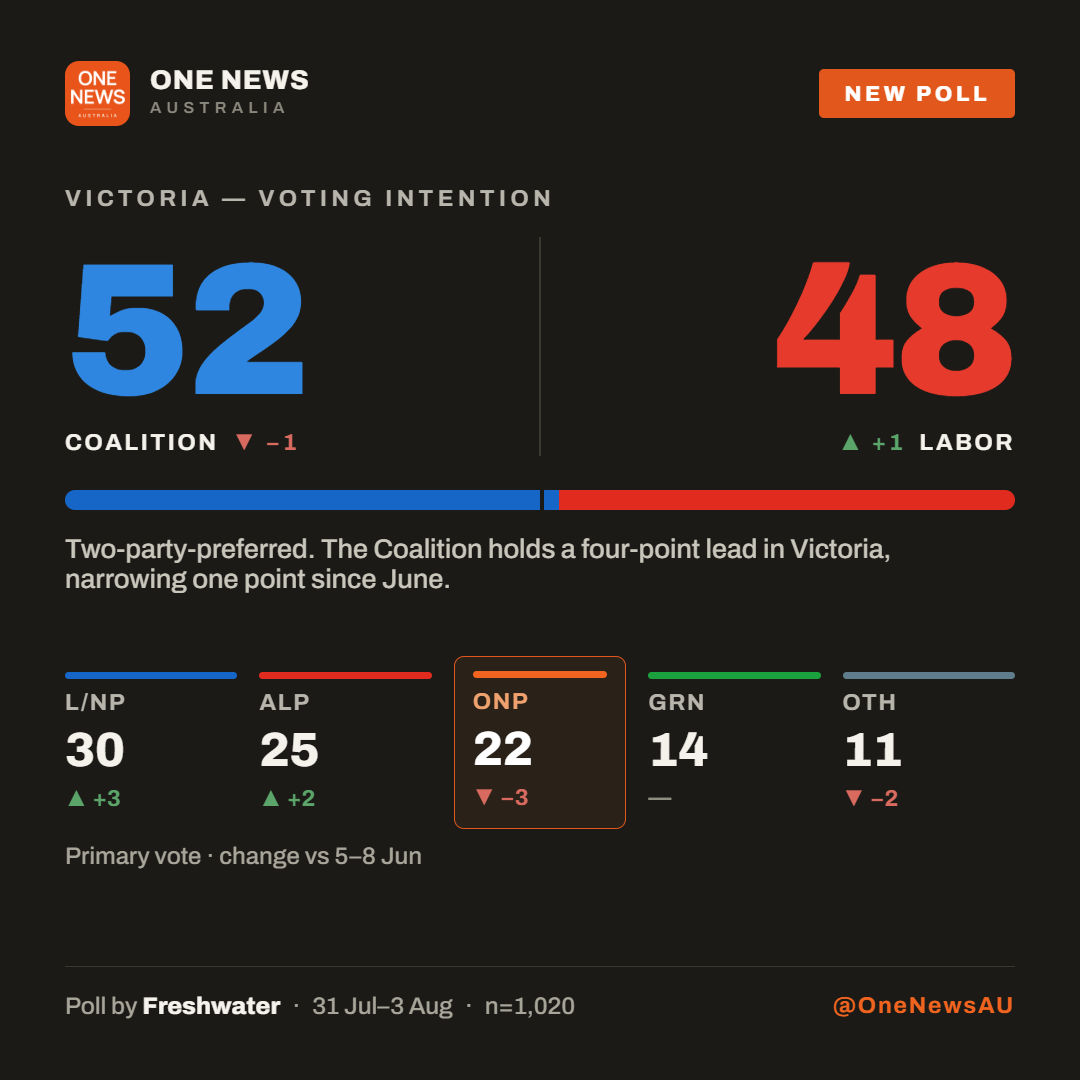
Voters already have a view of the premier. Freshwater Strategy polled 1,020 Victorians between 31 July and 3 August, and when asked whether they trust Ben Carroll to act in the state's best interests, 42% said no and 27% said yes. Opposition Leader Jess Wilson leads him as preferred premier 48% to 27%, and the Coalition leads 52 to 48 after preferences, with One Nation on 22% and candidates locked in for up to 76 of Victoria's 88 lower house seats.
The premier can settle his own position whenever he likes. He can say, in his own words, that no government he leads will enter a joint venture, a long term lease or a securitisation over Melbourne Water or its wastewater business, and he can release the Project Nerva papers and the EY brief. He has done neither.
No transaction has been launched and no investment bank appointed. What exists is five years of work, $6.15 million approved to continue it, a legal path that avoids a vote in parliament, a written prediction that voters would object if they found out, and a premier who was in the room the whole time. Even on Labor's own numbers it's a poor trade, because whoever pays $3 billion to $4 billion only pays it expecting to collect more than that back out of Victorian water bills over the following 40 years. The state gets one cheque, the buyer gets four decades, and the people who were never told any of it get the invoice. Victorians vote on 28 November.