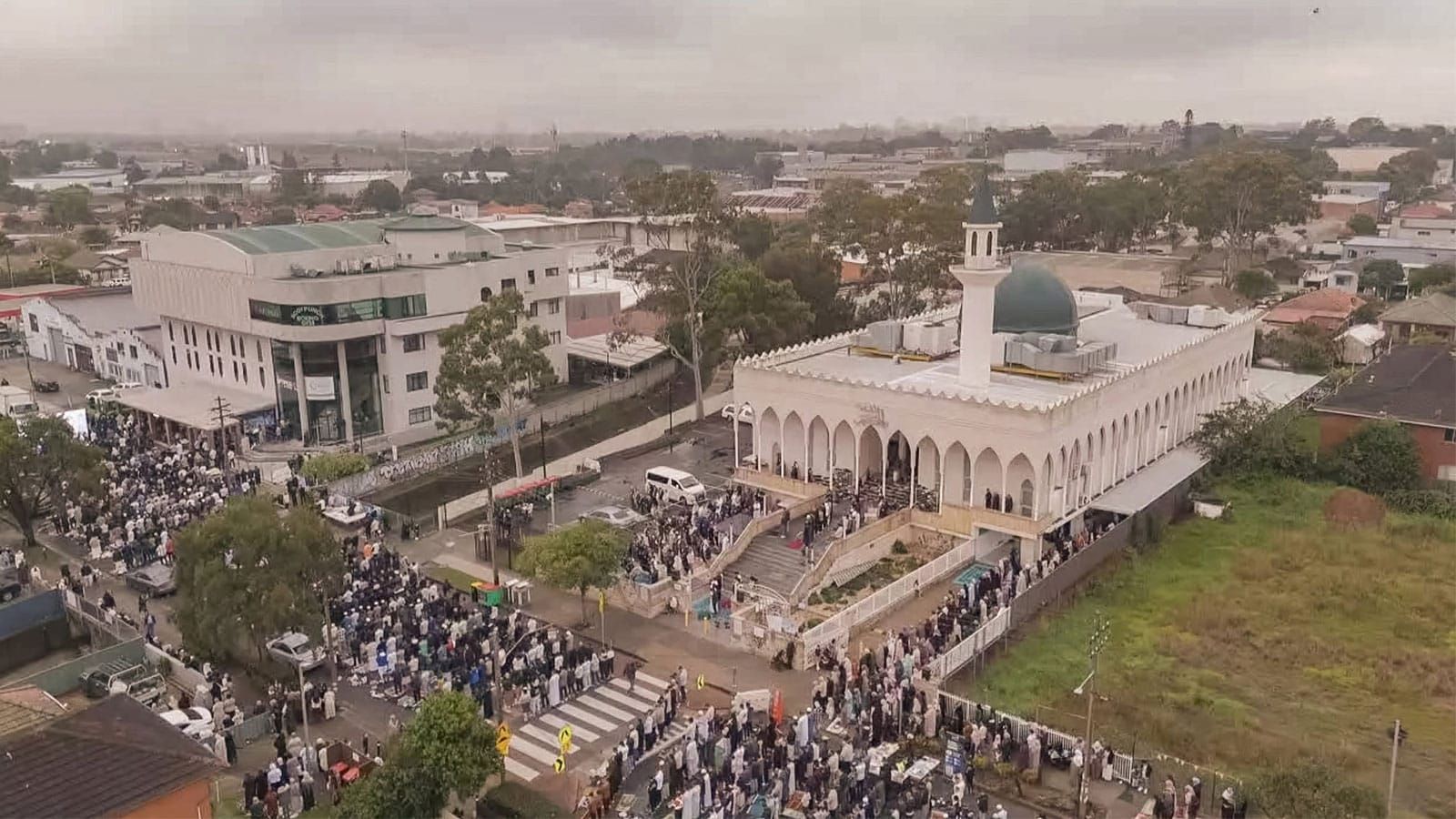
The Lebanese Muslim Association wants to broadcast the high volume Islamic call to prayer from four loudspeakers mounted 20 metres up the minaret of Lakemba Mosque, blasting it across surrounding residential streets every Friday. Canterbury-Bankstown Council officers have now delivered a sharp blow to the proposal, writing to inform the association that they cannot support the plan in its current form due to several critical planning flaws.
The call, known as the Adhan, is an Arabic recitation declaring that God is greatest, that there is no god but Allah, and that Muhammad is his messenger.
Gamel Kheir, the association secretary, recorded an interview to address what he called misconceptions, explicitly spelling out what the call historically demanded of those forced to hear it. In his own words, listeners were given a stark ultimatum: return the call and accept Islam, pay a tax, or fight.
This aggressive push for external amplification marks the second time the association has tried to impose the broadcast on the community. An independent planning panel resoundingly rejected the first application in August 2025 on eight separate grounds, and this latest attempt has been stalled with council since May.
Councillors had already had their chance to stop it. On 28 July they voted down a rule that would have blocked the broadcast no matter how quiet the mosque promised to keep it. Independent councillor Barbara Coorey moved to write a ban on the routine use of outdoor loudspeakers at places of worship into the council planning rulebook, and it was beaten 3 to 6 by Labor’s Chris Cahill, Clare Raffan, Hady Saleh and David Walsh, who were joined by Greens councillor Conroy Blood and Community Voice of Australia’s Saud Abu-Samen.
Mayor Bilal El Hayek and councillor Khal Asfour never voted on it at all, because both declared a financial conflict of interest and walked out of the chamber, minutes after voting together on a church bell motion that Asfour had moved himself. With Coorey’s rule dead, there is still nothing in the planning rulebook about loudspeakers at a place of worship, so the mosque only has to get its decibel readings under the general noise limit and no other rule stands in its way.
Public controversy deepens as mosque secretary outlines historical terms of the call to prayer
Gamel Kheir recorded an interview to defend the high volume application against widespread community backlash, but a clip broadcast on News24 on 13 August only fuelled further outrage. When asked directly if blasting the Adhan over residential streets marks out religious territory, Kheir claimed it does the opposite before spelling out the harsh historical ultimatum behind the broadcast.
"The people of that city or town or village, or whatever the case may be, would be given three options. The call to prayer, which means they’ve accepted the Islamic faith, because they’ve said the call to prayer, and they would reply the call to prayer," Kheir said. "It’s not that we’ve conquered, it’s to say, we are here."
He attempted to push back against the perception of community conquest, stating his position explicitly. Yet the rest of his explanation detailed the severe consequences historically imposed on residents who did not want to hear or submit to the sound.
"If you reply, return the call to prayer back to us, then that’s an assumption on our behalf that you’ve accepted the faith, and then we leave you alone. If you don’t return the call to prayer, then you’ve got two choices. You either fight or you give a tax, and then you’re under our protection."
Kheir insisted he was referencing ancient 7th century history rather than modern local policy. However, as the lead secretary demanding permission to force this very broadcast across a quiet Sydney suburb every single week, his admission of the call's aggressive history has raised intense alarm among residents fighting the intrusive noise.
Five minute broadcast limit exposed as tactical move in ongoing Lakemba Mosque loudspeaker bid
The formal application currently before council, listed as DA-518/2026, was lodged on 4 May 2026 and exhibited until 9 June. It demands permission to mount four heavy duty loudspeakers on the existing minaret at 67 Wangee Road, projecting sound from 20 metres directly above street level across the entire neighbourhood.
In a calculated move to dilute community opposition, the accompanying environmental effects statement attempts to downplay the impact by capping the forced broadcast at "no longer than 5 minutes" right before Friday Jummah prayers, occurring at midday or 1pm depending on the lunar calendar. The applicant also explicitly notes that "the Adhan will be a recording and not live".
The 15 minute duration circulating in public debate stems from the initial aggressive application that council decisively rejected last year.
Further confusing the public record, the association launched an online campaign under the banner One Call, One Nation, which closed with 5,222 supporters. That petition claims the intrusion will last "for no longer than three minutes", directly contradicting the five minute window sought in their own official planning documents while dismissing legitimate local acoustic concerns with the claim that "this is not about noise, this is about belonging".
Planning panel rejected intrusive mosque sound proposal after 328 residents filed objections
The original attempt to blast the call to prayer over local homes, listed as DA-217/2025, met a devastating end on 11 August 2025 when the Canterbury Bankstown Local Planning Panel voted 3 to 1 to crush the application. No councillor sits on the panel or votes on its determinations, though one of its four members is a community representative appointed by council.
The panel dismantled the aggressive sound proposal across eight separate grounds. Planning experts determined that the project utterly failed to prevent sound spikes from exceeding the 5dBA limit above ambient background noise, delivered unacceptable residential amenity destruction, completely omitted a mandatory Social Impact Assessment, and explicitly concluded that granting approval "would not be in the public interest".
Refusing to throw the applicant a lifeline, the panel shut down attempts to delay the decision and flatly rejected giving the association extra time to patch up its non compliant plans.
"The Community Member was of the view that the application should be deferred to enable the applicant to consider amendments to the proposal to address the issues raised in the Council staff report and the Reasons for Refusal. However, the majority of the Panel considered that, given the extent of insufficient information and the incompatibility of the proposal with Council's controls, that the application should be refused."
The official assessment records reveal massive local opposition to the intrusive sound scheme. Out of 329 formal public submissions lodged during the exhibition window, an overwhelming 328 objected while only a single submission was lodged in support.
Mosque association downplays devastating planning rejection as a simple acoustic paperwork fix
The Lebanese Muslim Association has attempted to publicly spin the total collapse of its 2025 application, claiming council merely requested supplementary noise modelling rather than delivering a decisive refusal on the merits. Official planning panel minutes completely demolish that soft narrative.
Only one of the eight scathing reasons for refusal actually turned on technical acoustic numbers. The remaining seven grounds struck directly at the core of the proposal, exposing fundamental breaches of local zone objectives, total failure to comply with council controls for places of public worship, an absent social impact report, and a clear finding that forcing this external noise onto the community was flatly against the public interest.
Mosque applicant dismisses severe community disruption by omitting key social impact assessment
The applicant has doubled down on its disregard for planning rules by completely ignoring refusal reason seven from the previous knockback. The 2026 Statement of Environmental Effects, prepared by Think Planners Pty Ltd, contains zero social impact assessment. Instead of analysing the disruptive acoustic fallout on nearby families, the document boldly asserts an "absence of adverse environmental, social or economic impacts" before pushing for immediate council approval.
This blatant omission directly defies the independent planning panel, which explicitly slammed the original application for hiding from community scrutiny. In 2025 the panel explicitly ruled that "in the absence of a Social Impact Assessment, and having regard to the objections received, there is doubt as to whether the proposal will in fact provide a social benefit to the community as stated in the applicant's Statement of Environmental Effects". Charging ahead without evaluating the disruption to local living standards proves the applicant is simply trying to bypass fundamental community protections.
New noise report reveals nearby family homes pushed to absolute legal limit by mosque speakers
The applicant brought in a new consultancy to produce report 8231-1.1R, issued on 24 February 2026 by Day Design Pty Ltd, in a fresh bid to demonstrate acoustic compliance. Sound loggers deployed at 20 Boorea Avenue and 1/74-76 Wangee Road recorded quiet daytime background levels of 39 dBA and 48 dBA, setting the maximum legal noise threshold at 44 dBA for the Boorea Avenue homes under council background plus 5 rules.
The actual numbers reveal just how aggressively this proposal pushes sound into surrounding residential living spaces. The report’s own figures show two neighbouring family homes driven directly to the absolute legal ceiling with zero margin for error, while the primary school next door clears the limit by a razor thin 1 dB. Rather than providing genuine relief to residents, the calculations land squarely on the maximum permissible noise line and the proposal is declared compliant.
| Receiver | Predicted | Limit |
|---|---|---|
| 18 Boorea Avenue | 44 dBA | 44 dBA |
| 16 Boorea Avenue | 44 dBA | 44 dBA |
| Primary school, 57-63 Wangee Road | 57 dBA | 58 dBA |
Source: Day Design environmental noise impact assessment 8231-1.1R, 24 February 2026. Levels are Leq over 15 minutes.
Primary school forced to lock classroom windows to shield children from mosque loudspeaker noise
The desperate attempt to prove the primary school next door passes noise limits relies on an assumption buried deep within the acoustic report. The compliance figure hinges entirely on a hidden footnote assumption.
"It is assumed, considering the high level of existing ambient noise (60 dBA), any windows on the northern facade of the primary school would be closed during the use of the class rooms to provide the students acoustic amenity."
The northern facade faces the mosque directly. Without forcing teachers and children to keep their glazing completely shut to gain an artificial 20 dB noise drop, the compliance argument completely collapses.
Adding insult to injury, Community Voice of Australia councillor Saud Abu-Samen aggressively dismissed local family concerns in the council chamber on 28 July. He blatantly told residents that if they did not want to hear the intrusive broadcast, they should simply trap themselves inside and close their windows. Independent councillor Barbara Coorey immediately fired back, exposing the total absurdity of expecting locals to pay for soundproofing just to escape the noise.
"How much insulation will you then need to not hear the bells or the calls to prayer? You haven't explained that."
Math loop hole masks raw decibel blast that effectively doubles perceived noise in nearby streets
The compliance numbers presented in the applicant’s acoustic document do not convey the raw volume of the broadcast. The predicted noise levels do not reflect the actual loudness of the sound blasting from the minaret, because the report artificially spreads a 5 minute blast across a 15 minute quiet window to drag the mathematical average down.
To achieve this pass mark, the report applies a "time period correction" of minus 4.8 dB, calculated from 10 x log (5/15), "for Leq noise levels associated with the use of the speakers for 5 minutes in a 15 minute period". While this technical dilution is permitted under state policy guidelines, it hides the harsh reality facing nearby families.
Stripping away that mathematical filter reveals the true impact on local residents. During the actual 5 minutes the Adhan is firing, sound levels jump to roughly 49 dBA at the Boorea Avenue homes against a quiet measured background of 39 dBA. That is a massive 10 dB surge above background, which in acoustic science represents a total doubling of perceived loudness.
This aggressive volume spike directly violates the strict council control that crushed the application last year, which explicitly demands that noise must not exceed 5dBA above background. To blast the sound that far into the suburb, the report caps how loud each speaker may be driven, setting the west facing speaker at 82 dBA measured 1 metre away, the north facing at 78, the south at 77, and the east at 76.
Top council leaders declare cash conflicts and abandon vote to restrict high volume sound plans
A political storm broke in the council chamber on 28 July when two key leaders left the room rather than vote on strict sound restrictions. Item 11.9, moved by Asfour, demanded council support for "the rights of churches to ring their bells in accordance with our planning laws", while item 11.10, moved by Coorey, attempted to crack down on intrusive noise by tightening planning controls on all externally amplified sound at places of worship.
When item 11.10 came up for debate, Mayor Bilal El Hayek and councillor Khal Asfour both declared a conflict and withdrew. Official minutes record that El Hayek "declared a pecuniary conflict of interest given his working relationship with an entity which may be affected by this matter, as such he vacated the Chamber, taking no part in debate or decision of the matter". Asfour declared the exact same conflict in identical wording, and both men left the chamber at 9.02pm, returning at 9.26pm after the debate ended.
A pecuniary interest is the category of conflict that requires a councillor to leave the room and take no part at all. Yet minutes reveal neither man declared any conflict on item 11.9, the church bell motion Asfour created himself, which both voted to push through 8 to 3 just minutes earlier.
The ethical rules governing council conduct mandate that any official with a conflict "must disclose the interest and the nature of the interest to the meeting as soon as practicable".
The formal acoustic report submitted to support the mosque loudspeaker application is addressed directly to the Lebanese Muslim Association, marked specifically to the attention of "Mr Khal Asfour". What role, if any, he holds with the association is not stated on the public record, he is not listed on its board, and the minutes do not name the entity either councillor was referring to.
Labor bloc votes down emergency planning controls designed to stop intrusive loudspeaker sound
The crucial effort to protect residents from unwanted external noise was crushed in a 3 to 6 vote. Independent councillor Barbara Coorey led the charge to force public exhibition of draft amendments to the Canterbury Bankstown Development Control Plan 2023, seeking tough new rules explicitly prohibiting the "routine use of externally amplified sound, except for designated special religious or cultural occasions, subject to appropriate controls".
Coorey’s motion targeted a massive policy loophole, arguing that existing council rules cover general background noise but leave neighbourhoods completely unprotected against high volume electronic loudspeakers. In a local government area housing over 40 distinct religious groups, her proposal sought to establish strict boundaries including capped decibel levels, defined operating hours, and mandatory neighbour notification.
Had it passed, the motion would have started the formal process of writing a brand new rule into the council’s planning book, banning places of worship from using external loudspeakers as a matter of routine and permitting them only for designated special religious or cultural occasions, with set hours, capped noise levels and written notice to nearby residents. It would have applied to every faith in the area, not to the mosque alone.
Because it was defeated, the Development Control Plan still says nothing whatsoever about externally amplified sound at a place of worship, so an application like the mosque’s is measured only against the general noise controls, which turn on whether the predicted decibel readings sit within 5dB(A) of the existing background level. Any proposal that satisfies those numbers now has no separate rule standing in its way.
Councillors Coorey, Lindsay and Stavrinos voted to protect suburban peace. Voting to kill the restrictions were Labor’s Cahill, Raffan, Saleh and Walsh, joined by Greens councillor Conroy Blood and Community Voice of Australia’s Saud Abu-Samen, who sided with Labor in all three divisions recorded that night.
During debate on the earlier bell motion, Asfour tried to normalise external sound by citing Good Friday at St Charbel’s Maronite Catholic Church in Punchbowl as "an example of respectful processions led by prayer and supported by the sound of church bells". Coorey immediately challenged the comparison on the chamber floor.
"Councillor Asfour, I'm sorry to tell you they do not ring at St Charbel on a Friday. That is totally incorrect for a practising Christian. You ought to know that."
Our Local Community councillor Harry Stavrinos later called out the political manoeuvring, saying the church bell motion was put up specifically to neutralise Coorey’s attempt to rein in outdoor loudspeakers, and that it was politically driven and not coincidental. Asfour then went after Coorey directly, accusing her of using One Nation style tactics.
| Councillor | Party | Vote |
|---|---|---|
| Coorey | Independent | For |
| Lindsay | Liberal | For |
| Stavrinos | Our Local Community | For |
| Abu-Samen | Community Voice | Against |
| Blood | Greens | Against |
| Cahill | Labor | Against |
| Raffan | Labor | Against |
| Saleh | Labor | Against |
| Walsh | Labor | Against |
How councillors voted on Barbara Coorey’s motion to restrict externally amplified sound at places of worship, 28 July 2026. Mayor Bilal El-Hayek and Councillor Khal Asfour declared a pecuniary conflict of interest and left the chamber, so neither voted. Four councillors were on leave of absence.
Lakemba Mosque has had four threatening letters this year, and one was addressed to Gamel Kheir
The site became the focus of police investigations following four threatening letters received between January and March 2026, including graphic threats referencing Christchurch and depictions of violence, with one letter targeted directly at association secretary Gamel Kheir. NSW Police increased patrols while the site added CCTV.
Mosque leadership has since pointed to those incidents while rejecting the planning objections, casting community opposition to the loudspeakers as hostility rather than standard planning scrutiny.
"Unfortunately, the debate has shifted beyond planning to targeted hostility."
Kheir repeated the same argument made in the council chamber, claiming double standards by asking why people accept traditional bells at St Mary’s Cathedral while resisting high powered electronic loudspeakers in suburban Lakemba.
The mosque did broadcast the Adhan over loudspeakers during Ramadan in 2020, under COVID restrictions and without a recorded complaint, and what the association is asking for now is a permanent year round consent to broadcast over local homes every single week.
Approving mosque speakers threatens to trigger widespread suburban noise precedents across state
Community fury across 329 formal submissions on the original application exposed widespread panic over the dangerous legal precedent this proposal sets. Residents slammed the intrusive sound scheme for destroying acoustic amenity, violating maximum building heights without proper clause 4.6 variation requests, slashing local property values, and threatening quiet residential suburbs across the entire state.
While each development application is technically judged on its own merits, granting approval for high powered minaret loudspeakers creates a catastrophic planning roadmap. It establishes an approved acoustic method, an approved broadcast duration, and a set of lax conditions that future applicants anywhere in Sydney can exploit to force amplified noise onto local neighbourhoods. Coorey’s defeated motion was the only mechanism to shut down this loophole, yet council voted it down and left suburban streets completely exposed.
The Statement of Environmental Effects dismisses the community wide noise impact in a single line, asserting that the broadcast "is a fundamental aspect of the Islamic religious community and its shared participation in faith". Meanwhile, the same document reveals the applicant owns the land directly north and south of the minaret and plans to push through separate redevelopment applications, raising fears of an even larger scale expansion once external sound rights are secured.
Mosque applicant prepares for Land & Environment court showdown after council staff reject non compliant sound plan
The non compliant proposal has not yet been listed before the Local Planning Panel, leaving the association backed into a corner. They must either pull the application, scramble to patch up missing studies, or arrogantly push forward and risk a second humiliating refusal.
If the panel rejects the proposal again, the applicant could try to force the intrusive sound plan onto the community by dragging the matter to the Land and Environment Court. Local planning rejections have been bypassed in court before, just as a judge overturned Brisbane City Council’s refusal of a $20 million Islamic centre on appeal.
This battle over suburban peace is part of a global pushback against external religious broadcasts. Overseas, Denmark’s Social Democrat government reopened investigations into outright national bans on the public call to prayer.
The facts surrounding this application remain damning. Council staff explicitly refuse to support the proposal as submitted, the independent panel previously crushed the scheme on eight comprehensive grounds far beyond basic decibel figures, and the two politicians who left the chamber over declared financial conflicts had voted on the church bell motion minutes earlier.