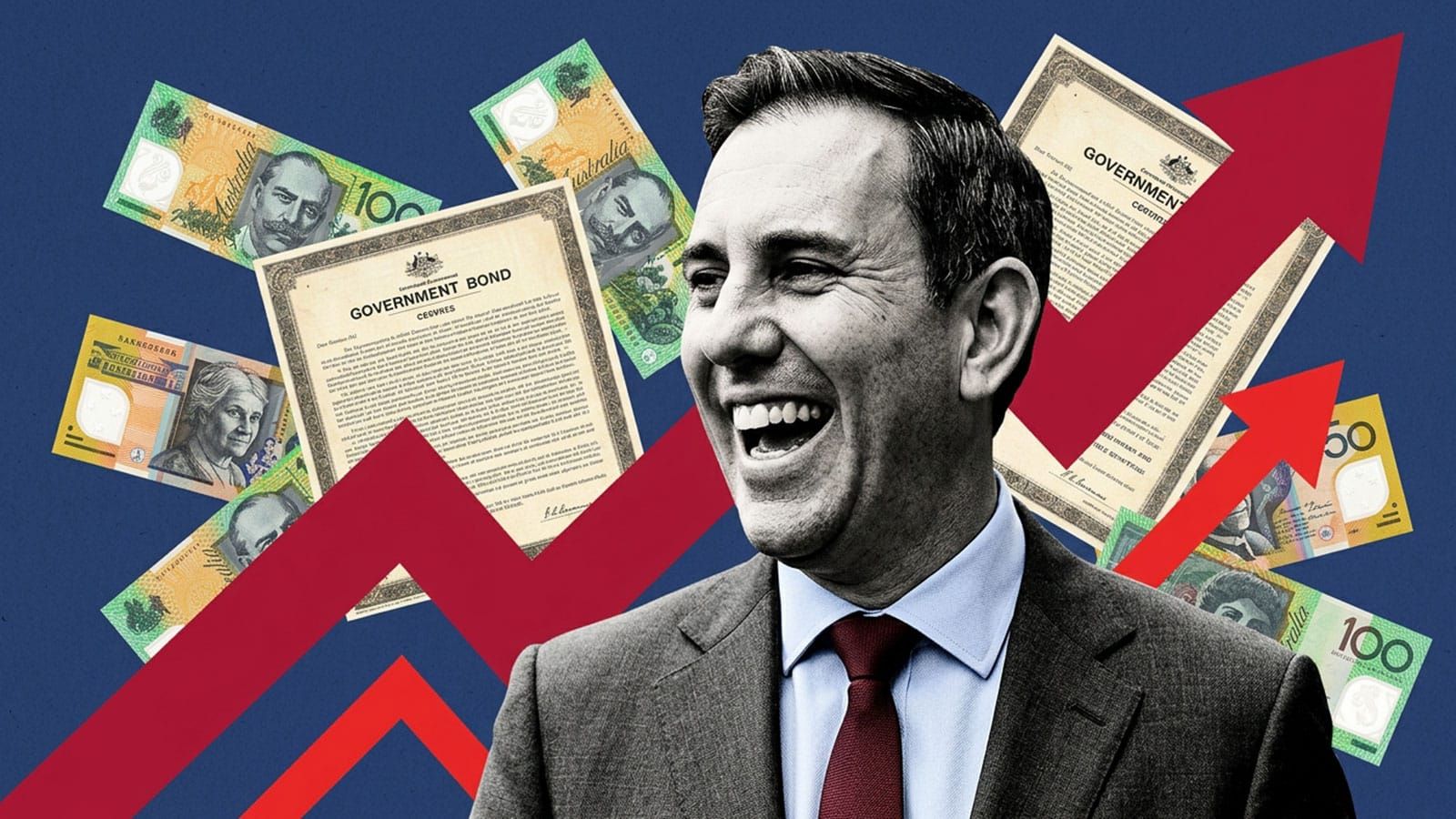
In Question Time on Wednesday, Jim Chalmers stood before parliament and bragged he had kept gross debt "$200 billion lower than what we inherited." Less than 24 hours later, the national debt agency issued another $4 billion in bonds, officially crowning Chalmers as Australia's first trillion dollar debt Treasurer.
The Treasurer spent the 2022 campaign hammering the Coalition over a "trillion dollars in debt" with almost nothing to show for it. Now that historic milestone belongs entirely to him. It arrives backed by a $31.5 billion deficit, a restrictive 4.35% cash rate, and Treasury's own projections showing national borrowing climbing relentlessly through the end of the decade.
Chalmers' Trillion Dollar Deception
The boast came in an answer to Labor's Sarah Witty on Wednesday afternoon, less than 24 hours before the trillion ticked over:
"We saw that recognised overnight when Moody's, the second biggest global ratings agency, in the course of the last couple of weeks reaffirmed Australia's AAA credit rating. They did that because of the responsible way that we have gone about managing the budget, getting gross debt down $200 billion lower than what we inherited and the trajectory that those opposite left us when we came to office."
Yet the official ledger at the Australian Office of Financial Management tells a completely different story. Its numbers show $867.7 billion of gross debt at 30 June 2022, just five weeks after Labor took office. The total that passed $1,000.8 billion on Thursday represents a $133 billion surge on Chalmers' watch, backed by an $86 billion annual spike that marks the largest single year jump since the pandemic.
The Treasurer's touted $200 billion savings figure exists only when shifting the metric from real debt to future projections. Treasury's budget paper puts the improvement against the Coalition's 2022 pre election projection at $173 billion, measuring him against a past prediction rather than what his government actually inherited. Back in the 2022 campaign, Chalmers branded the Morrison government "the most wasteful government since Federation" and later attacked "deficits as far as the eye can see". Yet his own May budget drives $150.5 billion of deficits over the next four years, and intense pressure has already forced him to dump the widow tax this week.
Wednesday's answer closed with an attack on opponents, claiming the Liberals, the Nationals, and One Nation "hate superannuation", even as Pauline Hanson spent the entire month battling to stop Labor from directing private retirement savings into net zero projects.
| What Chalmers said | What the record shows |
|---|---|
| "Getting gross debt down $200 billion lower than what we inherited" (question time, Wednesday) | The AOFM ledger: $867.7 billion when Labor took office, $1,000.8 billion now. His own budget paper claims $173 billion, and only against a Coalition forecast, never actual debt. |
| "Moody’s … reaffirmed Australia’s AAA credit rating … because of the responsible way that we have gone about managing the budget" (question time, Wednesday) | S&P kept the AAA on 6 August with a written warning attached: weaker budgets or weaker per capita growth could cost Australia the rating. |
| "At the same time, we’re strengthening the budget" (question time, Wednesday) | A $31.5 billion deficit this year and red ink in every year to 2034-35. In 2022 he attacked the Coalition over "deficits as far as the eye can see". |
| "A trillion dollars in debt and almost nothing to show for it" (attacking the Coalition, May 2022) | Gross debt passed $1 trillion on his watch on 20 August 2026 and reaches $1,249 billion by 2030 on his own forecasts. |
Australia's Sinking Interest Trap
Servicing the national debt will burn $29.6 billion this financial year alone according to the budget's own figures, ballooning to a staggering $42.3 billion by 2029-30. Not a single dollar of that massive outlay builds a new road, upgrades a school, or staffs a hospital. It is pure, dead weight interest paying off money already spent.
The interest bill is growing far faster than the underlying debt because the era of cheap money has vanished. Treasury now assumes a 4.8% yield on new bond issues, compared to just 2.2% at the 2022 election. Every single maturing bond is now being refinanced at more than double the old interest rate.
Compounding the damage, foreign investors hold half of all federal debt on official figures, which effectively drains half of every interest dollar straight offshore. Australian taxpayers are forced to foot the bill through the heaviest income tax load in Australian history, with total income tax collections forecast to hit 18.6% of GDP this year, the highest since records began.
The spending driving this borrowing binge continues at 26.8% of GDP, a level Opposition Leader Angus Taylor points out is the highest outside an economic recession in roughly 40 years. That expenditure includes a string of costly bailouts and major project cost blowouts, from the $2.5 billion Tomago rescue package to Snowy 2.0's revised $12 billion price tag.
| What Canberra spends in 2026-27 | Annual cost |
|---|---|
| Interest on the debt | $29.6bn |
| Army and Navy combined | $25.7bn |
| The entire Pharmaceutical Benefits Scheme | $24.6bn |
| Commonwealth funding for every government school | $13.0bn |
By 2029-30 the interest bill reaches $42.3 billion. Source: Budget Paper 1, Statements 6 and 7, May 2026.
Smashing His Own $1.2 trillion Debt Ceiling
The Commonwealth Inscribed Stock Act caps the total debt the federal government can issue, with the ceiling set directly by the sitting Treasurer. The current limit of $1.2 trillion was established in October 2020, and Jim Chalmers has operated under it for his entire tenure. Yet his own budget documents forecast gross debt peaking at $1.198 trillion in April 2029, a razor thin $2 billion below the legal boundary, before blowing out to $1.273 trillion in May 2030. That trajectory forces Chalmers, or whoever succeeds him, to sign a formal directive raising the very debt cap Labor fiercely campaigned against in 2022.
The gross debt total will not stay past $1 trillion this week, as roughly $6 billion of short term notes mature on Friday to pull the figure temporarily back under the threshold before heavy issuance permanently locks it above $1 trillion. "It hasn't so much broken $1 trillion as it has just touched the wall and done a tumble-turn," Barrenjoey interest rate strategist Andrew Lilley told The Australian.
The Fine Print on Australia's Triple A Warning
Chalmers told the House Moody's was "effusive" about his management and encouraged MPs to read its statement. He didn't quote the other agency. S&P Global Ratings affirmed Australia's AAA rating on 6 August and spelled out what would cost the country the rating: fiscal outcomes and per capita economic growth coming in materially below its forecasts.
Per capita GDP has fallen in 10 of the past 15 quarters on S&P's own report, and Chalmers conceded last week that productivity is "too low" while the Reserve Bank pushed any recovery out to 2028.
State ratings sit beneath the Commonwealth's and bank funding costs price off the sovereign, so a downgrade would feed into borrowing costs across the economy, including mortgages, with a fourth rate rise this year still on the table.
S&P also credited the budget's new property taxes, which "should help mitigate rising structural spending pressures". The taxes helping hold the rating up are the same negative gearing and capital gains changes Treasury said would add $2 a week to rents, an estimate already collapsing in his own electorate.
Australia’s $1.7 Trillion Debt Mountain
The Parliamentary Budget Office released its national fiscal outlook on Wednesday, delivering a brutal reality check on the very same day Jim Chalmers was praising his own financial stewardship. Consolidated federal, state, and local gross debt is set to reach a staggering $1.7 trillion this financial year and surge to $2 trillion by 2029-30. That trajectory pushes total public borrowing past its pandemic era peak as a proportion of the entire Australian economy.
Interest payments across all tiers of government will consume 6.2 cents of every dollar of government revenue by 2029-30, double the 3.1% low recorded in 2021-22. The PBO warned that this escalating burden may reduce fiscal flexibility by locking up an ever larger share of public revenue in unavoidable interest bills. Outside of the Commonwealth itself, only Victoria, the ACT, and the Northern Territory carry heavier net debt loads per person.
The federal share alone translates to approximately $35,700 in debt for every single man, woman, and child in Australia, with the current budget trajectory adding another $250 billion to that tab by 2030. A February Newspoll found that 70% of voters are worried about national debt levels, with Coalition and One Nation supporters expressing the highest concern.
Opposition Leader Angus Taylor blasted the milestone as a grim turning point for the nation, calling it the direct result of a Labor administration incapable of reining in spending. In response, Chalmers' office did not deny the numbers, claiming gross debt under the Coalition would already be approaching $1.2 trillion, conveniently ignoring that Treasury's own budget papers put Labor at $1.198 trillion by April 2029.