Australia would have roughly 66,000 more businesses actively trading today if survival rates had not completely collapsed after COVID. Fresh analysis of Australian Bureau of Statistics data by Airteam and Primara Research, reported by News24, exposes a dismal four year survival rate of just 61.9%. That is a sharp drop from 63.1% the year prior and sits far below the pre pandemic mark of 64.5%. That represents four consecutive years of decline in business survival.
Primara Research expert Peter Drennan destroyed the illusion of past resilience, pointing out that peak survival numbers were artificially manufactured during stimulus spending. "That's JobKeeper and the insolvency moratorium holding businesses up rather than a sign of underlying strength," he said. "Conditions for businesses have clearly become harder over that time."
Meanwhile, Treasurer Jim Chalmers bragged to parliament that his capital gains overhaul is "the most ambitious tax reform package for a quarter of a century". Yet not a single element of that overhaul takes effect until 1 July 2027, leaving struggling owners stranded while the very enterprises the reform claims to help collapse today.
Labor counts 85,130 new businesses, but only 2,025 of them employ others
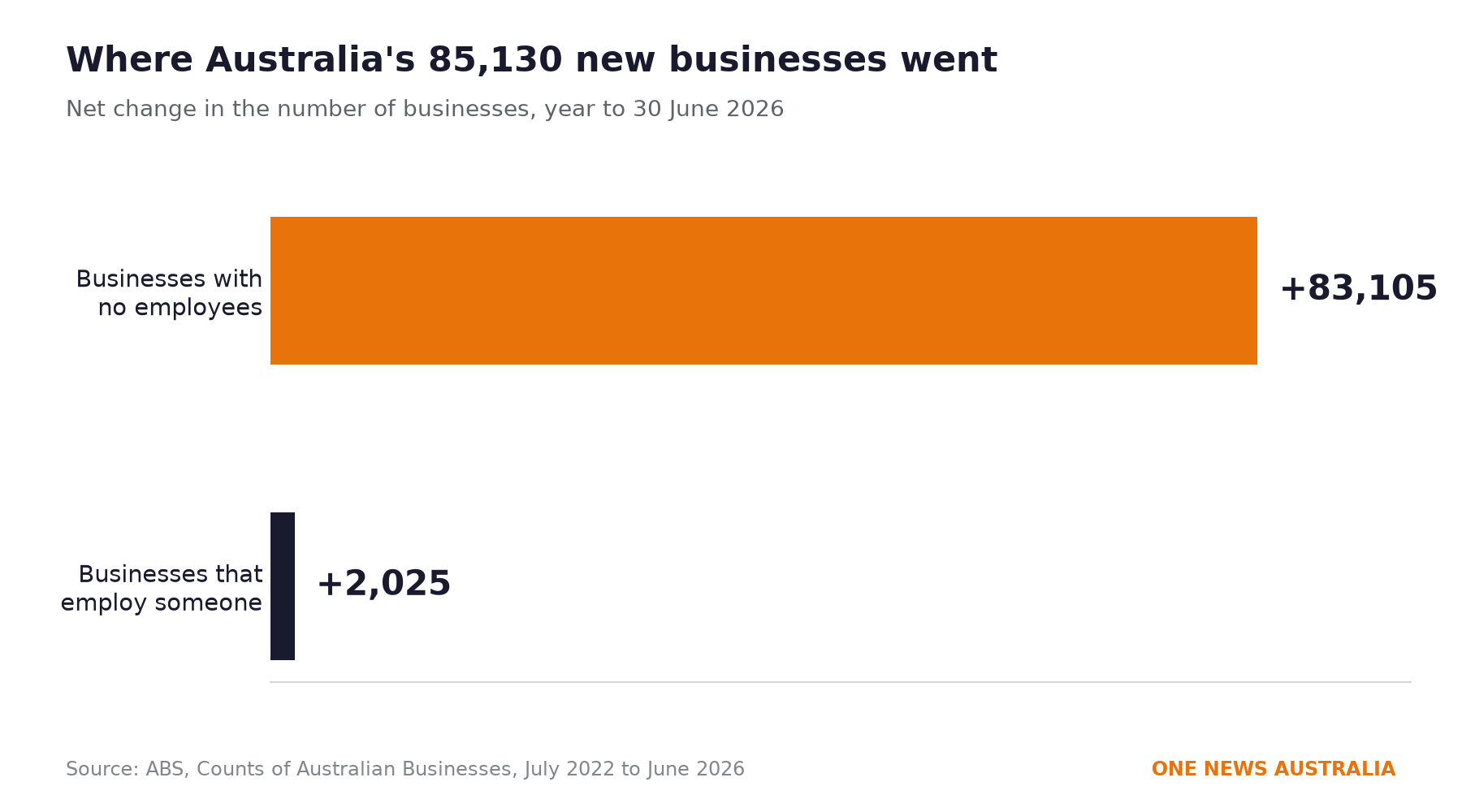
The government will proudly parade ABS numbers showing 2,814,778 actively trading businesses at 30 June 2026, claiming a net increase of 85,130. Break open those headline stats and the reality is grotesque. A massive 83,105 of that growth consists of solo operators with zero staff, leaving a pathetic net gain of 2,025 employing businesses for the entire country.
Even worse, 28,127 enterprises that previously hired staff were forced to slash their workforce down to zero just to keep the lights on. The statistics register them as survivors, while the discarded workers disappear into thin air. Anthony Albanese's government is not creating employers, it is accumulating desperate sole traders, using headline figures to mask the fact that growth in the number of employers has all but stopped.
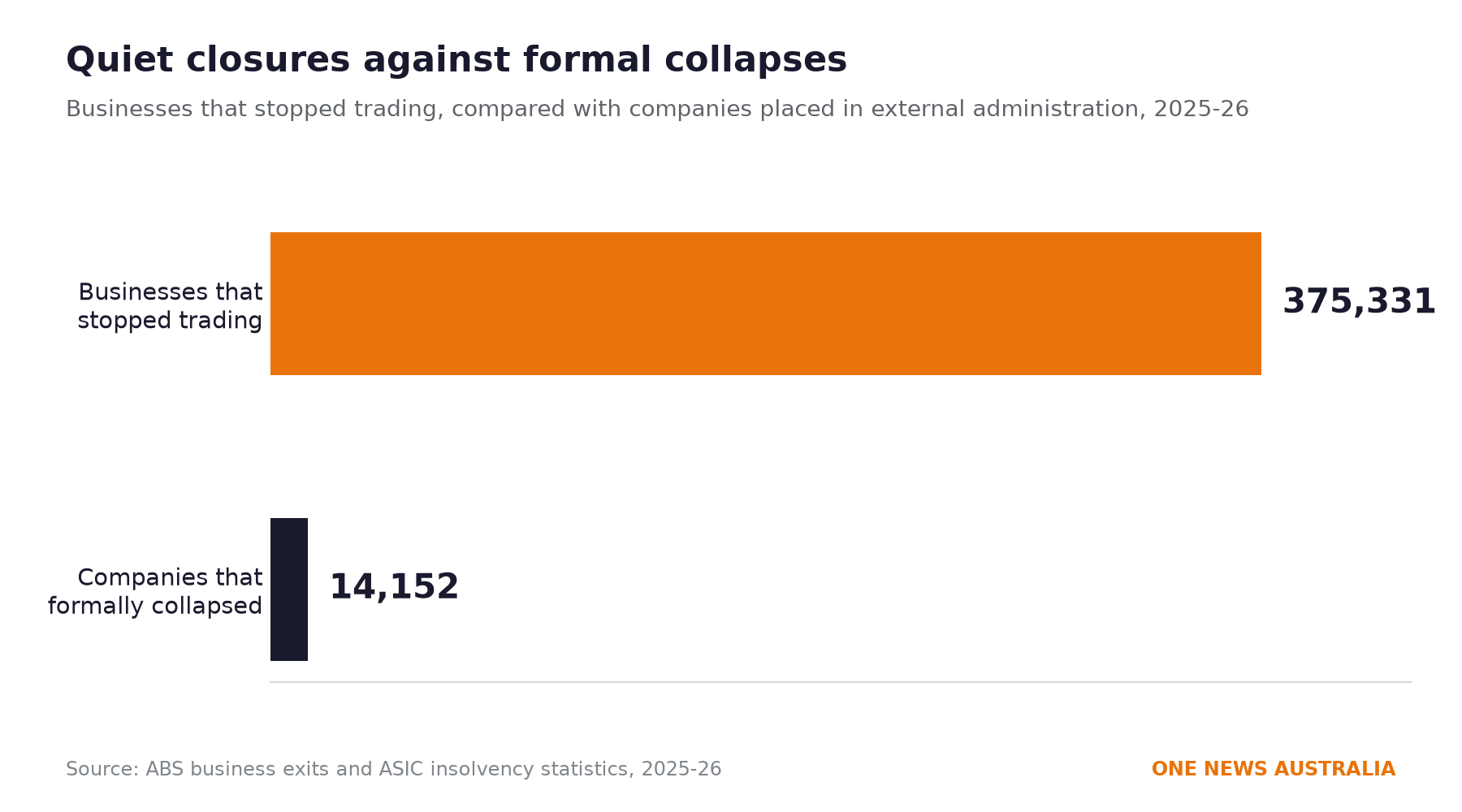
Media headline collapses represent a tiny fraction of the total carnage. ASIC recorded 14,152 companies entering external administration in 2025-26, down slightly from 14,722 the previous year, while the ABS registered a staggering 375,331 total business exits. Formal insolvency figures only cover corporate entities, whereas total exit stats capture every operational structure down to sole traders. That massive gap exposes where the true destruction sits. Most failing business owners never even reach an administrator. Instead, the owner quietly locks the door, cancels the ABN, and privately absorbs the devastating loss.
Construction collapses and soaring hospitality wages trigger mass Australian business failures
Hospitality venues, retail storefronts, and construction firms are collapsing under a brutal crisis across key Australian industries. Construction remains the single largest driver of formal corporate failures, with a staggering 3,472 companies going under in 2025-26, followed closely by accommodation and food services at 2,078 failures. Retail is being hollowed out simultaneously, highlighted by administrators being called into Betts and Stateside Sports, and Accent Group moving to shut or sell its remaining 16 Glue Store outlets, in the first half of this year alone.
Consumer facing businesses are carrying the highest distress rates in the country alongside these corporate insolvencies. CreditorWatch data reveals that more than one in eight cafes, restaurants, and takeaway venues closed in the 12 months to July 2026, marking a 12.03% closure rate against a 6.69% national average. The underlying financial damage is even worse, with an alarming 10.21% of these businesses sitting 60 days or more behind on payments, representing the highest arrears rate of any sub industry in the country. Their trade payment default rate of 1.15% sits at nearly four times the national benchmark of 0.31%.
Sydney restaurateur Neil Perry identified the exact drivers of this collapse in March, long before assigning political blame. Speaking at The Australian's Global Food Forum, Perry warned that a single cup of coffee could hit $12 within five years due to a relentless 5% annual rise in the basic hospitality award wage every year since COVID, stating plainly that it is "now incredibly expensive to have young baristas".
Labor forces massive wage costs onto small businesses while offering a useless tax write off
Canberra executed a coordinated assault on small employers on 1 July, slamming small businesses with a wave of expensive new mandates. Almost every one of these cost increases landed on the exact same day, driven entirely by federal government decisions rather than market forces.
| What changed on 1 July 2026 | What it does | What it costs a small employer |
|---|---|---|
| Award wage rise | Award rates up 4.75%, the national minimum wage up 6% to $26.44 an hour | Repriced 2.8 million workers, so every roster costs more from the same day |
| Payday super | Super must be paid every pay run and reach the fund within 7 days | The 90 day quarterly float is gone, with no exemption for small employers |
| Super guarantee at 12% | Locked in since July 2025 | A $70,000 employee costs the business more than $108,000 fully loaded |
| Small Business Super Clearing House shut | The free ATO service closed on the same day payday super started | Every employer using it had to buy or build a replacement |
The national minimum wage jumped 6% to $26.44 an hour alongside a 4.75% increase in general award rates, instantly repricing roster costs for 2.8 million workers across the nation. Payday super rules ended the 90 day quarterly float, demanding superannuation be paid on every single pay run and reach the fund within 7 days, offering zero exemption for small employers. To make matters worse, the Commonwealth shut down its free Small Business Super Clearing House on the very day payday super took effect, forcing every employer in the country to buy or build a private software replacement.
Set those crippling burdens against the government's pathetic offset. Labor made the $20,000 instant asset write off permanent for businesses turning over under $10 million, a concession Treasury values at roughly $890 million spread across five years for the entire small business economy. That token gesture is dwarfed by the reality on the ground. Payroll industry estimates reveal that a basic $70,000 employee now costs an owner over $108,000 once superannuation locked at 12%, workers compensation, payroll tax, leave, and shift cover are loaded onto the base wage.
The ATO weaponises interest rates and director penalties to crush struggling small businesses
The Australian Taxation Office has officially ended its role as a flexible lender of last resort for businesses weathering a bad quarter. The general interest charge applied to unpaid tax debt sits at a punishing 11.43% annually, compounding on a daily basis. To make matters worse, the government removed the tax deductibility of these interest charges from 1 July 2025, forcing struggling business owners to generate income and pay full income tax on it before they can even touch their growing ATO interest debt.
Enforcement tactics have escalated drastically alongside these financial penalties. The tax office has unleashed a massive wave of Director Penalty Notices, which bypass corporate protections to make company directors personally liable for unpaid GST, superannuation, and PAYG withholding. Issuances of these notices surged by 136% to over 84,000 in 2024-25, triggering an official review by the Tax Ombudsman into the aggression of these debt collection practices. Falling behind on tax obligations no longer just threatens the future of the company, it directly places the owner's personal home and family assets on the line.
Impenetrable trust rules force family businesses to restructure before 2028
Massive capital gains and discretionary trust tax changes scheduled for 2027 and 2028 are already triggering chaos for Australian family enterprises. Crucial headline tax overhauls have not officially taken effect yet, but accountants across the country are advising family business owners to restructure immediately before the window closes.
| Measure | Starts | What it means for a family business |
|---|---|---|
| Deemed sale of every asset you hold | 30 June 2027 | The gain is frozen at market value and taxed later at a realisation event |
| 50% capital gains discount abolished for individuals | 1 July 2027 | Replaced with an inflation adjustment and a minimum 30% rate |
| Minimum 30% tax on discretionary trusts | 1 July 2028, announced, not yet law | Lands on the structure most Australian family businesses are held in |
| 50% active asset concession extended | Legislated | Now reaches businesses up to $10 million aggregated turnover |
The proposed 30% minimum tax rate on discretionary trusts hits at the very core of small business operations, targeting the primary structure used by Australian family enterprises. The capital gains Act passed in June spans 73 complex pages yet fails to mention death or deceased estates even once, creating legal gridlock. Professional accounting bodies remain unable to clarify for parliament what actually occurs when a business owner dies holding frozen gains under these rules. Family succession plans are being prematurely executed or entirely abandoned simply because the government introduced a law that legal experts cannot properly read or interpret.
Employers stop backfilling entry level roles as AI slows hiring and wage costs bite
Anyone who lost employment to automation this year will find official commentary infuriating, yet the precise mechanics require accurate exposure. Deloitte Access Economics partner David Rumbens claims there is little clear evidence AI has directly displaced Australian workers so far, a position mirrored by the Department of Employment and Workplace Relations in its official workplace analysis.
The underlying research exposes a far more sinister reality. Employment growth across vulnerable occupations is decelerating rapidly, falling from a 1.9% annual average over the last five years to a projected 1.2% moving forward. Data entry clerks, administrative support staff, routine customer service personnel, and core information technology roles carry the heaviest direct exposure, with the International Labour Organisation calculating that 32% of Australian jobs could be executed by AI systems. The position vanishes completely when an employer chooses not to backfill a vacant role, allowing government statistics to deceptively classify job destruction as mere hiring deceleration rather than outright redundancy.
Labor and Coalition governments oversee two decades of relentless small business decay
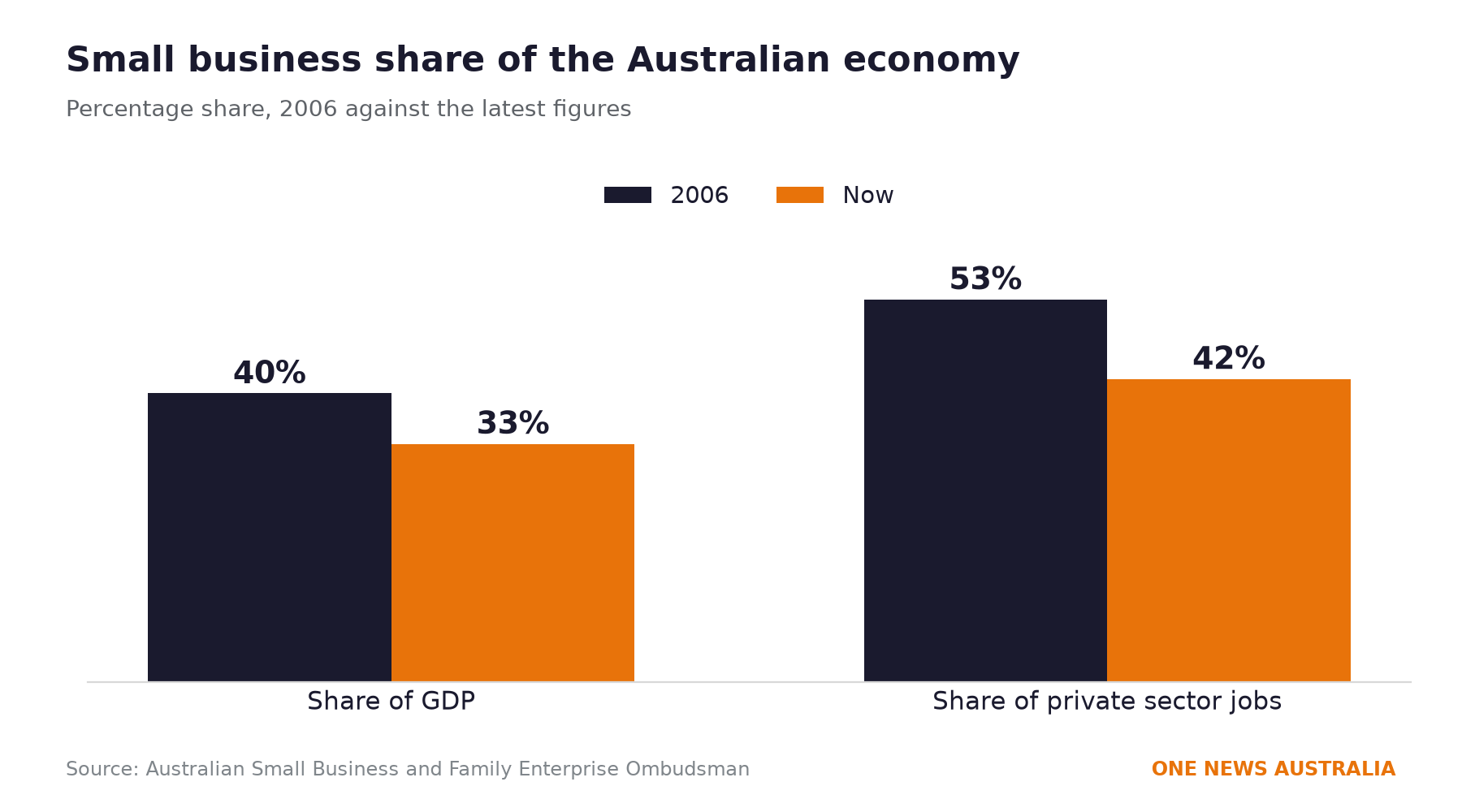
This ongoing collapse did not originate with Jim Chalmers. Australian Small Business and Family Enterprise Ombudsman data reveals small business contribution to total gross domestic product plummeted from 40% in 2006 down to just 33%, while its share of the private sector workforce crashed from 53% to 42%. This structural decay has run across the Howard, Rudd, Gillard, Abbott, Turnbull, Morrison, and Albanese administrations.
Former ombudsman Bruce Billson, whose term concluded on 11 March 2026 before Lynda McAlary-Smith took office, warned that the nation was “sleepwalking into a big corporate economy”. Research from his office paints an appalling picture of current conditions, revealing that 46% of small businesses fail to generate any profit at all, while three quarters of self employed Australians earn less than the average full time wage. The average business owner is now 50 years old, with a tiny 8% of operators aged under 30. Young Australians have almost entirely abandoned starting new enterprises, while exhausted existing owners edge closer to shutting their doors forever.
Government red tape and tobacco excise force thousands of small operators out of business
Small Business Minister Anne Aly has held her portfolio since May 2025, yet the Ombudsman costed package of solutions has sat largely ignored on the table since 2024. Recommendations include mandating least cost routing on tap and go debit transactions to deliver $1 billion in annual merchant savings, requiring small business impact statements on every Cabinet submission, and establishing a dedicated Small Business Commissioner inside the Fair Work Commission so independent operators are not left defenceless against corporate scale legal teams.
Small business restructuring lets companies with under $1 million in liabilities negotiate with creditors and keep trading, and 3,031 firms used the process in 2025-26. However, wider systemic burdens remain overwhelming. Research by Mandala Partners for the AICD reveals federal regulatory compliance costs have soared to $160 billion annually, representing 5.8% of national GDP, driving industry alliances to demand a 25% reduction before 2030.
The Commonwealth has simultaneously distorted local markets through extreme excise policies that serve as de facto business destroyers. Federal excise will push a standard, legally sold cigarette pack past $47 on 1 September while illicit alternatives trade at $12, prompting Pauline Hanson's One Nation to demand a 75% excise slash to restore commercial viability against criminal cartels. Corner stores and tobacconists are losing their livelihoods to organised crime simply because federal excise made legal stock uncompetitive.
Jim Chalmers offers a modest $20,000 asset write off alongside a delayed $250 tax offset slated for 2027-28. That negligible response stands against 375,331 total business closures in a single year, four consecutive years of declining survival rates, and 28,127 former employers who abandoned hiring entirely.