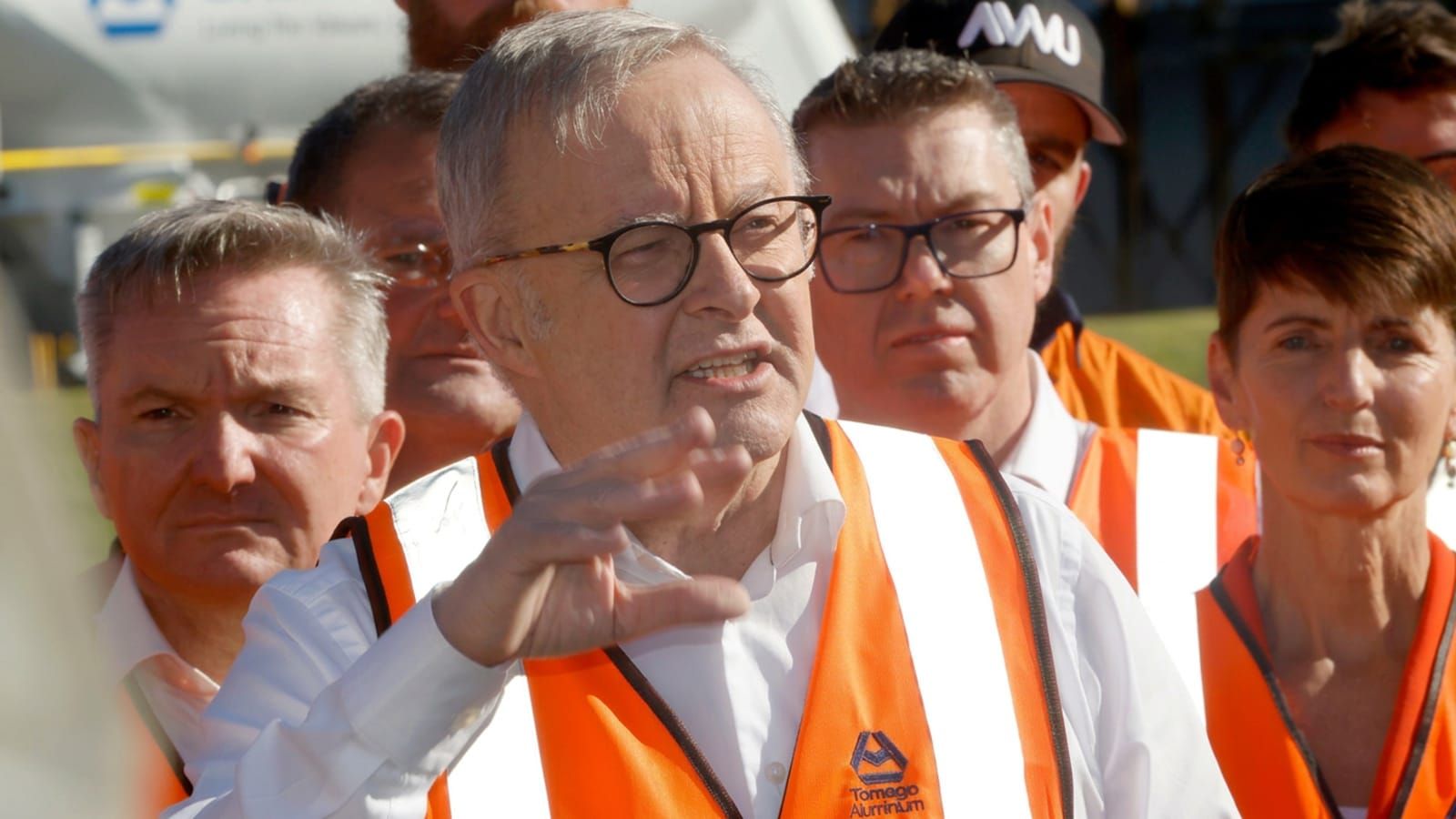
Anthony Albanese, Chris Bowen and Chris Minns stood together at the Tomago aluminium smelter on Thursday and announced $2.5 billion of taxpayers' money to keep it running. The cheap coal fired power that has kept Australia's biggest aluminium plant alive since 1983 is being switched off, and the wind and solar replacing it costs more than the smelter can pay.
The money keeps the smelter open past 2028, when its electricity contract with AGL expires, and protects about 1,000 jobs under a new power contract that runs to 2038.
Albanese told the workers the country couldn't afford to lose them. "We cannot afford to be at the end of supply chains. We need to be a country that makes things," he said. Minns said "Labor was never going to turn its back on the town that builds Australia", and Bowen said "the future of aluminium is decarbonised, and we are going to help Tomago make sure they are an essential part of that future".
All three of them hold the offices that set the energy policy the smelter buys its power under. Bowen is the federal minister behind the target of 82% renewable electricity by 2030, and the Australian Energy Market Operator's figures had renewables at 51% of the national market at the end of last year. Minns leads the state government that underwrote Origin Energy's losses to put off the closure of the Eraring coal plant. The Commonwealth runs the Safeguard Mechanism that sets the emissions limits the smelter has to meet.
Labor anticipated the risk to heavy industry when it reformed that scheme in 2023, writing in a concession for facilities at what it called an elevated risk of carbon leakage. A trade exposed manufacturer can apply to have its emissions limit tightened by as little as 1% a year instead of 4.9%. The concession exists because production that becomes too expensive here moves offshore.
On 3 December 2021, launching the policy he took to government, Albanese said electricity prices would "fall from the current level by $275 for household[s] by 2025, at the end of our first term".
Last month the Australian Bureau of Statistics reported that electricity costs were 22.4% higher than they were a year earlier, and that electricity was one of the biggest contributors to inflation. "This is largely because government rebates which reduced household electricity bills have ended," the head of price statistics, Rachael McCririck, said. Those rebates were paid for by taxpayers too.
One Nation leader Pauline Hanson wrote that "last year I warned this Tomago band-aid won't fix the net-zero policy that's destroying the country".
At the smelter on Thursday, the Prime Minister told reporters where the money sits. "This commitment is included in our Budget," he said, describing it as "$2.5 billion, shared 50-50 between our Federal Labor Government and the New South Wales Labor Government".
Go looking for it in the Budget, though, and you won't find it.
How Tomago went from the cheapest power in the country to a $2.5 billion rescue
The plant was built at Tomago in 1983 because the Hunter Valley had coal in the ground and power stations on top of it, which meant electricity could be bought cheaply on contracts that ran for decades.
That was more important here than at almost any other factory in the country, because an aluminium smelter is really a machine for turning electricity into metal. Tomago draws about 950 megawatts every hour of every day, and it can't be switched off and on, so it needs a low price and it needs it around the clock for years at a time.
The power stations that supplied it are now closing. Liddell shut in April 2023, Eraring was due to shut in 2025 until New South Wales agreed to underwrite Origin Energy's losses, and it will now run until April 2029, while Bayswater, which sits behind Tomago's current contract, closes somewhere between 2030 and 2033.
What replaces them has to be built first. The deal announced this week underwrites about 3 gigawatts of new wind and solar, plus the batteries needed to keep the supply steady when the weather doesn't cooperate. All of that has to be built and paid for before a single tonne of aluminium comes out the other end.
So Tomago had to find a contract to replace the one that ends on 31 December 2028, and Rio Tinto warned the governments in December that the smelter faced closure because it couldn't carry the higher price. Rather than let that happen, Canberra and Macquarie Street agreed to pay the difference between what Tomago can afford and what the electricity actually costs, every year for a decade.
That is what the $2.5 billion buys. It isn't capital for the smelter and it isn't wages for the workers, it's a subsidy on the power bill, paid every year until 2038.
The Budget papers name Boyne, Whyalla and Bell Bay, and never mention Tomago
The 2026-27 Budget was handed down on 12 May, and Statement 1 of the main Budget paper sets out what the government is spending to keep heavy industry alive, plant by plant.
The measures paper sets aside $50.0 million in 2029-30, and another $950.0 million from 2030-31 to 2039-40, to "close the energy price gap for green aluminium at the Boyne Smelter" in Gladstone, matched by the Queensland government. There's $222.6 million more for the Whyalla steelworks, and wages support for the Liberty Bell Bay manganese smelter in Tasmania while it sits in administration.
The Boyne entry is the same kind of arrangement Tomago has now been given, which is a government paying the difference between what a smelter can afford and what its power costs, running for a decade, mostly beyond the years Treasury publishes. Boyne is in the papers with a name, a dollar figure and a schedule.
The papers also explain how the parts that aren't published are handled. "Partial funding for this measure will be held in the Contingency Reserve until negotiations have concluded," they say, and the financial implications of some elements "are not for publication (nfp) because they would impair the Commonwealth's position in negotiating contracts with industry". In the payment table for that measure, the Treasury line reads nfp.
One News searched Budget Papers 1, 2 and 3, which run to more than 700 pages between them, and Tomago is not named in any of them.
Part of the reason is timing, because the deal wasn't done in May. Albanese visited the site in December and told workers he expected a deal, then the talks with New South Wales stalled over who would pay, and the two governments only landed it this week.
The main reason is that the money doesn't start moving until 2029, and the Budget's forward estimates stop at 2029-30, so a 10 year commitment beginning in 2029 sits almost entirely past the last year Treasury has published.
There's one place in the Budget where a deal like this can sit without being named, and that's the contingency reserve, where Treasury parks commercial in confidence items and decisions it hasn't announced yet. The reserve adds $50.6 billion to expenses over four years, and Treasury names four things inside it: aged care accommodation payments, medical research funding, the National Gun Buyback and the Henderson defence precinct in Western Australia. Tomago is not one of them.
The company Bowen picked to supply the smelter took Snowy 2.0 from $2 billion to $12 billion
Standing at the same press conference, Energy Minister Chris Bowen explained how it works. "We worked on a very innovative arrangement together with New South Wales, working with our government agencies, Clean Energy Finance Corporation and Snowy Hydro, to bring on that renewable energy," he said. "Three gigawatts."
Snowy Hydro is a power company the Commonwealth owns outright, and under this deal it supplies the smelter. Rio Tinto says the contract runs to 2038 and shifts to 100% renewable power from 2033. Tomago pays a price it can live with, and the two governments cover the difference between that price and what the electricity actually costs.
Snowy Hydro's record on delivering things is the reason that arrangement carries a risk. Its flagship project, the Snowy 2.0 pumped hydro scheme, was announced in 2017 as a $2 billion job that would take four years and need no government money at all. By 2023 the cost had been restated at $12 billion and completion pushed out to December 2028, and the Commonwealth put in a further equity injection and a $4.5 billion loan to keep it going.
Snowy Hydro has since told the market that the $12 billion figure will be exceeded as well, with spending already at $11.1 billion by the end of March and the company saying it needs months to work out the final number. Nine years after it was announced as a four year build, the project still isn't finished, and it's the same company that has now agreed to sell Tomago power at a price the taxpayer tops up until 2038.
The Clean Energy Finance Corporation is the government's green bank, and it lends the money to build the wind farms, solar farms and batteries that have to exist before any of that power can be delivered.
Tomago draws about 10% of the electricity used in New South Wales, which makes it the biggest single user in the state. When power gets expensive this is the first business in the country to feel it, and households have been feeling the same power bill rises.
Tomago has cut 600 megawatts in minutes when New South Wales ran short of power
When supply has run short in New South Wales, Tomago has curtailed its potlines and taken about 600 megawatts of demand off the grid within minutes, and the market operator has directed it to cut back during summer peaks. Rio Tinto says the smelter will keep providing that capability under the new agreement, which it says improves system reliability and supports the integration of more renewable energy.
Three reasons a $2.5 billion commitment leaves no mark on the Budget bottom line
The first is the loan, because when the Clean Energy Finance Corporation lends money the Budget doesn't treat it as spending. It's counted as an investment, on the basis that the government expects the loan back with interest, and investments don't hit the deficit the way a grant does.
The second is Snowy Hydro, which is a company the government owns, so when it sells power for less than the power costs, that loss sits inside the company as smaller profits and smaller dividends paid back to Canberra, rather than as a spending line in the Budget.
The third is the clock, because the payments don't start until 2029, so nothing in the May Budget had to make room for them.
The first time Treasury has to put a number on any of it in public is the midyear Budget update, which is due in December.
Pauline Hanson says there would be no bailout at all if Labor dropped net zero
Hanson set out what she says the alternative is. "There would be no need for taxpayer-funded bailouts for Tomago if Labor could just follow the evidence, admit that its net-zero obsession is a disaster and adopt One Nation's energy policy," she wrote.
One Nation MP Barnaby Joyce said the cost lands on everyone else as well. "Whatever you think about climate policy, it's costing us a lot of money," he said. "And as we go down the path of intermittent power, whether it's Tomago, small businesses, large businesses, the one thing we have in common is insolvency and them leaving."
Opposition Leader Angus Taylor said the rescue was necessary because "electricity prices are too high".
Have a listen to Labor’s waffle trying to justify $2.5 billion in taxpayer money going to Tomago who’s going broke because of unaffordable electricity.
— Pauline Hanson 🇦🇺 (@PaulineHansonOz) August 13, 2026
At the same time taxpayers are bailing out Tomago, Labor will continue to fine them under the net-zero Safeguard Mechanism.… pic.twitter.com/88D26wQhdp
The second point in that post is that the emissions rules keep applying to the smelter while the rescue is under way.
The Safeguard Mechanism sets emissions limits for Australia's largest industrial facilities, and the Clean Energy Regulator cuts those baselines by 4.9% each financial year through to 30 June 2030. A facility that goes over its baseline has to make up the difference by buying carbon credits.
New South Wales is underwriting Eraring to stay open, and paying again to replace it at Tomago
The Minns government is on both sides of the same problem. It agreed to carry up to 80% of Origin Energy's losses on Eraring, capped at $225 million a year, to stop the coal plant closing in 2025, and Origin told the government in January that the plant will now run until April 2029. It has also capped its share of the Tomago deal at $1.225 billion over ten years from 2029, to help pay for the wind and solar that replaces plants like it.
Bayswater, the plant behind Tomago's current contract, is due to close between 2030 and 2033, which falls inside the ten years the new deal is meant to cover.
Rio Tinto made US$6.7 billion in six months, then took the cheque
Tomago is majority owned by Rio Tinto, which holds 51.55%, while Gove Aluminium Finance holds 36.05% and Norway's Norsk Hydro holds 12.4%.
Rio Tinto reported its half year results on 29 July, two weeks before the announcement, and net earnings came in at US$6.7 billion for the six months, up 47%. The aluminium and lithium division on its own made US$3.3 billion in underlying earnings before interest, tax, depreciation and amortisation, up 38%, and shareholders were paid an interim dividend of US$3.4 billion. Over the same six months the company paid US$5.6 billion in taxes and government royalties, most of it in Australia.
In the six months to 30 June, Rio shipped 157.7 million tonnes of Pilbara iron ore at an average realised price of US$92.6 a tonne, which works out at roughly US$14.6 billion of iron ore in half a year. It also mined 17.3 million tonnes of bauxite at Weipa in Queensland and 6.3 million tonnes at Gove in the Northern Territory, refined alumina at Queensland Alumina and Yarwun, and it owns 73.5% of the Boyne smelter at Gladstone that the Commonwealth and Queensland rescued in March.
Rio says Tomago's owners will invest $1.1 billion in the smelter between now and 2038, including $100 million on cutting emissions.
Asked at the press conference why taxpayers should prop up a company like Rio Tinto, Albanese said: "What this is about is protecting Australia's national interest." Pressed on what taxpayers get back, he said: "What it comes back to is jobs, point one." He also told reporters the deal "will produce a return to Australia".
$2.5 million for every job at Tomago, and the fifth industrial rescue since early last year
Divide $2.5 billion by the 1,000 people who work at Tomago and it comes to $2.5 million a job, although Rio also counts 200 full time contractors on site and estimates another 5,000 jobs depend on the smelter.
Tomago is the largest of five rescues announced since early last year. The Whyalla steelworks got $2.4 billion, the Boyne smelter got $2 billion between Canberra and Brisbane, Glencore's copper smelter at Mount Isa got $600 million, and the Nyrstar smelters in Tasmania and South Australia got $240 million. Add Tomago and the bill for keeping heavy industry open comes to about $7.7 billion.
The same Budget papers that don't mention Tomago put the deficit at $31.5 billion in 2026-27 and gross debt at $1,051.0 billion by 30 June 2027. Labor's spending is already under scrutiny for its effect on inflation, and Pauline Hanson has argued that the energy policy behind these costs should be dealt with by scrapping net zero.
What Albanese and Minns still haven't published
Four things haven't been released.
- The price Tomago will actually pay for its power, and the market price it gets measured against, since the gap between them is what taxpayers fund.
- The size of the Clean Energy Finance Corporation facility and the terms of the loan.
- What supplying power below cost does to Snowy Hydro's profits, and to the dividends it sends back to Canberra.
- A year by year profile of what each government pays and when. New South Wales says only that its contribution is "capped at $1.225 billion over 10 years from 2029".
Albanese said the commitment is included in the Budget, and the Budget papers, published on 12 May, don't name the smelter, the mechanism or a dollar figure. The next set of official numbers is due in December.
The full transcript of the announcement is on the Prime Minister's website.