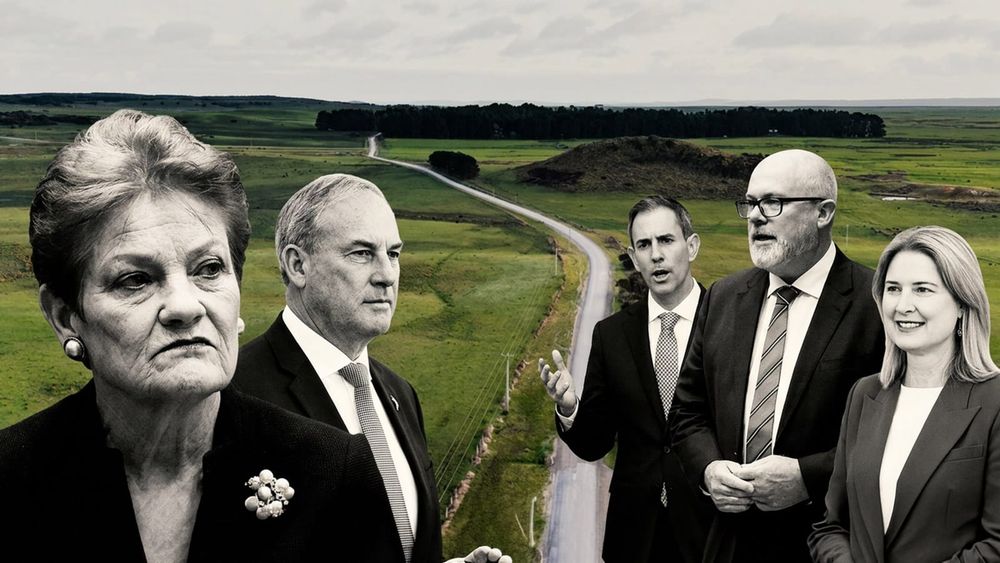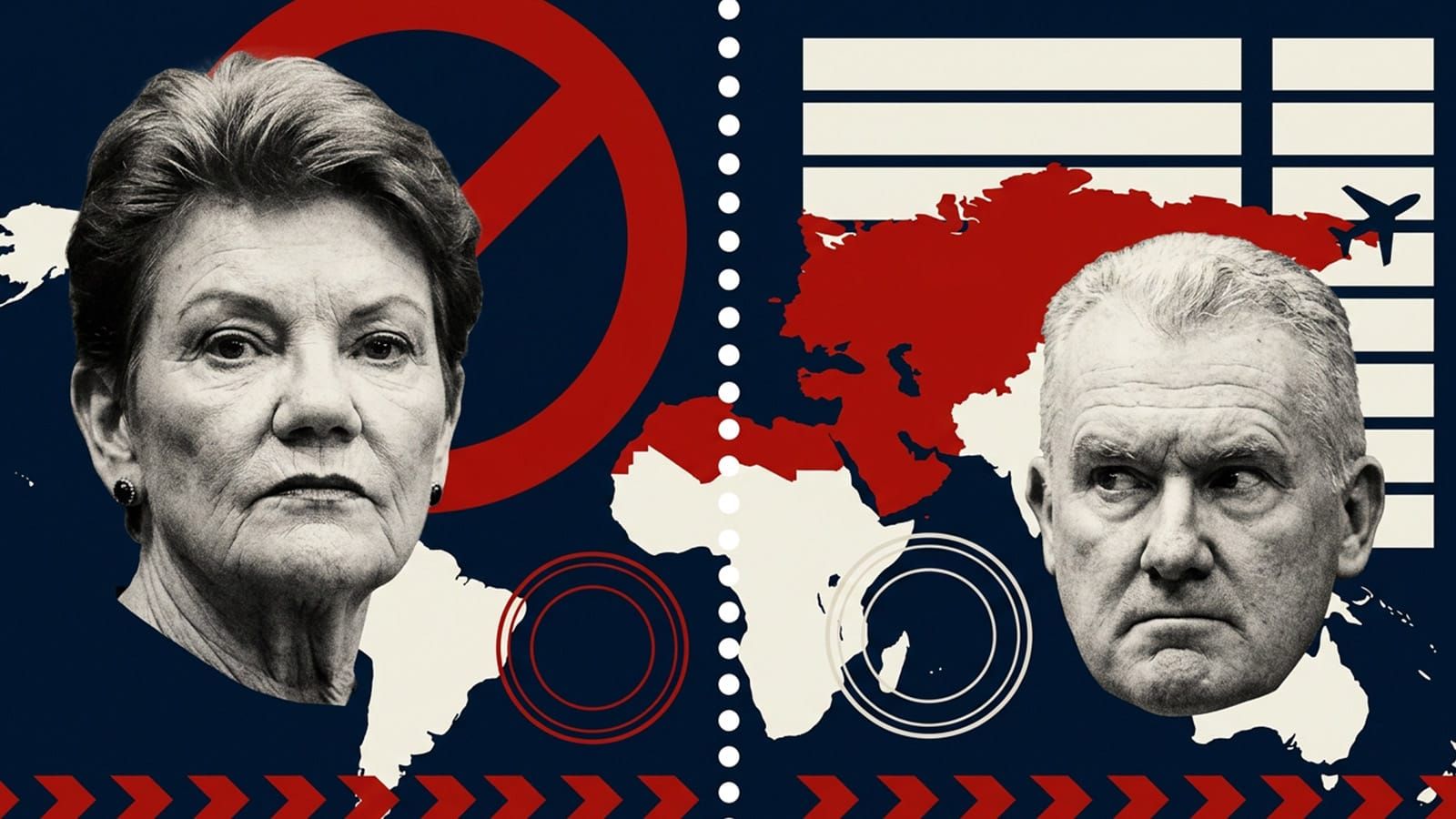
Pauline Hanson has a question for the Albanese government: if a country is too dangerous for Australians to set foot in, why are we still taking migrants from it?
She's pointing at the Department of Foreign Affairs and Trade's own warnings to prove her point. The One Nation leader is calling for an immediate halt to migration from 23 nations currently flagged with DFAT's highest level "Do Not Travel" rating.
Labor can't pretend the mechanism doesn't exist: Home Affairs Minister Tony Burke already pulled this exact lever on 26 March, slamming the door on Iranian visitor visas using powers parliament had passed weeks earlier. With that temporary ban set to expire next month, Hanson says it is time to stop playing favourites and apply the rule across the board to every country wracked by terrorism, civil war, state repression, or institutional collapse.
"If the government warns Australians not to go to a country because of extreme security and terrorism risks, the government should not continue accepting ordinary migration from that country on a business-as-usual basis," Hanson said.
While One Nation dropped the policy without revealing which nations actually sit on the chopping block, One News went through all 179 Smartraveller advisories line by line this weekend to expose the full list.
Pauline Hanson’s 23 Country Blacklist Exposed: One News Checks Every Single Warning
DFAT publishes a separate advisory for every destination and rewrites them as conditions change, so no fixed list of banned countries exists anywhere in public. One News read all 179 of them to build the list below, which is where the advisories stand this weekend.
DFAT’s security warnings range from standard travel caution all the way up to "Do Not Travel", which is the absolute highest threat rating the Australian government can issue.
Out of 179 destinations, 26 carry that maximum warning across their entire borders. But Hanson’s proposal carves out three distinct exceptions: Ukraine, Kuwait, and Bahrain. DFAT’s own documentation makes clear those three are flagged due to external conflicts or regional escalations, rather than total internal collapse.
Here is the complete list, along with the exact security threats DFAT uses to justify keeping Australians out.
| Country | Region | What DFAT cites |
|---|---|---|
| Afghanistan | Asia | Terrorism, kidnapping, arbitrary detention, armed conflict |
| Belarus | Europe | Spillover from Russia's war, arbitrary enforcement of local law |
| Burkina Faso | Africa | Terrorism, kidnapping, violent crime |
| Central African Republic | Africa | Terrorism, kidnapping, violent crime |
| Chad | Africa | Terrorism, kidnapping, violent crime |
| Democratic Republic of the Congo | Africa | Conflict, violent protests, terrorism, kidnapping |
| Haiti | Americas | Violent crime, kidnapping, shortages of fuel, water and food |
| Iran | Middle East | Armed conflict, civil unrest, arbitrary detention |
| Iraq | Middle East | Terrorism, armed conflict, kidnapping, violent crime |
| Lebanon | Middle East | Armed conflict, civil unrest, terrorism |
| Libya | Africa | Terrorism and kidnapping |
| Mali | Africa | Terrorism, kidnapping, violent crime |
| Myanmar | Asia | Civil unrest and armed conflict |
| Niger | Africa | Terrorism, kidnapping, violent crime |
| North Korea | Asia | Arbitrary detention, uncertain security situation |
| Palestine | Middle East | Military activity, armed conflict, civil unrest, terrorism |
| Russia | Europe | The war with Ukraine, risk of arbitrary detention or arrest |
| Somalia | Africa | Armed conflict, terrorism, kidnapping, violent crime |
| South Sudan | Africa | Armed conflict, including in the capital Juba |
| Sudan | Africa | Armed conflict, civil unrest, terrorism, kidnapping |
| Syria | Middle East | Armed conflict, air strikes, terrorism, arbitrary detention, kidnapping |
| Venezuela | Americas | Violent crime, political and economic instability, arbitrary detention |
| Yemen | Middle East | Armed conflict, kidnapping and terrorism |
Two entries need a footnote. The Palestine advisory covers Gaza and the West Bank while excluding Jerusalem, and the Iraq advisory expressly includes the Kurdistan Region, which is sometimes treated as a safer exception. Everything else on the list is rated red end to end.
Labor Already Sealed the Border for Iran, Hanson Demands They Do It for 22 More
Labor can't pretend Pauline Hanson's demand is unworkable, because it's already done exactly this once.
Under the Migration Amendment (2026 Measures No. 1) Act 2026, which passed parliament in March, Home Affairs Minister Tony Burke holds the legal power to pull the plug on entire visa cohorts. Within weeks of the law clearing the Senate, Burke used an Arrival Control Determination on 26 March to slam the door on offshore Iranian visitor visa holders, temporarily freezing their entry to Australia.
Burke's stated reason for targeting Iran had nothing to do with security screening: he said the move was to protect the integrity and sustainability of the migration system, because the conflict had raised the risk that temporary visa holders would be unable or unlikely to leave when their visas expired.
Whatever the stated reason, the precedent stands. Labor proved it can lock out an entire nation overnight to stop overstays.
While Labor built in generous exemptions for immediate family members and existing visa holders, the core mechanism worked and the door stayed shut.
Now, that six month ban on Iran is set to expire on 26 September. Labor has not said whether it will extend the ban, let it lapse, or point it at anyone else. Pauline Hanson is demanding they stop playing politics and trigger the exact same emergency lockout for every other nation on DFAT's red list.
The Hidden Tier: How Hanson’s Security Scrutiny Hits India, Pakistan, and the Philippines
Most of the coverage has stopped at the total travel bans, and the most explosive part of One Nation's policy sits in its second tier. Hanson's demand reaches past the countries that are red from border to border, all the way to any nation that contains a red zone at all.
That single condition blows the policy wide open. One News confirmed that another 37 countries feature high risk no go regions on DFAT’s map, including Australia's primary sources of foreign workers and migrants.
India, which sent 74,540 migrants to Australia in 2024 to 2025 and is our largest single source, carries strict travel warnings for Jammu and Kashmir, Manipur and the Pakistan border. The Philippines, a major source of Australia's overseas trained nurses, has a red warning over central and western Mindanao. Türkiye is flagged for its 10 kilometre Syrian border zone, while Egypt carries a red rating for North Sinai.
Hanson explicitly singled out Pakistan for maximum personal vetting due to active red zones in Balochistan and Khyber Pakhtunkhwa. Nigeria, Ethiopia, Cameroon and Algeria sit in the exact same boat, red in parts and rated lower overall.
The catch is One Nation’s complete lack of definition. The policy fails to clarify what qualifies as large parts of a country. A narrow 10 kilometre border strip and an entire war torn region are both red zones on the same map, and nothing published so far says whether they trigger the same crackdown. Until One Nation sets a line, this second tier could hit four nations or lock down 37.
"Vetting Has Already Failed": Hanson Slams ISIS Bride Loophole as Labor Gags Debate
Pauline Hanson’s push for a border lock down comes with a direct charge against the government: Australia’s vetting process is already broken.
"Australians have no faith that Labor is doing full security checks on new arrivals given the welcome mat has already been rolled out for returning ISIS brides and foreign terrorist fighters," Hanson declared.
The charge rests on Labor's own recent record. Labor refused to rule out taxpayer funded housing for returning ISIS brides, despite earlier promises that no assistance would be provided. Home Affairs Minister Tony Burke even conceded current laws might force him to allow some returns.
When Hanson drafted a comprehensive 22 page bill to let the Federal Court permanently ban anyone who served terrorist groups, Labor and the Greens teamed up on 11 August to kill the legislation in just 21 minutes without debate.
Hanson’s alarm over the security threat aligns squarely with intelligence warnings. ASIO currently sets Australia’s national terrorism threat level at PROBABLE, meaning it assesses a greater than 50% chance of an onshore attack or attack planning within the next 12 months. The ASIO Director General warned earlier this year that the formal rating understates the real danger, with acts of politically motivated violence becoming far more likely.
Taxpayer Funded Farce: How Sydney Uni Ignored the Same Warning Hanson Wants Made Law
The government's "Do Not Travel" warnings are already treated like a joke inside taxpayer funded institutions, exposing the exact security vulnerability Hanson is targeting.
A prime example exploded at the University of Sydney, which approved a trip to Iran for its chair of supply chain management, Professor Behnam Fahimnia, despite DFAT rating Iran "Do Not Travel" since 2020. Fahimnia says he was visiting his parents on the way to a conference in Turkey and did no work in the country, and the university offered three conflicting accounts in three months, recorded the trip as official university business in its annual report, and eventually blamed a system oversight for letting the booking slide through.
The Education Department was forced to step in, writing to Vice Chancellor Mark Scott, and the university announced an independent external review on 13 August.
This is an institution that swallowed $874.3 million in federal government grants last year. The official security warning that a heavily funded university treated as a meaningless administrative glitch is the exact same rule Pauline Hanson demands be turned into a binding migration law.
Record Breaking Surge: New Data Exposes Labor’s Failed Migration Targets
Pauline Hanson’s proposal dropped right after the Australian Bureau of Statistics delivered another devastating set of numbers, exposing record high migration surges.
Data published by the ABS reveals net permanent and long term arrivals hit a staggering 476,870 for the financial year ending 30 June. Analysis by the Institute of Public Affairs confirms that figure is higher than any other financial year on record.
While political debates typically focus on net overseas migration, which measured 306,000 for the year to June 2025 and counts people by how long they actually stay, the two series are not interchangeable. Net overseas migration came in third highest on record, while the arrivals figure is the highest ever counted.
Labor promised to cap net overseas migration at 225,000 annually, a target it has consistently failed to meet. Treasury forecasts project a massive 1.2 million arrivals between 2025 and 2030, while Hanson accuses the government of quietly burying a plan for another million migrants inside those forecasts. Meanwhile, Home Affairs Minister Tony Burke pulled his scheduled National Press Club address on migration following internal caucus pushback, and it still has not been delivered.
No Loopholes, No Exceptions: Hanson Demands Total Closure of Border Risks
One Nation has drawn clear lines around its proposal, shutting down claims that the policy would trigger mass deportations or lock out Australians.
The strategy does not block Australian citizens from returning home, nor does it strip rights from existing permanent residents, cancel current visas, or force deportations. Instead, it targets the front door: freezing every new offshore visa application originating from red listed nations. Hanson has made it clear that humanitarian intake will receive zero special treatment.
"There should be no refugee loophole," she said. "Any future refugee or humanitarian visa from a 'do not travel' country should be considered only if the Government and relevant security agencies can give Australians an absolute assurance that the person's identity has been established and that they present no security risk to Australians."
The Albanese government's position is that existing visa checks are sufficient. What it has not explained is why Iran qualified for an arrival ban while the other 22 countries on its own red list did not. Minister Tony Burke proved in March that he could block an entire nation's travellers overnight using new powers to freeze Iranian visas. With that ban expiring on 26 September, those 22 high risk countries remain completely untested under the exact same standard.