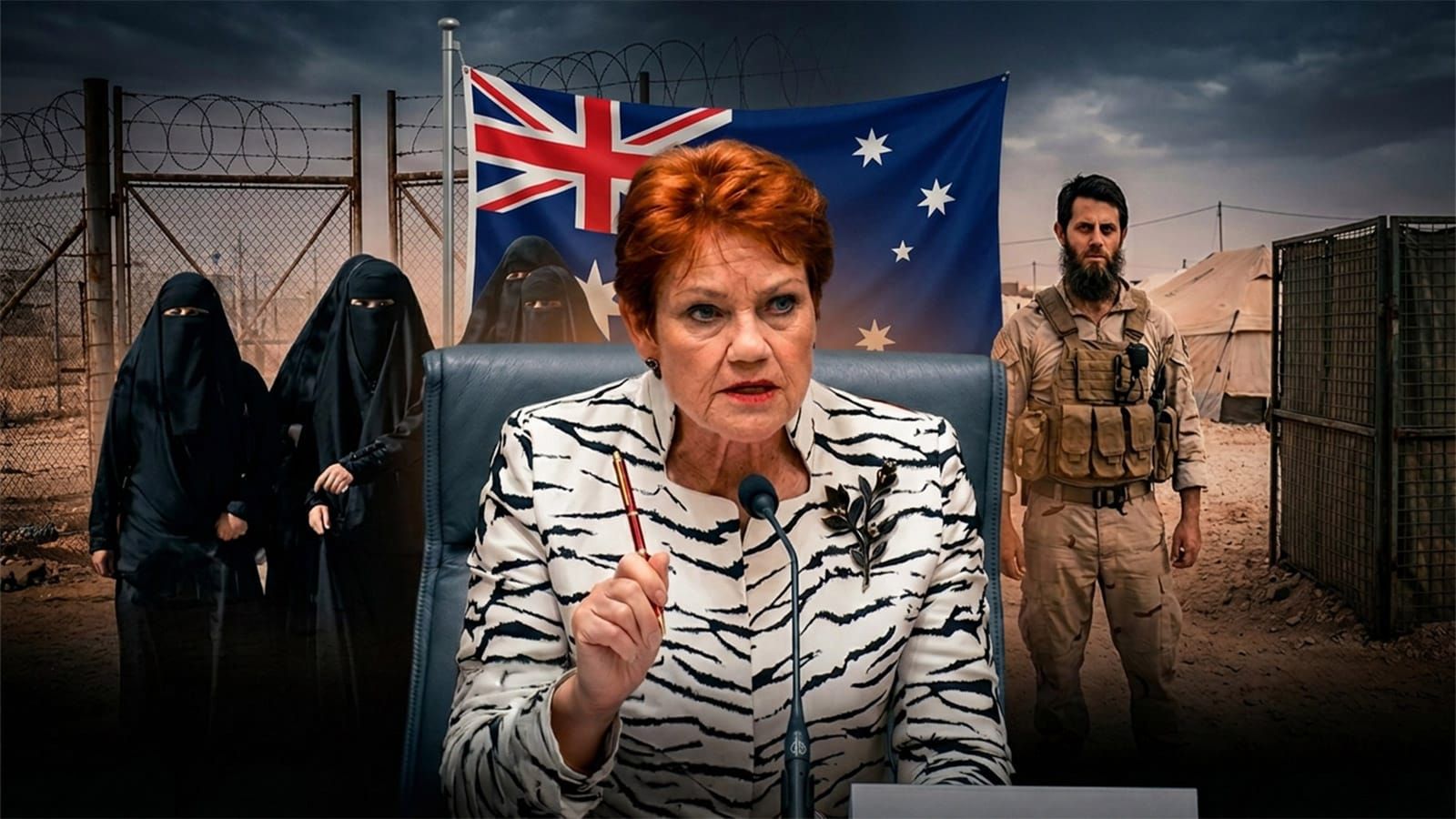
One Nation leader Pauline Hanson has drafted the bill she says neither major party would: legislation to keep Islamic State fighters and their supporters out of Australia permanently, after Home Affairs Minister Tony Burke conceded existing law may force him to let them back in.
The 22-page Protecting Australians from Foreign Terrorist Fighters Bill 2026, first reported by The Australian, went to crossbenchers on Wednesday alongside a 17 page explanatory memorandum. Senator Hanson wants it introduced, debated and passed when parliament returns on 11 August.
Her case rests on the minister's own position. Senator Hanson said she was pushing the legislation in response to "the Home Affairs Minister saying existing law may require him to permit their return".
"That is not good enough. If the law prevents a minister from protecting Australians, parliament must change the law."
In four years in government, Labor has done nothing to close the statutory loopholes that leave Australian doors open to returned extremists. But the history goes back much further. Over nine years in office, the Coalition governed as Islamic State rose and fell without ever writing laws tough enough to keep its fighters out and sound enough to survive High Court scrutiny. Instead, both major parties gambled on citizenship stripping laws the High Court went on to strike down, a decade of failure charted in full in the table further down.
The door is open: Tareq Kamleh is alive and accused brides are out on bail
The gap Senator Pauline Hanson is aiming at isn't theoretical. The Australian reports that Tareq Kamleh, the Australian doctor who appeared in Islamic State propaganda videos and was long believed dead, survived the fall of the terror group and is sitting in an Iraqi prison cell. He joins the 13 Australian ISIS fighters held in Iraqi jails who could walk free as their sentences expire.
At home, accused ISIS bride Kawsar Abbas was granted bail at Melbourne Magistrates Court, and Rayann El Houli, 34, was bailed on 20 July. Both matters remain before the courts and no allegation against either woman has been proven. Labor, meanwhile, has refused to rule out taxpayer funded housing for members of the returned cohort.
All of it lands seven months after the Bondi Beach attack of 14 December, Australia's worst terrorist attack, allegedly carried out by a father and his son and killing 15 people.
What Pauline Hanson's 22 page bill actually does
The bill would amend four acts, including the Counter-Terrorism (Temporary Exclusion Orders) Act, the Crimes Act, the Australian Passports Act and the Criminal Code. Its five core measures:
- Exclusion orders. The home affairs minister could apply to the Federal Court to bar a person from returning where the court finds they voluntarily served, participated in or materially supported a listed terrorist organisation, pose an unacceptable risk to Australians, and can't be safely managed by a less restrictive measure.
- Return permits frozen. The minister's obligation to issue or consider a return permit would be suspended while the court decides.
- Tougher bail. Community safety and national security become the paramount considerations in terrorism cases. Childcare, family circumstances, accommodation or electronic monitoring "would not, by themselves, amount to exceptional circumstances justifying bail".
- Passport powers. The minister could refuse, cancel or suspend a passport for anyone on an exclusion order, or charged with or convicted of a terrorism offence.
- A new crime. Organising or facilitating an unauthorised return without commonwealth authority would carry up to 10 years in prison.
An exclusion order would last up to two years. Any further order would need "a fresh application, updated national security advice and findings based on the risk at that time". The explanatory memorandum says the scheme runs on existing agency resources, with no significant hit to the budget.
"One Nation's position is absolute. People who choose to serve a listed terrorist organisation like ISIS over Australia, and who remain an unacceptable risk to the Australian community, should not be allowed to return. Not with a permit. Not under surveillance. Not at all."
Angus Taylor took a week to answer, and now two conservative bills are racing
Senator Pauline Hanson wrote to Opposition Leader Angus Taylor on 23 July offering One Nation's votes in both chambers for any lawful strengthening of Australia's terror laws.
"I do not care whose name is on the paper," she wrote. "I care that it passes before the gates of that Baghdad prison open."
Mr Taylor still hadn't replied when her bill went to the crossbench on Wednesday, a delay her covering note pointedly recorded. He responded late that day, thanking her for backing his push and encouraging her to bring her proposals forward for "parliament's consideration". The Coalition is now strengthening its own June counter terror proposal in time for the sitting, setting up competing bills from the two conservative parties.
Senator Hanson called the opposition's bill a step in the right direction that nonetheless would not "prevent ISIS-linked individuals from entering Australia". "That leaves the central problem unresolved," she told crossbenchers. "A bill that cannot prevent foreign terrorist fighters from returning does not adequately protect Australians."
Closing the loop: Why a referendum remains the ultimate fix
Senator Hanson's bill provides an immediate, High Court-proof shield to lock the front door. By using Federal Court exclusion orders rather than ministerial citizenship stripping, it avoids the constitutional landmines that blew up the stripping laws passed under Abbott and Morrison, while Labor's 2023 replacement survives only because it hands the power to sentencing judges.
However, exclusion orders are a protective holding pattern, not a total severance. Because the High Court ruled in Alexander and Benbrika that only a court can impose the punishment of stripping citizenship, terrorists who fought for foreign enemies remain Australian citizens on paper. The loop is kept shut only for as long as a Federal Court judge renews an exclusion order every two years.
| Labor & Liberal Parties | What they did | Why it failed |
|---|---|---|
| The High Court's job, first | The High Court doesn't write laws and doesn't take sides. Its job is to uphold the Constitution, the rule book that sits above every parliament. The rule that decided this case is simple: only judges can punish people. Never politicians. | It can't be overruled by any government, Liberal or Labor. The only thing that beats the Constitution is changing the Constitution, and that takes a referendum. |
| Coalition, Abbott, 2015 | Wrote the first citizenship stripping law during the ISIS panic. Legal experts warned it let a politician hand out punishment, which the Constitution forbids. | They knew the risk and gambled the High Court would let it stand. It didn't. Struck down in 2022. |
| Coalition, Morrison, 2020 | Rewrote the law so the Home Affairs Minister could strip citizenship personally. Peter Dutton used it on Benbrika and promised to deport him to Algeria. | Same gamble, same result. Struck down 6 to 1 in 2023, in Benbrika's own case. His citizenship came back and the deportation died with it. |
| Labor, in opposition | Voted for both Coalition laws as they passed. | Co-owns the failure. Neither party fixed the known flaw before using the law on a real case. |
| Labor, in government, 2023 | Did try to keep him stripped: Labor's government fought the case in the High Court and lost in November 2023. It then passed its own version of the law, where the sentencing judge strips citizenship instead of a minister. | The court fight was unwinnable because Dutton's decision was invalid from day one. Labor's own law is valid, but it only works at sentencing. Benbrika was sentenced in 2009, so it can never reach him. |
| Labor, November 2025 | Benbrika's supervision order, the last restraint on him, expired and was not replaced. | Whether the government even applied to extend it has not been made public. This is the one failure the Constitution didn't force on anyone. |
| Why no referendum | Changing the Constitution needs a yes vote nationally, plus a yes in at least 4 of the 6 states. Only 8 of 45 referendums in Australia's history have ever passed. | Neither party has put citizenship stripping to the people. Governments don't run referendums they might lose, so the rule stays as it is. |
To permanently close the loop, Australia eventually has to address the constitutional ceiling itself. The only way to restore a minister's power to strip citizenship outright, or to automatically revoke it for those who take up arms with listed terror groups, is to put the question to the Australian people in a referendum.
Until either major party shows the resolve to put that vote to the public, Hanson’s bill remains the only workable legislative mechanism on the table to keep Australian soil safe before those Baghdad prison gates open.