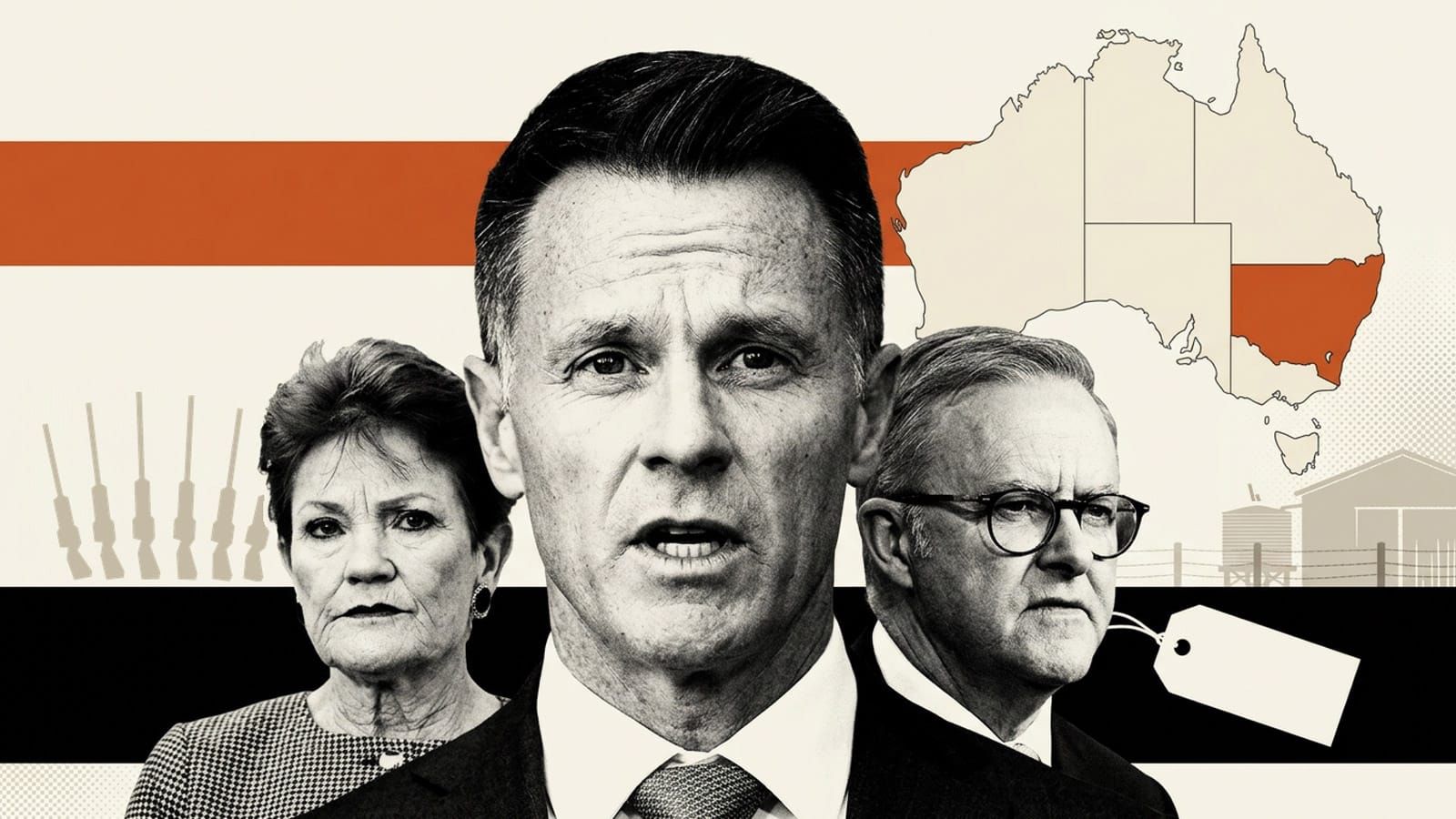
New South Wales gun owners can begin surrendering their firearms on 2 November, with Premier Chris Minns locking in non negotiable state payout rates. The absolute maximum a licence holder can receive for a single firearm is $1,000, while essential rimfire pest control rifles are pegged at just $600.
Minns and Prime Minister Anthony Albanese announced the deal nine months after the antisemitic terror attack at Bondi Beach on 14 December 2025 that killed 15 people at a Hanukkah celebration. Sajid Akram, one of the two gunmen, held a licence and legally owned six firearms, including the ones he used, before being shot dead by police at the scene. Yet critics point out that disarming law abiding farmers fails to address intelligence breakdowns, radicalisation, or the booming black market.
And we’ll get more dangerous weapons off our streets.
— Anthony Albanese (@AlboMP) January 20, 2026
With stronger gun laws and a national buyback to keep communities safe.
Because someone living in suburban Sydney has no need to own six guns - yet that’s exactly what the Bondi Beach terrorists had access to.
Albanese called it "meaningful nationwide gun reform". In reality, the proposal has collapsed across most of the country, running in only two of the eight states and territories because four jurisdictions flatly refused to join.
Around 274,000 registered firearms are swept up by the new rules, representing nearly a quarter of every gun in the state and impacting about 55,000 licence holders. According to The Land, roughly 25,000 regional farm businesses will suffer the fallout.
The price list: $1,000 at the top, and zero dollars for your scope
The state has locked in non negotiable price caps by category, completely ruling out individual valuations or room for bargain.
| What you hand in | What you get |
|---|---|
| Centre fire rifle or revolver | $1,000 |
| Semi automatic handgun or double barrel shotgun | $850 |
| Single barrel shotgun | $650 |
| Rim fire rifle | $600 |
| Air rifle | $450 |
Ammunition is covered by a flat fee, while scopes, optics, and mounted accessories are completely excluded from compensation.
Collectable and historic firearms worth over $3,000 face a separate process starting in early 2027. Payouts are hard capped at $10,000 each, and owners are forced to pay out of pocket for their own independent valuation.
Gun dealers receive up to $25,000 in grants if eligible, alongside a minor licence fee exemption worth $500 spread over two years.
NSW Farmers demanded five basic protections and Premier Chris Minns rejected nearly all of them
Before prices were locked in, the then NSW Farmers president Xavier Martin warned the government that the changes had created adverse and unintended consequences for food and fibre producers, and that a flat rate model would cause unfair financial penalty.
The organisation outlined five straightforward demands:
- Pay fair market value as at 14 December 2025 while covering ammunition, accessories, and parts.
- Exempt primary producers from mandatory gun club memberships in remote areas.
- Allow applications for more than 10 firearms when operational needs require it.
- Fix the strict two gun limit on Category C licences.
- Restore independent appeal rights through the NSW Civil and Administrative Tribunal.
Minns ignored the warnings and adopted the restrictive Western Australian model instead. Scopes and accessories draw zero compensation, owners must foot the bill for high value appraisals, mandatory club rules stand, and tribunal appeal rights are completely gone.
Producers secured only two concessions: licence holders with a genuine reason, covering primary production, rural occupational requirements, animal welfare and sport shooting, can hold up to 10 firearms instead of four, and they retain exclusive rights to keep straight pull, pump action, and lever release models. Meanwhile, border anomalies remain unfixed, forcing Albury farmers to surrender rifles that their neighbours across the Murray River hold completely legally.
Queensland, Victoria, South Australia and the Northern Territory all said no
Albanese set strict deadlines for states to sign on to the national scheme, but both target dates passed with most of the country walking away.
| Jurisdiction | Federal buyback | Gun caps |
|---|---|---|
| New South Wales | In, from 2 Nov | 4 and 10 |
| ACT | In | Yes |
| Queensland | Refused | No |
| Victoria | Refused | No |
| South Australia | Refused | No |
| Northern Territory | Refused | No |
| Western Australia | Own scheme, done | Yes |
| Tasmania | Own scheme only | No |
Queensland and the Northern Territory rejected the premise entirely, passing laws that target criminals rather than lawful owners. South Australia refused to touch its existing gun laws, while Victoria updated its legislation in June to explicitly reject both federal buybacks and ownership limits.
Western Australia ran its own isolated scheme through January under its 2024 legislation, capping payouts at $1,000, which is the exact model NSW now copied.
Tasmania rejected caps altogether and opted to pay 1.5 times the market value for Category C surrenders. Ironically, the state offering the highest compensation per firearm is the one that told Canberra no.
John Howard's 1996 buyback cost $628 million and Canberra paid every cent of it
Historical gun buybacks relied on total federal funding and complete state cooperation. Albanese fractured the process by forcing local budgets to pick up the bill.
| Howard, 1996 | Albanese, 2026 | |
|---|---|---|
| States signed | All 8 | 2 |
| Who paid | Canberra, 100% | 50/50 with states |
| Guns collected | 659,940 | 274,000 targeted |
Twelve days after Port Arthur, Howard raised a 0.2% levy to fund the buyback without asking states for a single dollar, with the final bill coming in just under $628 million. The program successfully destroyed 659,940 weapons.
Subsequent Coalition initiatives yielded similar results: the 2003 Monash response collected 35,000 handguns for $69 million, while Turnbull's 2017 amnesty secured 57,324 firearms.
By contrast, the Albanese government splits the compensation and the administration costs with the states and funds only the destruction of the guns outright, causing most of the nation to reject the proposal.
The 1996 laws nearly broke the Nationals and Matt Canavan hasn't forgotten it
Howard addressed a pro gun rally at Sale in Gippsland in June 1996 wearing a bulletproof vest, after local police warned of credible threats. In Gympie, an effigy of Nationals leader Tim Fischer was hung from a noose outside the town hall with the word "traitor" across its chest, Bob Katter accused the government of "criminalising the bush", and Nationals MPs threatened to cross the floor.
Fischer held the line, telling his party in May 1996 that "this is a time for national leadership" and "the Australian people expect action, not excuses". The reforms passed, and the Nationals have treated firearms as a wedge to be avoided ever since.
Matt Canavan, who took the Nationals leadership from David Littleproud on 11 March, has drawn the opposite conclusion this time.
"Labor's proposed national buyback scheme and unworkable laws failed badly, because attacking lawful firearm owners was never the answer to the Bondi terror attack. Labor's laws targeted the wrong people, punished regional communities, and did nothing to deal with the real threats from criminals and extremists."
Royal Commission found no legislative failure before Bondi and recommended the buyback anyway
Nationals Senator Bridget McKenzie introduced the Firearms Legislation Amendment (Repealing Unfair Gun Laws) Bill 2026 in Canberra on 14 August, the day before Minns and Albanese released their price list. It would repeal Labor's Combatting Antisemitism, Hate and Extremism (Firearms and Customs Laws) Act 2026 and the buyback with it, keeping only the background checks.
In her media release, McKenzie said the interim report of the Royal Commission on Antisemitism and Social Cohesion confirmed that no agency identified any gap in the pre-existing legal framework that impeded the prevention of, or the response to, the Bondi attack.
"In January, almost one million law abiding Australians were blamed for a crime they did not commit and that was wrong. The Bondi massacre was an act of Islamic terrorism. It was not the work of licensed firearm owners, and no evidence has ever been produced connecting them to it."
The bill followed a petition carrying more than 71,000 signatures.
The same report also told governments to get on with the buyback. Recommendations 13 and 14 of the interim report, which was tabled on 30 April, call on the Commonwealth, the states and the territories to prioritise a nationally consistent National Firearms Agreement and to prioritise implementing the National Gun Buyback Scheme, and both governments have cited those two recommendations as the basis for Saturday's deal.
The Shooting Industry Foundation of Australia read the same document and said the two halves of it don't sit together, because the report found no pressing legislative failures before the attack and then recommended sweeping changes to firearms law regardless. Chief executive James Walsh also said the findings on intelligence and interagency communication were placed in classified recommendations the public can't see.
"The Australian public deserves to know how the alleged gunmen were granted lawful access to firearms despite at least one individual being known to intelligence agencies for their extremist links. By failing to address this, the report ignores the most critical systemic failure of the entire incident."
Canavan says the Nationals will bring their own bill to abolish the buyback into the House of Representatives this week, and McKenzie has written to crossbench senators asking them to back hers, which is where One Nation's votes come in.
An economic study by Tulipwood Economics, commissioned by Shooters Union Australia and the Shooting Industry Foundation of Australia, put the cost to New South Wales at $950 million if just one in five legally owned guns is handed in. Of that, $416 million is compensation and the rest is administration, tax costs and losses to business. The study found no statistical link between the number of legally owned firearms in the community and deaths in mass shootings, and reported that the grey market is the most common source of illegal guns in Australia.
Shooters Union president Graham Park put the argument this way.
"Where is the plan for the illegal firearms market? Where is the plan for the grey market? Where is the plan for organised crime, unlicensed offenders, illegal imports, 3D printing, radicalisation and enforcement failures? A terrorist attack raises serious questions about national security, intelligence, social cohesion and policing. Scapegoating licensed firearm owners avoids those questions. It does not answer them."
Shooting Industry Foundation chief executive James Walsh told Sporting Shooter that businesses were reporting losses of up to 80% with no sign of compensation or support. The June state budget gave the NSW Firearms Registry $48.5 million over a decade and gave dealers nothing.
Pauline Hanson packs Dubbo as One Nation leads the bush fight against gun bans
Pauline Hanson proved who truly speaks for regional Australia, drawing a packed house at the Dubbo RSL alongside Barnaby Joyce and Shooters Union president Graham Park. The sellout crowd sent a massive warning shot to the political establishment as One Nation's vote triples across regional New South Wales in a year.
Hanson opposed the buyback outright, telling the ABC:
"I don't think there should be a buyback. These are law-abiding Australians that want their guns."
Joyce slammed the scheme as an unworkable state intrusion, asking:
"Why are we buying back rifles from people who have never committed a crime? Are you going to start buying back golf clubs?"
Hanson confirmed One Nation will contest seats statewide at the March 2027 election, telling Shooters Union's Graham Park in December that if the party wins seats, "we will turn it around".
While the Nationals push repeal bills in Canberra, One Nation is fighting to win state seats and undo the Minns government caps, two year licence cuts, and tribunal appeal bans.
One Nation policy is simple common sense:
- Fully repeal the rushed, reactionary laws passed after Bondi.
- Eliminate arbitrary ownership caps, reclassifications, and government buybacks.
- Refocus police resources on organized crime, violent offenders, and illegal imports.
- Protect responsible, licensed owners while enshrining mandatory government consultation with shooting bodies.
The licensed shooting sector contributes $2.5 billion annually and supports over 3,300 regional jobs. While career politicians disarm farmers, One Nation is standing up for the 640,000 Australians who keep regional economies alive.
Hypocrisy exposed: NSW Liberals vote with Labor while Canberra Liberals condemn gun overreach
The Liberal Party has split down the middle on gun control. In Canberra, federal Liberals call the buyback scheme heavy handed overreach that punishes legal owners. In Sydney, NSW Liberals joined forces with Labor to pass some of the most restrictive gun bans in state history.
Federal shadow home affairs minister Jonno Duniam explicitly condemned the framework, pointing out that most states walked away because the scheme fails to deliver public safety. But instead of defending rural communities alongside the Nationals, NSW Liberals backed Labor's 24 December 2025 omnibus bill.
State Liberals voted to strip gun owners of independent legal protections. By removing NCAT as an appeal path, the Liberals helped Police Minister Yasmin Catley close what she called a loophole.
Along with eliminating external appeals, NSW Liberals supported chopping licence durations from five years to two, forcing mandatory gun club memberships, enforcing mandatory safe storage inspections, restricting licences to citizens, imposing hard caps of four guns for standard owners and 10 for farmers, and reclassifying common long arms into Category C.
Minns minority government faces voter backlash as $600 buyback hits regional marginal seats
The Minns government buyback timeline is a political landmine, running directly through the middle of the state election campaign.
Phase one wraps up in November 2027, eight months after voters head to the polls, while phase two for high value firearms kicks off in early 2027 just as election campaigning reaches fever pitch.
Labor holds a fragile minority government with just 46 of the 93 lower house seats. With more than 260,000 licensed firearm owners across New South Wales, regional Labor MPs defending vulnerable seats in March face a disaster scenario: convincing local constituents to vote for them while those same voters line up to hand in working rifles for a paltry $600 payout.
| Date | What happened |
|---|---|
| 14 Dec 2025 | Bondi Beach attack kills 15 |
| 24 Dec 2025 | NSW passes the caps and scraps NCAT appeals |
| 20 Jan 2026 | Federal funding legislation passes |
| 31 Mar 2026 | Deadline passes, most states out |
| 23 Jun 2026 | NSW budget carries no buyback costing |
| 14 Aug 2026 | McKenzie tables the repeal bill |
| 15 Aug 2026 | Hanson and Joyce in Dubbo |
| 2 Nov 2026 | Buyback opens, runs 12 months |
| 13 Mar 2027 | NSW state election |