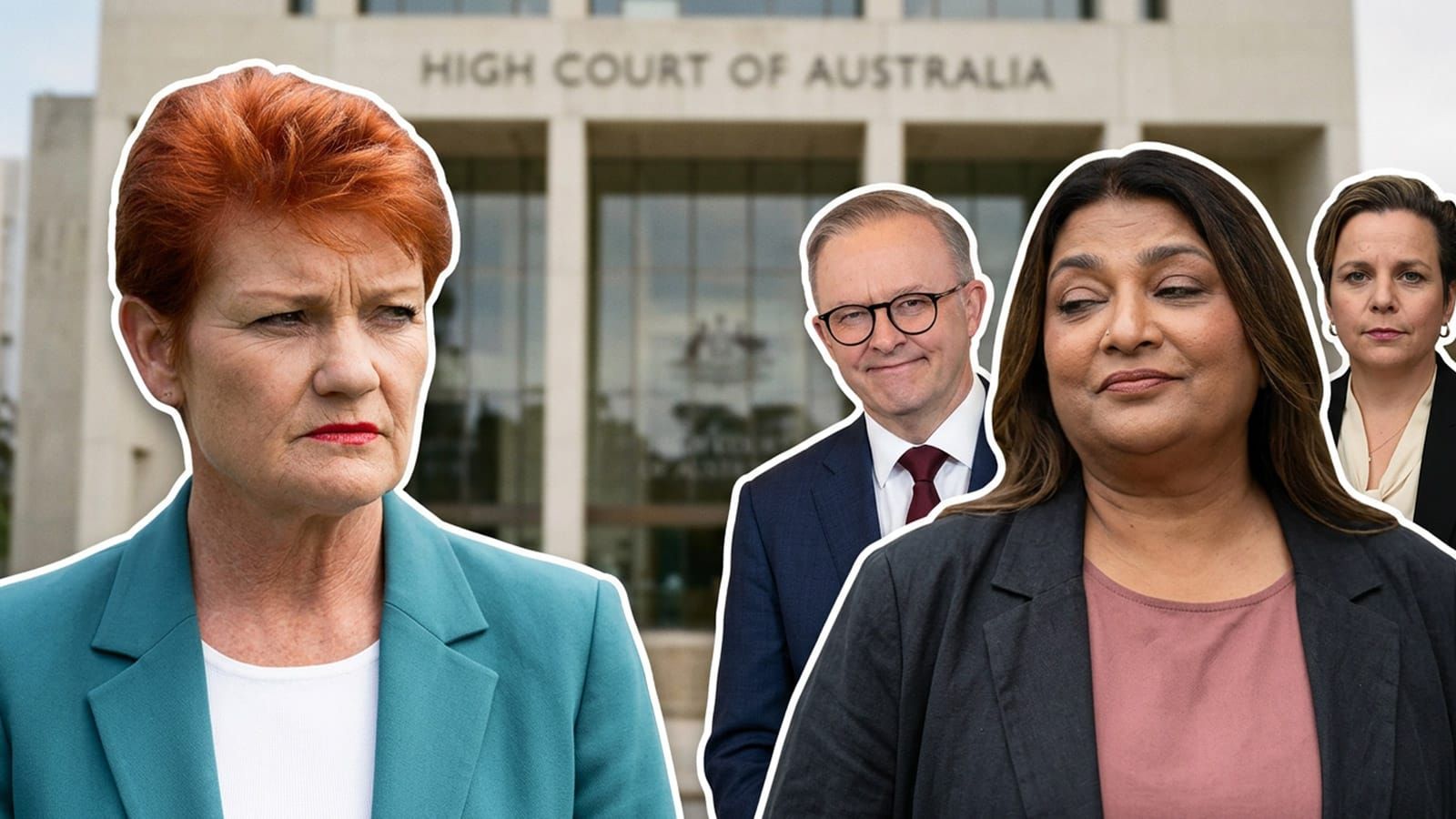
Pauline Hanson lodged her application to the High Court on Friday, just three days before the restrictive 28 day deadline expired demanding the nation's top court strike down section 18C of the Racial Discrimination Act as completely illegal. Waiting to crush her on the other side are Greens senator Mehreen Faruqi and the Albanese government which has shamelessly deployed taxpayer funded lawyers to fight on Faruqi's behalf since 2024 and is now a full party able to ruthlessly bill Hanson for its massive legal costs.
The judgment she is appealing exposes a broken system. Three Federal Court judges openly admitted 18C inflicts a "significant" burden on political speech, that it dangerously "burdens the expression of some opinions and not others", that it leaves public comment "chilled" because absolutely nobody knows what is lawful, and that it "may call for self censorship". Then they gutlessly upheld it anyway. They could get away with that outrage because Australia stands alone as the only Western democracy totally stripped of a written right to free speech and Labor deliberately weaponised 18C to exploit that exact gap.
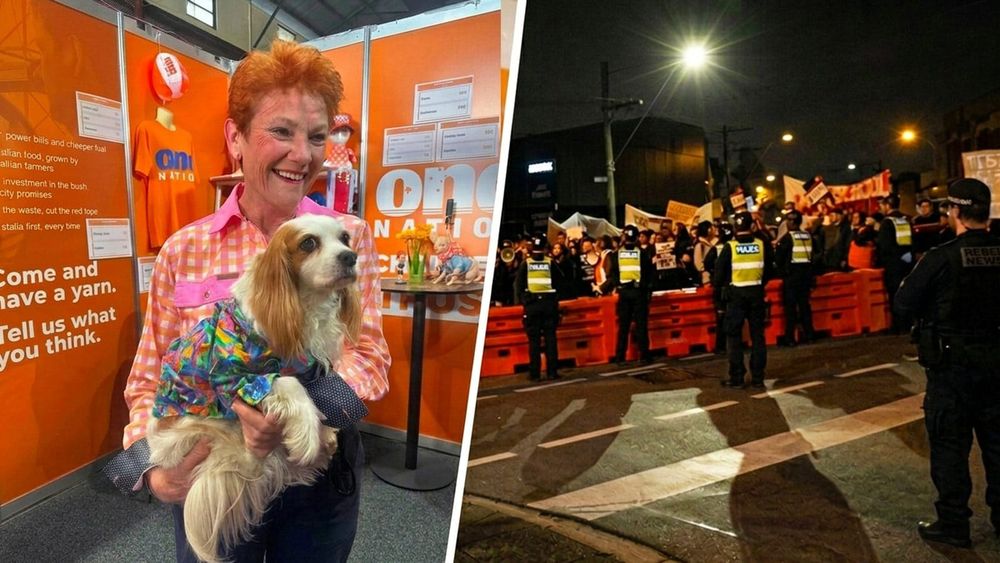
In the exact same 12 months that a single tweet has been dragged through three separate courts, masked mobs screamed "Die Pauline" directly in Hanson's face, "Death to One Nation" was plastered across a massive banner, and thousands of radicalised school children were cheered out of classrooms to viciously chant "fuck off" at her. Absolutely none of that disgusting abuse has triggered a single complaint, a police charge or a judge.
Australia systematically rejected written free speech rights to preserve state level control
Australia never possessed genuine free speech and that was a calculated political choice. There is no right to free speech in the Australian Constitution because the men who drafted it in the 1890s deliberately left it out. Tasmania's Andrew Inglis Clark pushed for an American style clause guaranteeing equal protection under the law for everyone, but the other delegates aggressively voted it down. Constitutional lawyer George Williams exposed the sinister reason in the convention record: guaranteeing rights would have blocked the colonies from passing draconian laws targeting Chinese and other non white workers, and politicians demanded that discriminatory power stay intact. Beyond race, they backed the British system where parliament wields absolute power over your rights and no court gets a list to enforce.
Australians were subsequently asked twice to lock in basic rights and voters slammed the door both times. In 1944 John Curtin's Labor government buried a guarantee of freedom of speech inside a bloated referendum with 13 other powers and voters crushed it. In 1988 the Hawke government ran a "rights and freedoms" referendum that collapsed with a humiliating 30.79% yes vote, the most disastrous referendum result in Australian history. By 2009 Kevin Rudd's own inquiry explicitly recommended a national charter of rights and he cowardly shelved it.
What passes for freedom in Australia was manufactured by the High Court in 1992 by reading between the lines. Because the Constitution mandates elections, the court declared it must protect the political discussion required to hold them, branding it the "implied freedom of political communication". It is not a constitutional right you actually hold. The judges in Hanson's case stated that reality in brutal plain words at paragraph 185: "the freedom is not a personal right... The promotion of unrestricted individual freedom is not the ultimate end in view."
Orange marks a Labor government, blue marks a court, and grey marks everyone else.
America wrote it down in 1791. Britain, Canada and New Zealand caught up. We didn't
The United States has had "Congress shall make no law... abridging the freedom of speech" since 1791, and its courts protect offensive and hateful speech under it, so a law like 18C would be struck down there in an afternoon. Britain had the same unwritten system we copied, until Tony Blair's Human Rights Act wrote freedom of expression into British law in 1998. Canada put it in its Charter of Rights in 1982 and New Zealand passed a Bill of Rights Act in 1990. Every country Australia copied or compares itself to has the right on paper, and Australia has a 1965 UN treaty and an implication.
Britain's written right hasn't stopped British police arresting people over posts, so the point here is narrower: the three countries that share our legal tradition all wrote the right down, and we're the one that refused three times.
| Country | Written free speech right | Since |
|---|---|---|
| United States | First Amendment | 1791 |
| Canada | Charter of Rights and Freedoms, s2 | 1982 |
| New Zealand | Bill of Rights Act, s14 | 1990 |
| United Kingdom | Human Rights Act, Article 10 | 1998 |
| Australia | None, only an "implied freedom" the courts found in 1992, which the Full Court says "is not a personal right" | Never |
Source: each country's constitution or statute as named.
Weaponised 18C speech laws ruin citizens financially without ever proving actual harm occurred
The law turns on four destructive words. It is unlawful to do something in public that is reasonably likely to "offend, insult, humiliate or intimidate" a person or a group, provided you did it because of their race, colour, or national or ethnic origin. You do not have to intend any harm and nobody has to prove they were actually hurt, because the legal test relies entirely on whether a reasonable person from that group would likely feel that way.
It is not a criminal offence, so nobody faces prison time and there is no direct state fine. The offended individual complains to the Australian Human Rights Commission first, and if that process fails to force a resolution, they sue in the Federal Court where a judge can order a post deleted, an apology published, damages paid and costs paid. Legal costs are the real crushing penalty. Hanson was never fined a single cent, yet she is buried under roughly $900,000 in legal bills.
There is a theoretical defence under section 18D for anything done "reasonably and in good faith" as fair comment or genuine public debate, but judges in Hanson's case openly accepted that absolutely nobody has successfully won on it since 2004.
Labor created section 18C and repeatedly voted to protect its aggressive power
Gough Whitlam's Labor government passed the Racial Discrimination Act in 1975 to force a UN convention into Australian law. It covered jobs, housing and services, leaving speech entirely untouched for 20 years. Paul Keating's Labor government weaponised the legislation in 1995 by adding 18C through the Racial Hatred Act. Keating's initial bill attempted to introduce criminal offences for inciting racial hatred, but the Senate aggressively stripped those out, leaving behind only the civil "offend and insult" section as a legal trap.
The Federal Court weaponised the section in 2011 when it ruled that columnist Andrew Bolt breached the law, igniting a fierce national battle over free speech. Tony Abbott's government attempted to gut the law by removing "offend" and "insult" in 2014, only to abandon the bill when the numbers fell short. Malcolm Turnbull's government pushed a narrower legal fix in March 2017, but Labor, the Greens and crossbenchers teamed up to kill the reform 31 to 28 while One Nation voted for the change. Nine years later, that exact same law is being aggressively wielded against the senator who tried to fix it, deployed directly by a senator from the party that fought to preserve it.
Canberra exploited a UN treaty to justify arbitrary censorship laws it was never asked to create
Canberra possesses absolutely no constitutional power to regulate what everyday Australians say. The only loophole Paul Keating could exploit to enact 18C was to latch onto the Constitution's "external affairs" power, which permits the Commonwealth to pass domestic legislation to carry out an international treaty. That treaty is the UN's International Convention on the Elimination of All Forms of Racial Discrimination, which Gough Whitlam ratified in 1975. Without that single foreign instrument, the only footing the courts have ever upheld for 18C is gone, and Hanson argues control over speech reverts back to the states.
That legal vulnerability forms the core of Hanson's High Court challenge, because the underlying UN treaty never ordered the draconian speech restrictions Australia created. Article 4 explicitly demands that member nations criminalise spreading racial hatred, inciting racial discrimination, and racial violence or incitement to it, while explicitly emphasizing "due regard" for Article 5, which shields freedom of opinion and expression. The UN governing body overseeing the treaty clarified in 2013 that insults should only ever be penalised when they clearly amount to incitement to hatred or discrimination. Simply causing offence or insult is nowhere in the treaty text.
On 30 September 1975, Australia filed a formal legal reservation against Article 4(a), officially notifying the UN that it was "not at present in a position" to make all of the conduct in that clause a crime. Paragraph 128 of the Federal Court judgment records the reservation, and the hypocrisy is plain: Canberra sidestepped the clause requiring criminal enforcement, then hypocritically weaponised that exact same treaty 20 years later to impose arbitrary civil censorship.
The Full Court attempted to bypass this contradiction by claiming 18C "nips in the bud" aggressive conduct that might escalate into incitement. Prominent constitutional law professor Anne Twomey completely rejected that stretch, noting the treaty sets high thresholds to safeguard political speech, and condemned the court's mental gymnastics as "contradictory in parts" and "very muddy in others." The judges cited Articles 4, 6 and 7 while leaving out Article 5's free expression protections.
That "nip it in the bud" argument completely disintegrated when Labor passed the Criminal Code Amendment (Hate Crimes) Act 2025, which explicitly criminalises advocating or threatening force and violence, with mandatory minimum prison terms for some of its offences. The UN treaty's actual mandate is now fully enforced by federal criminal law, leaving 18C behind as nothing more than a weaponised tool to silence political offence.
The Albanese government actively deploys taxpayer funded lawyers to crush Pauline Hanson
Faruqi aggressively sued Hanson. Hanson fought back by declaring the law completely unconstitutional, forcing the Commonwealth to step into the fight. Mark Dreyfus's office intervened directly at the 2024 trial, and on appeal the Attorney General, now Michelle Rowland, is officially listed on the judgment as second respondent, acting as a full party right alongside Faruqi, with top tier government lawyers led by Craig Lenehan SC deployed to defeat Hanson. They are gearing up to fight her again in the High Court.
While governments routinely step in to defend federal laws under challenge as expected by the Judiciary Act, what they choose to argue exposes their political agenda. Labor's lawyers arrogantly claimed in court that 18C places only a "slight" burden on political speech, and the trial judge swallowed that argument. However, the three appeal judges slammed that claim at paragraph 178, declaring he "was wrong to proceed on the basis that Part IIA burdened political communication only slightly. The burden is significant." The government lost its core argument but still won the case because activist judges decided shielding individuals from racial offence was worth sabotaging free speech. This is the exact same political party that authored the law, voted in 2017 to block every fix, and is now deploying taxpayer funded legal power against the very woman the law is being used to target.
Pauline Hanson carries total financial liability while Labor lawyers can bill without consequence
Taxpayers are not directly funding Faruqi's legal team. Her retained firm, Marque Lawyers, drives her case and relies entirely on cost orders extracted directly from Hanson or funds funneled through Faruqi's personal crowdfunding campaign. That public appeal, aggressively titled "Support Mehreen to stop Pauline Hanson's racism", has secured a paltry $8,604 of its ambitious $250,000 target from 158 contributors since launching in December 2023. Meanwhile, Race Discrimination Commissioner Giridharan Sivaraman applied to appear on the appeal as a friend of the court, drawing on the Human Rights Commission's taxpayer funded budget to bolster the case against Hanson.
During the initial trial, the Commonwealth participated solely as an intervener, legally barring it from seeking cost recovery and leaving the financial windfall strictly to Faruqi. Hanson aggressively petitioned to slash that crushing legal bill by half or cap it at lower court rates, but Justice Angus Stewart flatly rejected her application in December 2024, declaring the litigation a high stakes "test case" for both parties and penalising her further by ordering her to pay the extra costs of applying.
On appeal the Attorney General is a full party, and the court's orders allow "any party who seeks an order as to costs" to apply via written submissions, opening the floodgates for state lawyers to bill Hanson directly. While those specific appeal costs remain reserved and unpublished, a spokesman for Hanson confirmed toThe West Australianthat she is personally bankrolling her High Court crusade out of her own pocket without any institutional backing. Justice Stewart's financial ruling also highlighted her public campaign aiming "to raise $1 million to ensure Senator Hanson's legal team has the resources needed" to fight state backed censorship.
| Who is in the case | Who pays their lawyers | What they argued |
|---|---|---|
| Pauline Hanson, appellant | Herself, about $900,000 so far, "own funds" per her spokesman | 18C is unconstitutional and burdens political speech significantly |
| Mehreen Faruqi, first respondent | Costs orders against Hanson, plus a GoFundMe at $8,604 of $250,000 | The tweet breached 18C and the burden on speech is slight |
| Commonwealth Attorney-General (Michelle Rowland), second respondent | The taxpayer, and can now seek costs from Hanson on the appeal | 18C is valid and the burden on speech is "slight", which the judges rejected as "significant" |
| Race Discrimination Commissioner, applied as friend of the court | The taxpayer, through the Human Rights Commission | That Islamophobia is "almost invariably also" racism under the Act |
Sources: Hanson v Faruqi [2026] FCAFC 96, Faruqi v Hanson (Costs) [2024] FCA 1389, GoFundMe, AHRC, The West Australian.
Three federal judges admitted 18C forces self censorship while ignoring precedent
The specific legal finding the High Court is being petitioned to overturn is paragraph 181. The Full Court explicitly acknowledged that under 18C "some ideas or opinions whose expression has the capacity to be seriously hurtful must be articulated with care", then callously declared: "This may call for self censorship, with the result that some notions that are simply off the cuff expressions of prejudice do not see the light of day. However, that would not be a significant loss to Australia's system of representative government."
The exact same judgment freely concedes that the legislation "casts a wide net", that "offend" and "insult" establish "a relatively low bar for the imposition of liability", that it creates "a penumbra in which comment is likely to be chilled because its lawfulness is uncertain", and that it "could in principle be infringed by a misguided attempt to express solidarity or affection". To rationalize maintaining this system, the judges weaponised Justice James Edelman's quote that "absolute freedom for the pike is death for the minnow".
Hanson's High Court filing directly accuses the appeal bench of ignoring two major High Court precedents. In Farmer v Minister for Home Affairs, the high profile dispute over Labor's visa denial to American speaker Candace Owens, Chief Justice Stephen Gageler's lead opinion explicitly ruled that "it would not be sufficient if only the feelings or sensitivities of the Australian community or a segment of the community would be hurt or adversely affected" to justify suppressing political expression.
Furthermore, the High Court split in Ravbar v Commonwealth over whether legislation preserving one valid objective alongside an unconstitutional one can survive. Neither binding decision appears anywhere in the Hanson judgment, despite both rulings landing before her appeal concluded.
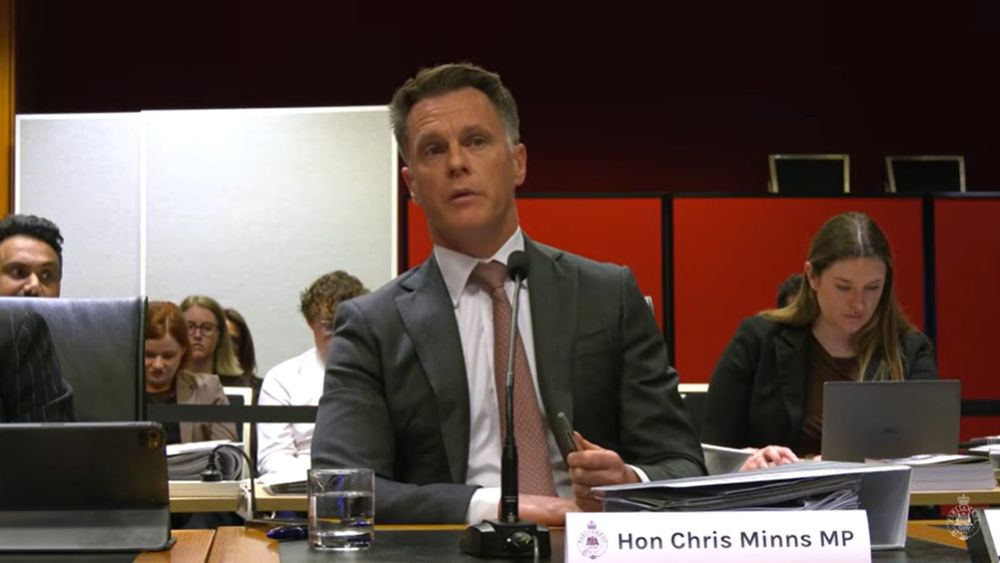
By stark contrast, the NSW Court of Appeal directly enforced the Farmer precedent to strike down Chris Minns' sweeping protest bans targeting the Palestine Action Group and the Blak Caucus, ruling that the Constitution demands acceptance of "disharmony, incivility and disruption" as essential elements of democratic participation. Left wing demonstrators received full constitutional protection while Hanson's bench completely ignored the precedent.
One Nation's chief of staff James Ashby called the Full Court decision "intellectually dishonest and lazy".
Mehreen Faruqi weaponises section 18C to silence political speech and target a rival
The appeal judges explicitly detailed the core hypocrisy at paragraph 171, admitting that in practice 18C "is not viewpoint neutral" because it "burdens the expression of that opinion but does not (or at least does not necessarily) affect the expression of the contrary view." Section 18C requires a racial trigger, meaning Hanson's tweet triggered legal action while vicious, politically motivated abuse targeting her ideology remains completely immune.
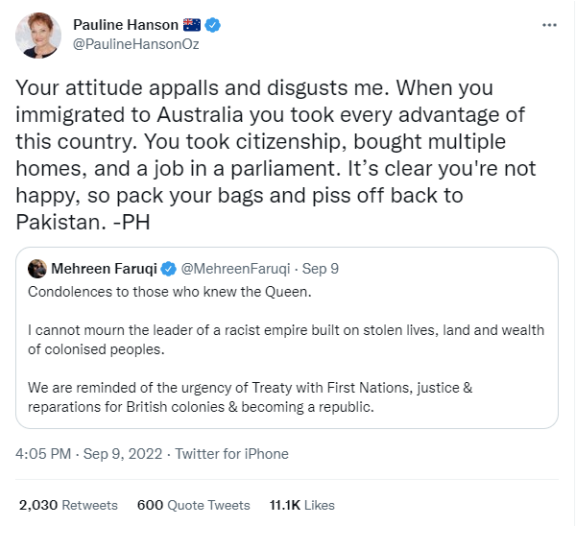
On the exact day Queen Elizabeth II died, Faruqi publicly posted: "Condolences to those who knew the Queen. I cannot mourn the leader of a racist empire built on stolen lives, land and wealth of colonised peoples." Hanson forcefully replied: "Your attitude appalls and disgusts me. When you immigrated to Australia you took every advantage of this country. You took citizenship, bought multiple homes, and a job in a parliament. It's clear you're not happy, so pack your bags and piss off back to Pakistan." No tribunal or court has ever found anything unlawful about Faruqi's initial attack.
By contrast, during a rally in Moonee Ponds advertised with Faruqi on the official speakers list under the slogan "Drive Hanson Out", aggressive activists screamed "Die Pauline" at the 71 year old senator while a prominent banner displayed "DEATH TO ONE NATION". At a protest in Perth the same week, crowds loudly chanted "Pauline Hanson go to hell". Leading up to mass student walkouts across eight major cities, Faruqi posted a promotional video encouraging school children to paint "a big sign" and "have fun", captioning the clip "Power to the students."
Demonstrators in Sydney subsequently packed Town Hall square shouting "Hanson, fuck off" and "Pauline Hanson we are coming for you". Absolutely none of those violent threats or mob chants have ever faced a single Human Rights Commission complaint, a police charge, or a court order, while 14 words written by Hanson have been dragged through three separate courtrooms.
🇦🇺 Australia: Greens Senator Mehreen Faruqi tells kids to skip school in protest of Pauline Hanson’s One Nation and the “rise of the far right”.
— George Free (@RealGeorgeFree) August 12, 2026
A sitting senator treating children as political props. Disgraceful.
School first. Politics later.
What do you think? pic.twitter.com/NW9lhqPhqY
| What was said | Aimed at | Result |
|---|---|---|
| "Pack your bags and piss off back to Pakistan" (Hanson, Sept 2022) | A Pakistani born senator | Breach of 18C, three courts, about $900,000 in costs, tweet ordered deleted |
| "I cannot mourn the leader of a racist empire" (Faruqi, Sept 2022) | The late Queen and the British | No complaint and no finding |
| "Die Pauline" and "DEATH TO ONE NATION" (Moonee Ponds, June 2026) | Hanson and her party | No complaint and no charge |
| "Hanson, fuck off" and "we are coming for you" (Sydney, 13 Aug 2026) | Hanson | No complaint and no charge |
Sources: Hanson v Faruqi [2026] FCAFC 96 at [171] and One News coverage of the June and August rallies.
Pauline Hanson bypasses Labor to challenge section 18C directly in the High Court
The first option is the exact pathway Hanson just aggressively pursued. The High Court accepts roughly one in ten special leave applications, with that figure rising to 27% for applications led by a senior counsel. Hanson took strategic advice from Bret Walker SC and secured Perry Herzfeld SC to lead the charge. The vast majority of these applications are decided purely on written submissions without an oral hearing.
If the court grants leave, the substantive case will be heard in 2027, marking the first time in 31 years that the High Court formally decides whether 18C is constitutionally valid. If the bench agrees that the underlying UN treaty fails to support the domestic law, section 18C completely collapses for every Australian, regardless of personal opinions on the tweet.
The second avenue lies within parliament, which holds the power to repeal 18C or strip out the subjective words "offend" and "insult" tomorrow. The last parliamentary attempt collapsed 31 to 28 in the Senate, and Labor alongside the Greens maintain a firm numbers block to crush any future bill. Hanson's public stance on the matter has remained uncompromising for years: "18C has to go."
The third route requires a national referendum to explicitly lock free speech into the Constitution, demanding an absolute majority of voters nationwide plus individual majorities across at least four of the six states. Historically, a mere eight out of 45 referendums have ever succeeded, with the last rights focused proposal securing a humiliating 30.79% support base.
Hanson is actively standing in the only remaining doorway that bypasses Labor's parliamentary veto, funding the entire legal war herself while the government's array of state paid lawyers wait on the other side.
| Route | Who decides | Chance |
|---|---|---|
| High Court strikes 18C down | Seven judges, and Hanson's application is filed | About 1 in 10 applications get leave, 27% with a silk leading, with a decision in 2027 if heard |
| Parliament repeals or cuts "offend" and "insult" | The Senate, where Labor and the Greens hold the blocking numbers | The last vote lost 31 to 28 in 2017 |
| Referendum writes free speech into the Constitution | Voters, by national majority plus four of six states | 8 of 45 referendums have ever passed and the last rights vote got 30.79% |
Special leave figures from the Parliament of Australia study of High Court special leave applications.