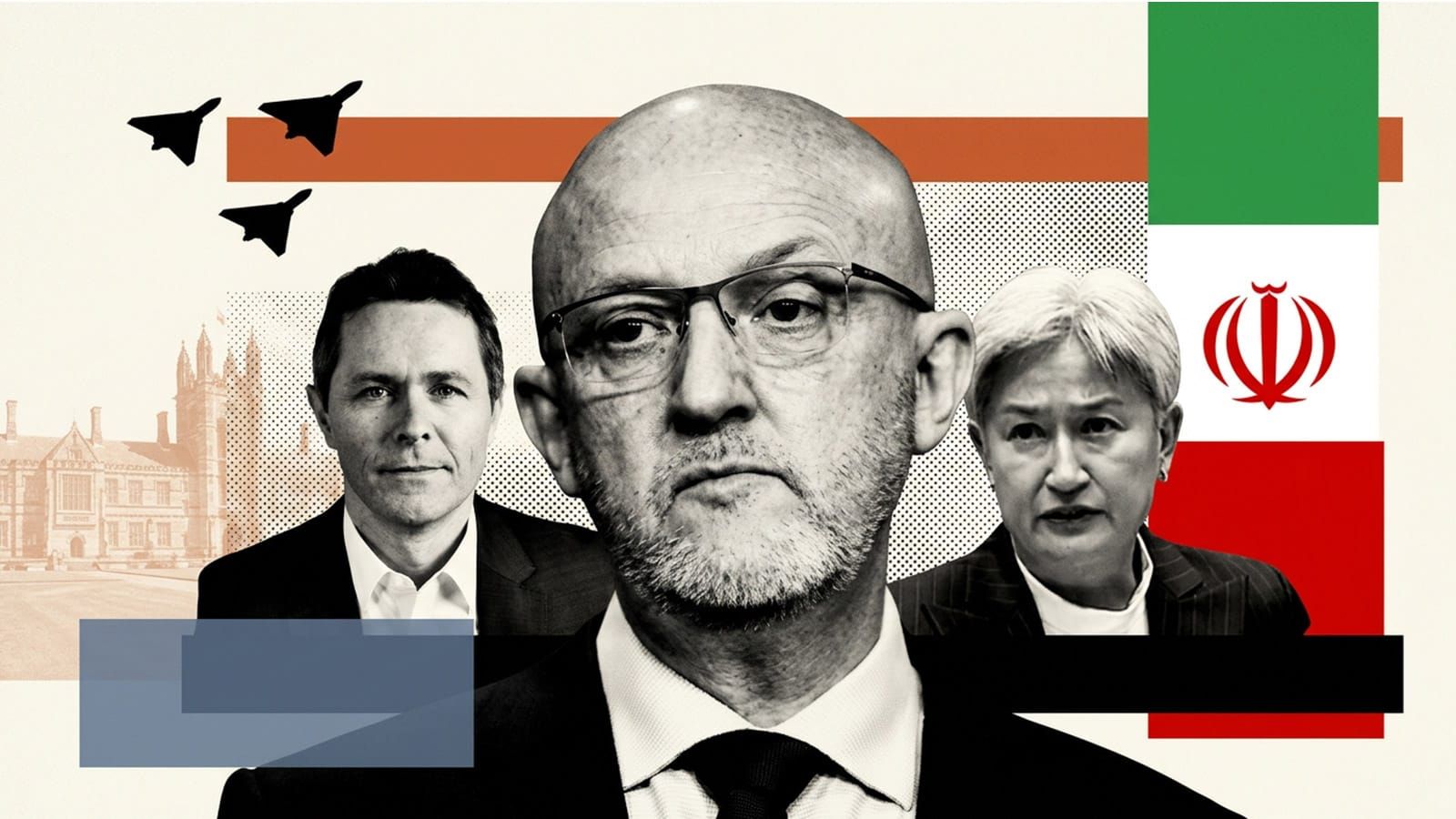
A visiting academic with links to a foreign government broke into a restricted Australian technology laboratory and filmed what was inside. That comes from ASIO director general Mike Burgess, who used it last year to show what foreign intelligence services are doing on Australian campuses.
The Albanese government now wants to let ASIO investigate those campuses without telling them. A bill before parliament would allow the spy agency to advise Foreign Minister Penny Wong about a university in secret, with no notice to the university and no tribunal to appeal to.
It arrives while the government is still trying to get universities to stop working with Iran. The Education Department told the University of Sydney and Macquarie University on 3 June to end all research collaboration with Iranian institutions, the second time in three months it had put that in writing.
Those letters went to Sydney vice chancellor Mark Scott and Macquarie vice chancellor Bruce Dowton, and were signed by the department's deputy secretary for higher education, Jasmina Joldic. Between March and June, the department wrote to 26 universities in total to "reiterate the expectation" that collaboration with Iran, Russia, Belarus and North Korea end.
The letters were handed to a Senate committee at the Coalition's request and reported by The Australian. Several universities had written back to say their own researchers had recently been working with academics from sanctioned countries.
"I am writing to reiterate the government's expectation that Australian universities and their researchers cease all direct collaboration with Iranian, Russian, Belarusian and (North Korean) entities and researchers," Joldic wrote to Scott.
The warnings went to a university sector that's been busy with other things. On Thursday 13 August, students at campuses in 8 cities walk out of class in a national day of action against Pauline Hanson, organised by the National Union of Students and fronted by its education officer Yasmine Johnson, a Socialist Alternative member and a national convenor of Students for Palestine.
The Australian Research Council is separately funding a $532,718 project on intercultural protocols for human activity in outer space, guided by songlines and creation stories, which One Nation senator Malcolm Roberts has spent since July asking the government to justify. Far left campus politics and contested research spending have dominated the sector's year, and these are the same institutions the government has now had to warn twice about Iran.
Mike Burgess says a visiting academic broke into a restricted lab and filmed it
Burgess set that out in public a year ago, delivering the Hawke Lecture in Adelaide on 31 July last year. Australia's spy chief said foreign intelligence services were aggressively targeting science and technology, "particularly advanced technology with both civilian and military applications". Foreign companies tied to those services, he said, had "sought to collaborate with researchers developing sensitive technologies".
"A visiting academic with links to a foreign government broke into a restricted technology laboratory and filmed its contents," Burgess said.
He didn't name the academic, the university or the country, and he explained why. The break in was one of a list of cases he ran through, covering a recruited security clearance holder, hacked law firms and foreign agents applying for Australian national security jobs. ASIO investigated all of them.
"Some may yet result in police charges so I won't go into further detail," Burgess said.
He put the cost of espionage to Australia at $12.5 billion in 2023 to 2024, a figure ASIO says understates the real total because many organisations never learn their secrets were taken. Close to $2 billion of that was trade secrets and intellectual property stripped from Australian companies by cyber spies in a single year. Thousands of Australian students, academics, researchers and public servants have been targeted, he said.
Burgess also ran through the excuses he gets when he raises it, and one of them came from the universities.
"I've been assured stolen academic research would have been published anyway," he said.
He stopped short of telling universities to cut off foreign partners, saying he wasn't suggesting they halt joint projects with overseas institutions. His warning was narrower and harder to argue with: "some foreign intelligence services use academic collaborations as cover".
Fake job ads and LinkedIn trawling are how ASIO says the spies get in
Breaking into a laboratory is the exception. On Burgess's account, foreign intelligence services mostly walk in through the front door, because somebody invites them. They trawl professional networking sites looking for Australians with access to something worth having, and they arrive wearing a job title that sounds useful.
"The spies pose as consultants, head-hunters, local government officials, academics and think tank researchers, claiming to be from fictional companies," Burgess said.
The opening offer is usually money for writing. Thousands of dollars for reports on Australian trade, politics, economics, foreign policy, defence and security, with extra payments available for what they call inside or non public information. If someone bites, the conversation moves to an encrypted messaging app, and then comes the offer of an overseas trip to meet in person. Burgess called it low cost, low risk and low effort, run at a scale of hundreds of friend requests a day. More recently one service began posting fake online job ads for well paid part time roles aimed at people with expertise in geopolitics or defence.
Thousands of Australian students, academics, researchers and public servants have been approached this way. Most say no.
"Unfortunately, though, some are sucked in and end up being used, recklessly or consciously, to gather information for a foreign country," Burgess said.
In one case he described, a foreign service found an Australian with access to security clearance holders and cultivated them over a long period, paying for written reports. The early requests were broad, covering bilateral relations and strategic policy. Over time the requests became demands and the subject matter narrowed towards Australia's intelligence priorities. ASIO stepped in before anything of consequence changed hands.
Part of the problem is self inflicted. Burgess said more than 35,000 Australians on a single professional networking site have profiles indicating access to sensitive or classified material. Around 7,000 name their defence work, including the project, the team and the technology. Close to 400 state outright that they work on AUKUS, and about 2,500 advertise that they hold a security clearance.
What ASIO says Iran's Revolutionary Guard did in Sydney and Melbourne
ASIO director general Mike Burgess said on 26 August 2025 that Iran's Islamic Revolutionary Guard Corps had directed two arson attacks on Australian soil: the firebombing of Lewis' Continental Kitchen in Sydney on 20 October 2024, and the fire at the Adass Israel Synagogue in Melbourne on 6 December 2024. Burgess said the IRGC had worked through a web of proxies and intermediaries to conceal its involvement, and that the agency believed there were more.
"ASIO assesses it is likely Iran directed further attacks as well," Burgess said at a press conference.
Prime Minister Anthony Albanese announced the same day that Iran's ambassador, Ahmad Sadeghi, and three other officials had been declared persona non grata and given 7 days to leave the country. Australia suspended operations at its embassy in Tehran and committed to listing the IRGC as a terrorist organisation. Foreign Minister Penny Wong said it was the first time in the postwar period that Australia had expelled an ambassador.
"Iran has sought to harm and terrify Jewish Australians and to sow hatred and division in our community," Albanese said.
Nine months later, the federal Education Department was still sending letters asking universities to stop dealing with the same regime.
Sydney sent a staff member to Iran, and Penny Wong had already blocked one Sydney deal
The University of Sydney sent a staff member to Iran last year, a trip The Australian reported shortly before Joldic's letter landed. That academic has since been named as Professor Behnam (Ben) Fahimnia, the university's chair of supply chain management, who says he did no work in Iran. Sydney responded publicly on 3 June, saying the academic "has no background or research ties in STEM (science, technology, engineering, maths) or defence" and that the travel took in a planned conference in Turkey and a period of annual leave.
Sydney's account has since shifted. The university now says it does not allow university related travel to destinations under Do Not Travel advice, and that the booking was allowed by what it calls an oversight in its processes that it is working to correct. It says it has reviewed and tightened its controls, updated its guidance on international research collaboration and written to its researchers to restate what is expected of them. Its consideration of the academic's role in arranging the travel is continuing.
The university has also confirmed it worked with authorities to get the academic out of Iran safely after war broke out between Israel and Iran. DFAT has had a Do Not Travel warning in place for Iran since 2020.
Wong had already used her existing powers against the same university. Under a scheme set up in 2020, universities, councils and state governments have to tell the Foreign Minister before they sign deals with foreign governments or foreign universities, and she can block them. On 23 April she blocked Sydney from entering agreements with institutions in Russia and Belarus, a decision recorded on the scheme's public register. Sydney has said no work with those institutions went ahead and no data was shared.
Macquarie was still hosting Iranian PhD students this year. Joldic's letter to Dowton said engagement involving Iran, Russia, Belarus and North Korea warranted "heightened caution and may expose Australian people, systems and institutions to significant risk", while acknowledging the university had started phasing out its partnerships in sanctioned countries.
The research that set this off surfaced in March. Australian researchers at Sydney, UNSW and Adelaide had worked with scientists at Iran's Sharif University of Technology on making drones more efficient, in papers published in 2023 and 2024. Sharif is sanctioned by the European Union, which found it holds cooperation agreements with Iranian government bodies operating in military fields, including ballistic missile production.
The universities say the work was civilian. Sydney said the research was "devoted exclusively to civilian wireless communication system optimisation", that it was theoretical and academic in scope, and that it was carried out before Wong's directive. UNSW said it has no institutional arrangements with Iran and put the 2023 instruction into effect. There is no suggestion the research was intended for military use.
That work sat outside the grant system. Inside it, Australian Research Council records show 15 funded collaborations with Iran between 2014 and 2023, alongside 1,468 with China and 76 with Russia. Wong's office has said that when Labor took office in 2022 there were "an alarming number of foreign arrangements in effect" between universities and Iran, entered into under the Coalition.
Three days after the drone research surfaced, Clare's department wrote to every vice chancellor seeking assurance that "there are no current collaborations with Iranian entities". That letter went well past Iran.
"Universities operate in a contested environment where some seek to exploit Australia's research, data and expertise," it said. "Foreign interference, espionage and unwanted transfer of sensitive knowledge and technology are among the most serious national security challenges facing Australia."
The department told universities the expectation covered individual researchers as well as institutional deals, and extended to letting foreign researchers use facilities and specialised equipment. It asked for "additional attention" to research that looks civilian but carries "potential dual-use or strategic applications", meaning work that could serve a military purpose as easily as a peaceful one.
UNSW told its staff in April that any activity involving individuals or entities in Iran, Russia, Belarus or North Korea now needs prior approval, and that breaching Australian sanctions is a criminal offence. Pro Vice Chancellor for Research Dane McCamey wrote that even informal help, such as giving editorial guidance to a researcher in one of those countries, could be enough to breach the law.
The Australian Sanctions Office updated its own guidance note for universities on 28 July, a day after submissions to the committee closed. It warns that sanctions law can reach past research collaboration into enrolling a student or employing a person from a country under sanctions. An individual who breaches it faces up to 10 years in prison and a fine of $910,000, or three times the value of the transaction if that is greater. For a university itself the fine runs to $3.64 million.
| Country | ARC projects | What the research covered |
|---|---|---|
| China | 1,468 | Mostly hi tech engineering and computing. Nearly 10% of all ARC funded research since 2014, making China Australia's fourth ranking research partner. |
| Russia | 76 | Three quarters of them science, engineering or maths. ANU took part in 14, Melbourne and UNSW 13 each. |
| Iran | 15 | Maths, biology, psychology, law, archaeology, art and religion, with Monash on 4 projects and ANU on 3, all banned in February 2023. |
| North Korea | 1 | A single economics related project at UNSW in 2014. |
Australian Research Council grants database, 2014 to 2023. The drone research with Iran's Sharif University of Technology sat outside the ARC system and was sponsored by the universities themselves.
Julian Leeser says a letter is not enforcement
Opposition education spokesman Julian Leeser said the department's response was far too soft, describing the message in the letters as "hopelessly weak" and arguing that a university helping Australia's adversaries can currently expect little more than correspondence.
"The Iranian regime attacked Australia on at least two occasions that we know of, so why on Earth are taxpayer-funded institutions allowing researchers to collaborate with them?" Leeser said.
The Foreign Arrangements Scheme register lists 14,470 arrangements, and across its entire life the Foreign Minister has used her power to block a deal outright, a decision the register calls "must not enter", exactly twice. Both came on 23 April this year against the University of Sydney, covering data transfer agreements with Northern State Medical University in Russia and a tuberculosis research centre in Belarus, and neither of them involved Iran.
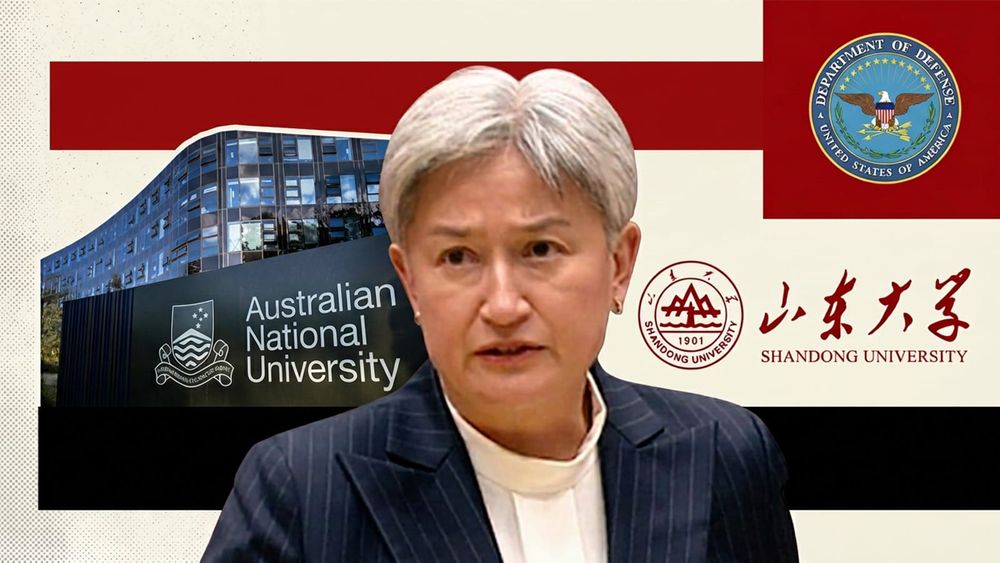
A separate power has since been used for the first time. On 10 August Wong terminated the Australian National University's joint science college with Shandong University in China, which the register records as a termination rather than a refusal, and marks invalid and unenforceable.
Every other enforcement category on the register is largely routine, taking in a national parks climate statement, a Swedish museum specimen loan and a Queensland study of sweet potato virus among the 24 arrangements marked as unlawful entries and the 18 marked as failures to notify.
Education Minister Jason Clare said the government had gone further on research security than any before it. He pointed to 13 Australian Research Council grants he vetoed this year on national security grounds, and to laws already passed that let the government refuse or cancel a grant on security, defence or international relations grounds.
"Australian universities need to be laser focused on the risk of foreign interference," Clare said.
Opposition defence spokesman James Paterson said universities still hadn't absorbed the lessons of the past decade on research that has potential military uses.
"Naivete is no longer a defence, particularly in research areas with such strategic significance like drones," Paterson said.
He said that if universities wouldn't fall into line, the government should force their hand using powers it already holds under the Foreign Relations Act.
The Coalition was in government for most of the period those grants ran, from 2013 until May 2022. Labor imposed the ban that ended the Iran projects in February 2023.
The bill lets ASIO advise Penny Wong in secret, with no notice and no appeal
Australia's Foreign Relations (State and Territory Arrangements) Amendment Bill 2026 was introduced on 1 July. It implements the recommendations of an independent review of the 2020 Act led by Rosemary Huxtable, so it wasn't written in response to the Iran reporting, but it arrives in the middle of it.
Until now the minister could only step in if a deal hurt Australia's relationships with other countries. The bill widens that to anything she judges to be against the national interest, a term the bill never defines, which takes in national security and the economy. For the first time it also covers the campuses Australian universities run overseas. Wong also gains the power to attach conditions to an arrangement at any point during its life.
That conditions power wasn't one of the review's recommendations. The government added it to the bill on its own account, saying it wanted more flexibility to respond to changes that affect whether an arrangement is still acceptable.
When ASIO tells the government that someone is a security risk, it normally has to do that through a formal security assessment, and that carries rights with it. The person or organisation gets told it happened, and they can challenge it at a tribunal. This bill takes decisions under the Foreign Relations Act out of that system. ASIO will be able to advise Wong about a university without the university ever being told, and there will be no tribunal to appeal to.
"The purpose of this amendment is to ensure that any advice given by ASIO to the Foreign Minister is subject to the same review framework as the Foreign Minister's ultimate decisions under the Foreign Relations Act," the explanatory memorandum says.
DFAT's first assistant secretary for regulatory and legal policy, Julie Heckscher, confirmed the effect to the committee on 6 August.
"These amendments would ensure that the advice given by ASIO to the Foreign minister is subject to the same review framework as the Foreign minister's ultimate decisions under the Foreign Relations Act, namely such decisions are not subject to merits review," Heckscher said.
She told the committee more than 22,000 deals have been reported to the department since the scheme began in 2021. The bill would cut that number by exempting deals with Australia's Five Eyes intelligence partners, the United States, Britain, Canada and New Zealand, and officials said those four countries make up roughly 51% of the reports that currently get the closest look. Sister school agreements, TAFEs, museums and galleries move into a lighter category too. Secrecy widens at one end of the bill while the number of deals anyone checks falls at the other.
One route to a court goes with it too. The courts aren't shut out completely, but what is left is narrower. According to the Parliamentary Library's Bills Digest, a university or academic can still ask the Federal Court or the High Court to examine whether the decision was made lawfully, which is a different question from whether it was the right call.
Where the crackdown stands
1. 13 ARC grants vetoed
Education Minister Jason Clare has blocked 13 Australian Research Council grants this year on national security grounds, using powers passed by his own government.
2. 26 universities warned, twice
The Education Department wrote to 26 universities between March and June telling them to end collaboration with Iran, Russia, Belarus and North Korea. The June letters were sent because the March ones hadn't worked.
3. Tighter ARC screening
The ARC says it now runs enhanced due diligence on applications, and that projects can be modified, made subject to extra conditions, refused funding or terminated outright.
4. Still only proposed
The secret ASIO advice, the national interest test and the extension to overseas campuses are all in a bill that has not passed. The intelligence and security committee held its hearing on 6 August and the bill remains before parliament.
Universities support the bill and warn that national interest could mean anything
Most of the sector wants the bill passed. The Group of Eight told the Parliamentary Joint Committee on Intelligence and Security that the national interest test was the "most consequential change" in the bill and asked the committee to support it, noting the reforms also cut compliance work by simplifying notifications and dropping approvals for minor variations. Universities Australia recommended passing it subject to three safeguards, among them a requirement that decisions be proportionate to the identified risk and, wherever practicable, preceded by consultation with the university involved.
Queensland University of Technology was blunter about the phrase the bill now turns on, telling the committee that the term is left undefined.
"If the Bill neglects to provide a definition of 'national interest' in reference to the Foreign Relations Act's purpose, 'national interest' would in practice simply mean whatever the Minister says it means," QUT wrote.
The sharpest question at the hearing came from the chair. Senator Raff Ciccone, a Labor senator for Victoria, told the university witnesses the public would struggle with collaborations "where research has been done with certain countries that export terrorism, surveil their citizens or use the research for surveillance research". He added that he didn't need to name the countries.
Dr Matthew Brown, deputy chief executive of the Group of Eight, said its members had ruled out a number of institution to institution arrangements with certain countries on the advice of DFAT and the Foreign Minister. He then described what the sector is doing now.
"Within universities they are also, in response to those media stories, accelerating a program already in place, which is to get better clarity of what their researchers are doing individually," Brown said.
The committee held its public hearing in Canberra on 6 August, and the bill is still before parliament.