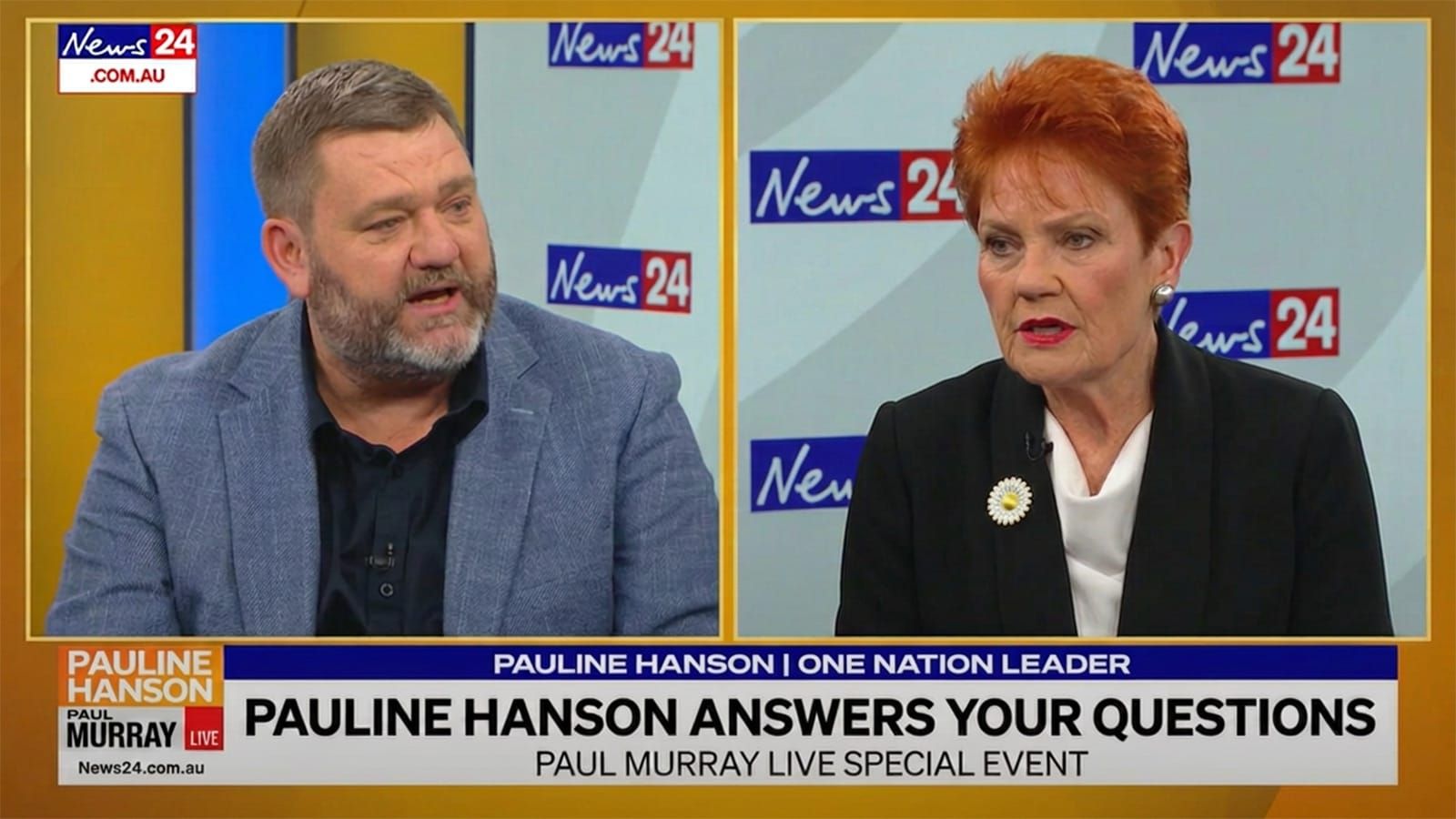
One Nation leader Pauline Hanson sat down for a special episode of Paul Murray Live: Pauline Hanson, Please Explain on News24 on Tuesday night, and the format was as simple as it was rare: voters could ask her anything. What they got in return was something Australian politics almost never produces, a leader naming exactly what she'd do in her first 100 days in power, in order.
For readers, the answers land squarely on the household budget. Hanson's three first moves for a One Nation government are cutting immigration to 130,000 a year, cutting government spending she says drove inflation, and dismantling the net zero policies she blames for high power bills. The night went well past the big three too: a healthcare card for every self-funded retiree, Welcome to Country stripped out of schools and government departments, a full investigation into childcare’s $16 billion bill, and her 18C fight headed for the High Court.
Immigration comes down to 130,000, with doctors and nurses still welcome
Asked what a One Nation government's 100 day plan would look like if the party won the 2028 federal election, Hanson put immigration first and gave a number with a clear explanation:
"(I would) cut back on the immigration. I'm selecting a figure around about 130,000 people. You've still got to allow those into the country because a lot of businesses and doctors and nurses that we need, you fill those positions by all means."
That's a cut with a carve out built in. Visas would stay open for occupations facing genuine workforce shortages, so the hospitals keep their staff while the overall intake comes down.
An 89-year-old permanent resident's benefits are safe
The open format produced the night's most personal moment, and it came on immigration. A man whose parents came to Australia as permanent residents, his father working at the BHP steelworks in Port Kembla, asked whether his 89-year-old parents would lose their benefits under One Nation because they never took citizenship. Hanson's answer was immediate.
“No way,” she said. “They are permanent residents in Australia? Yeah, yeah. They've been paying the taxes all these years. I don't believe in taking away their benefits at 89 years of age.”
Government spending, the NDIS and Aboriginal affairs departments are next
Hanson's second priority is spending, and she drew a straight line from Canberra's outlays to the prices Australians pay at the checkout.
"Government has been wasting and spending too much money, which created the inflation, which has driven cost of living," she said.
Childcare's $16 billion bill and NDIS rorters are in her sights
Asked by a parent what One Nation would do about childcare costs, Hanson said the sector needs a full investigation before more money goes in.
“Actually, to tell you the truth, it's costing the taxpayers $16 billion a year, and something's out of control there,” she said. “That's a lot of money spent in childcare, so that's where I'd like an investigation into it.”
On the NDIS, she put her numbers on the overhaul: about $52 billion a year now, on track for $100 billion by 2032, and already, she said, equal to what Australia spends on defence.
“Go after the ones that are scamming it. A lot of people are ripping the system off, and so NDIS is one. The Aboriginal industry that I've been on about this for a long, long time. The waste of money that goes in that, and I'd like to see every Australian individual needs based not based on race.”
Self-funded retirees would finally get the healthcare card
The cuts come with a give back, and it was one of the night's biggest announcements. Hanson said self-funded retirees, who currently lose the seniors healthcare card once their income passes a means test, should get the card, and the cheaper medicines and discounted care that come with it, as a right of reaching retirement age.
“So, self-funded retirees, you worked hard, you get nothing back. Even getting a healthcare card, I think that if you've reached the age of retirement, you should be given the same benefits of having that healthcare card at least.”
Net zero, the climate change department and the Paris Agreement all go
Her third move is the energy overhaul she's been building the case for all month, most recently in her plan to make Australians wealthy again by scrapping net zero.
"I think the other one is get rid of the climate change department, get rid of all that net zero rubbish, get out of the Paris Agreement. Once you do that, you're going to reduce the cost of living and the cost of electricity as well. Industries, manufacturing, small business will thrive from it. The average household will also thrive because it's not paying the high electricity costs."
She went further than energy, saying a One Nation government would also remove what she described as the "international agreements that are holding us back with our sovereignty as a nation".
Welcome to Country would be shut down across government and schools
One voter asked whether she'd end Welcome to Country and Acknowledgement of Country ceremonies in daycares, kindergartens, primary schools and junior sport. Hanson, who turns her back on the practice in the Senate, didn't hedge.
“I do not believe in having Welcome to Country. You can't stop people if businesses want to do it, all right. But in government departments, I wouldn't have a Welcome to Country on the bottom of their literature or their sheets of paper they put out or government websites. I wouldn't be having it in educational systems schools. I'd shut it all down.”
She's taking the 18C fight to the High Court
Hanson also confirmed she'll fight on after the full Federal Court upheld the 18C ruling over her “piss off back to Pakistan” remark to Greens senator Mehreen Faruqi this week. She's reportedly consulted top constitutional silks Bret Walker SC and Perry Herzfeld SC ahead of a High Court challenge aimed at the section itself.
“There's a lot riding on this,” she said. “The government under Tony Abbott and Scott Morrison had the opportunity to get rid of 18C. 18C is where anyone can take you if they feel offended, harassed, intimidated, or insulted. It's just a ridiculous piece of legislation. So if I win this case, that will be thrown out. I am talking to my lawyers now at the moment of putting an appeal to the High Court. I'm not going to drop it.”
1,500 people have applied to run for One Nation in 2028
The episode also gave the clearest picture yet of the machine One Nation is building for 2028. Hanson confirmed the party intends to run candidates in every single seat, and said the interest in standing for the party has surged since the polls started showing One Nation can form government.
"This time around, you know, there's a real chance that we can actually win seats in the lower house and the Senate. The seat of Farrer that we won, we had 81 (candidate) expressions of interests for that. The federal so far, 1,500 (candidate applications). So the process that we've got now is a system that we've put in place that it really has a thorough look at the candidates."
The 100 day plan builds on the platform Hanson set out at her National Press Club address in June, where she also named "transgender ideology" as a key concern, said transgender women shouldn't be allowed into women's change rooms, and pledged to cut all funding for the SBS and strip the ABC of the majority of its taxpayer funding.
Labor's 28% primary is the lowest winning number since Federation
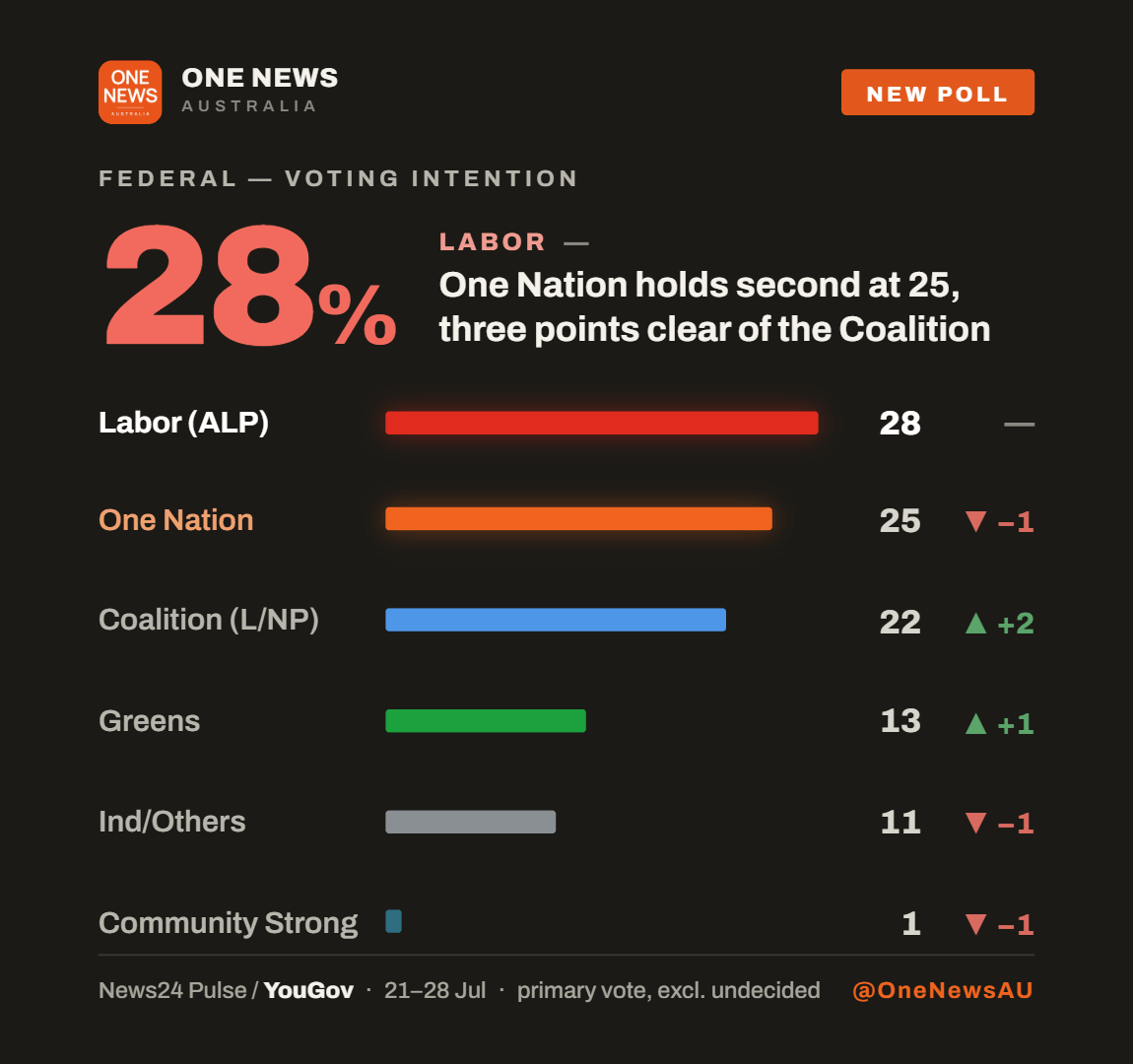
The episode aired as the latest News24 Pulse / YouGov poll, conducted between 21 and 28 July, showed Labor holding a historically low 28% primary vote, with One Nation easing one point to 25% and holding its place as Australia's second most popular political party. You can follow every published survey on our live poll tracker.
On a two party preferred basis, Labor would still win an election held today, leading the Coalition 53 to 47 and One Nation 56 to 44. YouGov Director of Public Data Paul Smith said the numbers say more about the alternatives on offer than about enthusiasm for the government.
"In an election held now, Labor would easily win a majority of seats, despite having the lowest primary vote for a party winning a majority since Federation," he said.
That's the gap Hanson's 100 day plan is aimed at. A government sitting on a 28% primary vote is winning on preferences, not popularity, and last night the voters asking the questions got to hear what one alternative would actually do with the job.