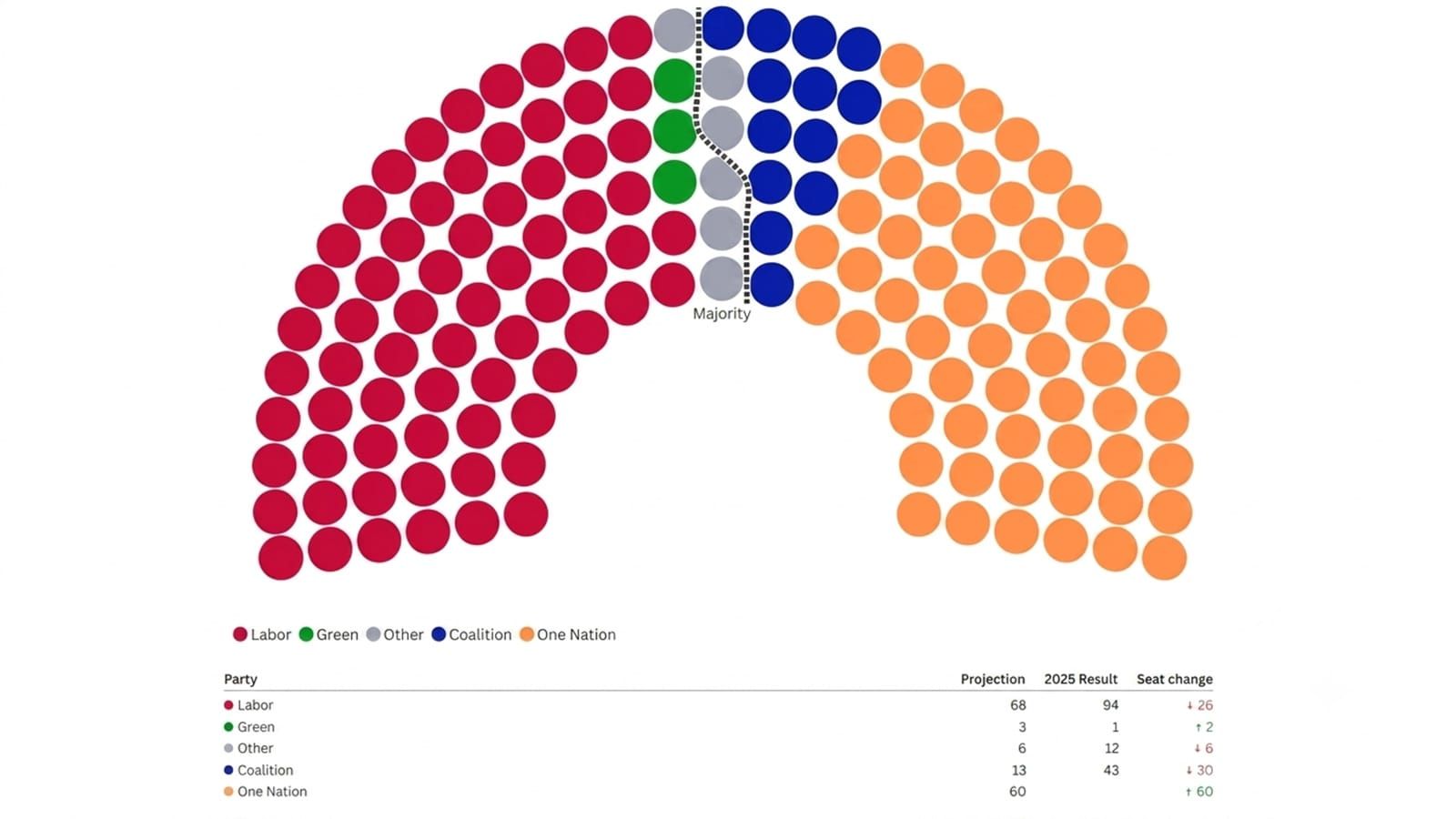
Pauline Hanson's One Nation would be within arm's reach of forming government with Coalition support if an election were held today, according to new modelling from pollster DemosAU based on 9,343 voters surveyed between May and July.
The poll uses a technique called multi level regression and poststratification, or MRP. In plain English, it takes one very large national sample and matches it against the demographics of each electorate, which lets it project a result for every one of the 150 seats in the House of Representatives rather than just a national number.
Those projections put One Nation on a primary vote of 30%, up 3 percentage points since the last DemosAU model in February and March. Labor has slipped 3 points to 26%, the Coalition is stuck on 21% and the Greens are up 1 point to 13%.
Run through 20,000 simulations, the model has Labor winning 60 to 72 seats and One Nation 53 to 66, with the Coalition reduced to between 11 and 22, the Greens 1 to 5 and others 3 to 7. With 76 seats needed for a majority, that's a hung parliament, and both Labor and One Nation would have a claim on minority government.
One Nation leads in 39 of 41 regional seats, and the outer suburbs decide the rest
The regional numbers are close to a clean sweep. One Nation leads in 39 of the 41 seats DemosAU classifies as regional or rural, on a primary vote of 41%, and the pollster says a sweep of all 41 is a "live possibility".
Labor's firewall is the 45 inner metro seats, where it leads in 34 on a 31% primary. That leaves the 64 outer metro seats as the battleground that will decide government. One Nation leads the primary vote there on 30%, ahead of Labor on 28%, and is in front in 21 of them to Labor's 34.
"The most significant finding of the MRP is that One Nation is now leading across many outer metro seats in Brisbane and Perth and also a few in outer Sydney and outer Melbourne," DemosAU head of research George Hasanakos said.
"It is in these seats which One Nation needs to win to have a chance of forming at least a minority government."
Angus Taylor said never. Andrew Bragg says "of course we would be pragmatic"
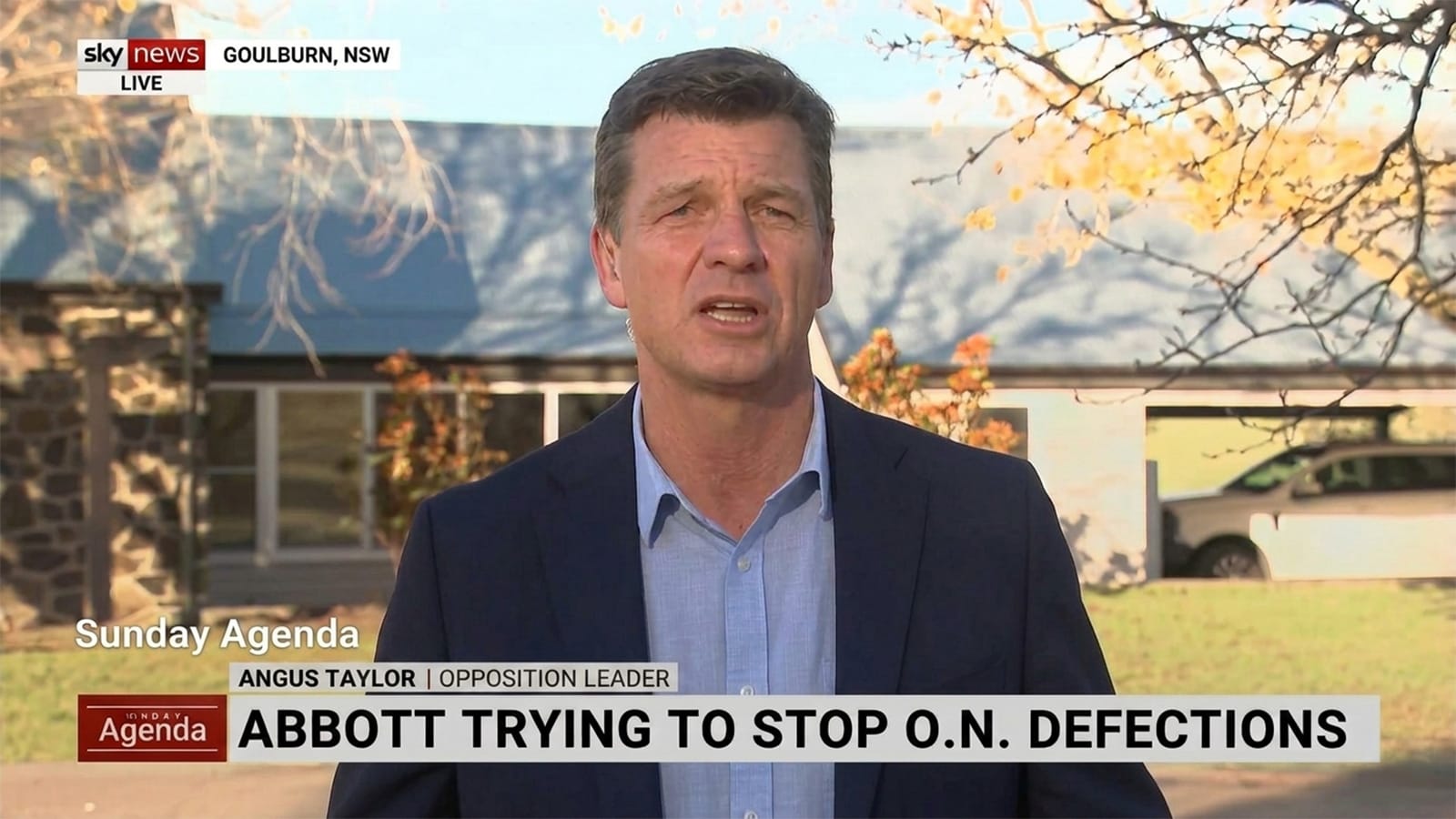
The numbers land in the middle of a Coalition argument about whether to deal with One Nation at all. Opposition leader Angus Taylor shut the door on any arrangement earlier this month, claiming One Nation's economic plan would bring an "eternity of pain" and "send us broke".
His frontbencher Andrew Bragg reopened it on Monday. Leaving the door open on the Today show to a three way arrangement with One Nation and the Nationals, Senator Bragg said the Coalition would "work it out then".
"At the end of the day, the most important thing is that we've got to get rid of this terrible Communist government. So, if the numbers were the numbers, and we had to be in coalition with others, then of course we would be pragmatic. I mean, we have to get rid of these guys," he said.
The context makes the shift harder to dismiss. One Nation hasn't finalised candidates in every seat, and full policy costings aren't required this far out from an election. Voters are looking at the framework and backing it anyway, ahead of both parties of government. On these numbers, a party on 21% is debating the terms on which it would serve alongside a party on 30%.
Queensland hands One Nation 20 of its 30 seats, and only Victoria holds out
One Nation's strongest state is Queensland, where its primary vote has climbed to 34% and the model has it leading in 20 of the state's 30 seats. In Western Australia its vote is up 5 points, mostly at Labor's expense, cementing its lead in Bullwinkel and giving it what Mr Hasanakos calls strong chances against Labor in Moore and Pearce. A similar swing in Tasmania puts it ahead in the three northern and central seats, leaving Labor a firm lead only in Franklin.
Victoria is the Coalition's one bright spot. It has halved the primary vote gap there and now trails One Nation by just 3 points, and of the 13 seats where the Coalition leads nationally, 8 are Victorian. "Outside of Page in NSW, the Nationals have the best chance of retaining seats in Victoria," Mr Hasanakos said.
High income earners are walking out on Labor after the budget tax changes
The demographic detail explains why Labor is rattled. Its vote fell 4 points among women this quarter against a 2 point fall among men, and the higher a voter's income, the harder Labor's vote has fallen.
One Nation's vote rose 8 percentage points among voters earning more than $200,000 a year, against a 1 point rise among those earning under $45,000.
"Conversely Labor's vote share has fallen more as the respondent's income has increased, which indicates an impact from the public reaction about the recent budget tax changes," Mr Hasanakos said.
"Never Hanson" Liberals are the last thing keeping Labor in the race
Preferences are where Labor still clings on. One Nation voters now send 80% of their preferences to the Coalition, but only 67% of Coalition preferences flow back to One Nation, because a cohort of metropolitan Liberal voters would rather preference Labor than Senator Hanson.
"There are a minority cohort of Liberal voters in metropolitan Australia that are averse to One Nation, and their preferences are keeping Labor from falling behind in the race for government at this point," Mr Hasanakos said.
DemosAU is one of the five pollsters tracked on the One News Australia poll tracker, and it has had One Nation leading the national primary vote in every survey since May. The next federal election isn't due until 2028.