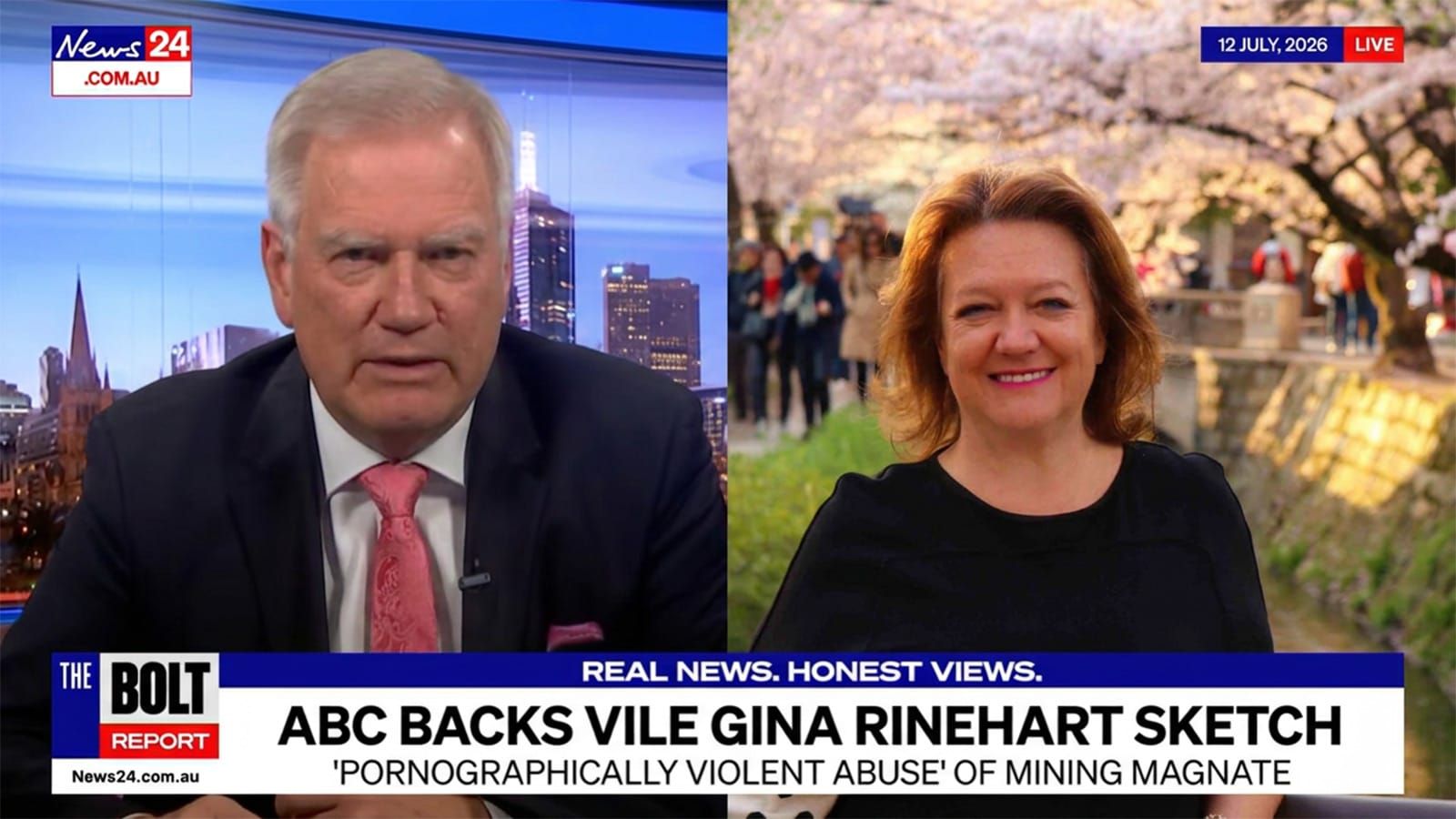
The ABC has refused to take down a segment of its program Race Around the World that depicts mining magnate Gina Rinehart being sexually mutilated and killed, and it's defended putting the segment to air as "editorially justifiable." Rinehart, the executive chair of Hancock Prospecting and one of the country's largest private employers, has been made the target of a broadcast on a network her own company helps fund. Managing Director Hugh Marks, whom the ABC's rules make ultimately responsible for what it airs, hasn't responded to a request to remove the segment or to apologise.
The film has drawn condemnation from Hancock Prospecting and from News24. Inside the ABC's own studio, though, it drew applause. It's also dropped the national broadcaster into a fight it can't easily win, because the words it chose to air run straight into the standards the ABC wrote for itself.
What the ABC put to air, and the words it won't delete
Race Around the World sends amateur filmmakers overseas to shoot short films that are then screened and judged by a studio panel. The segment, titled "A Very Relaxing Video," was made by contestant Kate McGuinness while she was filming in Scotland, and it aired on the 12 July episode.
It followed a figure billed as a Scottish forest warrior ninja, teaching viewers to be at one with nature. Under the calm footage, though, ran a darker theme. The film suggested society would "gradually fall apart," that when "our society crumbles" certain "down to earth skills may come in handy," and it kept returning to sticks, and to fighting with them, as the skill worth learning. This wasn't a gentle nature film that lost its way in the final seconds. It was building towards violence from the start, and it landed here:
"Because when the revolution comes, will you hide under the bed? Or will you know exactly how to shove a stick right up Gina Rinehart's butthole, stirring it around, mixing her guts up nice and smooth, making her into one big sausage roll to make something out of nothing."
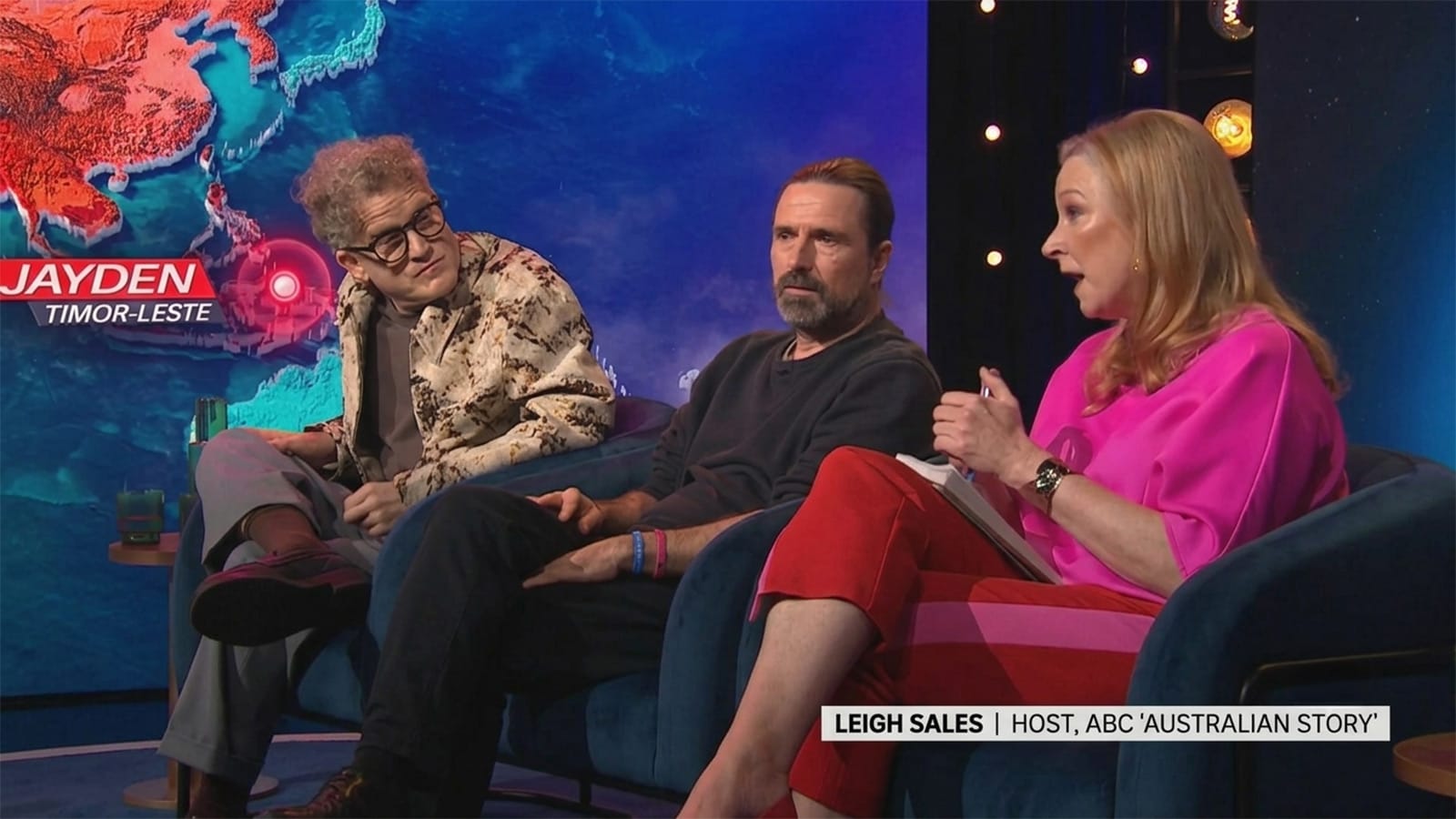
The panel, which included writer John Safran, director David Michôd and presenter Leigh Sales, applauded when the film finished.
The ABC didn't stumble into this. It signed off, then signed off again
This wasn't a live slip or an unscripted aside. Race Around the World is recorded in advance, and every film on it moves through the ABC's production, editorial and scheduling process before it reaches air. Hancock Prospecting made that point directly, saying the segment "passed through production, editorial and broadcast processes" and wasn't "an unscripted live comment."
The broadcaster then made a second decision. After the film aired, drew complaints and was widely reported, the ABC left it up and defended it. A spokesperson said the film was "intended to be satirical in tone" and "considered to be editorially justifiable within the context of the program." An earlier statement said the program "features films created by amateur filmmakers, whose contributions reflect their own viewpoints," while conceding that "all content broadcast by the ABC is subject to the ABC's editorial standards, policies, and review processes." By the broadcaster's own account, this cleared those processes.

The rulebook the ABC wrote, and the line it now has to explain
The ABC publishes its Editorial Policies online and describes them as "the enforceable standards you must follow." Its first policy, on independence, integrity and responsibility, opens with the line:
"The trust and respect of the community depend on the ABC's editorial independence and integrity."
Its policy on harm and offence protects risky and innovative work, but it requires that harm or offence be justified by its editorial context. That's the exact test the ABC invoked when it called the segment "editorially justifiable." Which leaves one question the broadcaster hasn't answered: whether a filmed fantasy of torturing and killing a named, living woman clears the bar the ABC set for itself. The ABC says it does.
No one on the ABC's own panel objected to the violence
The reaction in the studio is its own indictment. Not one of the four on the panel, John Safran, David Michôd, Leigh Sales and the host, objected to the violence. Michôd criticised the film itself, but not the attack on Rinehart within it. The closest anyone came to challenging the segment was Sales, and even she opened by saying she had liked the film. Her only quarrel was with the tone, that a piece she found "universal" had been spoiled by what she called "a very easy, nasty gag" about Rinehart, and she raised it lightly:
"I really did quite like it, but then I had a bone to pick, which is that you shifted the tone from a film that was kind of universal and including all of us. And then you backed it in with a very easy, nasty gag about Gina Rinehart. So what you were saying to the viewer was, we're all in this together, unless you don't share my politics."
Sales wasn't condemning the brutality. She was pointing out that the politics of the joke shut out anyone who doesn't share them, which is its own breach of the ABC's impartiality principle. On the violence itself, none of them said a word against it.
Anthony Albanese warned about this exact harm a fortnight earlier
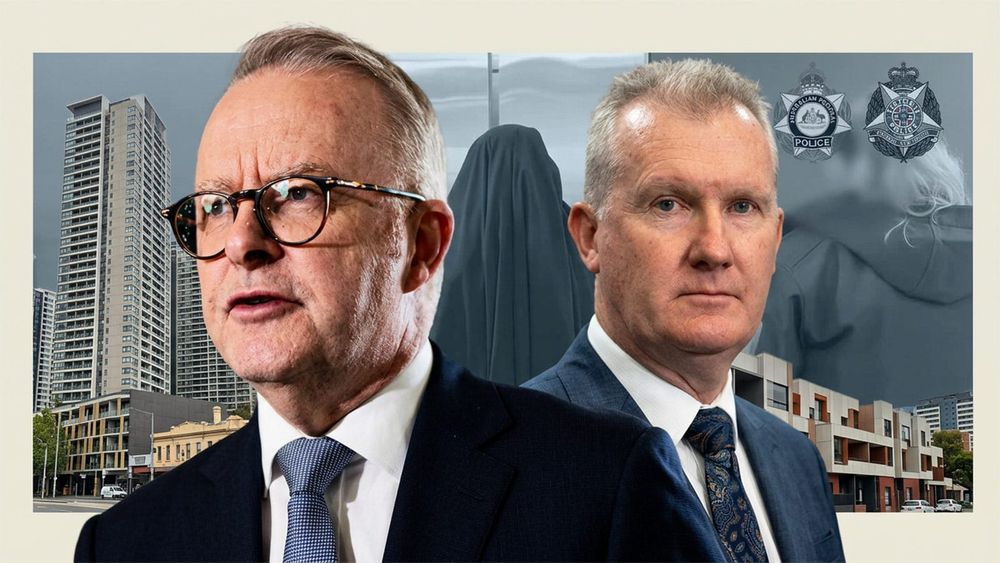
The timing makes it harder for the broadcaster. The ABC is funded by the Albanese Government, and in June the Prime Minister used the floor of Parliament to warn about the normalising of sexual violence. On 25 June, Anthony Albanese told the House of Representatives that extreme online material was driving hospital admissions for strangulation and anal tearing at what he called "an extraordinary, horrific rate," as The Nightly reported. "What too many young men are seeing online is normalising behaviour that is anything but normal," he said.
Just over a fortnight later, the broadcaster his government funds screened a woman being sodomised with a stick, and a studio audience clapped. It leaves the Prime Minister in an awkward spot. He warned Parliament that normalising this kind of violence was doing real harm, yet he's said nothing about his own broadcaster doing exactly that, and he hasn't asked for the segment to be taken down. That silence sits oddly beside his own words, and beside the ABC's editorial code he could point to.
Picture: ParlView / House of Representatives. Anthony Albanese addressing Parliament on 25 June.
The taxpayer funded ABC
It's worth remembering who pays for the ABC. The broadcaster runs on more than $1.2 billion of public money a year. Hancock Prospecting, the company Rinehart chairs, is among the nation's largest corporate taxpayers. On figures cited this week its tax bill ran to about $2.6 billion last year, enough to fund the entire ABC twice over. Rinehart is also one of the country's biggest private employers and sporting benefactors, bankrolling Australian Olympic swimmers and grassroots teams out of her own pocket. The woman whose company helps pay for the ABC is the woman the ABC chose to screen being killed for a laugh. The reason isn't hard to see: she's a target because she backs the political right, not the left.
What Gina Rinehart gives, and who she backs
Rinehart's giving runs well past $100 million in sport alone, plus a $200 million pledge for veteran housing, much of it channelled through her Georgina Hope Foundation and Rinehart Medical Foundation. Her political donations, disclosed to the Australian Electoral Commission, are a separate and smaller matter.
| Type | Recipient | Amount | Year |
|---|---|---|---|
| Sport | Australian sport overall | Over $100 million | Since 2012 |
| Sport | Swimming Australia | $10 million over four years | 2012 |
| Sport | Volleyball Australia, Patron's Medal fund | $3 million | 2023 |
| Sport | 90+ Olympic and Paralympic athletes, paid directly | About $10 million a year | Ongoing |
| Charity | Veteran homelessness, motels and apartments | $200 million pledged | Pledged |
| Charity | Royal Flying Doctor Service, via Rinehart Medical Foundation | $16 million | Reported |
| Charity | Bendat Comprehensive Cancer Centre, breast cancer | $2 million | 2010 |
| Political | Pauline Hanson's One Nation, Cirrus SR22 G7 aircraft | About $2.1 million | 2026 |
| Political | One Nation, via two Hancock executives | $500,000 each | 2026 |
| Political | All parties combined | About $2.12 million | 1998 to 2025 |
| Political | Advance | $895,000 | Across period |
| Political | Liberal Party | $756,300 | Across period |
| Political | LNP (Queensland) | $333,250 | Across period |
| Political | Nationals | $135,000 | Across period |
| Subtotal | Documented and pledged giving (approx) | Over $300 million | To date |
| Tax | Hancock company tax, one year | About $2.6 billion | One year |
| Combined | Giving plus one year of tax | About $2.9 billion | To date |
On top of this, we also learned last week that the athletes Gina funds aren't even allowed to thank her. At the Commonwealth Games, Australian swimmers were warned they couldn't publicly thank Rinehart in interviews because she isn't an official team partner, even as she was paying their medal bonuses. They can thank family, coaches and teammates, just not the woman funding them. Pauline Hanson has challenged the rule. She might want to look into becoming an official sponsor next time.
Even Mitchell Johnson says the ban makes no sense
The restriction has drawn criticism well beyond politics. Mitchell Johnson, the former Test fast bowler, writing in The West Australian, said Commonwealth Games Australia was wrong to warn swimmers off thanking Rinehart. He accepted that official sponsors pay for their position and that athletes shouldn't turn interviews into advertisements, but he drew a clear line between promoting a company and thanking a person. Athletes routinely thank parents, coaches, clubs and private backers who aren't sponsors either, he wrote, so singling out the woman funding their sport made little sense.
The money is real for athletes who often struggle. Johnson noted Rinehart offers Australian swimmers $20,000 for an individual gold, $15,000 for silver and $10,000 for bronze, with further bonuses for relays and world records, while Commonwealth Games Australia's own grant is $5,000 a head. Kyle Chalmers has spoken about how much that support matters. Protecting sponsors is fair, Johnson wrote, but telling athletes they can't sincerely thank the people who backed them "isn't good commercial management. It is administrators forgetting what sport, and basic human decency, should be about."
Strip away the politics and what's left is envy
There's a tell in the film's own words. It sneers at Rinehart for "making something out of nothing," a strange charge to lay against one of the largest tax bills in the country. Strip away the politics and what's left is envy. Rinehart's offence, in the eyes of her critics, isn't anything she's done. It's that she's rich, she's successful and she won't nor should she apologise for either. She pays her tax, she creates jobs and she gives fortunes away, and none of it is ever enough, because the objection was never really about what she does with her money. It's that she has it.
Reverse the target to reveal the hypocrisy
Try the test the ABC won't. Picture the same film made about a woman on the left, say a Greens senator, or any activist the broadcaster admires. The word satire wouldn't survive the first phone call. There'd be blanket coverage, an apology from the managing director by lunchtime, and a national conversation about violence against women. The ABC understands this, which is why the satire defence only ever comes out when the target is someone its audience is glad to see hurt.
Why the ABC picked this fight
There's a reason a broadcaster with five million followers spent its time on this. Rinehart is a prominent backer of the political right and an ally of Pauline Hanson, whose One Nation has openly campaigned to defund the ABC. The broadcaster's budget is set by whoever forms government, which gives it a direct stake in the fortunes of the movement Rinehart supports. And the ABC isn't the only part of the media living on public money. As One News has reported, the federal government is topping up the wages of journalists at 184 private newsrooms to the tune of $67.6 million, on top of the ABC and SBS. The outlets that demand transparency from everyone else have said little about their own share of it.
Someone approved this, and the public can ask who
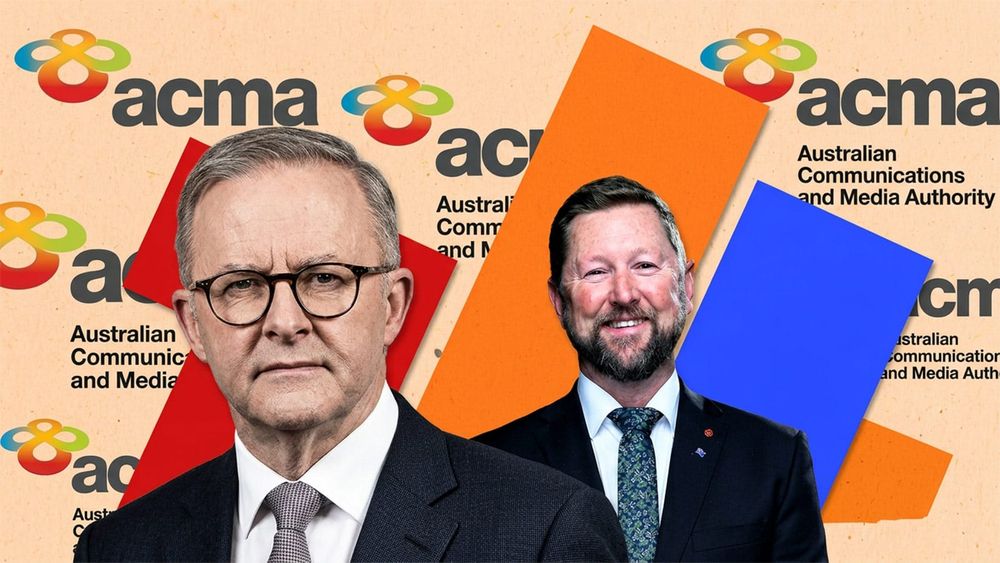
Hancock Prospecting has called for a public apology and an investigation into who cleared the segment for broadcast. Complaints can also be made to the ABC directly and escalated to the media regulator, the Australian Communications and Media Authority. Someone at the ABC read those words, watched that film and approved it to air. The public that pays for the broadcaster is entitled to know who, and whether anything follows. For now the film is still on the ABC's platforms, the apology Hancock asked for hasn't come, and Hugh Marks hasn't replied.
A note to our readers
The ABC has lately turned its attention to us, too. We're a fraction of its size, 44,000 followers to its five million, and we take none of the public money the ABC and 184 other newsrooms rely on. We're not going anywhere. When the next attack comes, ask one question: who funds the outlet doing the attacking, and who funds us? You do. That's the whole difference.