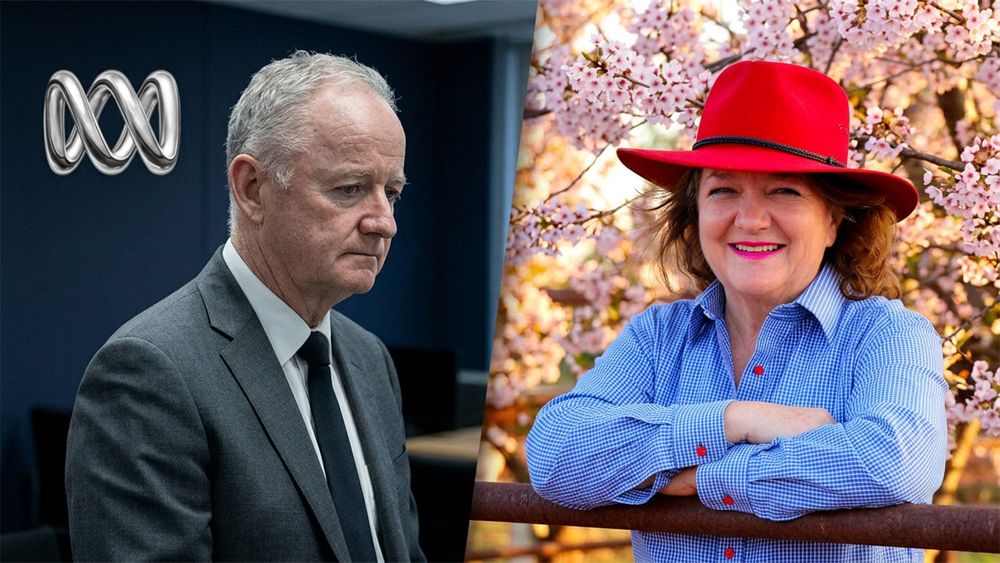
Gina Rinehart asked the ABC to take down the Race Around the World film describing her being killed, and to apologise for putting it to air. For more than three weeks the ABC refused both. On Thursday it backed down: Managing Director Hugh Marks apologised to Rinehart and said the film has been edited on the ABC's platforms to remove the material. The reversal came only after her company Hancock Prospecting put Chair Kim Williams, Deputy Chair Lisa Caffery and Mr Marks on notice of what it calls serious breaches of civil and criminal law, as set out in our earlier report.
Three bodies outside the ABC are supposed to hold it to account. The ABC Ombudsman, the media regulator ACMA and the eSafety Commissioner. On the law as written, none of them can order the film off iview, make the ABC apologise, or award Rinehart a dollar.
The strongest outcome any of them can produce is a finding the broadcaster is free to ignore, which leaves Rinehart with one option, and it's the one she's taken. A civil claim she runs herself is the only place the film could ever be ordered down and the only place she can be compensated. Thursday's backdown bore that out: the ABC Ombudsman found the film did not breach the ABC's own editorial policies, no regulator ordered anything, and the apology came from management with Hancock's legal letters on the table.
A complaints system that answers to the organisation being complained about is a problem only Parliament can fix, and whatever it eventually does will come too late for this case. This is what each body can and can't do for her.
| Body | Can it order the film down? | Can Rinehart be paid? |
|---|---|---|
| ABC Ombudsman | No | No |
| ACMA | No, and iview is outside its remit | No |
| eSafety Commissioner | Not the copy on iview | No |
| AFP and CDPP | No | No |
| A civil court | Yes, if she wins | Yes, if she wins |
Source: One News analysis of the Broadcasting Services Act 1992, the Online Safety Act 2021 and ACMA’s published guidance, 6 August 2026.

The ABC review Gina Rinehart is waiting on reports to the same three men her lawyers wrote to
An ABC spokesperson told News24 that "the ABC Ombudsman is independently reviewing audience complaints in relation to the 12 July Race Around The World episode in accordance with the ABC's complaints handling process," and that the broadcaster "won't be commenting further while the review is in progress."
The Ombudsman's own twelve month report describes the arrangement in one sentence.
"The Ombudsman reports directly to the ABC Board and leads a small team which is independent from the news and content making areas of the ABC."
The independence described there runs to the ABC's news and content divisions, and the Ombudsman still answers to the board.
Under section 12 of the Australian Broadcasting Corporation Act 1983, the board consists of the Managing Director, the Chairperson, a staff elected Director and between 4 and 6 other Directors. Section 3 defines a Director as a member of the board, "and includes the Chairperson, the Deputy Chairperson and the Managing Director."
Williams, Caffery and Marks hold exactly those three positions, so all three sit on the board the Ombudsman reports to, and all three are named in Hancock's letters.
The office's own caseload shows how rarely a complaint gets up. In the financial year to June 2025 the ABC received 18,163 written complaints, of which 4,907 content issues were assessed and 2,919 investigated. 56 were found in breach, or 2%.
Even a breach finding wouldn't compel the ABC to act, because the Ombudsman has no power to order the film removed, require an apology or award Rinehart compensation. That is how this review ended on Thursday. The Ombudsman found the film did not breach the ABC's editorial policies but had fallen short of community expectations, and Marks said the ABC will amend its guidance on violence. The ABC found none of its own rules were broken, and says it will now rewrite them.
ACMA has assessed 30 complaints about the ABC since January 2025 and investigated none of them
ACMA told News24 it would let the ABC's internal process run first.
"As previously advised, the ACMA has confirmed with the ABC that this matter has been referred to the ABC Ombudsman. Consistent with the broadcasting co-regulatory framework established by Parliament, the ACMA will consider the outcome of that process and determine whether any further action is appropriate."
The framework Parliament established doesn't actually require that wait. Section 150 of the Broadcasting Services Act 1992 gives a complainant two routes to ACMA, not one. Either the ABC hasn't responded within 60 days, or the person "has received a response within that period but considers that response to be inadequate." Anyone in that second category can complain to ACMA today.
What ACMA does next is its own call, and section 151 reads: "The ACMA may investigate the complaint if the ACMA thinks that it is desirable to do so."
ACMA's published complaint outcomes show how that discretion has been used. One News counted every ABC entry on the table. There are 30, covering broadcasts from 16 January 2025 to 10 June 2026, and every one is marked "No further action". Eight were complaints under the harm and offence standard, which is the standard the Rinehart film engages.
| Program | Broadcast | Standard |
|---|---|---|
| Q&A | 12 May 2025 | Accuracy, impartiality and harm and offence |
| ABC Radio Melbourne Mornings | 5 Sep 2025 | Harm and offence |
| 7:30 | 17 Sep 2025 | Accuracy, impartiality and harm and offence |
| 7:30 | 17 Sep 2025 | Impartiality and harm and offence |
| Late Night Live | 15 Sep 2025 | Accuracy, impartiality and harm and offence |
| 7.30 | 17 Dec 2025 | Impartiality, harm and offence |
| Can You Keep A Secret? | 15 Mar 2026 | Harm and offence |
| ABC Country | Not stated | Harm and offence |
All eight were marked “No further action”. Source: ACMA broadcasting complaint outcomes, counted by One News on 6 August 2026.
Even if ACMA found against the ABC, the most it could do is recommend an apology the ABC can refuse
If ACMA did investigate and did find against the ABC, section 152 sets the limit on what follows. ACMA "may, by notice in writing", recommend that the ABC comply with the code and take other action, and the Act says that other action "may include broadcasting or otherwise publishing an apology or retraction."
That's a recommendation the ABC is free to decline, and if it does, section 153 applies. Where the ABC hasn't acted within 30 days, ACMA "may give the Minister a written report on the matter", and the Minister must table that report in each House within 7 sitting days.
A letter tabled in Parliament is as far as it goes. There's no fine, no licence condition, no order to remove anything and nothing payable to Rinehart, while a commercial broadcaster in the same position faces civil penalty provisions and conditions on its licence.
ACMA's own website tells complainants that iview is not its problem
The copy still streaming on iview is what Rinehart wants gone. Hancock asked for removal from all ABC platforms, and Deputy Prime Minister Richard Marles, who was acting Prime Minister at the time, has said he was surprised it hadn't come down.
ACMA's complaints page deals with streaming in two lines, and it names iview.
"Programs on streaming services such as Netflix, ABC iview, 7Plus or 9Now or other online platforms. We do not manage these complaints. You need to contact the streaming service directly."
The streaming service a complainant would have to contact is the ABC, which has already refused to take it down.
The Online Safety Act exempts ABC catch up, so eSafety can't order the iview copy down
The eSafety Commissioner holds the only power in Australian law that forces content offline quickly. Under the adult cyber abuse scheme a removal notice requires material gone within 24 hours, with civil penalties for failing to comply.
That power doesn't reach iview. Sections 88, 89 and 90 of the Online Safety Act 2021 each require the material to be provided on "a social media service", "a relevant electronic service" or "a designated internet service", and there is no fourth category.
Section 14 then excludes an "on-demand program service" from the definition of a designated internet service. Section 18 defines an "on-demand program service" as one delivered over the internet, "to the extent to which the service provides material that is identical to a program that has been, or is being, transmitted on" a list of broadcast services that includes "a television broadcasting service provided by the Australian Broadcasting Corporation."
That describes iview carrying the catch up copy of a program that aired on ABC TV. The same three service types gate the class 1 removal notices at sections 109 and 110, so the exclusion runs through the Act.
If a viewer clipped that segment and posted it to X or YouTube, the eSafety Commissioner could order that copy removed within 24 hours. The original, on the ABC's own platform, sits outside the power, which leaves the broadcaster better protected than the viewer would be.
Whether the film meets the Act's serious harm test never gets decided, because the jurisdiction question rules it out first.
A police investigation wouldn't take the film down or pay Gina Rinehart a dollar
Section 474.17 of the Criminal Code makes it an offence to use a carriage service "in a way (whether by the method of use or the content of a communication, or both) that reasonable persons would regard as being, in all the circumstances, menacing, harassing or offensive." The penalty is 5 years imprisonment.
No streaming exclusion applies to it. Hancock's letters allege breaches of both civil and criminal law, and none of those allegations has been tested.
A criminal offence is a matter for the Australian Federal Police and the Commonwealth Director of Public Prosecutions, so Rinehart can neither start a prosecution nor compel one. A prosecution would punish an offence against the Commonwealth, and it would leave the film where it is and Rinehart uncompensated.
The ACMA door is open now, and Senate estimates waits in late October
The first date has already moved. With the review concluded and the ABC's response delivered, any complainant who considers that response inadequate can take the matter to ACMA now, without waiting out the 60 days in section 150.
The second is 12 October. ACMA's guidance says complaints about an ABC broadcast "should be made within 3 months of the broadcast", which closes the window on the 12 July episode.
The third is 26 to 29 October, when Senate Supplementary Budget Estimates sit under the 2026 parliamentary calendar. Estimates is the one forum that puts ABC executives in front of senators and on the record about how the film was commissioned, approved and defended for three weeks before Thursday's reversal.
The ABC moved only after Gina Rinehart's lawyers did
Rinehart asked in July and was refused. Her lawyers wrote to the board, and on Thursday the ABC apologised and cut the material. No proceedings have been filed yet, and whether Hancock presses on, for the three weeks the film stayed up and the applause it aired to, is now the question.
It took legal letters to three board members, and a review that cleared the film under the ABC's own rules, to produce an apology no watchdog in the country could compel.