Strip out the left spin and look at the position Iran is signing from. Its Supreme Leader is dead, killed alongside much of its leadership. Its nuclear sites are bombed, its military cut to pieces, its missile force gutted and its air defences wrecked. Its proxy network across the Middle East is shattered, its main oil island flattened, its economy in crisis and its ports blockaded. That is the state Iran is in as it comes to the table on 19 June, and it's the context every critic calling this a loss for Trump quietly leaves out.
The United States and Iran are set to sign a deal on 19 June in Switzerland that ends their war. It's a memorandum of understanding that opens a 60 day window to negotiate the final agreement, not the final deal itself, and the broad shape is already clear. Under the terms as reported, Iran is to stop enriching uranium, place its highly enriched stockpile under inspection, accept tighter monitoring and reopen the Strait of Hormuz, which it had illegally mined to charge ships up to $2 million to cross. In return, Washington drip releases about $24 billion of Iran's own frozen money, paid out only as Iran complies, and lifts its naval blockade. A separate $300 billion reconstruction fund is also part of the framework, funded by the Gulf states and conditional on Iran's compliance, not paid from US taxpayer money.
Online, the reaction from one side has been remarkably consistent. ''Trump started it. Trump achieved nothing. It's the same as Obama's deal. Iran didn't cave.'' Line them up against the public record and they don't hold. Two are flat wrong, the other two are half-truths that leave out what Iran actually did. Here are the facts, not opinions.
Who actually started it
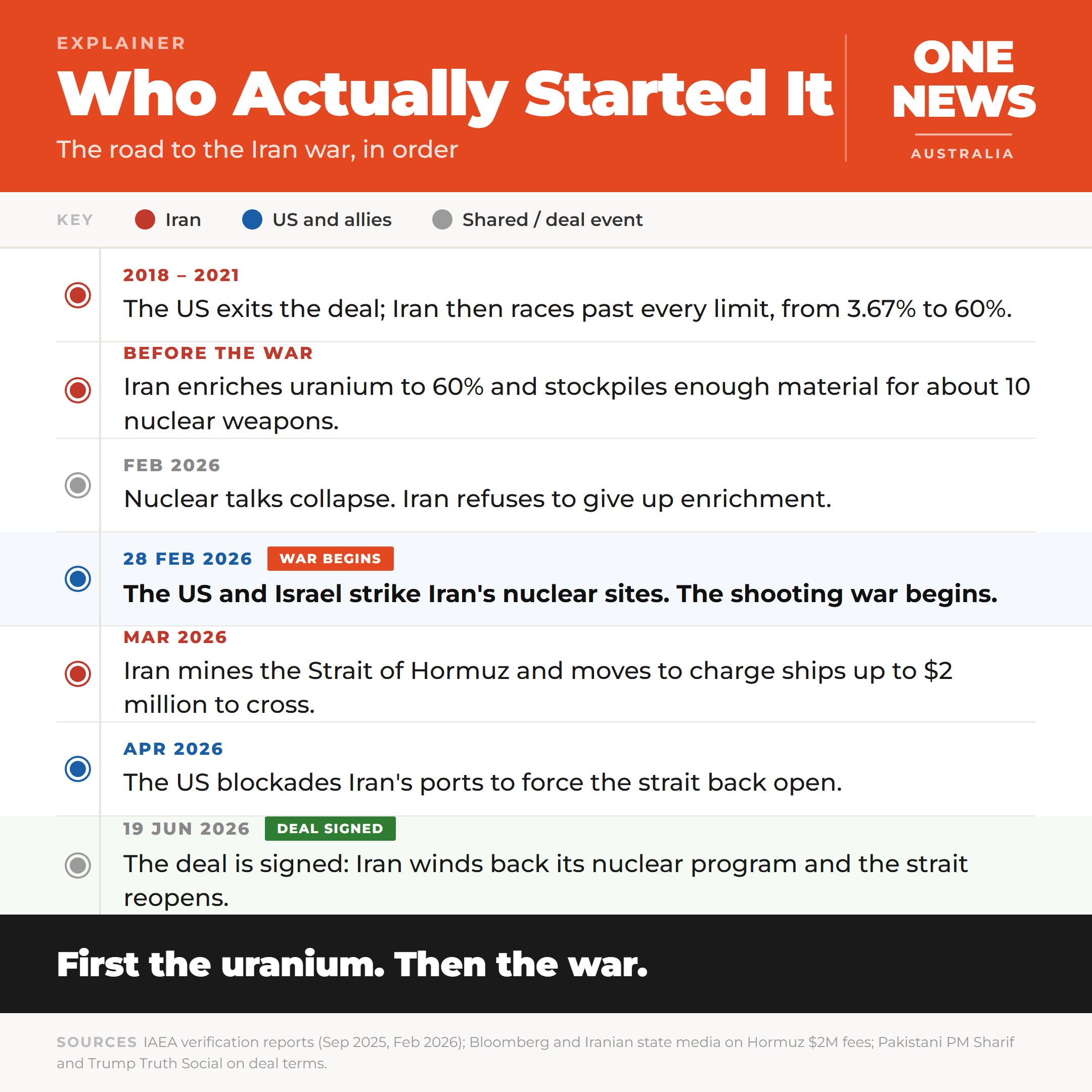
The war began on 28 February 2026, when the United States and Israel launched coordinated strikes on Iran. That much the critics get right. What they leave out is the most important part, why?
By then Iran was sitting on more than 400 kilograms of uranium enriched to 60%, far beyond any civilian use and, once enriched further, enough material for around 10 weapons. Trump's own intelligence chief, Tulsi Gabbard, had told Congress in March 2025 that the intelligence community assessed Iran hadn't made the final decision to build a bomb, and Trump dismissed that assessment. Critics treat that as the end of the argument. It isn't. "Hasn't decided yet" is not the same as "safe" when the material for 10 bombs is already in the building and weapons grade is weeks away.
The Strait of Hormuz tells the same story. Iran mined "large segments" of the strait, in the words of US Secretary of State Marco Rubio, and stood up a new authority charging ships up to $2 million each to pass, payable in Chinese yuan or cryptocurrency. That came after the strikes, as retaliation, which is the honest sequence. But it's also the point. This is a regime that will weaponise the world's most important oil route the moment it's cornered.
Strip away the noise and the principle is simple. Iran has long been designated by the United States as the world's foremost state sponsor of terrorism, the regime that armed Hezbollah, Hamas and the Houthis. A government that funds terror across the region cannot be allowed to cross the threshold to a nuclear weapon, because the day it does, every one of those proxies sits behind a nuclear shield. That's the case for acting before the line was crossed, not after. You don't wait for a regime like that to finish the job.
It's worth being clear about the nature of that regime. Under its own laws, Iran lets girls be married at 13, and as young as 9 with a father's consent and a court's sign off, and roughly 17% of Iranian girls are married before they turn 18. It is one of the world's leading executioners, carries out public hangings, and has put to death women who were themselves child brides driven to kill abusive husbands. Women are denied equal rights in marriage, divorce, inheritance and custody, domestic violence isn't a crime, and the morality police enforce the dress code that sparked the country's nationwide protests after they killed Mahsa Amini in custody for showing her hair. That is the government critics would have left enriching uranium toward a bomb.
Who actually controls the Strait of Hormuz
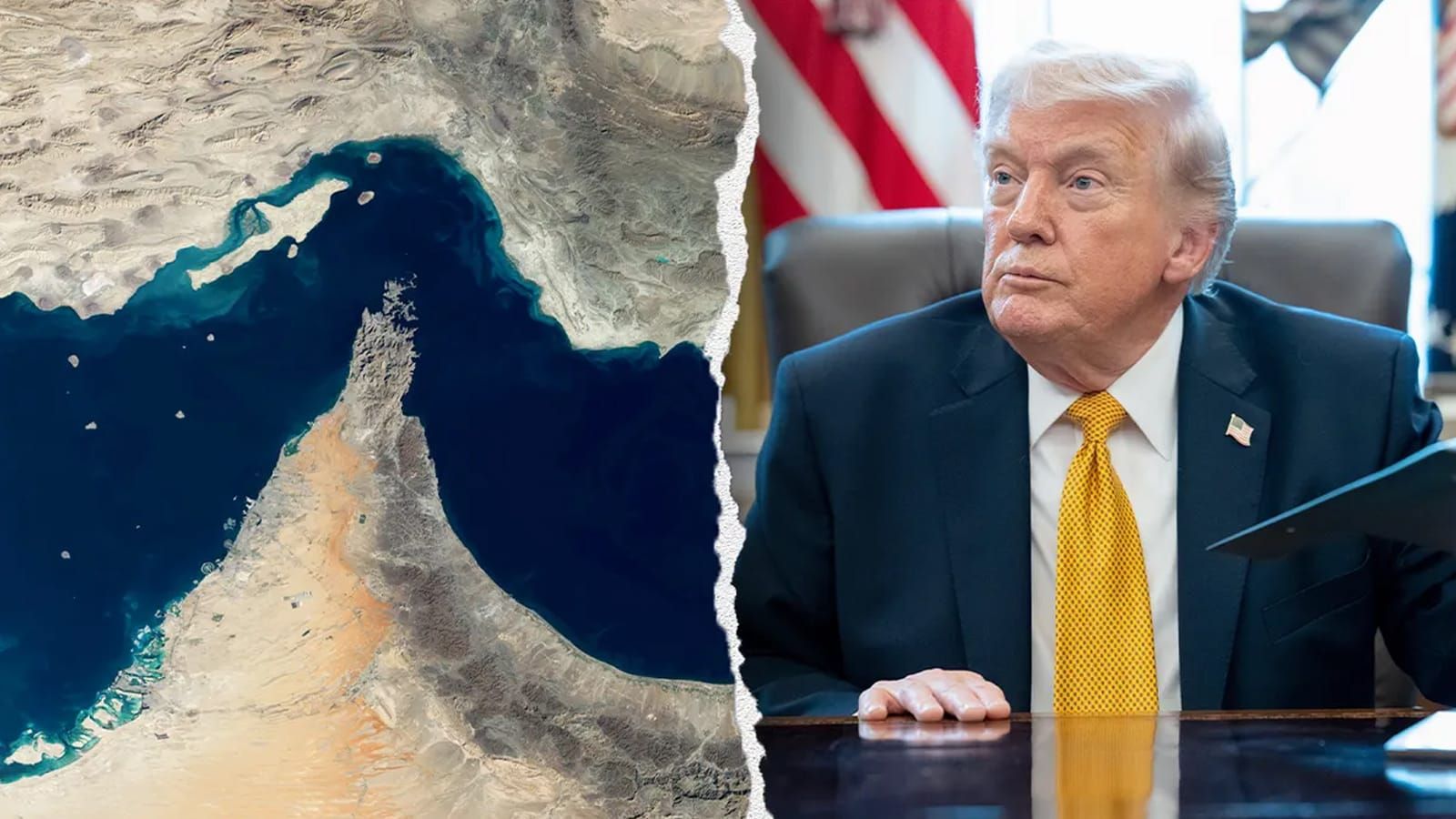
It's worth clearing up a question Iran has deliberately muddied. Nobody owns the Strait of Hormuz. It's an international waterway, bordered by Iran on one shore and Oman on the other, and under the UN Law of the Sea every ship has the right of transit passage through it. Iran and Oman hold sovereignty over their own waters, but neither is allowed to close the strait or charge for passage. That's the law Iran was breaking when it laid mines and demanded up to $2 million a ship.
Iran will argue it isn't bound by all this, because it signed the UN Law of the Sea but never ratified it, and it claims the stricter rules of "innocent passage" let it police who comes through. The international community rejects that, and it changes nothing on the point that matters: under no reading of the law can Iran lawfully close the strait or charge tolls to use it. None of this is new, either. In 1988, Iran mined these same Gulf waters and nearly sank a US warship, the USS Samuel B. Roberts, triggering the biggest US naval battle since the Second World War. Choking the Gulf is a tactic Tehran has kept ready for decades.
The deal reopens the strait to all shipping, with no tolls, and the US lifts its blockade. Nobody seizes control. It simply goes back to being the open route it's meant to be. The catch is that Iran still sits on the northern shore, so it keeps the ability to threaten the strait again. That's why the deal leans on the blockade and sanctions snapping back if Iran reneges, rather than on trusting Tehran to behave.
Iran didn't walk away untouched
The claim that Iran gave up nothing runs into the reported terms. Under the agreement, US Defence Secretary Pete Hegseth said Iran's enriched uranium is to be "destroyed, removed or downblended" under IAEA inspection, with Iran to neither build nor buy a nuclear weapon and to accept tighter monitoring. Hegseth went further: "Nuclear material will be destroyed and removed. The nuclear program will be dismantled." Iran is reopening Hormuz with no tolls, and the toll racket ends with it.
Some outlets report the nuclear detail is still to be settled during a 60 day negotiating window, so the final wording matters. But no version has Iran walking away untouched.
Washington's side of the ledger is releasing about $24 billion of Iran's own frozen assets, slow released only as Iran complies, and lifting the blockade it imposed. The separate $300 billion reconstruction fund is real, but the framing matters. It's funded by the Gulf Coast Coalition, not the US Treasury, and Iran only accesses it if it complies with the deal. The funds cannot be used to support terrorism. Vice President JD Vance laid this out on CBS on Monday and reinforced it on Fox the same night: "They're agreeing right now to eliminate the enriched stockpile. And if they don't get to a point where they agree to stop enriching, then they don't get the other benefits of the bargain." His shorthand: not a dime until Iran meets its obligations.
Iran's hardliners are publicly framing the $300 billion as reparations for war damage, because they need a domestic win. Iranian state media outlets like Mehr News are running with that framing. The US is selling it as performance based investment because that is what it is. One of those framings is supported by the people actually negotiating the deal.
One side is rolling back its path to a bomb. The other is handing back money that already belonged to Tehran, with a conditional investment fund attached if Tehran behaves. Calling that an Iranian win takes a particular kind of determination.
The Obama comparison doesn't survive a second look
The most repeated line is that this just returns the world to Obama's 2015 deal, as if nothing changed. It doesn't hold.
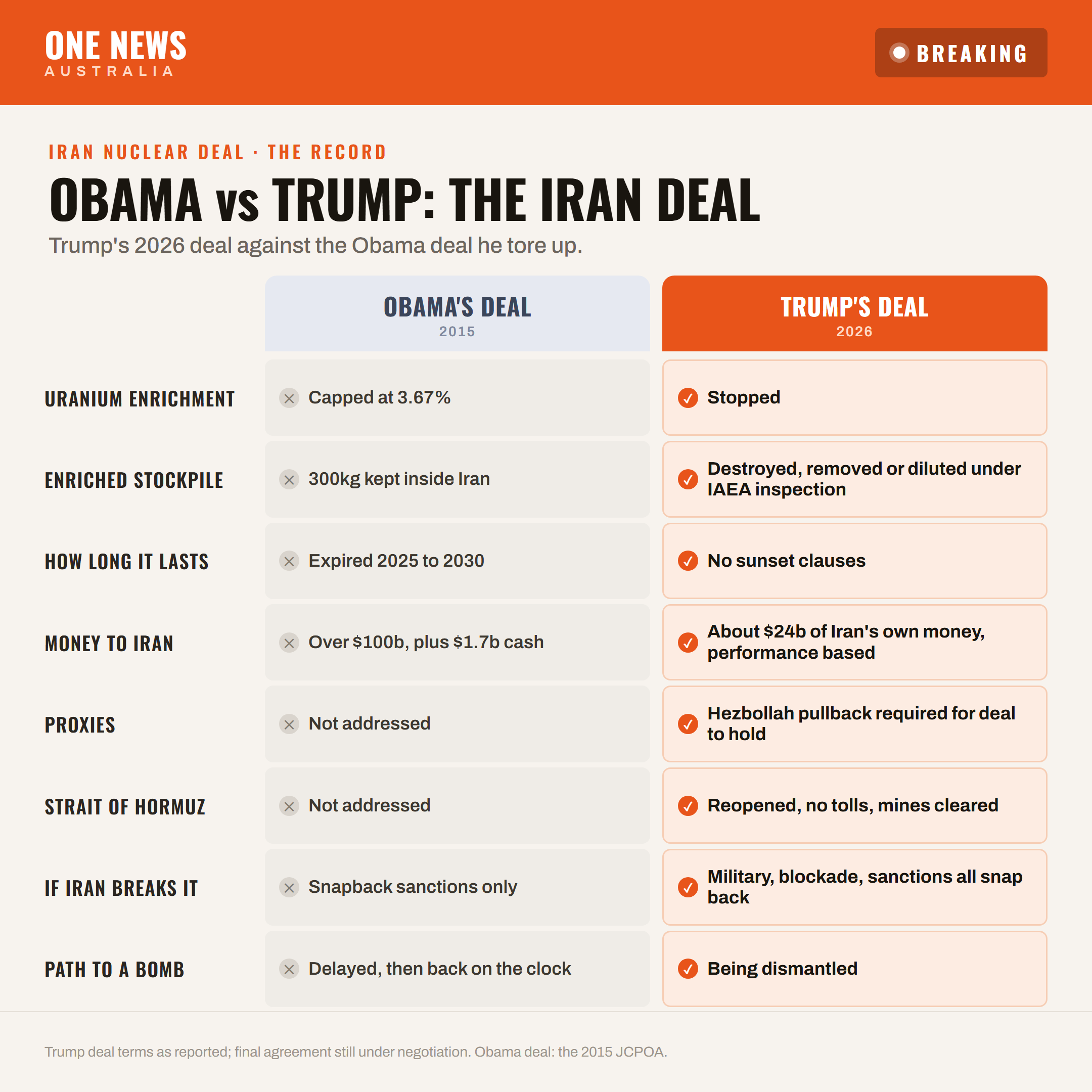
Obama's deal, the JCPOA, capped Iranian enrichment at 3.67% and cut the stockpile to 300 kilograms. Those were real limits. The problem was they were temporary. The deal's sunset clauses let the centrifuge limits lapse from 2025 and the enrichment and stockpile caps expire by 2030, after which Iran could enrich at industrial scale, legally. It also unfroze well over $100 billion and included a $1.7 billion cash component.
Trump's deal aims to halt enrichment outright, strip out the highly enriched material under inspection, and hold rather than expire on a timer. And it does it while releasing about a quarter of the money Obama did, with the larger reconstruction fund held conditional and Gulf funded. Whatever else you call that, "the same deal" isn't it.
It's worth being honest about how Iran's 60% stockpile was built. Iran complied with JCPOA limits from 2015 until 2019, one full year after Trump withdrew in May 2018. After that it began breaching the limits in stages, climbing from 4.5% to 20% to 60% by April 2021, three months into Biden's term, while Biden was actively trying to revive the Obama deal. If Trump's exit alone forced Iran's hand, Iran would have stopped enriching the moment Biden offered the deal back. Iran didn't. Iran spent the next four years sprinting toward weapons grade with the deal sitting on the table. That stockpile is the reason this war happened. It's also the reason "go back to JCPOA" was never going to work. JCPOA didn't survive its first test.
What the "ring of fire" was, and why it's broken
For decades Iran's main weapon wasn't its own army. It was what analysts call the ring of fire, or the Axis of Resistance: a network of armed proxy groups positioned around Israel and across the region. Hezbollah in Lebanon, Hamas in Gaza, the Houthis in Yemen, and a web of militias in Iraq and Syria, all funded, armed and directed from Tehran. The idea was simple. Iran could strike at Israel and menace the region without firing a shot itself, by lighting fires through its proxies.
That ring is now a shadow of what it was. Hezbollah has been driven into terminal decline, its finances strained and its Syrian supply line gone. Hamas's infrastructure in Gaza lies in ruins, with Iran unable to resupply it. The Houthis sat the war out, wary of retaliation. By the time the deal was reached, Iran's proxies had fallen conspicuously silent. Tehran has lost the deterrent it spent decades building.
This is the part that doesn't fit on a placard, and it's the part that matters most. A nuclear deal is one thing. A Middle East where Iran can no longer reach across borders through its proxies is a structural change, and the whole world feels the benefit, from energy markets to the shipping lanes to the odds of the next regional war.
Iran's military was taken apart
Beyond the proxies, Iran's own forces were gutted. On 13 March the US Air Force hit Kharg Island, the terminal that handles roughly 90% of Iran's crude exports, and destroyed more than 90 military sites on it: the runway, the Joshan naval base, air defences, missile bunkers and mine stores. The oil facilities themselves were left standing, which tells you the strikes were precise, not indiscriminate.
Across the war the picture was the same. Israel says it destroyed around 300 of Iran's roughly 500 ballistic missile launchers, about 70%, and Iran lost between a third and half of its missile arsenal. Hegseth told reporters the US had "finished completely destroying Iran's defence industrial base", and that Iran could "no longer build missiles, build rockets, build launchers or build drones, their factories have been razed to the ground". The barrages that opened the war at 150 missiles a wave had shrunk to sporadic volleys of 9 to 30. Iran's air defences were so heavily degraded that the US began flying heavy bombers over the country with little to stop them. Of the hundreds of drones Iran launched, nearly all were shot down.
This is the context the "Trump lost the war" crowd skips. A country doesn't end a war with its missile force halved, its air defences in pieces and its main military island flattened and call itself the winner.
The regime took the hardest blow of all
One thing the deal doesn't settle is the future of the regime itself, and that's where the war landed its heaviest blows. The opening strikes on 28 February killed Supreme Leader Ali Khamenei alongside several family members and senior aides. On 17 March, Israel killed Ali Larijani, the Secretary of Iran's Supreme National Security Council and the man widely described as Iran's de facto wartime leader after Khamenei's death. Khamenei's son Mojtaba has since been confirmed as the new Supreme Leader, with Iranian President Pezeshkian publicly confirming that decisions on war and negotiations now rest with Mojtaba and the Supreme National Security Council.
The Islamic Republic is still standing, but it's under the worst combined pressure it has faced since the 1979 revolution: economic breakdown, military defeat, a freshly installed and untested leadership, and protests that have been building since December. Whether that opens the door to the freedoms Iranians had before 1979 is an open question, not a done deal. But for the first time in decades, the people pushing for change aren't pushing against a leadership at full strength.
Iran stays on a short leash, because it can't be trusted
None of this rests on taking Iran at its word, and it shouldn't. This is a regime that enriched uranium to 60% while insisting its program was peaceful, mined an international shipping lane and then called it "navigational services". Trust isn't the currency here. Verification is.
That's why the deal, as reported, leans on tighter IAEA inspections, the removal or downblending of the highly enriched material under inspection, and a blockade that can be reimposed if Tehran reneges. The final status of enrichment is still to be settled over the next 60 days, and Iran says publicly it won't accept a permanent ban, which is exactly why the monitoring matters. The leash is short by design. The moment Iran is trusted rather than watched is the moment this falls apart.
The sanctions relief works the same way. Iran's economy has been throttled by years of oil and financial sanctions, and the deal eases them, but the relief is performance based, released as Iran delivers rather than handed over in advance. The $24 billion is its own frozen money, unlocked in stages. The $300 billion Gulf reconstruction fund only opens if Iran complies. Step out of line and the relief reverses. It's a carrot on a string, not a cheque in the post.
What America walked away with
Set against the cost, what did the United States actually get? More than the critics admit, though less than the loudest cheerleaders claim.
Start with the nuclear program. US officials estimate the strikes set it back by about two years, and under the deal, as reported, Iran commits not to build or buy a weapon, halts the expansion of its facilities and accepts tighter inspections. Whether the highly enriched stockpile is fully removed or simply frozen is still being negotiated, so this is a rollback in progress, not a finished dismantlement. But a program that was weeks from weapons grade is now boxed in and watched.
Then there's everything around it. The Strait of Hormuz, the artery for around a fifth of the world's oil, reopens with no tolls. Iran's proxy network and missile force, the two tools it used to project power, have been hollowed out. Its main foothold in the Middle East, and China's cheap oil pipeline with it, has been gutted. And Washington reasserted something it had let slide, that the US, not Iran, sets the terms in the Gulf, without sinking into another open ended occupation.
Put plainly, the US handed back some of Iran's own frozen money, opened the door to a Gulf funded conditional reconstruction fund Iran can only touch if it behaves, and got a disarmed, diminished and isolated adversary, a reopened oil route, and a regional rival to China knocked flat. Whatever you make of Trump, that's the ledger.
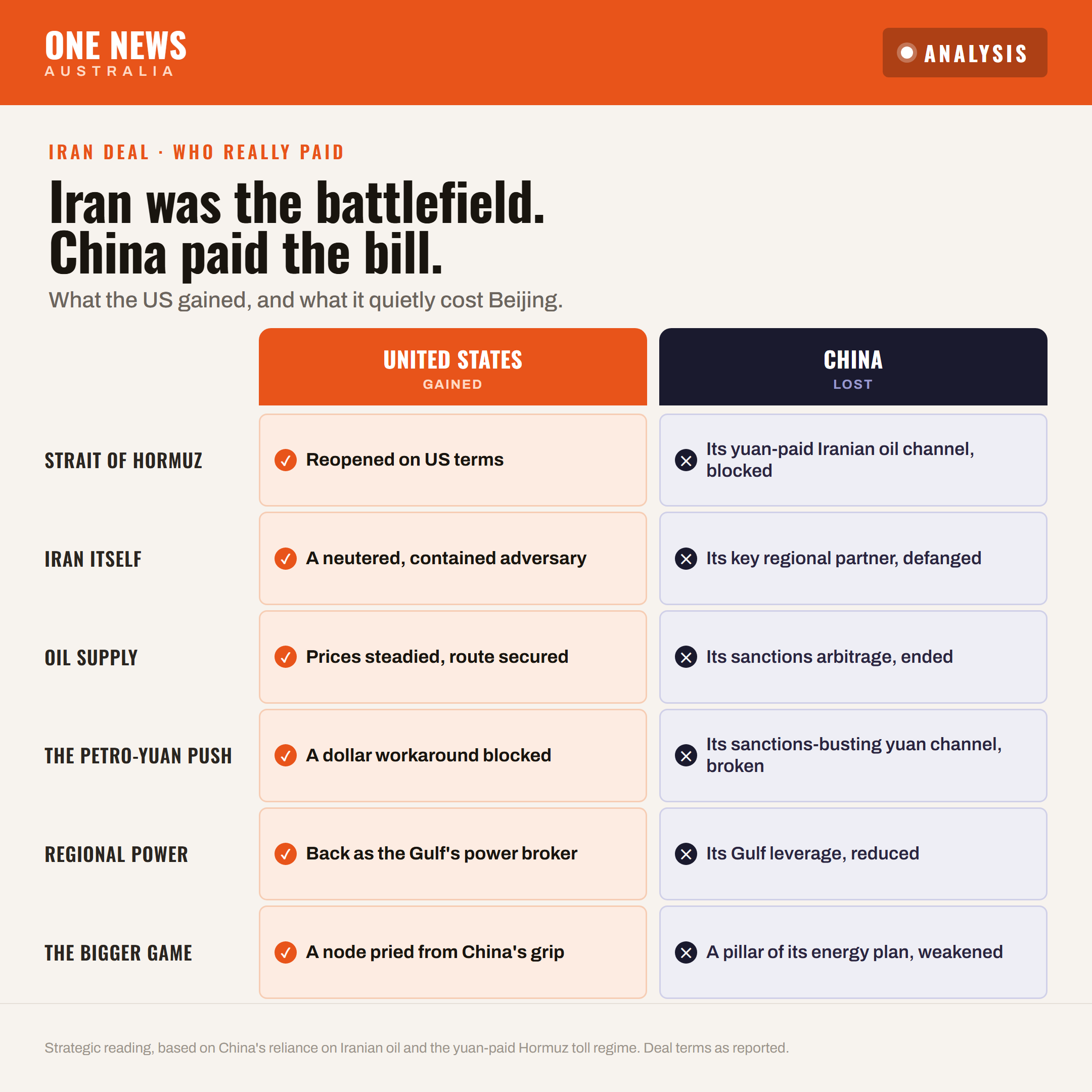
The quiet loser is China
One country that wasn't at the table lost more than it lets on. China is the world's largest oil importer and the biggest single buyer of crude through the Strait of Hormuz, taking more than 5 million barrels a day through it. Nearly all of Iran's oil exports were heading to China, and Beijing spent the early months of the war frantically stockpiling to cushion the shock.
Iran was the cornerstone of China's energy reach into the Middle East: a cheap, sanctioned supplier that leaned on Chinese cover at the UN and helped Beijing chip away at the US dollar, with the Hormuz tolls payable in yuan. That arrangement is now in pieces. Iran's military is broken, its regime is reeling, its oil route answers to a reopened strait, and the toll racket that ran on Chinese currency is gone.
This is the thread that connects Iran to the rest of the map. As we argued in our main piece, the campaign against Iran is one front in a wider effort to prise the world's energy and resources out of China's grip. Beijing didn't lose a war it never fought. It lost a partner, a foothold, and a slice of leverage it had spent years building.
And Iran is only one front. The same logic runs through Washington's other moves: squeezing China's cheapest oil supplier in the Western Hemisphere, the contest over Latin America's lithium, and the reach into Cuba and Antarctica. Each looks like a separate crisis. Together they trace a single US strategy, to roll back the cheap energy and critical minerals China spent two decades wiring itself into. The Iran deal isn't the end of that campaign. It's a battle won in a much longer one, and the real prize isn't Tehran. It's Beijing's grip on the world's resources.
The whole region is safer for it
The benefit isn't only America's. For the first time in years, Iran's neighbours can breathe. During the war Iran fired on Kuwait, Saudi Arabia, the UAE, Qatar and Jordan, and for decades it armed the militias that destabilised Lebanon, Iraq, Syria, Gaza and Yemen. With its military and proxies degraded and its enrichment program checked, the immediate threats that hung over the Gulf and Israel have come down hard.
The Strait of Hormuz reopening matters here too. The Gulf states that depend on it for their exports are no longer at the mercy of Iranian mines and tolls. None of this makes the Middle East peaceful, a wounded and unstable regime carries its own risks, but a region where Iran can no longer reach across borders at will, or build toward a bomb, is a safer one than the region that existed before February.
None of this came free
A credible account doesn't stop at the wins. The war cost 13 American service members their lives and wounded more than 400. The United States lost or damaged more than 40 aircraft, at a cost of around $2.6 billion. And on 28 February a missile struck a girls' school at Minab, killing about 165 children, with a US internal investigation later concluding the strike was likely American. That's a real and serious civilian toll, and no amount of geopolitical success erases it.
Yes, it hit the world economy, and reopening Hormuz is the way back
The other bill the world paid while the war ran was at the petrol bowser and the checkout. Choking the Strait of Hormuz triggered what was described as the largest supply disruption in the history of the oil market. The strait normally carries about a fifth of the world's oil, and with it shut, Brent crude ran past $115 a barrel, fuel jumped, and inflation hit its highest in nearly two years. Australians felt it like everyone else.
So yes, the war cost the world money. But the same critics leave out what was driving those prices: Iran's blockade of the strait. The deal reopening it is exactly what brings them back down, with forecasters already tipping crude to ease toward $80 by the end of the year. The longer Iran was left to hold the world's oil route hostage and charge tolls to use it, the longer that pain would have run. Ending it is the relief, not the cause.
Was it even a legal war?
Critics have a point on the paperwork. Trump launched the strikes on executive authority, without a Congressional vote, and in June the House passed a war powers resolution pushing him to wind the conflict down. But a US president acting without a formal declaration of war isn't new, and it isn't unique to Trump. It's how nearly every American military operation of the past 30 years has happened, from Kosovo under Clinton to Libya under Obama. You can argue the War Powers Act needs real teeth. What you can't seriously argue is that this one strike was uniquely lawless.
Australia welcomed the result, just not the man
Prime Minister Anthony Albanese and Foreign Minister Penny Wong welcomed the agreement and called on both sides to use the opportunity to restore stability. Their joint statement said they were "pleased the agreement between the US and Iran includes steps towards reopening the Strait of Hormuz and the restoration of freedom of navigation," and noted that restoring the trade corridor was essential to easing pressure on energy prices and economies, "including in our region".
It's a fair point. A large share of the oil and trade that moves through that strait feeds into what Australians pay. What the statement didn't include was Trump's name anywhere near the word thanks. Albanese was happy to welcome the reopened shipping lane. He was less keen to credit the administration that reopened it. Diplomatic, perhaps. Grateful, not quite.
What it means for Australia
The deal lands on a country with a foot in two camps. The United States is Australia's security guarantor, through AUKUS and the submarine programme. China is Australia's largest trading partner, taking roughly a third of our exports. For years that split has been manageable. It's getting less so.
On trade, the friction is already here. A baseline US tariff of 10% applies to most Australian goods, and the fight over steel and aluminium has run hot and cold, with exemptions granted, threatened and disputed depending on the month. Whatever the final number, the message from Washington is that old friendships don't come with automatic carve outs.
And the Iran war isn't a standalone event. As we set out in our earlier breakdown, the moves in Iran, Venezuela, Cuba and the contest over critical minerals point to one strategy: prising the world's energy and resources out of China's grip. If that's the game, the days of Australia banking Chinese money while sheltering under American security are numbered. At some point the bloc question stops being theoretical. We sell to one and shelter behind the other, and Washington is making it clear it expects us to choose.
Not everyone calls it a win
This isn't a unanimous verdict, and honest coverage says so. Tom Nichols, a former professor at the US Naval War College writing in The Atlantic, calls the outcome a defeat, and he has fair points. Trump promised regime change and "unconditional surrender" and got neither. The Islamic Republic survived, the IRGC still runs what's left of it, Iran keeps significant missile stocks, and billions in frozen assets and a Gulf funded reconstruction fund are flowing its way on the condition of compliance. By the maximalist goals Trump himself set, this fell short.
Where the argument strains is the claim that Iran came out stronger. A regime with its Supreme Leader dead, its wartime leader dead, its military halved, its proxies in ruins, its economy in crisis and protesters in the streets is not a more powerful actor. It survived. That isn't the same as winning. And with the deal unsigned and the nuclear terms still being negotiated, calling it a capitulation is a forecast, not a result.
Reasonable people will land in different places on this, and that's the honest state of it. What can't be argued is that Trump started a pointless war and achieved nothing. The damage to Iran is real, the strait is reopening, and the final reckoning rests on terms that aren't signed yet.
The deal still has to be signed, and the strait still has to open. Until both happen, scepticism is fair, and it should be. But step back from the comment section and the picture is hard to argue with. Iran's nuclear program is being wound back under inspection, the world's most important oil route is reopening, its proxy network is shattered and its leadership has been gutted. The world is measurably safer than it was on 27 February, and it got there because someone was willing to act. Whatever the cost, that isn't nothing. And it certainly isn't Obama's deal.