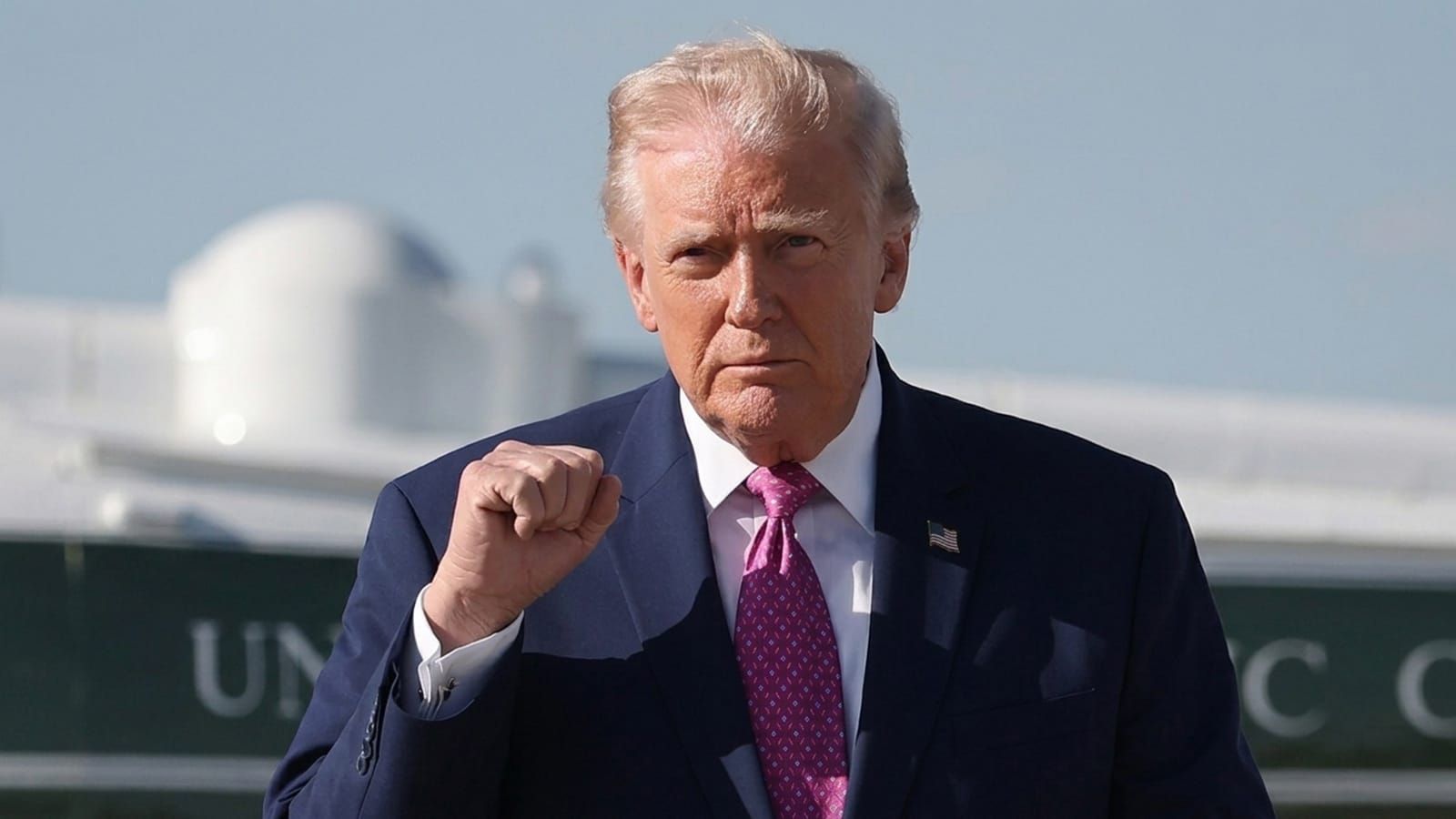
Trump declares the Iran deal complete and lifts the US naval blockade on the Strait of Hormuz
Donald Trump has declared the war with Iran over, posting on Truth Social that the agreement is "now complete" and ordering the US naval blockade of Iranian ports lifted as the Strait of Hormuz reopens to global shipping.
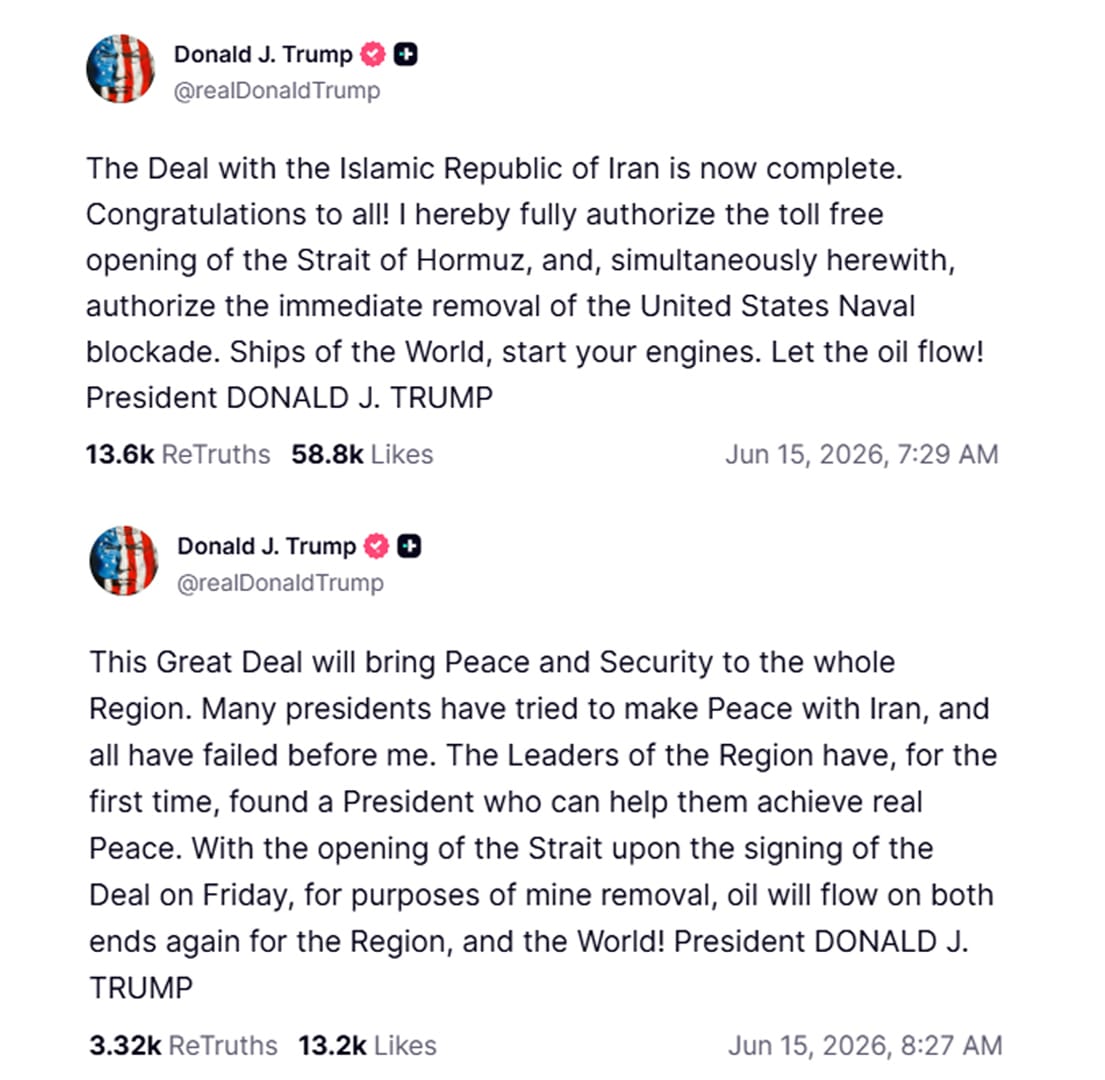
"The Deal with the Islamic Republic of Iran is now complete. Congratulations to all! I hereby fully authorize the toll free opening of the Strait of Hormuz, and, simultaneously herewith, authorize the immediate removal of the United States Naval blockade. Ships of the World, start your engines. Let the oil flow!"
Pakistan confirms the agreement and sets the signing date
The announcement came minutes after Pakistani Prime Minister Shehbaz Sharif confirmed the breakthrough on X, with Pakistan having brokered the deal between Washington and Tehran. Both sides have declared "the immediate and permanent termination of military operations on all fronts, including in Lebanon", Sharif said. A formal signing ceremony is set for Friday 19 June in Switzerland.
Trump told the Wall Street Journal the agreement would be signed either electronically by the President or in person by Vice President JD Vance. Pakistan said "pre-implementation discussions" will take place in the interim.
The end of three and a half months of war
The deal ends the conflict that began on 28 February with joint US-Israeli strikes on Iran's nuclear program and the killing of Supreme Leader Ayatollah Ali Khamenei. Iran responded by closing the Strait of Hormuz, through which roughly 20% of the world's oil flows. The US imposed its naval blockade of Iranian ports in mid April, disabling nine non compliant tankers and redirecting 135 others as it cut off Tehran's energy revenue.
What's in the deal
The full memorandum of understanding won't be public until the Friday signing, but the confirmed terms from Trump, Hegseth, Sharif and the verified reporting are clear.
- The Strait of Hormuz reopens to all shipping with no tolls, ever. Iran's bid to charge "service fees" instead of tolls has been foreclosed by Trump's wording.
- The US naval blockade of Iranian ports is lifted immediately on signing, ending the campaign that disabled nine tankers and redirected 135 others since 13 April.
- All military operations stop on every front, including Lebanon. Iran is responsible for pulling Hezbollah back. If Hezbollah breaches, sanctions relief stops.
- Iran's enriched uranium will be destroyed, removed or downblended under IAEA inspection. The nuclear program will be dismantled. Hegseth: "Nuclear material will be destroyed and removed."
- Mine clearance in the strait will take place between Sunday's announcement and Friday's signing, with the waterway physically reopening on signature.
- No money changes hands up front. Sanctions relief and the release of frozen Iranian oil revenue, around $24 billion held in foreign banks, is performance based. Trump's wording: "no money will exchange hands". Treasury Secretary Scott Bessent has separately directed his department to calculate the damage Iranian strikes inflicted on Kuwait and Bahrain, with frozen Iranian assets potentially redirected to pay for the repairs.
- Iran cannot fund proxies and receive economic benefits. The moment Tehran reverts, the cage closes again.
- The US military option remains in place. Hegseth: "We'll make sure the military option is there."
- The agreement is countersigned by the entire region, the US, Israel, Saudi Arabia, the UAE, Qatar, Turkey, Pakistan, Bahrain, Kuwait, Jordan and Egypt.
The whole architecture is performance based. Iran behaves like a normal country, or the money stays frozen, the blockade comes back, and the bombs return.
The MOU and the 60-day implementation window
The document being signed on Friday in Switzerland is a memorandum of understanding, not the final treaty. It locks in the architecture Trump declared complete, but the signing kicks off a 60 day window of intensive negotiations to convert the MOU into a permanent comprehensive peace deal.
During those 60 days the operational mechanisms get built: the IAEA inspection protocols, the uranium downblending mechanism, the asset release schedule, the timing of any sanctions waiver, the Hezbollah pullback verification process, and the reconstruction and development plan that Washington and its regional allies will negotiate with Tehran. The MOU sets the framework. The 60 day window writes the detail.
Iran maintains a nuclear status quo during the window. No new enrichment, no facility expansion, no new centrifuges, no acquisition or production of nuclear weapons. The dismantling mechanism is agreed to be worked out across the 60 days, with the US driving toward final destruction or dilution of the highly enriched stockpile as Hegseth confirmed on Face the Nation.
This isn't a delay or a soft signing. The architecture is locked on Friday. The mechanics get built in the 60 days that follow, with any breach by Iran during that window triggering the reversal clauses, the blockade returning and the military option remaining in place.
That's why earlier reporting from late May, including the New York Times $300 billion reconstruction figure, doesn't carry into the current MOU. Iran suspended those talks on 1 June, the draft collapsed, the US struck Iran on 8 to 10 June, and the document now being signed is a different agreement. Reconstruction in the current MOU is a 60 day negotiation, not a locked figure.
Tehran appears to confirm, the IRGC hedges on the strait
Iran's deputy foreign minister told Tasnim news agency that the immediate and permanent end to the war and military operations on all fronts, including Lebanon, would be announced from tonight. The IRGC linked Fars news agency added a wrinkle, reporting that marine traffic through Hormuz would resume only after the formal signing on Friday, with the period before the ceremony reserved for mine removal. Trump later confirmed the same timing in a follow up post, saying the channel would open "upon the signing of the Deal on Friday, for purposes of mine removal".
The two messages don't contradict the deal, but they show how each side will frame what happens next. Tehran wants days, not minutes, to manage the optics of opening a waterway it spent four months declaring closed.
Hegseth: "it's a matter of when"
US Secretary of War Pete Hegseth told CBS News' Face the Nation earlier on Sunday that the deal was on track despite Israel's strike on Beirut's Dahiyeh district that morning, which had threatened to derail the signing. "From all I know, we are on track. It's not a matter of if, it's a matter of when. If Iran wants this to hold, they need to pull back Hezbollah, no doubt. Nuclear material will be destroyed and removed. The nuclear program will be dismantled. We'll make sure the military option is there."
Trump himself publicly rebuked Israel hours before the announcement, writing that the Beirut strike "should not have happened, particularly on a special day when we are so close to a Peace Deal with Iran" and warning all sides, including Hezbollah, to stand down.
Markets pre priced the breakthrough
Global oil prices had already fallen more than 3% on Friday and US equities had climbed when the agreement first hardened, with the S&P 500 up 0.6% and the Dow up 0.7% on the prospect of the strait reopening. The World Bank had warned earlier in the week that the war was on course to drive the lowest global growth since the COVID pandemic, with energy disruption pushing inflation to 4% across two thirds of the world's economies. The trajectory now reverses.
For Australia, the strait reopening means the war premium that has kept petrol elevated since February starts unwinding. Trump arrives at next week's G7 summit in France with the strait reopened, the blockade lifted, the world's number one state sponsor of terror at the signing table, and the inflation track headed in the right direction. The signature in Switzerland on Friday closes the loop.