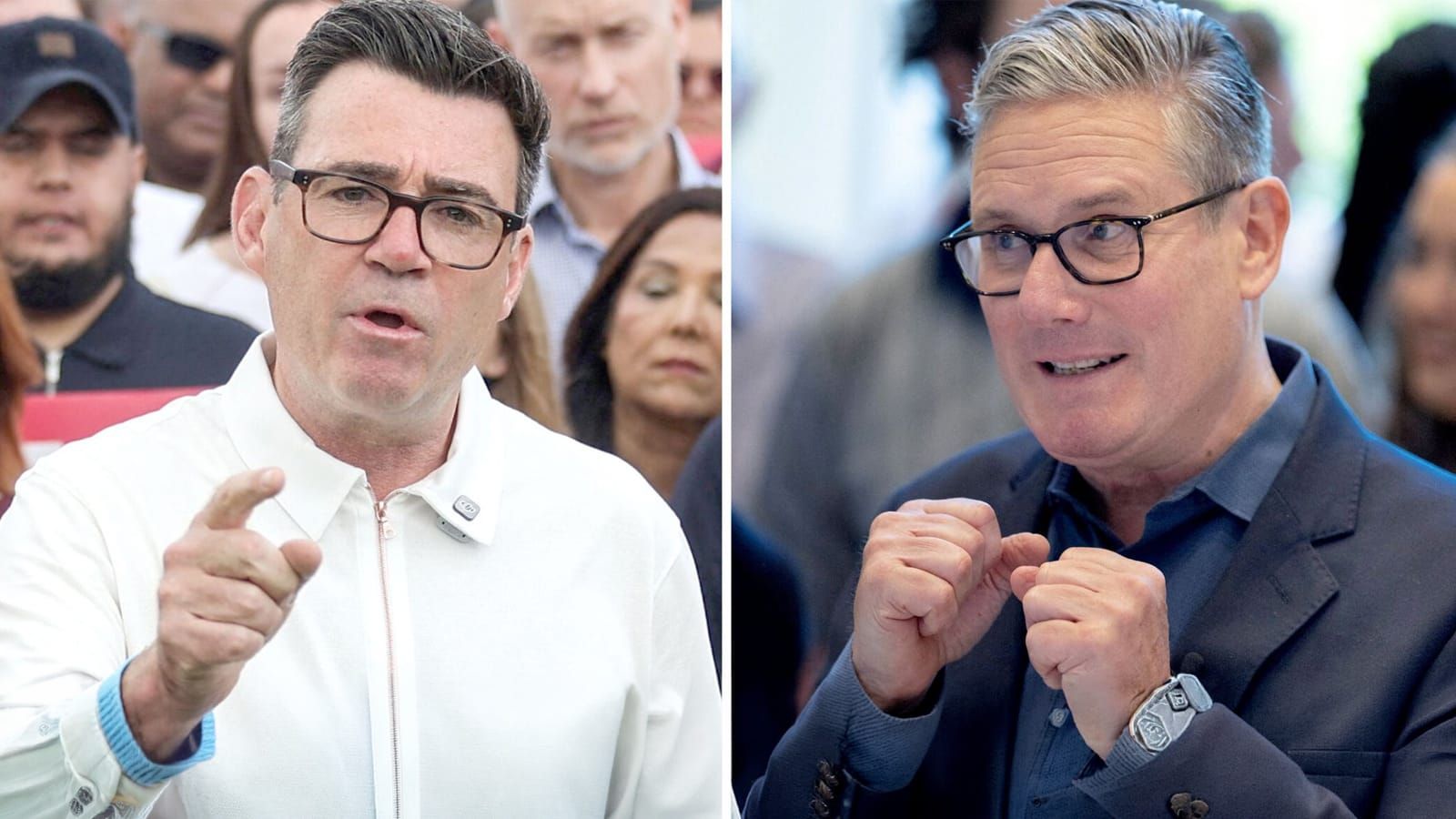
UK Prime Minister Keir Starmer is facing a weekend ultimatum to set out a timetable for his own departure, with Cabinet ministers reportedly drafting an "orderly transition" plan and around 100 of his own MPs publicly calling on him to step down.
The pressure tipped over on Thursday 18 June, when Greater Manchester Mayor Andy Burnham won the Makerfield by election with 54.8% of the vote, a 9,241 majority over Reform UK's Robert Kenyon. The Labour margin widened to 20.3 points, up from 13.4 at the 2024 general election, on a 58.75% turnout.
Burnham now sits in the Commons. That's the only piece he was missing.
Footage: Channel 7. Keir Starmer is expected to resign on Monday. Eleven months after a landslide, the PM's own party has finished him off.
Who is Andy Burnham?
He's been the man Labour talks about whenever the leadership comes up. Twice he's run for it, and twice he's lost. Now he's positioned to do it a third time, and the party is in the worst shape it's been in for decades, so he should be third time lucky.
Burnham was born in Liverpool in 1970, joined the Labour Party at 14, and read English at Cambridge. He worked as a researcher for Tessa Jowell before winning Leigh, a former mining seat in Greater Manchester, in 2001. He held it for 16 years.
Under Tony Blair and Gordon Brown he held three Cabinet positions in three years: Chief Secretary to the Treasury, then Culture Secretary, then Health Secretary. As Culture Secretary he attended the 20th anniversary of the Hillsborough disaster and was heckled by Liverpool fans. He turned that into a decade of campaigning that helped secure the second inquest into the 96 deaths and a finding of unlawful killing.
He lost the 2010 Labour leadership contest to Ed Miliband. He lost the 2015 contest to Jeremy Corbyn, finishing second. Then he walked out of Westminster and built a separate power base, winning the new Mayor of Greater Manchester role in 2017. He won re election in 2021 with 67.3% of the vote and again in 2024 in a landslide. During Boris Johnson's tier system standoff over COVID restrictions in October 2020, he fronted the press outside Manchester Central Library and refused to accept Westminster's terms. One of the local bars called him the King of the North. The name stuck.
What he stands for, in broad strokes: northern devolution, public ownership of buses and rail, social housing, and an aggressive line on rough sleeping. He's positioned as a soft left figure who can talk to Reform UK voters without losing the inner city. That's the case being made for him this weekend.
What Starmer's saying
The Telegraph, BBC, The Guardian and Sky News are all running the same line this weekend: Cabinet loyalists have told Starmer he has until Monday to set out a timetable for an "orderly transition" of power.
Asked outside Downing Street on Friday whether he'd stand in any leadership contest, Starmer told reporters: "There isn't one at the moment." He added that holding one would send "the country into chaos" but said: "If there is a contest, then yes I will run, I will stand, and I've said repeatedly I'm not going to walk away from that."
It's roughly what Theresa May said before resigning in May 2019, and what Boris Johnson said before resigning in July 2022.
How Starmer got here
Starmer was elected in July 2024 with a 172 seat majority and the smallest share of the electoral vote of any majority government since records began in 1830. That was the first warning. The roof started coming off almost immediately.
The Mandelson scandal. Starmer named Peter Mandelson as ambassador to Washington in December 2024 despite his own staff warning him in writing that Mandelson's friendship with convicted sex offender Jeffrey Epstein exposed the government to "reputational risk." Mandelson took up the post in February 2025 after security vetting that he reportedly failed. Starmer was not told. The emails came out in September 2025. Mandelson was sacked. Then in February 2026, newly published Epstein files showed Mandelson had sent market sensitive information to Epstein during the 2008 financial crash. Starmer's chief of staff Morgan McSweeney resigned over the appointment, saying he took full responsibility for advising the PM to make it. In April 2026, Starmer admitted to parliament he shouldn't have appointed Mandelson at all. He later apologised directly to Epstein's victims.
The economy. The flagship pledge was economic growth. Unemployment has risen from 4.8% to 5% on his watch. He's been forced into repeated policy U turns, and the cost of living crisis he was elected to fix is still the issue at the top of voter polling.
The May 7 elections. Labour suffered its worst local election result in living memory. 38 councils gone. Around 1,500 councillors lost. Reform UK swept across the old industrial north and into the midlands. In Wales, the Senedd election went down with the ship. Welsh First Minister Eluned Morgan lost her seat in Ceredigion Penfro and resigned as Welsh Labour leader the next day, the first sitting head of a UK government ever to be unseated while in post. Welsh Labour now has nine seats in the Senedd. In Scotland, the SNP came first and Labour finished tied with Reform UK on 17 seats each.
The cabinet walkout. On 14 May, Health Secretary Wes Streeting quit, telling Starmer he'd "lost confidence" in his leadership. Four junior ministers including Jess Phillips walked out behind him. So did four parliamentary private secretaries. The same day, Labour MP Josh Simons resigned the Makerfield seat in a move widely reported as clearing the path for Burnham.
The Labour grandees turn. David Blunkett and Harriet Harman publicly called on Starmer to set a departure date. Scottish Labour leader Anas Sarwar broke with him publicly. According to the LabourList tracker, 159 Labour MPs publicly back Starmer, 98 want him gone, and 146 are either silent or undeclare
How the revolt reached his Cabinet
It started on 7 May, when Labour suffered its worst local election result in living memory, losing more than 30 councils and around 1,500 councillors across England, Scotland and Wales. Welsh First Minister Eluned Morgan lost her seat in the Senedd. Reform UK and the Greens picked up the wreckage.
What's followed:
- On 14 May, Health Secretary Wes Streeting resigned, saying he'd "lost confidence" in Starmer's leadership. Four junior ministers including Jess Phillips followed him out. Four parliamentary private secretaries also walked.
- Also on 14 May, Labour MP Josh Simons resigned his Makerfield seat in a move widely reported as clearing the path for Burnham to return to Westminster.
- Labour grandees David Blunkett and Harriet Harman have publicly called on Starmer to set a departure date.
- Backbencher Catherine West has been collecting signatures for a leadership challenge. She needs 81 MPs, or 20% of the parliamentary Labour Party, to trigger one. The Mirror reported she had around 80 signatures by 11 May.
- According to the LabourList tracker, 159 Labour MPs publicly back Starmer, 98 want him gone, and 146 are either silent or undeclared.
Now look at Albanese's numbers
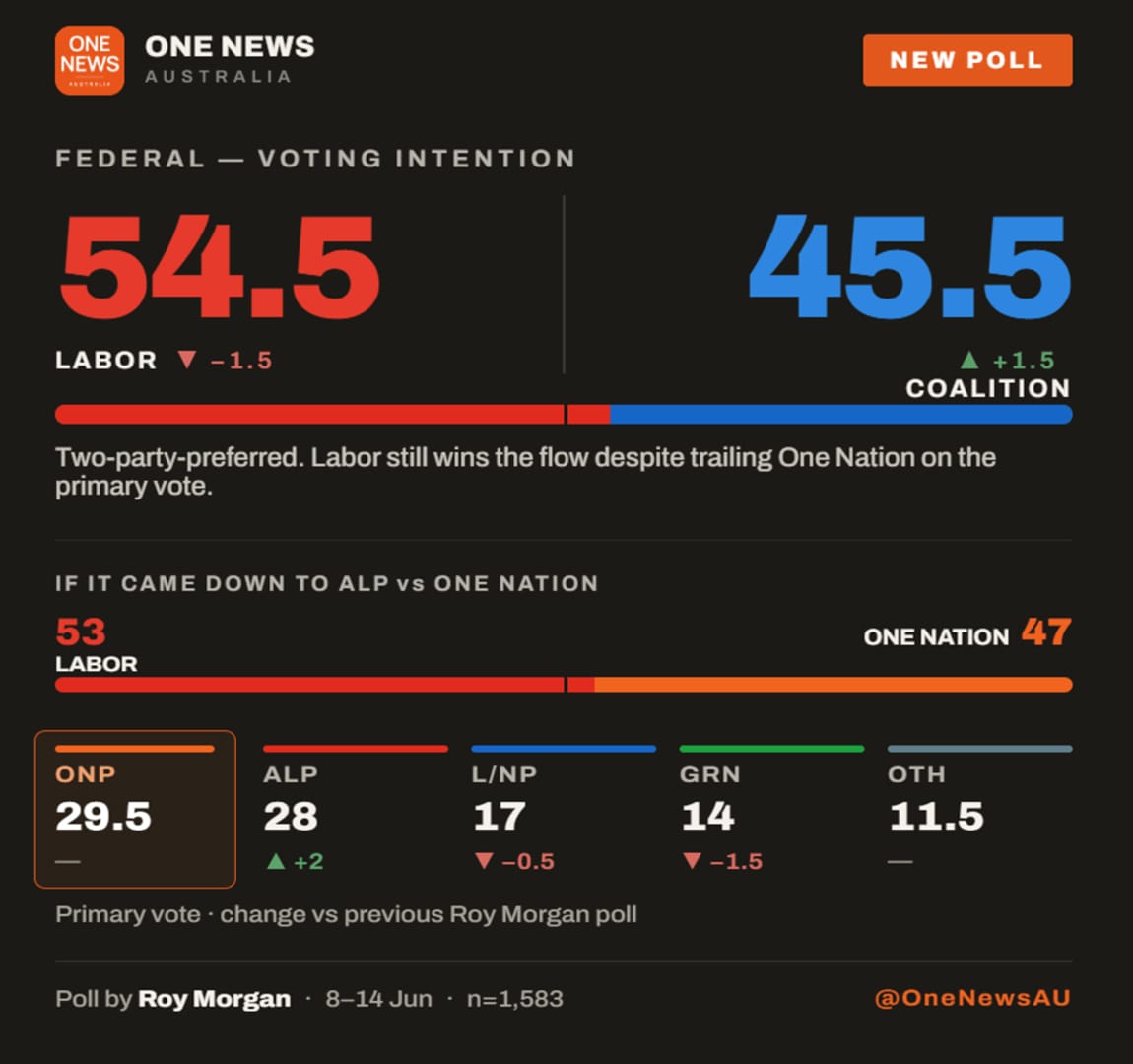
Anthony Albanese led Labor to its biggest federal majority since 1943 in May 2025. Thirteen months on, the latest Newspoll (conducted 8 to 14 June 2026) had the primary vote landing like this:
- One Nation 29.5%
- Labor 28%
- Coalition 17%
- Greens 14%
- Others 11.5%
It's the first time One Nation has led Labor in Newspoll. It's also the first time since Newspoll began in 1985 that the combined Labor and Coalition primary vote has dropped below 50%.
Albanese's net approval crashed to minus 24, the worst of his prime ministership and below his February 2025 record low of minus 21. 60% of voters told Newspoll they're dissatisfied with his performance, 36% are satisfied. 61% said Australia's overdue for a major political shake up.
Labor hasn't polled this badly on primary since the Gillard era of 2011 to 2013.
Why the same revolt is harder to trigger here
UK Labour has a clean mechanism. 20% of MPs nominate a challenger, and a contest is triggered. That's why Catherine West collecting signatures matters. That's why Streeting walking matters. There's a button to press.
Federal Labor doesn't work like that. Under the rules Kevin Rudd wrote into the caucus in 2013, 75% of caucus has to vote in favour of removing a sitting Labor prime minister before a leadership ballot can even start. With Labor holding 94 of 150 seats in the House and 30 of 76 in the Senate, that's a number nobody can plausibly assemble while the majority's intact.
Then there's the discipline. As Michelle Grattan wrote earlier this year, the Albanese caucus has taken what she called a "vow of public silence". MPs raise concerns in anonymous background briefings, never on the record. The 2025 landslide left every backbencher feeling they owe their seat to the leader.
The Labour caucus in the UK was every bit as locked down, right up until the May local elections. The trigger wasn't sudden courage. It was watching Reform UK gut Labour's primary vote and working out they couldn't survive the next general election with that result on the books.
What this means in marginal seats
One Nation's 29.5% isn't a protest vote any more. It's the lead. In DemosAU's April poll, Pauline Hanson outperformed both Albanese and then Liberal leader Angus Taylor on key leadership attributes. 58% saw her as decisive and strong, compared with 26% for Albanese and 33% for Taylor. 37% saw her as trustworthy, against 30% for Albanese and 24% for Taylor.
Newspoll's preference flows still put Labor narrowly ahead two party preferred, but that's only because One Nation preferences split. That cushion isn't a strategy.
Albanese isn't facing the same mechanism Starmer is this weekend. Federal Labor's rules and majority make a spill near impossible in the short term, and the next federal election isn't until 2028. But the parallel is now on the public record. UK Labour MPs went from publicly silent to publicly revolting in six weeks, and the latest Newspoll has One Nation at 31% and climbing.