British Prime Minister Keir Starmer is facing the end of his short tenure as his government falls apart at the seams following a devastating double resignation from his defence team.
Defence Secretary John Healey and Armed Forces Minister Al Carns have both walked out, leaving the UK Labour administration in a terminal freefall that political analysts believe will trigger an immediate leadership spill.
The high profile departures mean six ministers have abandoned the collapsing government in the space of a single month, leaving the Prime Minister isolated and entirely unable to govern.
Defence chiefs walk out over unsafe budget cuts
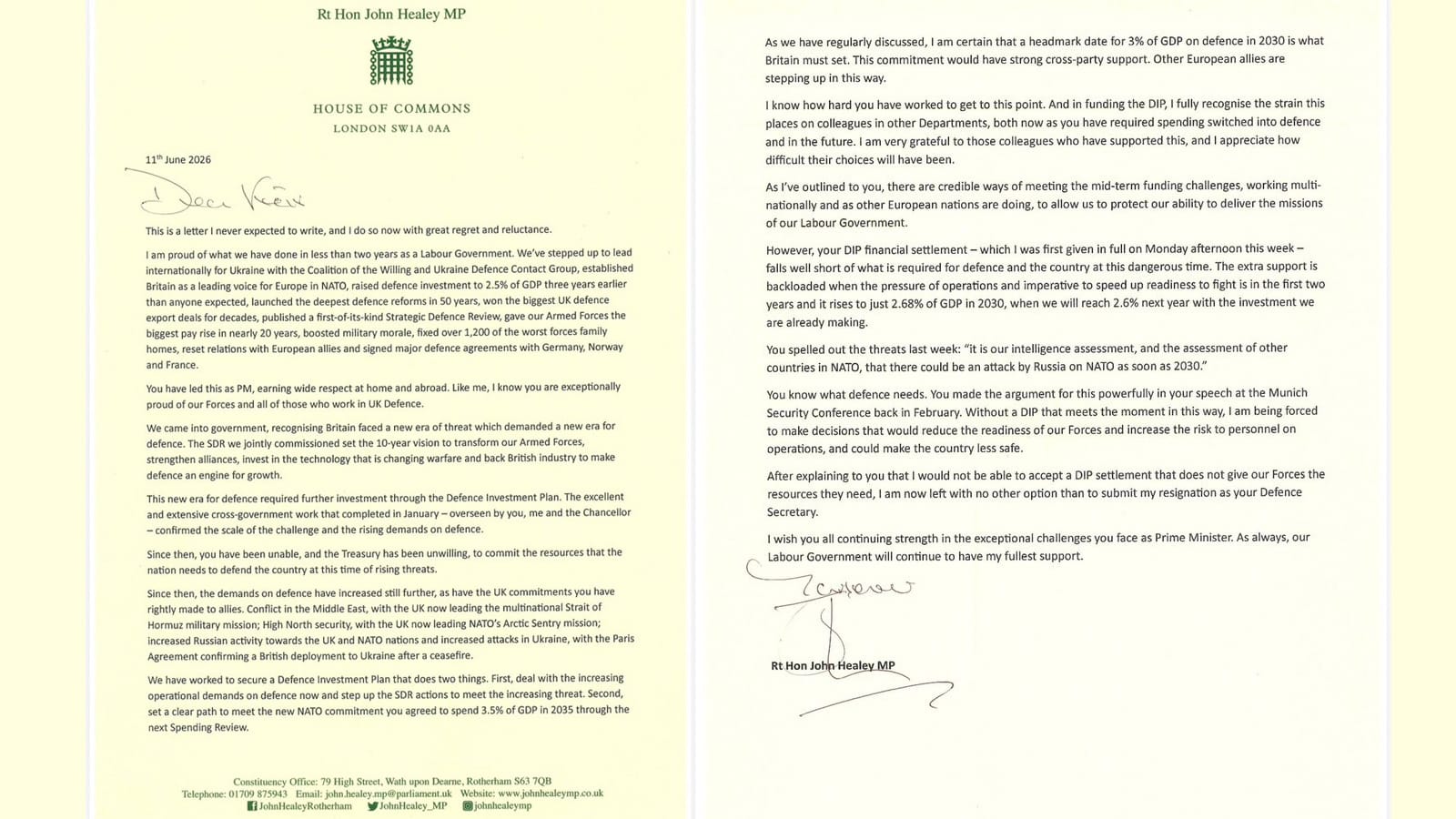
The immediate catalyst for the collapse is a bitter internal war over military funding, which culminated in John Healey delivering a damning exit letter to the Prime Minister.
John Healey stated he had "no other option" but to resign after the Treasury handed down a delayed Defence Investment Plan that he warned could make the country "less safe."
The former Defence Secretary had locked horns with Chancellor Rachel Reeves for months, demanding that defence spending rise to 3% of gross domestic product by 2030 to meet pressing NATO obligations.
Instead, the Starmer administration delivered a heavily backloaded settlement of just 2.68% of GDP, offering a meager £10 billion extra that defence officials insisted was a complete betrayal of national security.
Armed Forces Minister Al Carns backed the exit, publicly declaring that the Prime Minister's signature military strategy was "not fit for purpose" before walking out the door.
The timing of the cabinet collapse is catastrophic for the Prime Minister, arriving just weeks before a critical NATO summit where the UK must face global allies after admitting its own military strategy is compromised.
Critical pressure hits Australia's AUKUS alliance
The sudden resignation has sent immediate shockwaves through Canberra, directly disrupting critical talks regarding the future of the AUKUS agreement.
John Healey walked out just hours before he was scheduled to sit down with Australian Defence Minister Richard Marles to deepen intelligence sharing and defense ties between the two nations.
The sudden vacancy at the top of the British Ministry of Defence places immense structural pressure on the tripartite submarine and technology pact at a time of mounting global instability.
No other British Defence Secretary is thought to have resigned on a clear point of principle quite like this in living memory, leaving international allies completely blindsided.
The crisis leaves the UK armed forces hollowed out since the end of the Cold War and urgently needing to rearm to confront escalating international threats.
A record of severe mismanagement and failure
The defence collapse is the final blow for an administration already reeling from structural incompetence, a massive local election wipeout, and a string of poorly handled public scandals.
The Prime Minister's authority was already broken by the exposure of the Epstein Mandelson affair, which revealed the Labour leader appointed Peter Mandelson as Washington ambassador despite full knowledge of his ties to convicted pedophile Jeffrey Epstein.
The subsequent public backlash forced the resignations of Chief of Staff Morgan McSweeney and communications head Tim Allan, while Peter Mandelson was cast out of the Labour Party in disgrace.
Public anger has intensified over the Prime Minister's weak response to the Belfast beheading, where his administration faced intense criticism for failing to manage community safety and border controls effectively.
Further damage was done by the handling of the tragic Henry Nowak case, which became a symbol of a dysfunctional justice system operating under weak Labour oversight.
Compounding the policy failures, Labour was completely hammered in the May local elections, prompting more than 95 of the Prime Minister's own backbenchers to demand his immediate resignation.
Leadership spill looms as Labour rebels move in
The exit of John Healey is uniquely dangerous for the Prime Minister because it represents a revolt based on substance and national security rather than mere factional plotting.
Unlike previous rebels, John Healey was a party loyalist whose warning that the government is compromising national defense makes it impossible for Number 10 to spin the crisis away.
Health Secretary Wes Streeting, who walked out in mid May after declaring that the current leadership cannot take Labour into another election, immediately weaponised the defense departures to build momentum for a challenge.
With over 110 backbenchers already signing a letter of no confidence, rebel factions are moving quickly to consolidate behind a replacement candidate to force an immediate vote.
The Prime Minister has attempted to dig in, telling remaining cabinet members that he will stay because a formal challenge has not yet been officially triggered.
However, with his cabinet disintegrating in instalments and his own ministers branding his choices unsafe, the Prime Minister has run out of time, allies, and authority to hold onto power.