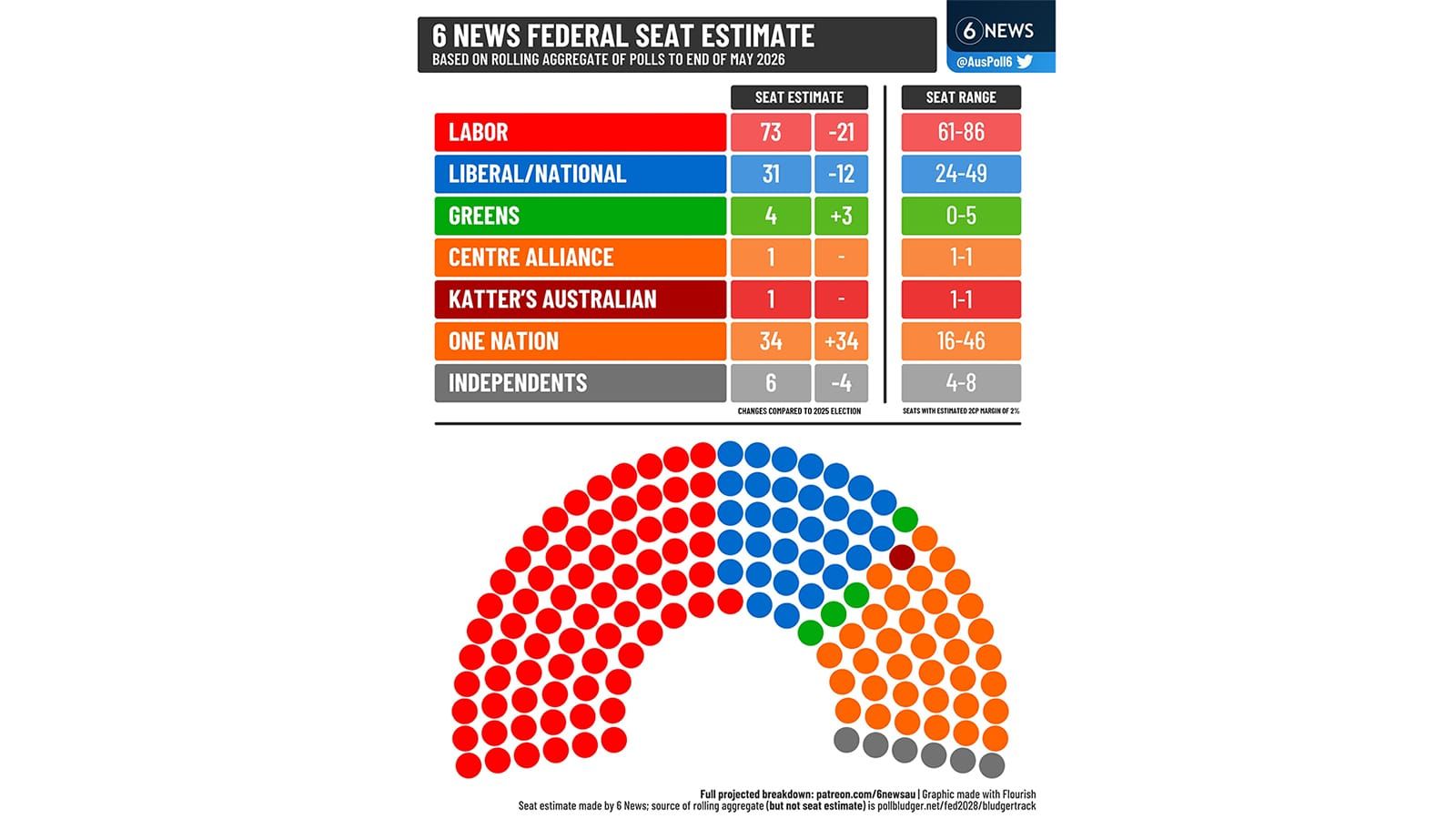
One Nation has overtaken the Coalition in the latest 6 News federal seat estimate, sitting on 34 projected seats to the Coalition's 31. Labor's still on top with 73, but well short of the 76 needed for majority government.
The maths is what matters next.
What the numbers actually say
The House of Representatives has 150 seats. Government requires 76. Labor's central projection of 73 puts the party three seats short. The Coalition on 31 sits so far back they couldn't form government even with every minor party and independent in the chamber behind them.
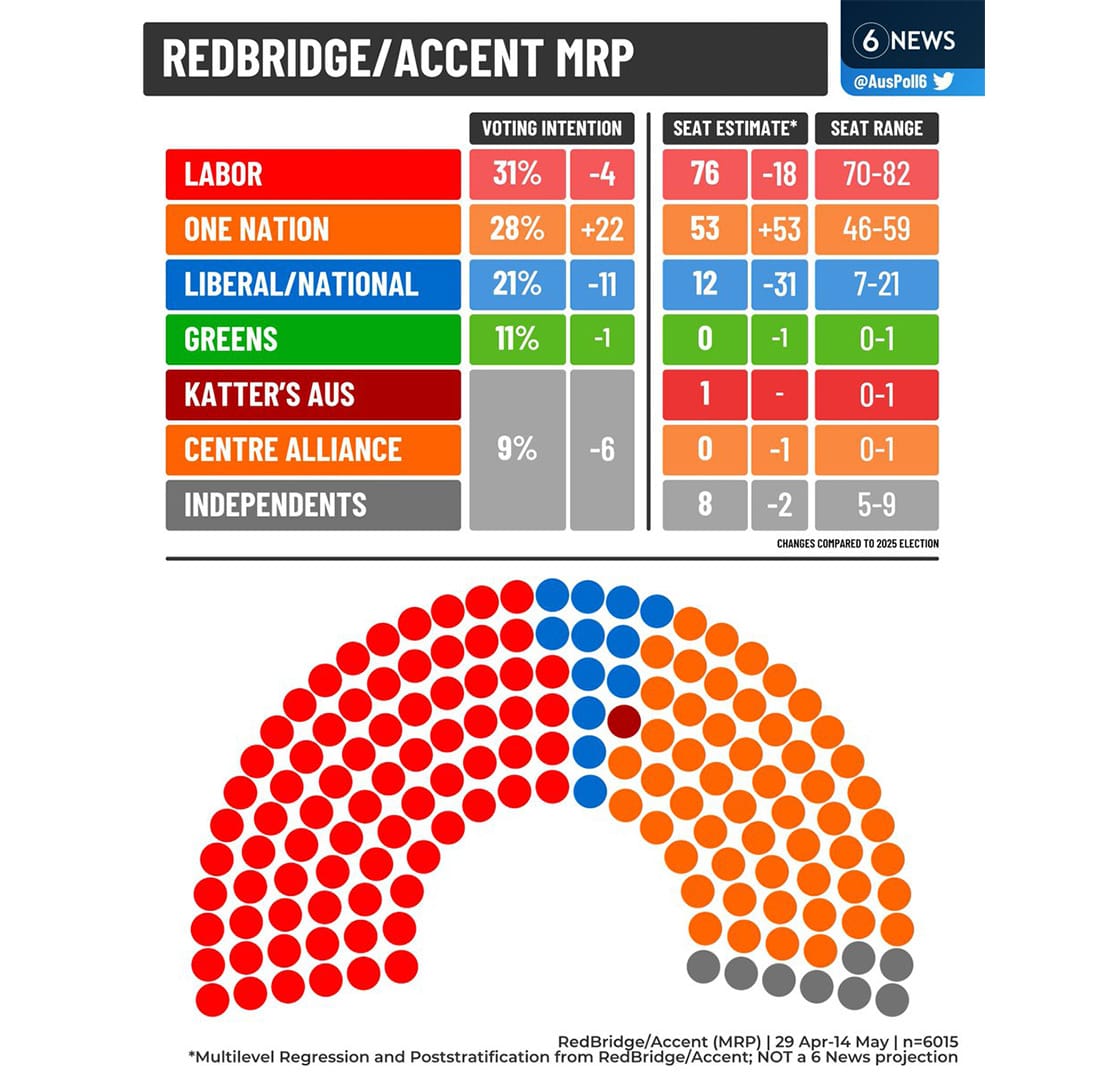
This is the first time in One Nation's history the party has sat ahead of the Coalition in a major polling aggregate. The seat range runs from 16 to 46, which is the working uncertainty. The recent RedBridge and Accent MRP, sample size 6015, projected One Nation as high as 53 seats on 28% of the vote before the broader aggregate smoothed it back to 34.
Why Labor still wins on these numbers
Labor's safety comes from the crossbench, not from its own seat count. The Greens, Centre Alliance, and most of the independents back Labor on confidence and supply. The teals have a voting record that lines up with Albanese on the questions that decide who governs.
Add it up. Labor 73, Greens 4, Centre Alliance 1, and four of the six independents. That's 82 seats. A comfortable working majority through confidence and supply, not a knife edge.
The Coalition collapse hasn't translated into a Coalition opportunity. The arithmetic still hands Albanese the keys.
Why the right bloc cannot form government yet
Bob Katter's Australian Party retains its single seat. Ideologically Katter sits closer to One Nation than to either major party on protectionism, energy policy, and rural concerns. In a confidence vote his number goes with the right bloc.
So the right bloc maths on the current aggregate reads: Coalition 31, One Nation 34, Katter's 1. Total 66.
Ten seats short.
That's the gap. The right bloc on current polling cannot form government, even with every member voting together. The Coalition's lost 12 seats compared to the 2025 result and now sits in third place. They're not the path to government anymore. One Nation is, but the party needs more seats than the aggregate currently projects.
When this becomes a real possibility
The next federal election is due in 2028. That's the date that matters. Two and a half years for the polling to keep shifting, for Labor to keep bleeding, and for One Nation to expand into the seats that decide it.
Labor's range bottoms out at 61 in the aggregate. If Labor drops to that level, the maths changes fast. The seats that move are not held by the Coalition. They're held by Labor.
Where the seats come from
The seats that decide a 2028 right bloc government are not Coalition heartland. They are working class and aspirational outer suburban Labor seats, plus regional Labor seats that have shifted on cost of living and immigration. The maps that matter are:
- Western Sydney
- Outer suburban and regional Queensland
- The Hunter and Central Coast
- Outer suburban Melbourne
These electorates moved heavily to Labor at the 2025 election. The polling shift in 2026 shows them moving again, but this time to One Nation rather than back to the Coalition. The Coalition's current pitch hasn't reached those voters in years. The inner city teal independent model never spoke to them either. Cost of living, energy prices, and immigration intake are the issues that move them, and One Nation has positioned itself as the only party willing to put numbers on those issues and hold the line.
How One Nation forms government
The working number is roughly 50 seats. If One Nation hits 50, Labor falls to the mid 60s, and the Coalition holds around 25, the maths gets there. 50 plus 25 plus Katter's 1 lands on 76.
That's the threshold. The current 34 seats need to hold as the floor. From there, One Nation expands into Labor marginals where the polling shift is already showing up. The Coalition's remaining seats come off the table by absorption rather than negotiation. Katter and any movable independents round out the bloc.
The polling trajectory shows voters aren't shifting from Labor to the Coalition. They're shifting to One Nation directly, with the Coalition bleeding into the same pool. The aggregate confirms it: One Nation up 34 seats from 2025, Labor down 21, Coalition down 12.
The 2028 election is the deadline. Between now and then, the ground work happens in the electorates that decide who governs.
Sources: