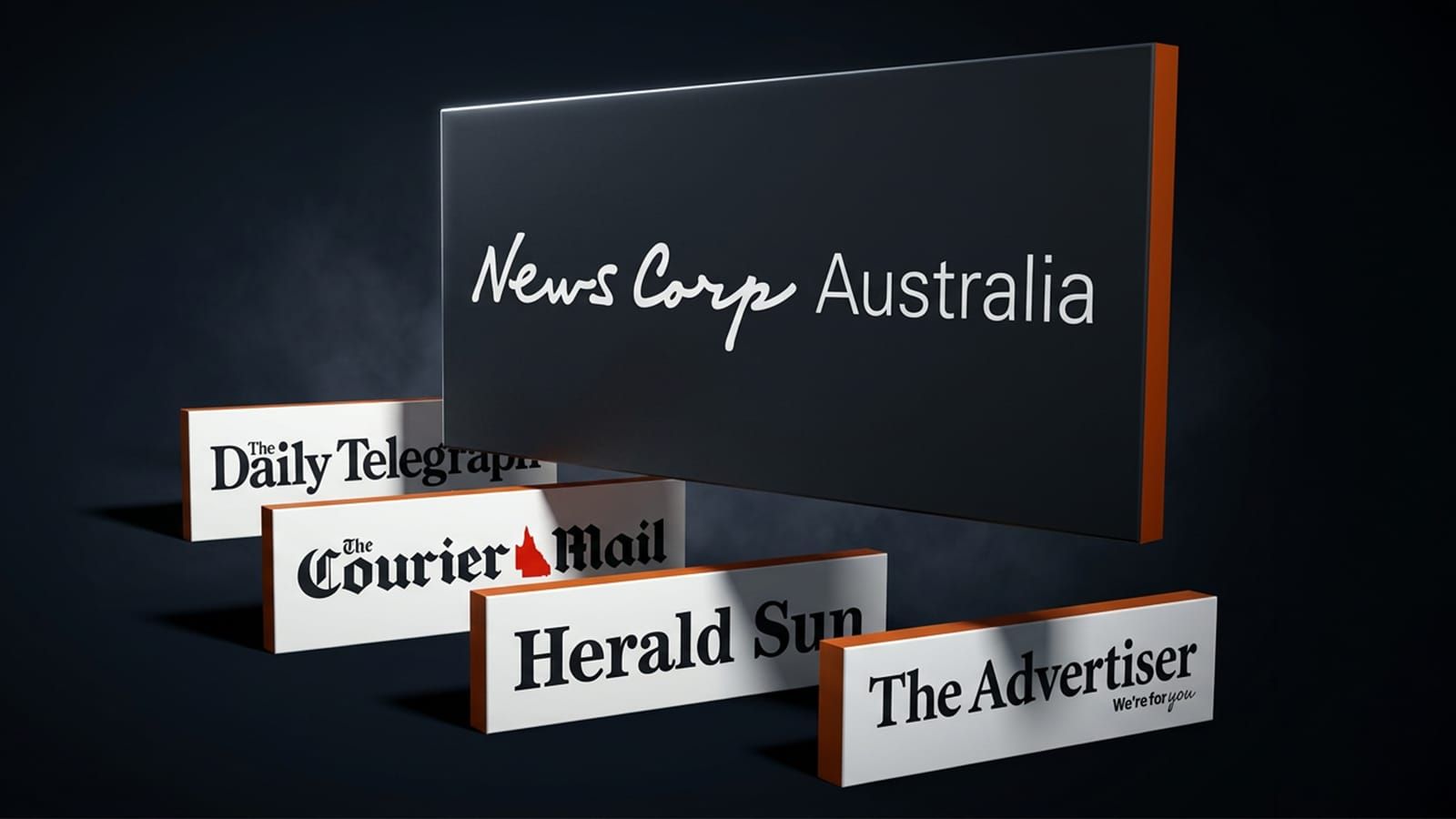
News Corp Australia's four biggest tabloid newspapers all lost paying subscribers in the same 12 months for the first time in a decade. A week before those figures became public, the Albanese government settled the design of a levy that will push Google, Meta, TikTok and LinkedIn to pay Australian news publishers.
The subscriber numbers sit in the company's own filings for the year to 30 June 2026, and all four of the big metropolitan tabloids went backwards:
- Sydney's The Daily Telegraph fell 7% to 141,000 paying subscribers
- Brisbane's The Courier Mail dropped from 144,000 to 132,000, a fall of more than 8%
- Melbourne's Herald Sun slid 3.4% to 149,000
- Adelaide's The Advertiser edged down 0.2% to 106,000
The Australian, the company's national masthead, was the only one of the five reported to grow, adding 1.8% to reach 342,000 subscribers. Numbers at the capital city papers have wobbled before, but this is the first year in a decade that all four fell together.
The Daily Telegraph lost 400,000 readers and the Herald Sun lost 500,000
Most people who read a tabloid never pay for it, so the readership numbers run well ahead of the subscriber numbers. On that wider measure, compiled by the research firm Roy Morgan and published inside the same filings, the Telegraph shed 400,000 of them to land on 4.2 million, and the Melbourne paper dropped half a million to finish on 4.3 million.
A senior News Corp executive, who spoke anonymously, said consumer revenue had still grown over the year, which means the higher prices covered the loss of the customers who left. The company declined to comment publicly on the figures.
The parent company's full year results, filed with United States regulators on 5 August, tell the same story in aggregate. News Corp Australia finished June with 1,162,000 digital subscribers across all its products, down from 1,166,000 a year earlier, and the news mastheads inside that total fell from 993,000 to 981,000. The group itself is in good health, with revenue of US$9.03 billion for the year, up 7%, and net income from continuing operations up 15% to US$743 million. The News Media division that houses the Australian papers had operating earnings down 9%.
Readers rank the Daily Telegraph and the Herald Sun the least trusted mastheads in Australia
The Digital News Report: Australia 2026, published on 16 June by the News and Media Research Centre at the University of Canberra, surveyed 2,025 Australians and asked them to rate 15 major news brands for trustworthiness. The Daily Telegraph finished last of the 15 on 48%, with the Herald Sun immediately above it on 49%. ABC News and SBS News led on 66%, and even a regional or local newspaper scored 63%.
Both mastheads gained 4 points over the year, in what the researchers describe as an almost across the board recovery in brand trust after a drop in 2025, and they still finished at the bottom of the table.
Only 23% of Australians pay for online news at all, a figure that has barely moved in four years, and the report puts the global plateau down to the persistent cost of living crisis. It also finds paying customers are increasingly men, higher earners, the highly educated and city dwellers, while payment rates in regional Australia, which is tabloid heartland, fell six percentage points.
News Corp raised the Daily Telegraph to $8 a week in October 2024
Some of the cost pressure on these subscriptions was applied by News Corp itself. On 18 October 2024 the company lifted the Daily Telegraph's digital subscription from $5 to $8 a week, a rise of 60%. A week earlier it had taken The Australian from $8 to $11 a week. Readers who signed up on a $1 introductory offer and then met the full price at renewal were being asked to find roughly $400 a year.
The Australian grew 1.8% over the same 12 months, under the same owner and through the same billing system as the four tabloids, which leaves household budgets unable to explain why only the tabloids lost customers.
The University of Canberra research also shows where the readers went. Television is still the main source of news for 33% of Australians, but social media has climbed to 29% and keeps growing.
The cancellation law Labor passed doesn't start until July 2027
Labor's new cancellation law has been blamed for the losses, but the dates don't support that.
The Competition and Consumer Amendment (Unfair Trading Practices) Bill 2026 passed parliament in early July 2026. It requires that every way of cancelling a subscription be easy to find and straightforward, and that anyone who signed up online can get out online, instead of being made to ring a call centre and argue with a retention agent. Andrew Leigh announced the reforms in November 2025 under the banner of stopping subscription traps.
The law commences on 1 July 2027, so it was not in force at any point during the 12 months in which these subscribers cancelled, and businesses have until then to rebuild their cancellation flows.
Daniel Mulino and Anika Wells settled a 2.5% levy on Google, Meta, TikTok and LinkedIn
On 3 August, Assistant Treasurer Daniel Mulino and Communications Minister Anika Wells finalised the legislation for the News Bargaining Incentive, and the two bills that carry it, the News Bargaining Incentive bill and the News Journalism Payments bill, reached parliament this week.
The scheme works as a charge the platforms can avoid by paying publishers instead. Any company running a significant social media or search service in Australia, and earning $250 million or more a year from it, faces the charge, and a platform that signs commercial deals with news businesses pays nothing. Treasury narrowed the base the charge applies to, from a company's wider Australian revenue down to its Australian digital advertising revenue, then lifted the rate to 2.5% from the 2.25% in the May draft to make up the difference. Mulino told ABC Radio National the government had "upped the charge rate from 2.25 to 2.5% to make sure that the overall amount of money raised by the deals entered into by these platforms with the media is about the same".
Professional networking sites are no longer excluded, which pulls LinkedIn in alongside Google, Meta and TikTok. The loading paid on regional journalists, small and medium publishers and outlets serving underrepresented communities doubles from 10% to 20%. A grants program opens for publishers and start ups turning over less than $150,000 a year, and the definition of a journalist now stretches to freelancers producing core news content.
"Journalism is the lifeblood of a robust democracy," Wells said. Any money the charge raises is distributed back to the news industry, and the government's stated preference is that the platforms sign deals so the charge collects nothing.
Meta walked away in 2024 and OpenAI signed a deal reported at US$250 million
The News Media Bargaining Code, passed in 2021, let the treasurer force the big platforms into paid negotiations with news businesses, and the deals that followed have been estimated at more than $200 million a year across the Australian industry. The individual contracts were confidential and none has been published, so what any single publisher receives is not on the public record.
That structure broke on 1 March 2024, when Meta announced it wouldn't renew its Australian news deals, arrangements worth about $70 million a year across the publishers who held them. Michael Miller, News Corp's Australasia executive chairman, said of the fight with the platforms: "If we cave in on this, we're caving in on everything." Google kept its deals but shortened them, renewing in July 2024 on one year terms with a cancellation clause attached.
In May 2024 News Corp signed a content licensing deal with OpenAI, the maker of ChatGPT, reported by The Wall Street Journal to be worth more than US$250 million over five years, covering mastheads across the group with the Daily Telegraph among them. Chief executive Robert Thomson told investors this month that the company has "trusted content relationships with OpenAI and Meta" and is in advanced discussions with several other companies.
News Corp was locked out of Labor's $67.6 million journalism fund
One News Australia revealed in July that the government's $67.6 million Journalism Assistance Fund is part paying the wages of more than 2,000 journalists across 184 private newsrooms. Each one draws roughly $39,000 for every full time journalist over three years, with the payments running until March 2028.
Nine Entertainment took $16.1 million of it and the Seven side of the newly merged Southern Cross group took $11.3 million. The eligibility rules barred any foreign controlled Australian entity from applying, which locked out News Corp's mastheads, Sky News Australia, Guardian Australia and Daily Mail Australia before they could lodge a form. News Corp also received nothing from the $50 million Public Interest News Gathering program in 2020, as fact checkers confirmed at the time.
Sky News host Andrew Bolt took that investigation to air the following night and called the arrangement "a corrupting influence". He argued funded journalists should declare the money at the bottom of every article they write, which the grant rules do not require.
Nine and Seven are drawing a Commonwealth wage subsidy while News Corp is positioned to be paid by Google, Meta and OpenAI under a levy the Commonwealth designed, and One News Australia takes no money from either side.
Whether any of that money reaches a newsroom depends on what Google, Meta, TikTok and LinkedIn decide to sign.