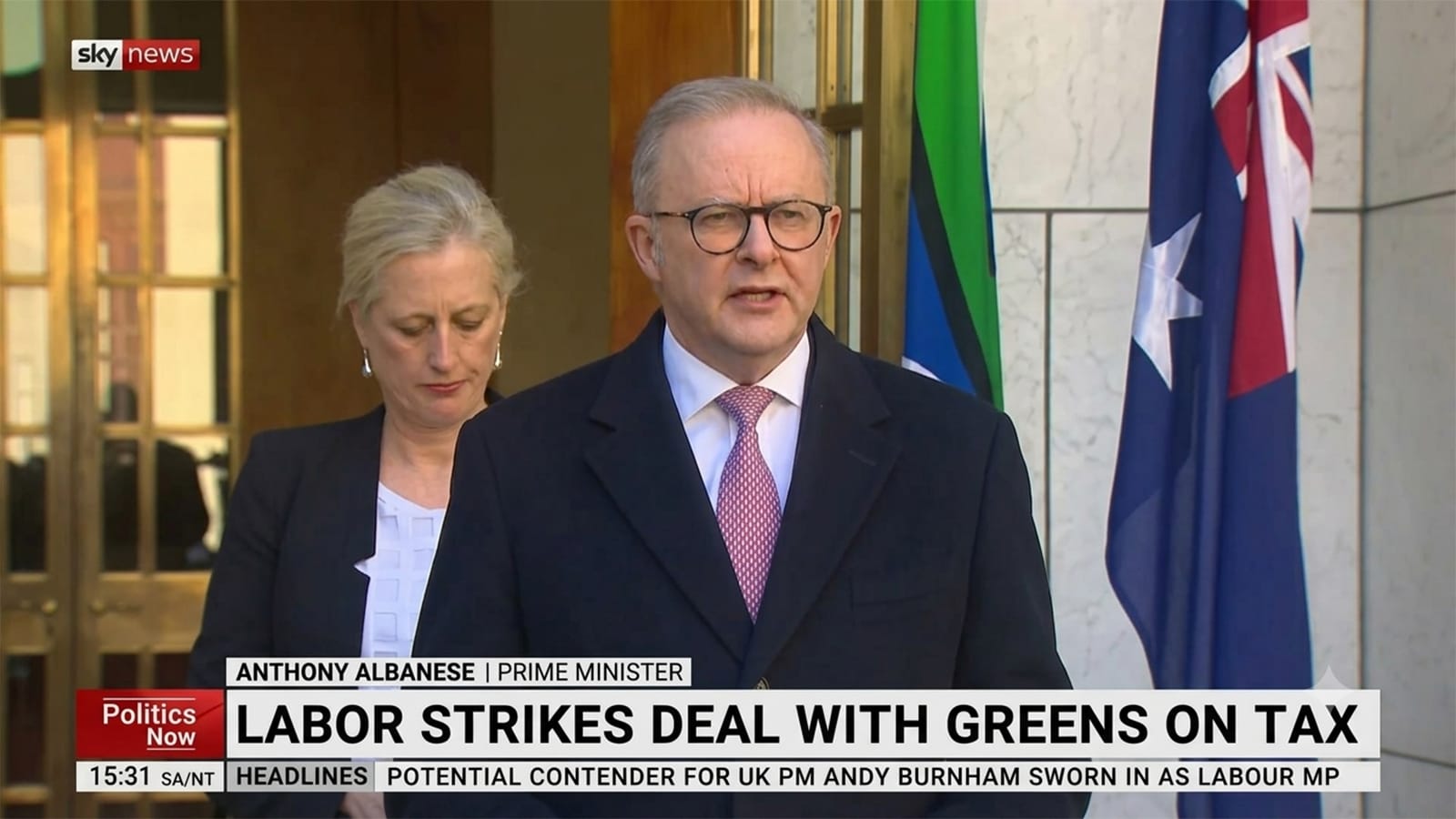
Anthony Albanese has done the one thing he spent the last election swearing he'd never do. To get his tax overhaul through the Senate this week, he cut a deal with the Greens.
He could not have been clearer beforehand. "I don't negotiate with the Greens," he told reporters in Perth in March 2025. By his own count he said it 385 times: Labor would "not govern in coalition with anyone, including the Greens." His own words are in the video. This week he negotiated with the Greens, and his tax bill, the Treasury Laws Amendment (Tax Reform No. 1) Bill 2026, is passing because of it.
Video: SBS News. Anthony Albanese rules out any changes to negative gearing or capital gains tax before the 2025 election.
It's not the first promise he's counted, then broken
This is a habit. The 385 times on the Greens is just the latest. "For the 50th time," he said in April 2025, Labor would not touch negative gearing or capital gains tax. This budget does both. And before the 2022 election he promised household power bills would fall $275 a year by 2025, a pledge the Coalition says he made 97 times. The regulator says bills went up instead, and the independent promise tracker marks it broken.
The Greens didn't actually win anything
Here's the odd part. For all the noise about a deal, the Greens walked away with next to nothing.
They got two things. A ban on new self managed super fund borrowing to buy houses, with existing loans grandfathered, and an eight week extension to a Senate inquiry into Labor's NDIS cuts.
The super fund ban sounds big and isn't. The government's own media release admits these loans are "less than half a per cent of new residential borrowing each year." And the extension buys nothing, because the Greens say they'll vote against the NDIS bill anyway, delay or no delay. So they traded their votes on tax for a short pause on a bill they were always going to oppose. Labor got its tax law. The Greens got a media release.
If you're trying to buy your first home
This is where it lands on you. Buy an established home from here, and you get neither negative gearing nor the full 50% capital gains tax discount that fuelled the market for years.
You'd think that finally tilts the field your way. It barely moves. The Grattan Institute says prices end up at most 2% lower than they would have been. At the same time the banks have tightened, auction clearances dropped to 50.4% after the budget, and a deposit is further out of reach than ever. You get a rounding error off the price and a harder loan.
If you already own an investment property
If you already own, you're better placed than the next buyer, but you're not left alone either. Negative gearing on what you hold is grandfathered, so that stays. The 50% capital gains tax discount is the catch. It only covers the growth up to 1 July 2027, when your property is treated as sold and rebought at its market value. Anything it earns after that date loses the discount and is taxed the new way, indexation plus a 30% minimum. So the only way to keep the old rules on the whole gain is to sell before 1 July 2027. Hold past it and your future growth is caught too.
What it looks like on a $1 million gain
Say you've got a $1,000,000 gain and you're on the top tax rate.
- Sell before 1 July 2027: the 50% discount means $500,000 is taxable, about $235,000 in tax, and you keep roughly $765,000.
- On $1,000,000 of growth after 1 July 2027: no discount, the gain is indexed, then taxed at up to 47% with a 30% floor, roughly $350,000 in tax, and you keep about $650,000.
Same gain, around $115,000 more, just on the part that grows after the cut off. This is general information, not financial advice. Your real position depends on your income, your cost base, any improvements and the apportionment method, which the government still hasn't finalised. Talk to a registered tax agent or financial adviser before you decide.
So the ones who come out ahead are the investors already holding, who can sell under the old rules before that date. The next buyer never gets that option. Even the Greens' Larissa Waters said Labor chose "to put the 1% over the millions of people trying to buy their first home." Politicians who own property are near the front of that queue.
The Prime Minister is the case study. He sold a Dulwich Hill investment property in December 2024 for $1.75 million, a $575,000 gain on what he paid for it in 2015, all taxed under the old rules. He still owns a property portfolio worth about $7 million and keeps negative gearing on what he holds. The window to sell the rest under the old discount runs until 1 July 2027. The first home buyer who comes next gets none of those options.
The death or divorce catch
And the grandfathering can be unwound by a death or a separation. The explanatory memorandum to the tax bill confirms that when a jointly owned property changes hands after budget night, and one owner "ceases to have an interest," the other is treated as having "acquired a new ownership interest." That share loses its grandfathering, so it drops out of negative gearing and into the new capital gains rules, even on a property bought years before the budget. The Australian Financial Review reports Treasurer Jim Chalmers has confirmed it: a co owner dying or a couple divorcing strips the protection from the share that passes over. We've broken down exactly how it works here.
If you're on the NDIS
The government is selling its NDIS cuts as a fraud crackdown. Its own numbers say otherwise. Of the roughly $38 billion the changes save, only about $0.9 billion, around 2.3%, comes from chasing fraud.
The rest comes from people. The government's own modelling points to about 241,000 people losing their place on the scheme by 2031, and from October, budgets for social and community participation are cut in half. That's the real saving. It's the bill the Greens just bought eight more weeks to keep arguing about, before voting no regardless.
What actually changed in the tax bill
The package that left the budget on 12 May hit nearly everyone. By the time it passed, the government had carved most of business back out to get it through, at a cost of about $475 million. Here's the before and after.
| Category | Original budget (12 May 2026) | Amended / final | Who forced it |
|---|---|---|---|
| CGT discount | Replace the 50% CGT discount with CPI cost base indexation plus a 30% minimum tax on gains from 1 July 2027, for individuals, trusts and partnerships. | Core change stands. Carve outs bolted on. Treasurer's power to extend the discount removed. | Greens + business |
| Small business | Same indexation and 30% min tax on active business assets. | 50% active asset reduction threshold lifted from $2m to $10m turnover, covering 98% of active businesses, about 2.7 million. | Business groups, Senate inquiry |
| Startups | No specific carve out. | Proposed Innovative Business CGT Concession keeping the 50% discount on startup shares: under $50m turnover, under 10 years old, held 5 years, unlisted. Still at consultation. | Tech Council, AusBiotech, founders |
| SMSF | Still able to borrow via LRBAs to buy residential property. | New residential borrowing banned, 45 days after royal assent. Existing loans grandfathered. Commercial borrowing unaffected. | Greens |
| Trusts | 30% min tax on discretionary trusts from 1 July 2028. | All testamentary trusts confirmed exempt for genuine estate planning. Broader trust changes split into separate legislation later in 2026. | Business, legal sector |
| Ministerial powers | Nine separate ministerial instruments, including the "new build" definition. | Discretions "no longer needed" removed; "new build" to be written into the Act. Definition still unpublished. | Greens, CPA Australia, Tax Institute |
| Big business | 2 year loss carry back to $1bn turnover, startup loss refundability, expanded venture capital incentives, permanent $20,000 instant asset write off. | Unchanged. Sweeteners, not targets. | n/a |
And the line Albanese keeps repeating, that this simply takes capital gains tax back to 1999, One News has already shown the Treasury Secretary won't back.
The part that wasn't for you: a land grab hiding in plain sight
Step back and the pattern is hard to miss. None of this was built for you.
You're priced out and the banks say no, so the same government points you to its Help to Buy scheme, where it takes up to a 40% stake in your home and shares in the growth when you sell. Renovate and lift the value, and its slice climbs too, for nothing. You don't get a home of your own. You get a silent part owner, and it's the Commonwealth.
While households are squeezed, the land itself is changing hands. In Victoria, a law passed in March lets transmission companies compulsorily take easements across private farmland for the government's energy projects before the environmental checks are even finished. The Victorian Farmers Federation called it a "land grab." In New South Wales the transmission bill for a single renewable zone has blown out from $650 million to $5.5 billion, with farmers sent compulsory acquisition letters.
Tie it together. Prices nudged down but loans pushed out of reach, so you reach for the government's hand in Help to Buy. Farmland taken cheaply and strung with lines for the government's energy plan. A tax bill sold as fairness that quietly protects the people already holding the assets. It's optics. The devil's hiding in plain sight.
So who's really looking out for you
Ask the question the government would rather you didn't. Who does this actually help? Existing investors got the head start. The government got its tax bill, a stake in your mortgage and a faster route across your land. The first home buyer, the family on the NDIS and the farmer can all see who's carrying the cost. And the man who said 385 times he'd never deal with the Greens did exactly that to make it law.