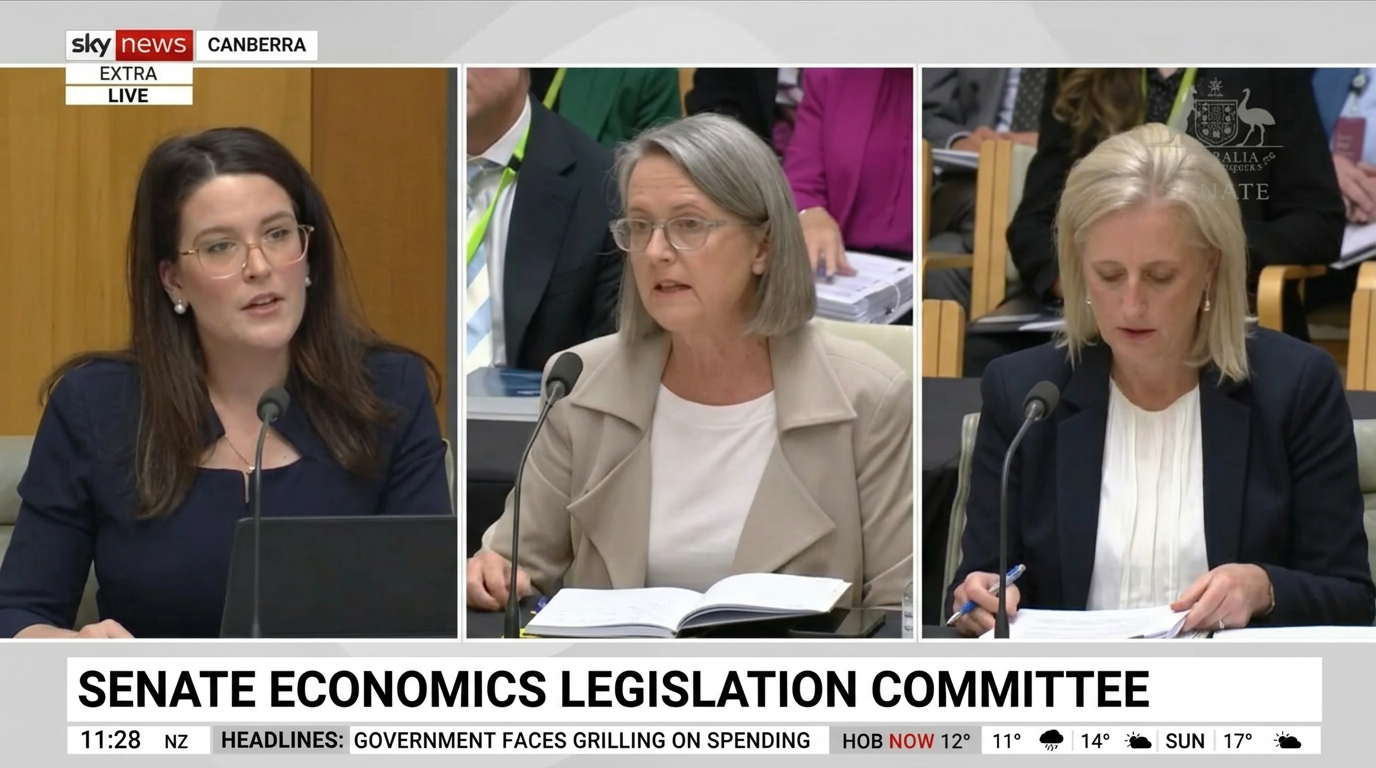
Treasury Secretary Jenny Wilkinson and Finance Minister Senator Katy Gallagher fronted the Senate Economics Legislation Committee this week, where Liberal Senator Claire Chandler led the questioning on the government's capital gains tax overhaul. Under that pressure, Wilkinson confirmed twice that the Albanese government's new system isn't the pre 1999 model the Prime Minister keeps describing in Parliament. The bill is missing 5 year income averaging, and it adds a 30% minimum tax the pre 1999 system never had. Both features make the new model harsher than the one it's being pitched to revive.
On 9 April 2025, a journalist asked the Prime Minister directly: "Can you just be really clear, can you rule out any changes to negative gearing and capital gains tax settings if reelected?"
His answer: "Yes. How hard is it? For the 50th time."
In August 2025 he reinforced it at the productivity roundtable, telling unions and welfare groups: "The only tax policy we're implementing is the one we took to the election."
The 2026 Budget was handed down on 12 May 2026. It included changes to negative gearing, replacement of the 50% capital gains tax discount with a cost base indexation regime, and a new 30% minimum tax on capital gains for individuals, trusts and partnerships. The Treasury Laws Amendment (Tax Reform No. 1) Bill 2026 was introduced into Parliament on 28 May 2026. The package takes effect from 1 July 2027.
Video credit: Senate Economics Legislation Committee broadcast, via Sky News Australia.
The back to 1999 line that doesn't quite land
In Parliament on 26 May 2026, the Prime Minister told the House: "We are also changing the capital gains tax regime to go back to 1999."
Chandler, Shadow Finance Minister and deputy chair of the committee, asked Wilkinson whether the pre 1999 system imposed a minimum 30% tax rate.
"Uh, no, it didn't, Senator," Wilkinson replied.
Chandler also asked whether the new system would allow the 5 year income averaging that existed before 1999.
Wilkinson: "That has not been part of the announcements that the government's made in relation to the tax package."
So two of the features that made the old system livable, indexation alone with no minimum rate and 5 year smoothing for one off gains, are missing from the bill being pitched as a restoration of that system. Independent legal commentary backs Wilkinson. Herbert Smith Freehills Kramer's budget analysis confirmed the government isn't reintroducing 5 year averaging, and that the 30% minimum tax is a new feature, not a revived one.
The maternity leave problem nobody modelled
Chandler put it plainly: "Why did the minimum 30% tax element embedded in these measures particularly affect women, and especially younger women, who might be taking time out of the workforce in a given year, for, say, maternity leave?"
Wilkinson didn't have a number. "I don't have a breakdown of the impact of the minimum tax rate by those cohorts."
Chandler pressed: "Has Treasury not undertaken analysis on these tax policies to see how they impact women specifically?"
Wilkinson took it on notice.
Gallagher, who is the Minister for Women as well as Finance Minister, pivoted to the Women's Budget Statement and the expansion of paid parental leave when pressed on gender impacts.
The mechanics of the policy are what makes the question matter. The 30% minimum tax applies to net capital gains for individuals whose marginal rate falls below 30%. Anyone earning under about $45,000 in the year they realise a gain is hit at 30%, regardless of their actual marginal rate. That captures people on parental leave, between jobs, studying, taking caring time off, or working part time. Paid Parental Leave isn't classed as means tested income support, so PPL recipients aren't covered by the carve out that protects pensioners and JobSeeker recipients.
The $2 rent flinch
Wilkinson told the committee, presenting her department's housing modelling: "Our best estimate is that rents would be slightly lower, about $2 per week lower."
Chandler waited. A few minutes later she logged the correction on the record: "I believe you just said that rents would be slightly lower about $2 per week lower as a consequence of just the tax changes. I think you meant to say $2 per week higher."
Wilkinson: "Yes, thank you. Have that correction."
The Secretary of the Treasury, presenting on her department's modelling for a tax bill introduced eight days earlier, misread the direction of the rent impact in front of a Senate committee. The $2 a week upward figure has been reported by Commonwealth Bank, Domain and others since budget night. It isn't an obscure number.
The 35,000 homes the budget doesn't brag about
Box 4.4 of Budget Paper 1 contains Treasury's own supply modelling. It accepts that the tax changes themselves will reduce dwelling supply, then leans on a $2 billion infrastructure fund to argue the net effect is positive.
Chandler asked Wilkinson the obvious question: "So if you didn't make the CGT changes and the negative gearing changes, would there be 35,000 more houses for young Australians to potentially purchase?"
Wilkinson didn't argue the number. She talked instead about "ownership mix" and switching investors out of established homes.
Property Investment Professionals Australia, citing Treasury, has reported the forecast supply loss from the tax changes is around 35,000 dwellings over a decade. The $2 billion infrastructure fund covers an estimated 65,000 enabling sites. The net headline gain only stacks up if the infrastructure spending is counted as a housing measure rather than a separate program.
The Treasury modelling that wasn't Treasury modelling
On the Monday before Estimates, the Treasurer released figures he said modelled the Coalition's alternative budget bottom line. Chandler asked Wilkinson directly whether Treasury had conducted that modelling.
Wilkinson: "No."
Chandler: "When did Treasury first learn of this government modelling of opposition policies?"
Wilkinson: "Well, the first time I learned of it was when I read it when it was reported."
Chandler then asked Gallagher to table the modelling. Gallagher's response: "I don't have a document."
Gallagher then proceeded to read out a list of Coalition policy positions and what she said the cost impact would be. Chandler pressed for the document. Gallagher refused to table it. Chandler logged the request on the record: "It's a reasonable request of this committee to ask for the modelling that the government has done, using taxpayer resources, apparently provided to the media."
By the end of the day at Estimates, the government still hadn't produced the document, identified its author, or explained its methodology.
The vibe is the budget
This is the most significant change to the capital gains tax system in a quarter of a century. Wilkinson called it that herself, in Sydney last Thursday, at the Australian Business Economists lunch.
At that lunch she also said 90% of young Australians would be better off under the reforms. Under questioning at Estimates she confirmed the 90% figure was generated by modelling the package as if it had been in place since the year 2000, and that the top 10% of lifetime earners would be worse off by age 30 under the new system. The headline figure was modelled by looking backwards over 26 years, not forecast forward.
So the package itself is missing two features of the system it claims to revive. The rent impact got misread by the Treasury Secretary on the day. The supply hit sits in the budget papers. The opposition modelling has no Treasury author. And the Minister for Women couldn't produce gender analysis on a tax that fires hardest on people taking time out of paid work.
Chandler summed up the morning on the record: "I'm not exactly sure why the government can't hold itself to the same transparency requirements of the Treasury Department."
The Prime Minister said it 50 times before the election. He's said back to 1999 twice in Parliament. His own Treasury Secretary has now confirmed under oath that it's neither.
Sources:
- https://www.sbs.com.au/news/article/anthony-albanese-promised-he-wouldnt-touch-housing-tax-reforms-now-hes-defending-them/3vqxy06kv
- https://ministers.treasury.gov.au/ministers/jim-chalmers-2022/speeches/2026-27-budget-speech-parliament-house-canberra
- https://www.accountantsdaily.com.au/tax-compliance/22482-labors-tax-changes-to-be-scrutinised-by-senate-inquiry
- https://www.hsfkramer.com/notes/taxaustralia/2026-posts/federal-budget-2026-back-to-the-future
- https://au.andersen.com/capital-gains-tax-changes-2026/
- https://www.commbank.com.au/articles/newsroom/2026/05/2026-budget-updated-housing-outlook.html
- https://www.domain.com.au/news/news-federal-budget-2026-negative-gearing-cgt-changes-explained-1513516/
- https://propertyinvestmentprofessionals.com.au/blog/budget-2026-negative-gearing-cgt-reform-international-lessons
- https://thenightly.com.au/politics/labor-to-submit-controversial-capital-gains-tax-negative-gearing-bill-despite-criticism-c-22346978
- https://en.wikipedia.org/wiki/2026_Australian_federal_budget