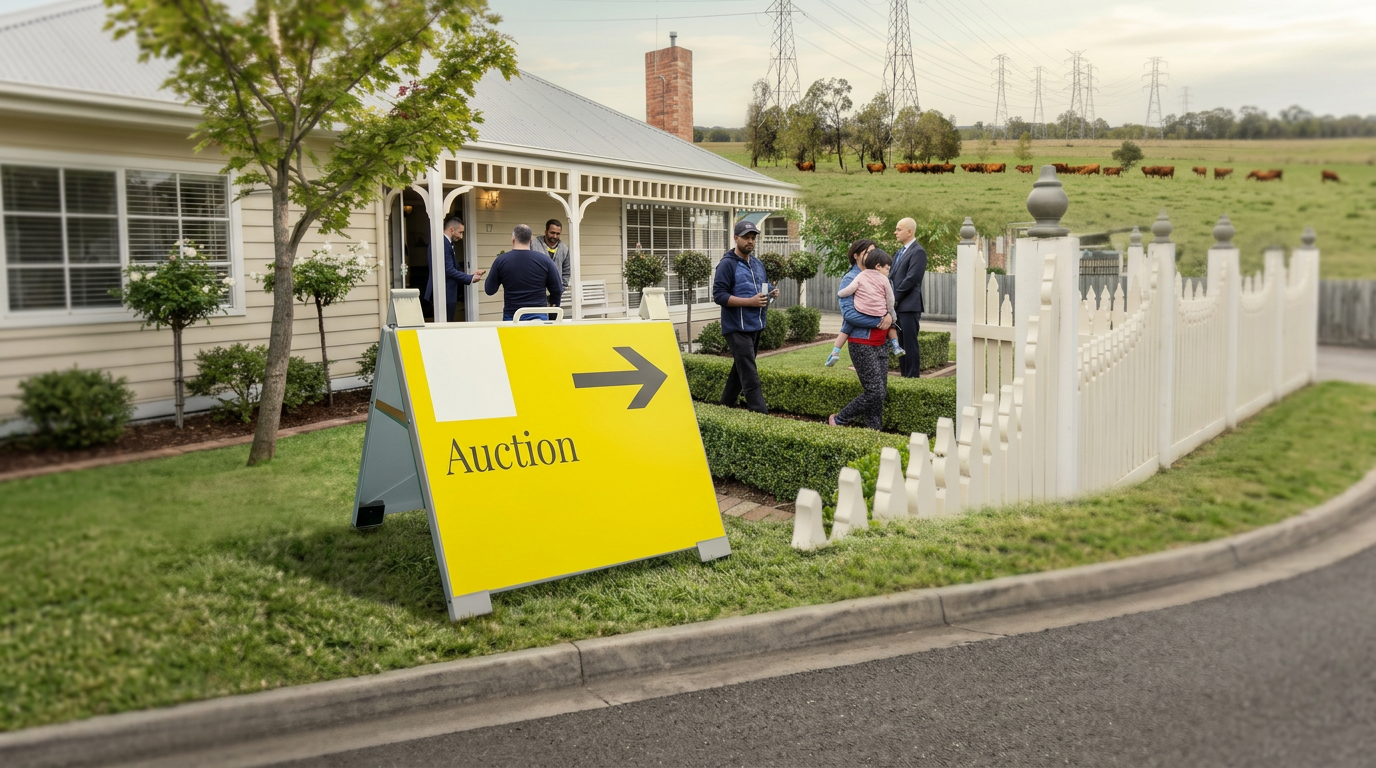
Three Labor housing and energy policies have landed on the Australian property market in quick succession, and the auction floor is now showing the strain.
The combined capital city auction clearance rate fell to 50.4 per cent on the first weekend after the May budget, the lowest final clearance result since the week ending 3 May 2020 in the early stages of the COVID pandemic. Sydney came in below 50 per cent the same weekend. The following weekend's national rate sat around 52 per cent. A year ago the combined capitals were clearing in the mid 60s.
Cotality head of research Tim Lawless told The Nightly the budget's negative gearing and capital gains tax changes could discourage landlords and reduce rental supply over the next two to five years. Ray White chief economist Nerida Conisbee told AAP that the biggest impact on the market right now was rising uncertainty, naming three consecutive interest rate rises, the Middle East conflict and the budget itself. Open home attendance, tracked across roughly 12,000 Ray White listings, fell from 2.5 attendees per property to 2.1 in a single week.
So the slide isn't all the budget. But the budget is doing the rest.
Negative Gearing & Capital Gains Tax
The 2026 to 2027 budget restricted negative gearing on established residential investment properties purchased after 7.30pm AEST on 12 May 2026, with full effect from 1 July 2027. New builds remain exempt. Existing investors are grandfathered, including buyers who'd exchanged contracts before budget night but hadn't yet settled. From 1 July 2027 the 50 per cent CGT discount is replaced with cost base indexation and a minimum 30 per cent tax on net capital gains for assets held longer than 12 months.
Westpac's economists now forecast a 34 per cent fall in new investor activity and a 20 per cent decline in total market turnover. Dwelling values across the major capitals are tipped to finish 2026 flat, with Sydney and Melbourne forecast for outright declines of 3 per cent and 4 per cent respectively. Morgan Stanley has tipped a 5 to 10 per cent national price fall. CBA's Luke Yeaman has estimated the tax changes alone could push prices roughly 3 per cent lower over three years.
The Lender Fallout
Two days after budget night, on 20 May 2026, Westpac wrote to mortgage brokers warning that investor loan applications would be reassessed under the new rules. Conditional approvals will be reassessed when they progress to unconditional approval, in line with the policy that applies at that point. Unconditional approvals already in place are not retrospectively reassessed.
The mechanics are simple. Lenders count expected negative gearing tax benefit as income when working out how much an investor can borrow. Strip that out for established property purchases and borrowing capacity drops. Mortgage brokers and analysts have put the reduction at up to 20 per cent, with some extreme cases higher.
Macquarie moved at the same time as Westpac. NAB and white label lender Connective Horizon followed in the weeks after, recalibrating their serviceability calculators to confine negative gearing benefits to qualifying new build stock for most fresh investor deals. Great Southern Bank confirmed its negative gearing policy had also changed, with negative gearing no longer included in servicing for investor applications on established property after 12 May.
For people mid purchase, the practical effect is that an investor with conditional approval before the budget should expect borrowing capacity to be recalculated under the new policy when their loan is formally settled. Brokers have been telling clients not to sign contracts on established investment property until they've confirmed in writing they're still approved on the new terms.
Help to Buy
The federal Help to Buy scheme launched on 5 December 2025. Under the scheme, the government takes an equity stake of up to 40 per cent in a new build or up to 30 per cent in an existing home, in exchange for a buyer being able to enter the market with as little as a 2 per cent deposit and no lenders mortgage insurance. Income caps are $100,000 for individuals and $160,000 for joint applicants and single parents. There are 10,000 places per year and 40,000 places over the four years the scheme is scheduled to run.
By 10 February 2026, two months after launch, Housing Australia had recorded 2,356 conditional or full approvals and 278 households who had already purchased a home under the scheme. At that rate the annual allocation could be spoken for well before the financial year is out.
The trade off is structural. The government's equity stake sits on the title until the property is sold or the homeowner buys the government out. When the property is sold, the government takes its proportional share of the property's value at that point, not the dollar amount it originally contributed. The homeowner pays all the rates, maintenance, insurance and mortgage repayments on the full property. There's no interest charged on the government's share, but the government does share in any capital growth.
The scheme is available only through two lenders, Commonwealth Bank and Bank Australia. CBA is offering it through its branch network only, not through mortgage brokers. Housing Australia's documentation notes that meeting the scheme criteria doesn't automatically guarantee a loan. Buyers still have to pass each lender's normal serviceability tests.
The Rental Supply Question
The connection between the negative gearing change and the rental market is what economists have been arguing about for years. Fewer investors competing for established property means fewer investors holding rental stock in the established market, at least until new build supply catches up. Cotality's Tim Lawless has flagged it could reduce rental supply over the next two to five years. CBA has revised its house price forecast down by about 3 per cent and noted the changes will modestly increase rental pressure over time.
This sits awkwardly alongside Help to Buy. The first home buyers the scheme is designed to support are typically renting while they save and qualify. If rental supply tightens during the same window the buyer is saving, the rent they're paying climbs.
Farmland and Transmission
The third policy is sitting outside the property market itself but is heading for power bills. Labor's renewable energy plan requires thousands of kilometres of new transmission lines to carry power from new wind and solar projects to the cities. The lines cross farmland.
On 11 March 2026 the Allan Labor Government's Energy and Other Legislation Amendment (Resilience Reforms and Other Matters) Bill 2026 received Royal Assent in Victoria. A late stage amendment, added during the committee stage on 5 March, allows the state government and transmission companies to compulsorily acquire farmland easements for transmission projects while an Environment Effects Statement is still in process, rather than only after it's complete. The Victorian government has said the change brings Victoria in line with the powers that already exist in NSW.
Victorian Farmers Federation president Brett Hosking said families now faced the shadow of compulsory acquisition while they were still trying to understand what a project meant for their homes and livelihoods. AusNet has since applied to the Victorian government for compulsory acquisition powers for the Western Renewables Link, a 190 kilometre transmission line from Bulgana to Sydenham. AusNet doesn't currently hold those powers. The state government decides whether they're granted.
On the bill side, the Central West Orana renewable energy zone in NSW was originally estimated at $650 million in 2020, when the project was envisaged on a smaller scale. The Australian Financial Review reports the current estimate at $5.5 billion, eight and a half times the original number. In NSW, transmission costs are recovered from electricity consumers through their bills.
The Debt Picture
The 2026 to 2027 budget is in deficit at $28.3 billion for the current year, peaking at $34.4 billion in 2028 to 2029. Gross national debt is expected to cross $1 trillion for the first time in 2026 to 2027. Net debt is forecast at $616.6 billion in 2026 to 2027, rising to $767.8 billion by 2029 to 2030. The budget is not projected to return to balance until 2034 to 2035.
The government has framed the deficit as a response to global pricing pressures, the Middle East conflict and structural reform spending. The opposition has framed it as overspending. Either way, the bill exists.
This article reports on policy and market activity. It is general information only and does not constitute financial, legal or tax advice. Anyone considering decisions about their property, superannuation, investments or finances should speak to a qualified financial adviser, accountant or solicitor about their own circumstances.
Sources:
- https://thenightly.com.au/politics/auction-clearance-rates-crash-to-six-year-low-as-budget-turns-off-property-investors-hurts-renters-c-22364409
- https://www.macrobusiness.com.au/2026/05/falling-auction-market-bad-news-for-house-prices/
- https://www.dailyadvertiser.com.au/story/9249114/mixed-results-from-first-post-budget-auction-weekend/
- https://www.pitcher.com.au/insights/federal-budget-2026-27-negative-gearing/
- https://www.bakermckenzie.com/en/insight/publications/2026/05/australia-budget-bites-cgt-discount-and-negative-gearing
- https://grafa.com/en/news/australia/westpac-triggers-investor-loan-reviews-after-budget-ban
- https://www.capitalbrief.com/article/macquarie-and-westpac-call-time-on-negative-gearing-as-big-banks-scramble-to-tighten-lending-28339ddd-0b01-40bc-a916-2b095e1de7ad/
- https://www.theadviser.com.au/lender/48477-more-lenders-announce-investor-servicing-reset
- https://www.brokernews.com.au/news/breaking-news/budget-tax-changes-to-slash-investor-activity-and-stall-house-prices-289418.aspx
- https://www.housingaustralia.gov.au/media/australians-begin-moving-homes-purchased-under-australian-government-help-buy-scheme
- https://www.money.com.au/home-loans/help-to-buy-scheme
- https://www.commbank.com.au/articles/newsroom/2025/11/CBA-help-to-buy-launch.html
- https://arr.news/2026/03/05/farmers-gutted-after-compulsory-acquisition-amendment-passes-vff/
- https://www.lexology.com/library/detail.aspx?g=b6b9c247-730b-4141-a1db-aa6ea3cc2acc
- https://arr.news/2026/05/07/ausnet-plays-dirty-to-pinch-paddocks-from-farmers/
- https://reneweconomy.com.au/cost-to-build-first-renewable-energy-zone-in-nsw-blows-out-to-5-5-billion/
- https://www.federalbudget.com.au/budget-2026-27
- https://www.businessnsw.com/members/member-alerts/federal-budget-2026-2027