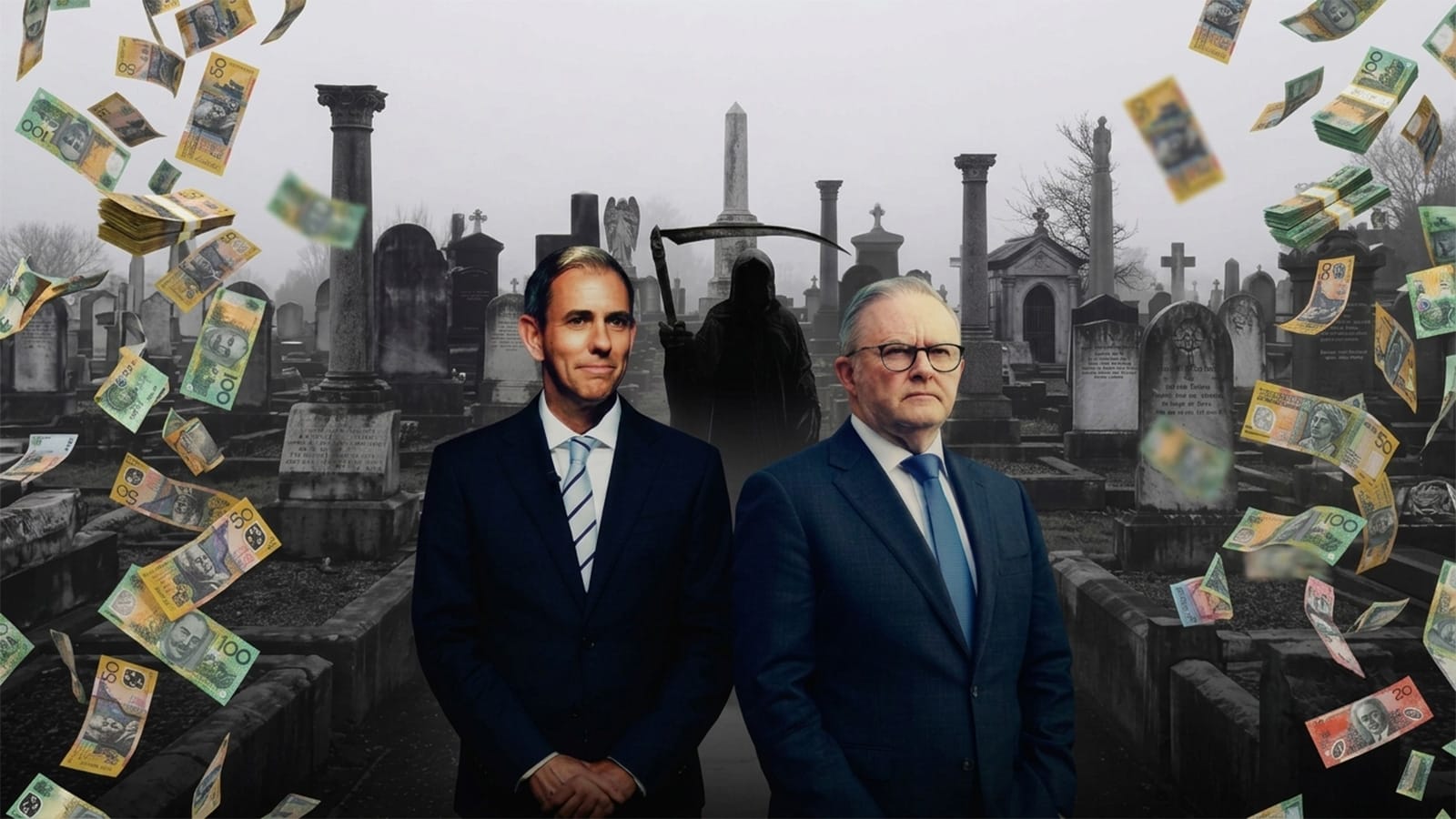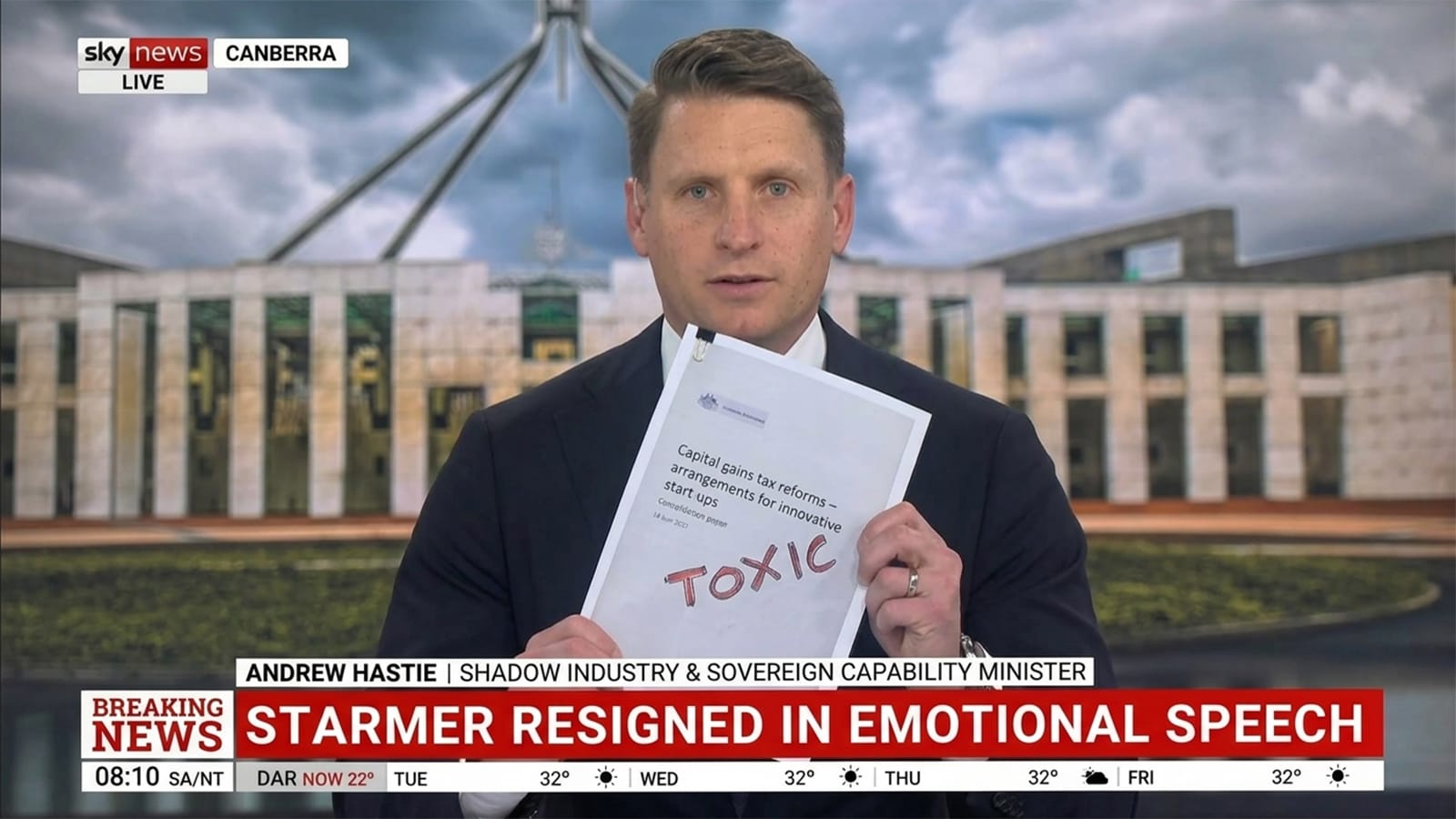
Andrew Hastie came on Sky News to talk about someone else's bad day, and ended up describing his own party.
The Shadow Minister for Industry and Sovereign Capability, who's also Deputy Leader of the Opposition in the House, was on to react to the resignation of UK Prime Minister Keir Starmer, who stood down this week after losing the confidence of his own Labour MPs. Hastie's verdict was warm.
"It was tough to watch a UK Prime Minister torn down by his own party," he said, "so soon after a massive landslide victory back in 2024."
It's a reasonable thing to feel. However, it's a strange thing to say, coming from him.
Because a leader torn down by their own side is not a sight Andrew Hastie has ever had much trouble with. Sometimes he helps it along.
The Line That Didn't Survive His Own CV
Hastie sits on the Coalition frontbench today for one reason. In February his colleagues tore down their leader. Angus Taylor challenged Sussan Ley and won the ballot 34 votes to 17. Ley was finished, and Taylor rebuilt the frontbench. Hastie, who had walked out on Ley four months earlier, came away with the Industry portfolio and the deputy leadership in the House.
He'd done his bit to get there. Back in October he'd resigned from Ley's shadow cabinet, publicly, over immigration policy, at the start of a sitting week, feeding a run of disunity that followed her until the end. So here's a man who helped make his own leader's position untenable, then collected a promotion when she fell, telling a national audience how hard it is to watch a leader torn down by their own side. Tough viewing indeed.
Sound familiar? Hint: someone's name that starts with a ''B'' and ends in an ''H''.
The Liberals have had three leaders in about a year. Peter Dutton lost his own seat at the 2025 election. Ley lasted nine months. Taylor has it now. Nobody needed a story from London to find a party pulling a leader down. There was a fresh example sitting in the studio.
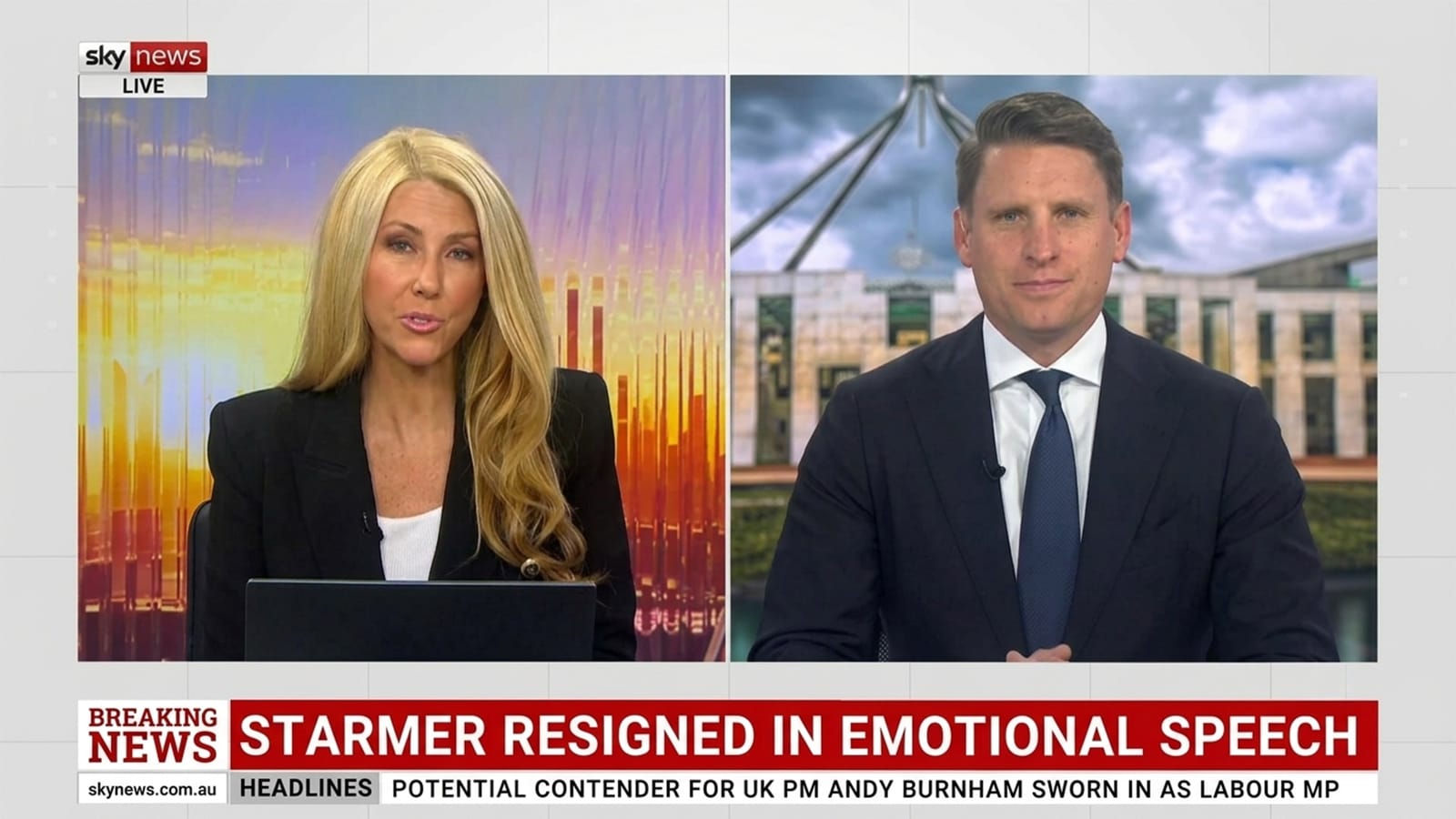
The Texta And The Treasury Paper
Hastie also brought a prop. At one point he held a government document up to the camera. It was Treasury's consultation paper on how the capital gains tax changes will apply to innovative startups, released in June as part of the Budget overhaul of the CGT discount. Across the front, in red marker, he'd written one word. TOXIC.
This is the Shadow Minister for Industry. His contribution to a live segment on how the tax system should treat Australian startups was to take a texta to the consultation paper and wave it around on breakfast television. He told viewers he'd spent the morning trying to understand the startup arrangements and found the paper confusing. The paper invites written submissions. That's the part where industry feedback usually goes, rather than onto the cover in red.
The Question He Couldn't Wave Away
The sharpest moment came when Hastie was asked about One Nation, and specifically about reports the party has overtaken the Coalition in New South Wales.
He didn't argue. He couldn't. The polling has pointed this way for months. A Roy Morgan survey in February had One Nation on 30% in New South Wales, ahead of Labor on 25% and the Coalition on 19%. On the Australian's own quarterly Newspoll figures, the Coalition was outpolled by One Nation in every state bar Victoria. What Hastie offered was an admission wearing a talking point. The public, he said, was "sending a signal that they're not happy with the current settings," and "the coalition has to work hard." Noted.
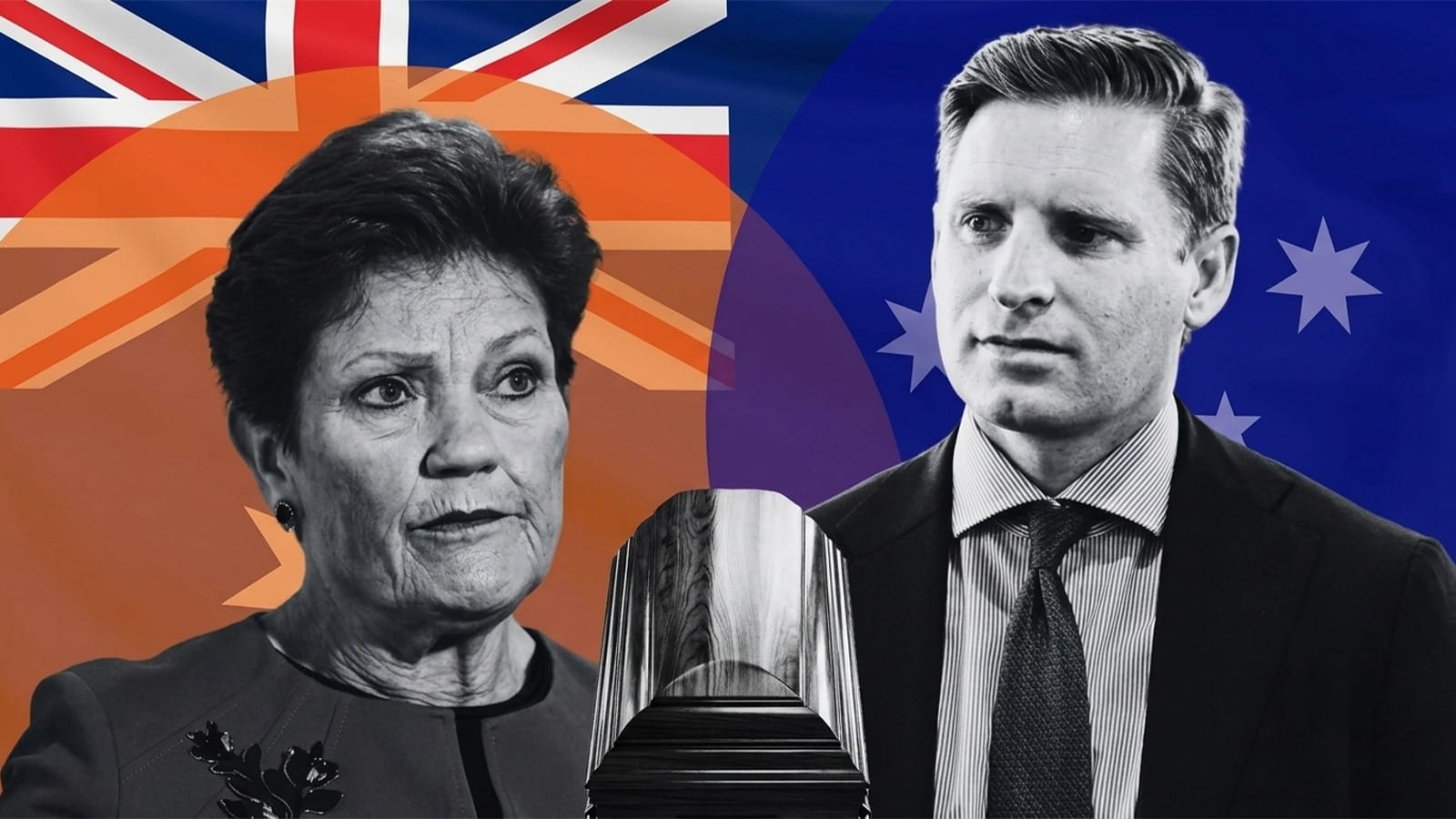
There's a certain cheek in the lecture, coming from a man who recently branded Pauline Hanson "MAGA first" and was himself turfed out of Question Time under 94A this month. He ran the rest of his script while he was there. On his telling, energy prices were up 40% over four years and 1.4 million people had arrived over the same period, and the Coalition is "out of net zero." It's a tidy pitch. It's also, give or take a word, the pitch One Nation has been making to the voters now leaving him for it.
The Job He Wants, Going Backwards
None of this is academic for Hastie, which is part of what makes it worth watching. He's never hidden that he wants the leadership one day, so every point the Coalition sheds to One Nation comes straight off the job he's quietly measuring up for with his texta ready and steadfast by his side. He torched Ley to climb the ladder, made deputy leader in the House, and the higher he gets the smaller the thing he's standing on.
And look at how he's losing it. He spent the segment running the One Nation script almost line for line, energy, immigration, out of net zero, and the only trouble is that One Nation runs it better and is walking off with his voters while he recites it. Roughly a third of the people who voted Coalition in 2025 have already swung to them.
The base that would crown him is defecting to the party he's pretending to compete with. He isn't being overtaken by Labor, or by the teals he loves to sneer at. He's being hollowed out by the one outfit that sounds exactly like him, only without the texta.
The Man He Testified Against
There's a deeper irony in Hastie, of all people, finding a public downfall hard to watch. Because when it came to the most public downfall this country has staged, he wasn't watching from the couch. He was in it.
Hastie and Roberts-Smith go back to the regiment. By Hastie's own account, his admiration for Roberts-Smith was part of what drew him to SAS selection in 2010, the course where, on his telling, Roberts-Smith, then a decorated corporal, gave the young officer a brutal time. The admiration curdled. By the time it counted, Hastie had decided the man he once looked up to was a bully, and he said so under oath.
He was one of 21 SAS veterans subpoenaed as witnesses in Roberts-Smith's defamation trial, and the evidence he gave did not help him. Hastie told the court he was "no longer proud" of Roberts-Smith, that the man had "a reputation for bullying" a comrade, and that he regarded him as a hypocrite, with around twenty people having told him the same. He also features prominently in the Stan documentary on the case, the one made with the journalists who broke the story. Whatever else this was, it was not the bearing of a man who finds another's unravelling hard to watch.
That reckoning had a face, and a court behind it. Roberts-Smith, Australia's most decorated living soldier, was found by the Federal Court in 2023, on the civil standard, to have been complicit in the murder of four unarmed Afghan prisoners and civilians, to have bullied and threatened witnesses, and to have lied, findings he failed to overturn on appeal to the Full Federal Court and the High Court. He was later charged in April with five counts of the war crime of murder, charges he denies, has not entered pleas to, and is entitled to be presumed innocent of. And it is not over: this week a court cleared him to attend the opening of the new Anzac Hall at the Australian War Memorial as one of four living Victoria Cross recipients.
So set it next to the tears. Hastie helped tip out Sussan Ley, the only person standing between him and the frontbench, and walked off with her job. He gave sworn evidence against the man he'd once admired, and put his face to the documentary of his downfall. The only fall that put a catch in his voice on breakfast television was Keir Starmer's, a man he has never met, in a parliament he will never sit in, whose removal costs him precisely nothing. It is hard not to read a pattern. Hastie can stomach a leader pulled down when it clears his path, and a soldier brought low when there is old history and a good-guy headline in it. A Labour vote in London is the one downfall he calls tough to watch. His sympathy switches on at the exact moment it stops costing him anything.