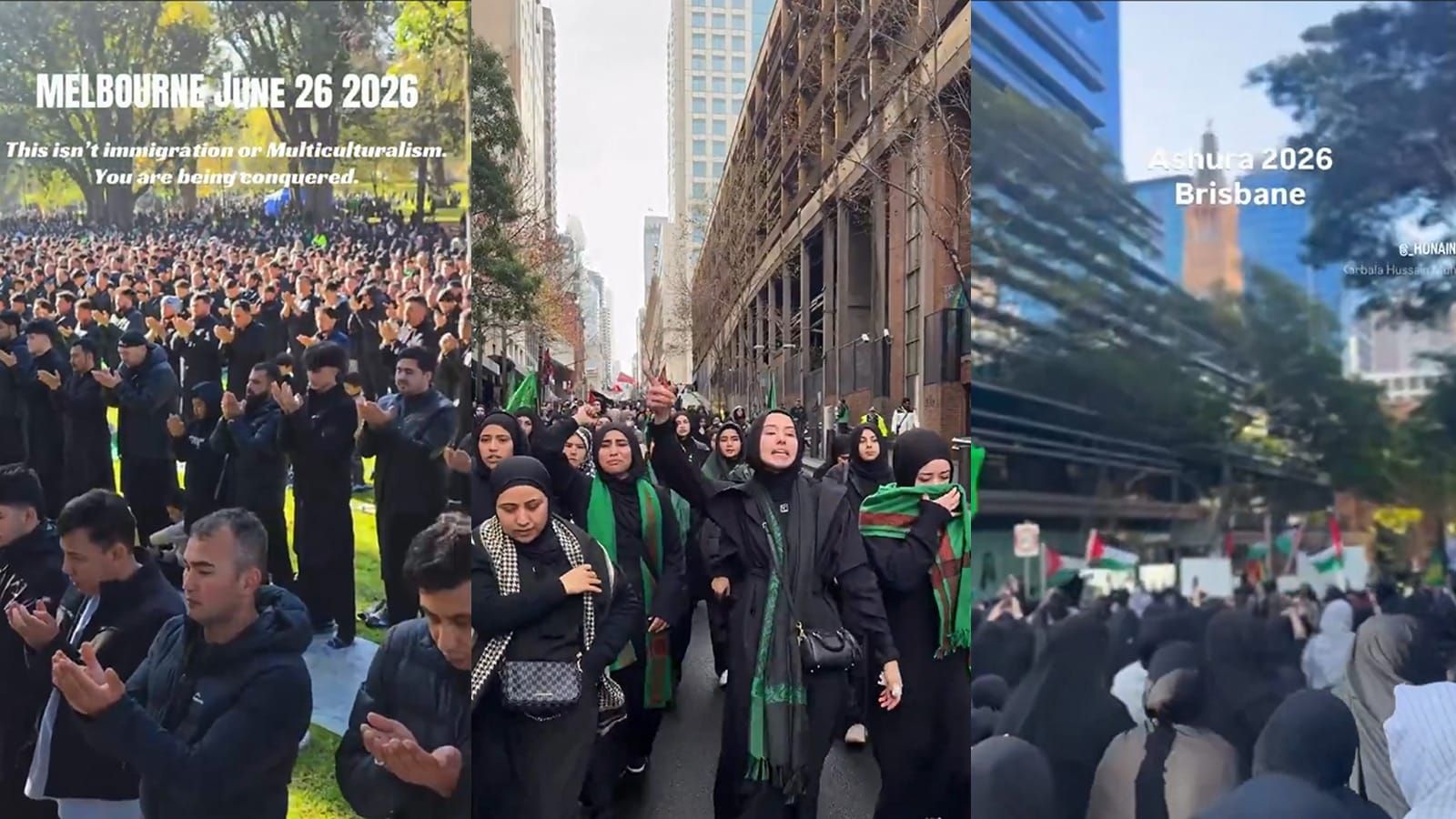
Thousands of Shia Muslims marched through Sydney, Melbourne, Adelaide and Brisbane on Friday to mark Ashura, the most solemn day of mourning in the Shia calendar. Within hours the footage of black-clad crowds filling Hyde Park and Victoria Square was everywhere. For Pauline Hanson, none of it was a surprise. It was the argument she's been making for years, walking down the main street.
And it's an argument that comes with a bill. Australia spends more than $435 million a year funding multiculturalism as policy, the community grants, the separate language and settlement services, the parallel programs, going by the figures One News set out in its explainer on what Hanson means by a monocultural Australia. The question Hanson keeps asking is what the country is buying, and Friday is part of her answer.
Image: footage via social media, Brisbane panel @_hunain___, compiled by One News Australia. Ashura processions across Melbourne, Sydney and Brisbane on Friday 26 June 2026.
What Friday actually was, because the case for One Nation's Monoculture is stronger
Ashura falls on the 10th day of Muharram, the first month of the Islamic year, and marks the killing of Imam Hussein, the grandson of the Prophet Muhammad, at the Battle of Karbala in 680 AD. For Shia Muslims it's the most solemn day of the year, a day of grief rather than celebration, and it's been commemorated for centuries.
In Sydney the procession set off from the Archibald Fountain in Hyde Park, the 23rd annual march, held, organisers said, 220 years after the first recorded commemoration of Imam Hussein on Australian soil in 1806. In Adelaide the Jafaria Islamic Society led its annual procession from Victoria Square to Adelaide Oval. and in Brisbane mourners marched through the CBD behind flags and banners. These were lawful, permitted, organised events, and nobody is saying otherwise.
That's the point worth getting straight, because the case Pauline Hanson makes doesn't depend on the marchers being anything other than devout and within their rights. They were both. Her argument is about monoculture: what the one shared public square is supposed to look like, who gets to set the terms, and whether a country can keep funding parallel cultures and still call itself one nation.
The Sydney march wasn't a quiet vigil, it was loud, chanting and closer to a protest
For all the talk of mourning, the Sydney event didn't read on the footage like a private moment of grief. It was loud. Crowds chanting in unison, slogans and lamentations echoing off the buildings, the rhythmic beating of chests, the whole CBD given over to it. To plenty of Australians watching the clips, it looked and sounded less like a vigil and more like a demonstration, a show of numbers moving through the centre of the country's biggest city.
Loud public lamentation is part of how Ashura is marked. But to a lot of the Australians watching and commenting, it read less as private mourning and more as a show of strength, and their reasoning was blunt. This isn't an Islamic country and it isn't the Middle East. It's Australia, with its own settled public culture, and a large, visibly separate religious bloc taking over the centre of the city reads to many people as a show of strength rather than an act of grief. That's exactly Hanson's point. This wasn't difference kept to a mosque or a hall. It was difference asserted, at volume and at scale, in the common space the rest of the city shares.
What Pauline Hanson actually means by monoculture, and why Friday is the picture of it
One News set out Hanson's position in full earlier this year. The short version is that she draws a hard line between being multiracial, which she accepts, and multiculturalism as government policy, which she rejects. People of every background are welcome. What she opposes is the state funding and encouraging separate cultures to be maintained as parallel public identities, instead of melting into one shared Australian civic culture with one language and one set of laws.
On that model, private faith, home language and family tradition are nobody's business but your own. The question is what happens in the public square, and her answer, like the French and Singaporean systems she points to, is that the public square stays common ground. An umbrella over difference, as she puts it, not a patchwork of it.
| The question | Multiculturalism | Monoculture (Hanson's version) |
|---|---|---|
| Language at home | Whatever you like | Whatever you like |
| Religion in private | Whatever you like | Whatever you like |
| Food, dress, customs | Whatever you like | Whatever you like |
| The one public language | Not insisted on | One shared language for public life |
| Does the state fund separate cultures? | Yes, as equal and parallel | No, it funds integration |
| Where first loyalty sits | Keep your original identity | Australian identity comes first |
| Are all cultures equal to ours? | Yes, by design | No, the host culture and its laws come first |
Friday is what the patchwork looks like. Gender-segregated processions, the crowds dressed in black and, as the footage showed, the men and women separated, many women in full-face veils, stopping to pray in public parks, moving through the civic heart of Sydney and Adelaide with a road-closure permit and the blessing of every level of government. Whether you find that moving or confronting, it's parallel, and parallel is exactly the word Hanson uses.
Rukshan Fernando says the same thing Hanson does, and spells out where it goes
The independent journalist Rukshan Fernando, who has spent years filming what the mainstream cameras leave out, made the point bluntly on X.
"Every year around this time, we see video footage of Islamic Ashura mourning rituals, particularly in major Western cities," he wrote. "This has been happening for decades, but you'll notice it more as demographics change and the crowds grow larger."
His warning is that condemnation online changes nothing.
"Islamic organisations do not care about words of condemnation, and they certainly don't care that many people feel uncomfortable seeing it. For them, it's a holy religious practice intrinsic to their faith." With the Muslim population now around one million and growing, he argues, "these gatherings will only become larger and more visible over the next decade."
And his conclusion is his to make.
"This is not just about immigration policy. It concerns fundamental freedoms the West holds dear, and unless we are willing to place sensible limits on certain religious practices and ethnic patterns of migration, nothing will change."
Every year around this time, we see video footage of Islamic Ashura mourning rituals, particularly in major Western cities. This has been happening for decades, but you’ll notice it more as demographics change and the crowds grow larger.
— Rukshan Fernando (@therealrukshan) June 27, 2026
Unless governments change public… pic.twitter.com/paPb77eLyL
The reaction split the country, and both sides ended up proving Hanson right
Online, the response divided hard. Some Australians called the marches a show of "intimidation" and said they were proof multiculturalism had "failed." Others said it was a peaceful religious procession and asked why a Christian march wouldn't draw the same complaint.
Both reactions, oddly, make Hanson's case. The defenders are right that the march was lawful and peaceful. The critics are reacting to something real, the sight of a large, visibly separate cultural bloc taking over the common square. That's the contradiction at the centre of multiculturalism as policy. It produces exactly this, communities living alongside one another rather than blended into one, and then asks the rest of the country to call it a success and stay quiet.
Why "it's just a religious march" misses the argument entirely
The most common defence on Friday was that this is simply religion, and Australia has freedom of religion. True, and nobody credible is proposing to ban Ashura. But the freedom to worship isn't the same question as whether taxpayers should be footing the bill to actively fund and promote the maintenance of separate cultures as the model for the nation.
And foot it they do. More than $435 million a year of public money goes into multiculturalism as policy, the grants, the community programs, the separate language and settlement services. That's the part people miss when they wave Friday off as harmless. The country isn't just tolerating parallel cultures, it's paying to keep them parallel, then acting surprised when they march down the main street looking exactly that way. Australians are funding the very separation they're being told to celebrate.
| Program | What it funds | Cost |
|---|---|---|
| Supporting Multicultural Communities package | Community grants, festivals, centres, refugee and African Australian projects, multicultural media | $190.3 million over 2 years |
| Multicultural media stream | Helping multicultural outlets move to digital (within the package above) | $10 million |
| Multicultural Grassroots Initiatives | 123 community organisations, latest round | $5 million |
| African Australian communities | "Participation, integration and sense of belonging" | $18.8 million over 4 years |
| Community Language Schools | 84 languages, 600-plus schools, 90,000-plus students | $25.6 million over 4 years |
| SBS, the multicultural broadcaster | Commonwealth funding to the multilingual national broadcaster | $359.1 million a year |
| TIS National interpreting | Free interpreting in 150-plus languages for migrants | Ongoing, not separately costed |
| TOTAL, one year | SBS, plus the 2025-26 slice of the package, plus the language schools | Over $435 million a year |
Figures: federal multicultural funding, compiled in the One News monoculture explainer.
Hanson's argument is that you can have the faith without the funding. France manages it. You keep your religion, your food and your language, and the public culture, the language of the street and the institutions, stays one thing. That's the monoculture she means. Not the erasure of difference, but a single shared identity that everything else sits underneath, and not a taxpayer-funded machine for maintaining the differences instead.
A peaceful procession isn't a crisis, but what it did was put her central claim on the screen in a way no speech ever could. A country that has spent decades and hundreds of millions of dollars funding multiculturalism as policy now watches separate cultural blocs march through its capitals and argues about what it's even looking at. That argument, and that bill, is the one Pauline Hanson has been trying to have looked at all along.