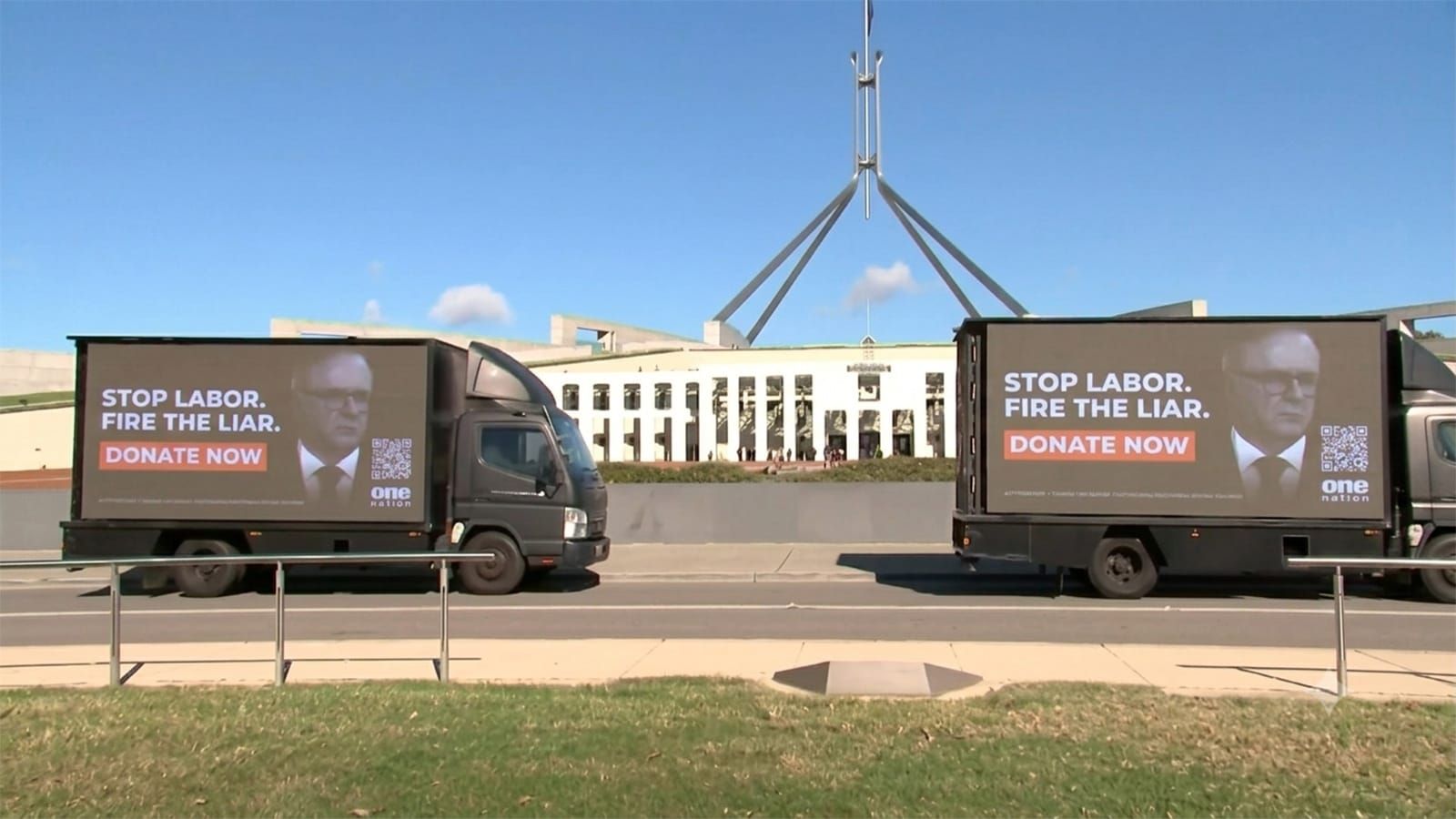
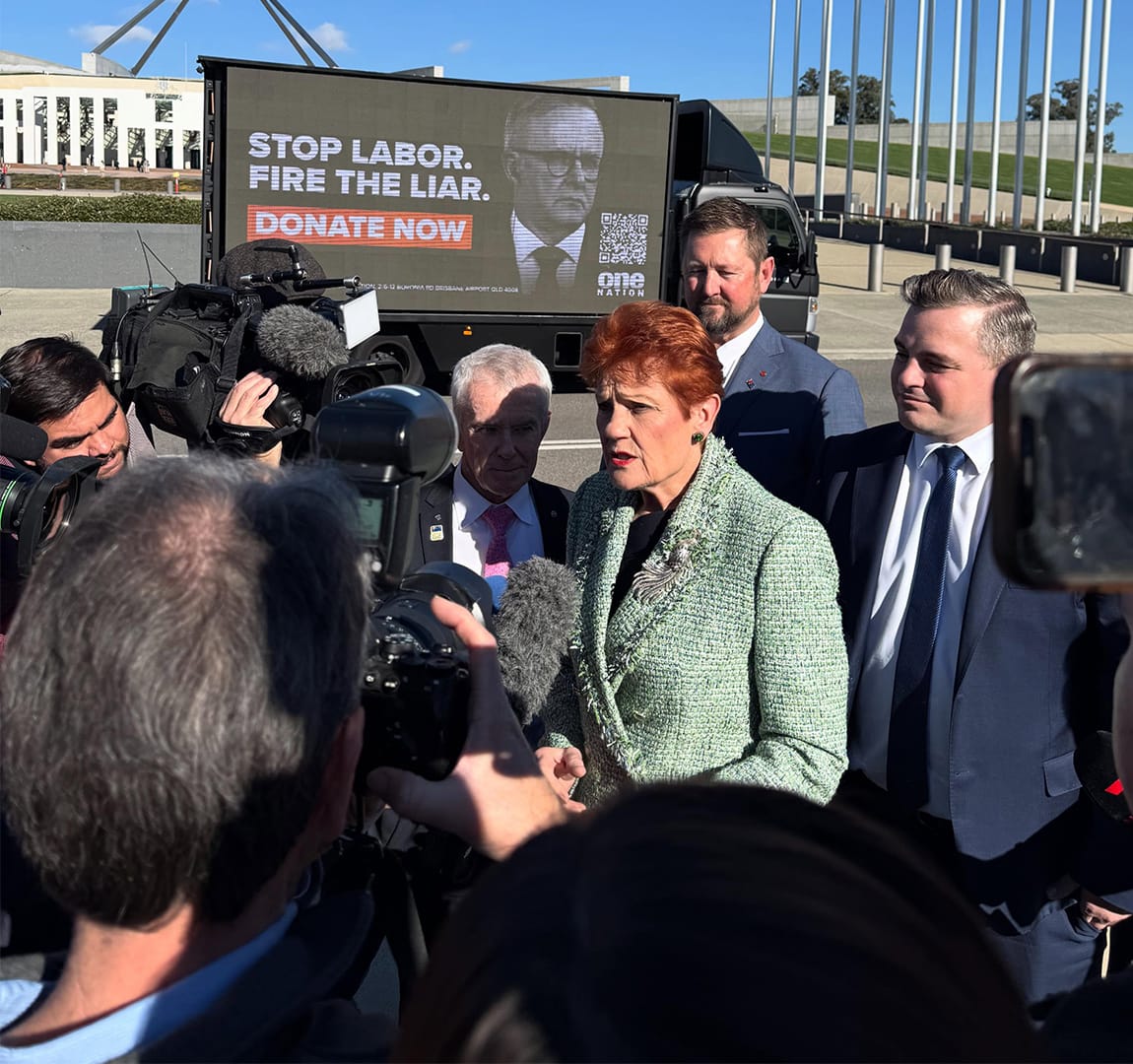
Pauline Hanson rolled up to Parliament House this week with a fleet of billboard trucks branded "Stop Labor. Fire the Liar," parked them where Anthony Albanese couldn't possibly miss them, then strolled out onto the lawn to pick a fight with the press. She got one, and one reporter nearly got cleaned up by a passing bus trying to keep up.
The trucks, paid for out of nearly $5 million in donations to her Fire the Liar campaign, were just the warm-up. The main event was her call for a monocultural Australia, the one she dropped at the National Press Club a week earlier and has cheerfully refused to walk back since. "Monoculturalism is virtually all you've been able to talk about since that day," she told the Senate. "It's exactly what I intended."
That's the part the press pack keeps missing while it clutches its pearls. She knows exactly what she's doing. So before anyone has another meltdown, here's what she actually said, what it actually means, and why the people shouting loudest can't lay a glove on the argument.
Here's exactly what she said, reported by The Nightly:
"We cannot be a multicultural society. We are a multiracial society, but we must be monocultural." She called multiculturalism "an utterly flawed policy" and said that "under the failed policy of multiculturalism, all cultures are allowed equivalence to ours."
Read it again. She isn't talking about race. She's drawing a line between being multiracial, which she accepts, and being multicultural, which she rejects. That distinction is the whole debate, and it's the part her critics keep walking straight past.
What monoculture and multiculturalism actually mean
The left works overtime to make this sound complicated. It isn't. Here's the plain version.
| The question | Multiculturalism | Monoculture (Hanson's version) |
|---|---|---|
| Language at home | Whatever you like | Whatever you like |
| Religion in private | Whatever you like | Whatever you like |
| Food, dress, customs | Whatever you like | Whatever you like |
| The one public language | Not insisted on | One shared language for public life |
| Does the state fund separate cultures? | Yes, as equal and parallel | No, it funds integration |
| Where first loyalty sits | Keep your original identity | Australian identity comes first |
| Are all cultures equal to ours? | Yes, by design | No, the host culture and its laws come first |
The short version: multiculturalism says keep your culture and we'll fund the difference. Hanson's monoculture says come from anywhere, look like anything, but here you're Australian first, under one set of laws and one common language. As she put it in the Senate, "Australian monoculture is not exclusive; it is welcoming. It's an umbrella, which covers all manner of difference." She added, "it's not a dirty word."
Isn't that just multiculturalism? The food, faith and language question answered
Ask the left to define monoculture and the first thing that springs to mind is dinner. That's exactly where the ABC's Clare Armstrong went outside Parliament House. It's the question her critics lean on hardest, and the easiest to quash.
"In your monoculture, can people speak a different language at home? Can they practice a different religion, if they can eat different fruits? That is multiculturalism, isn't it?" Armstrong asked.
Hanson's answer was blunt.
"Howard and Tony Abbott and other leaders around the world have said multiculturalism doesn't work. Go and research that," she said. "We are one nation. And it should be one language."
That last line is the key. On the private layer, Hanson's model and multiculturalism look identical. Nobody is banning your home language, your faith or your favourite meal. France doesn't ban any of it either. The fight was never about your kitchen or your living room.
It's about the public and official layer. One shared language for public life. One set of laws that comes first. One national identity that everyone joins. The question isn't whether you can cook your grandmother's recipes or speak several languages at hom. It's whether the state should fund and entrench separate cultures as parallel and equal. That's why Hanson's line is "one nation, one language," not one religion or one cuisine. Different food, same nation. That isn't multiculturalism. That's just a country.
The food jibe, and why Hanson says it misses the point
The so-called big gotcha is that Hanson has supposedly forfeited her right to a laksa. No more Thai, no more Lebanese, no more yum cha. As if disagreeing with a policy comes with a lifetime takeaway ban. She's heard it, and she swats it away
In her Senate speech she dismissed the suggestion she dislikes "Italian pasta or Chinese takeaway" as "rubbish." "In the past week, the far left have naturally taken my comments into the realm of utter fantasy. I was going to ban foreign food," she said. "What rubbish, predictable, and pathetic."
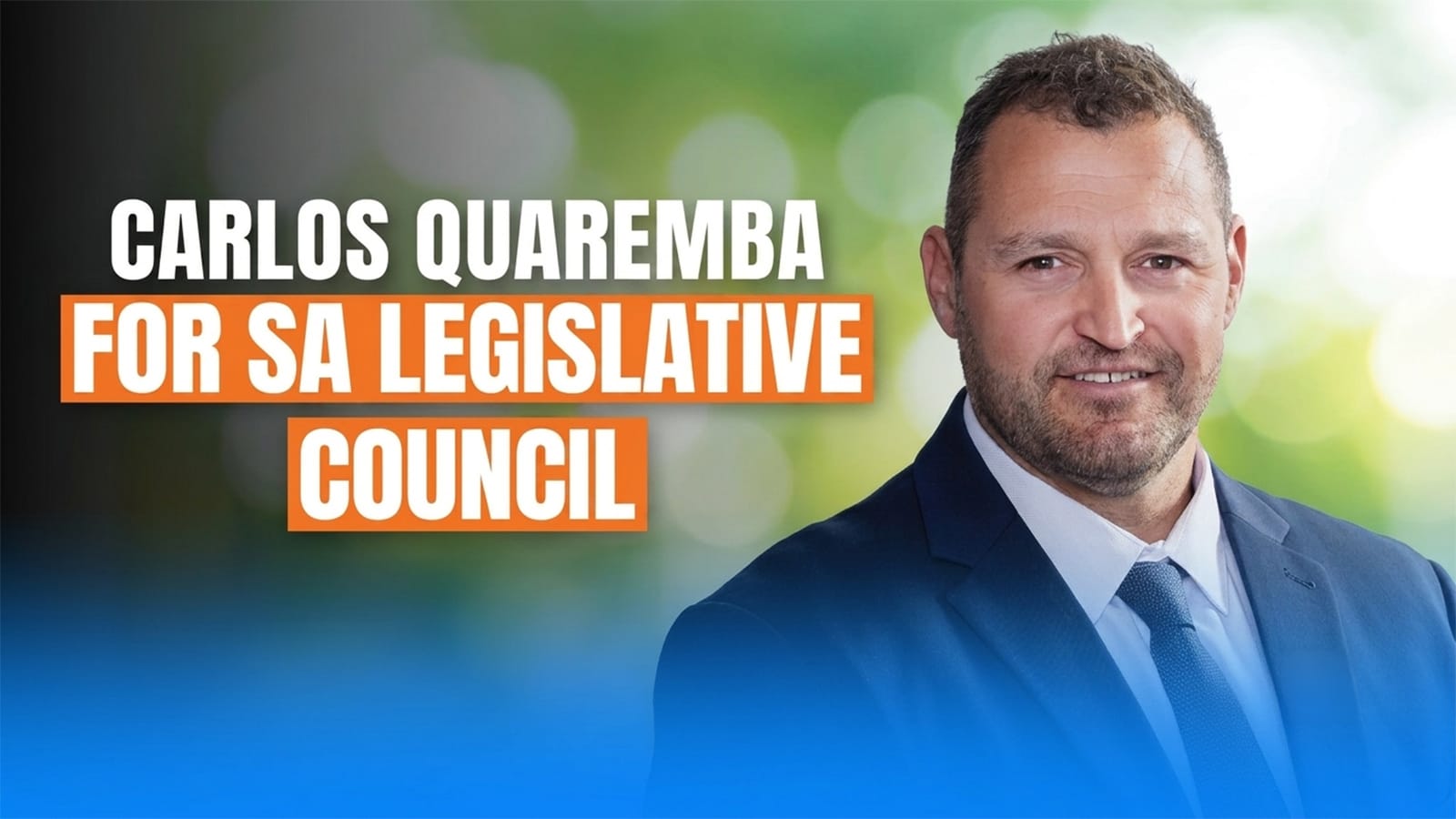
Her point is that eating food from other nations isn't multiculturalism the policy. It's the product of a multiracial, immigrant society, which she says plainly she supports. She pointed to her own South Australian colleague, Legislative Council member Carlos Quaremba, who came to Australia from Argentina. "He's a bloody Aussie, still loves his Argentinian barbecues, and wouldn't give them up for anything. I love them too," she said.
The distinction she's drawing is between the food and the policy. You can love every cuisine on earth and still think the state shouldn't be in the business of funding and building parallel societies. When the strongest defence of a policy is "but the food though," it tells you the policy itself isn't being defended at all.
One area alone: multiculturalism is costing $25.6 million to teach 84 languages in schools
If anyone doubts that the state actively funds the maintenance of separate cultures, the proof sits on a Commonwealth website. The Community Language Schools Grants Program, run through the Home Affairs multicultural portfolio, is investing $25.6 million over four years from 2025-26. It funds more than 90,000 students to learn 84 languages in over 600 community language schools, figures the responsible minister confirmed when the boost was announced in April 2024.
The government's own stated aim is the clearest part. The program is there to help young Australians "connect to the languages of their parents, grandparents and broader communities" and to "strengthen the social inclusion and prosperity of Australia's successful multicultural society."
That's the debate in black and white. This isn't tolerating what people speak at home, which nobody objects to. It's the taxpayer funding language maintenance, with "multicultural society" named as the goal. That is exactly the policy Hanson is pointing at when she says one nation, one language.
And languages are just one line of the bill, here's the rest
The language schools are a single slice. Step back and the full multicultural budget runs into the hundreds of millions, spread across grants, media, community projects and a taxpayer funded broadcaster.
| Program | What it funds | Cost |
|---|---|---|
| Supporting Multicultural Communities package | Community grants, festivals, centres, refugee and African Australian projects, multicultural media | $190.3 million over 2 years |
| Multicultural media stream | Helping multicultural outlets move to digital (within the package above) | $10 million |
| Multicultural Grassroots Initiatives | 123 community organisations, latest round | $5 million |
| African Australian communities | "Participation, integration and sense of belonging" | $18.8 million over 4 years |
| Community Language Schools | 84 languages, 600-plus schools, 90,000-plus students | $25.6 million over 4 years |
| SBS, the multicultural broadcaster | Commonwealth funding to the multilingual national broadcaster | $359.1 million a year |
| TIS National interpreting | Free interpreting in 150-plus languages for migrants | Ongoing, not separately costed |
| TOTAL, one year | SBS, plus the 2025-26 slice of the package, plus the language schools | Over $435 million a year |
You can't add a two year figure to a four year figure to an annual one and call it a single number, so here it is the honest way, per year. SBS alone takes $359.1 million a year. Add the 2025-26 slice of the multicultural communities package, $70.3 million, and the yearly cost of the language schools, about $6.4 million, and you clear $435 million in a single year, before interpreting services or a cent of state spending. In fresh grant money alone, the new commitments come to roughly $235 million.
Two of these deserve an asterisk, because we're not going to pretend otherwise. The African Australian funding is badged for "integration," which is the side of the ledger Hanson actually supports. And SBS broadcasts sport and general news as well, so not every dollar is multicultural programming. Strip both out and the bill is still enormous. That's the point. This isn't a slogan. It's a standing line in the federal budget, year after year.
And that’s just multiculturalism. The acknowledgement rituals cost extra. Welcome to Country ceremonies ran federal departments about $225,000 a year, roughly $452,953 over two years across 21 Commonwealth agencies, according to Freedom of Information data.
Hanson isn't out on a limb, and here are the leaders who agree
Hanson told the ABC to go and research what other leaders have said, and she's right that she's in mainstream company. She named two of them herself in the Senate: "John Howard said he always had trouble with it. UK Prime Minister David Cameron said multiculturalism had failed."
Howard's full quote bears it out:
"Multiculturalism is a concept that I've always had trouble with. I take the view that if people want to emigrate to a country, then they adopt the values and practices of that country," he said.
Tony Abbott has said multiculturalism turns the country into "Hotel Australia," with migrants "not so much joining Team Australia," and more recently that the policy has "run off the rails," in his own writing.
It isn't only Australians. Germany's Angela Merkel said the multicultural approach had "failed, utterly failed," as reported. Britain's David Cameron said that "under the doctrine of state multiculturalism, we have encouraged different cultures to live separate lives, apart from each other and apart from the mainstream," in a 2011 speech. Two of those four were sitting prime ministers when they said it.
Who already runs a monoculture, because the answer is not nobody
The strongest line against Hanson was that a multiracial monoculture exists nowhere. It isn't true, and the example is in plain sight.
France flatly rejects multiculturalism. Its model is assimilation into republican values. You can be any race or origin, but in public life you're French, full stop, with no official recognition of separate cultural blocs. Newcomers sign a Republican Integration Contract committing to civic and language training and to French values. That's almost word for word the multiracial but monocultural model Hanson described.
France isn't alone. As Foreign Affairs has documented, a string of Western democracies walked away from multiculturalism in the early 2000s and moved to civic integration. At the firmer end, Japan and South Korea preserve one national culture through low immigration and strong pressure to assimilate.
The clearest version of the idea Hanson's reaching for came from Lee Kuan Yew, the founder of modern Singapore. On independence day in 1965 he said:
"We are going to have a multi-racial nation in Singapore. This is not a Malay nation. This is not a Chinese nation. This is not an Indian nation. Everybody will have his place, equal: language, culture, religion."
Then he built exactly that. One nation of many races, held together by equal rules, merit and a shared civic identity instead of competing ethnic blocs. It's the multiracial but monocultural model in its purest form, and it turned a poor, divided port into one of the richest countries on earth. The quote resurfaced this week when Elon Musk shared it.
“We are going to have a multi-racial nation in Singapore. This is not a Malay nation. This is not a Chinese nation. This is not an Indian nation. Everybody will have his place here, equal: language, culture, religion.”
— Rothmus 🏴 (@Rothmus) June 25, 2026
— Lee Kuan Yew, August 9, 1965
LKY’s quote echoes… pic.twitter.com/vIuowRE9kZ
And the mood is still moving that way. In Denmark, Immigration Minister Morten Bodskov has reopened an investigation into banning the Islamic call to prayer nationwide, saying it "has no place in Denmark." The detail that matters: Denmark's government is led by the Social Democrats, the left. This isn't a fringe right position anymore.
Where it leaves Hanson
None of this makes the model painless. France has its own friction, from unrest in the banlieues to long fights over integration, so assimilation moves the tension somewhere else rather than erasing it. That's a fair caution.
But it kills the central charge against her, that she's describing something that has never existed and never could. A multiracial country running on one shared civic culture is real, it has a name, and France has been doing it for decades. Critics reached for the ABS finding that around 75% of Australians said in 2025 that multiculturalism is good for society, and Prime Minister Anthony Albanese said diversity is a strength of modern Australia. Both are fair points. Neither answers the question Hanson actually asked. As she told the press pack, "we are one nation, and it should be one language." It isn't whether people like the word. It's whether a country is better held together by one shared culture or by many kept deliberately, and expensively, apart.