The Minns government's plan to let registered medicinal cannabis patients drive with THC in their system has stalled in the NSW upper house, after Thursday night's debate ran to the 10pm cutoff and was interrupted mid speech with no vote taken.
The Road Transport Legislation Amendment (Medical Cannabis and Driving Offences) Bill 2026 passed the lower house on Wednesday, and Labor expected to push it through the Legislative Council a day later. Instead, the President stopped proceedings under standing orders at 10pm on Thursday, 6 August while the Coalition's Natasha Maclaren-Jones was still on her feet, and the final vote is now held over to the next sitting day. Labor is expected to have the numbers when the house returns.
The pause leaves two of the biggest questions about the scheme unanswered: what it does to the price of every NSW driver's green slip, and why a patient's prescription will travel on the digital licence they hand over as ID.
Right now, any detectable trace of THC is an offence in NSW, even days after a dose and with no impairment at all, which means the state's medicinal cannabis patients have been choosing between their medicine and their licence. NSW Health counted at least 130,000 people with a cannabis prescription in 2025, and the national regulator's estimate runs as high as 300,000 patients in this state, treating conditions from cancer and chronic pain to PTSD.
Two warnings before a fine: how the cannabis driving register would work
Under the bill, patients with a valid prescription can join a voluntary register run by Transport for NSW, provided they hold an unrestricted licence and complete an online education program. Learner, provisional and heavy vehicle drivers are excluded.
A registered patient who returns a THC reading below 50 nanograms per millilitre in oral fluid, or 3.5 nanograms per millilitre in blood, commits no offence, as long as they have zero alcohol and no other drugs in their system.
Above the threshold, a three strikes system applies. The first and second detections within 2 years draw formal warning letters. A third brings a $722 fine and a three month licence suspension, or up to $2,200 and a six month disqualification if the matter goes to court.
Nothing changes at the roadside. Every driver still gets tested the same way, and anyone who tests positive still cops a 24 hour driving ban on the spot.
Transport Minister John Graham, who carried the bill into the upper house, told parliament the thresholds are not safe limits.
"I am not suggesting that people should drive immediately after taking cannabis medicine," Graham said.
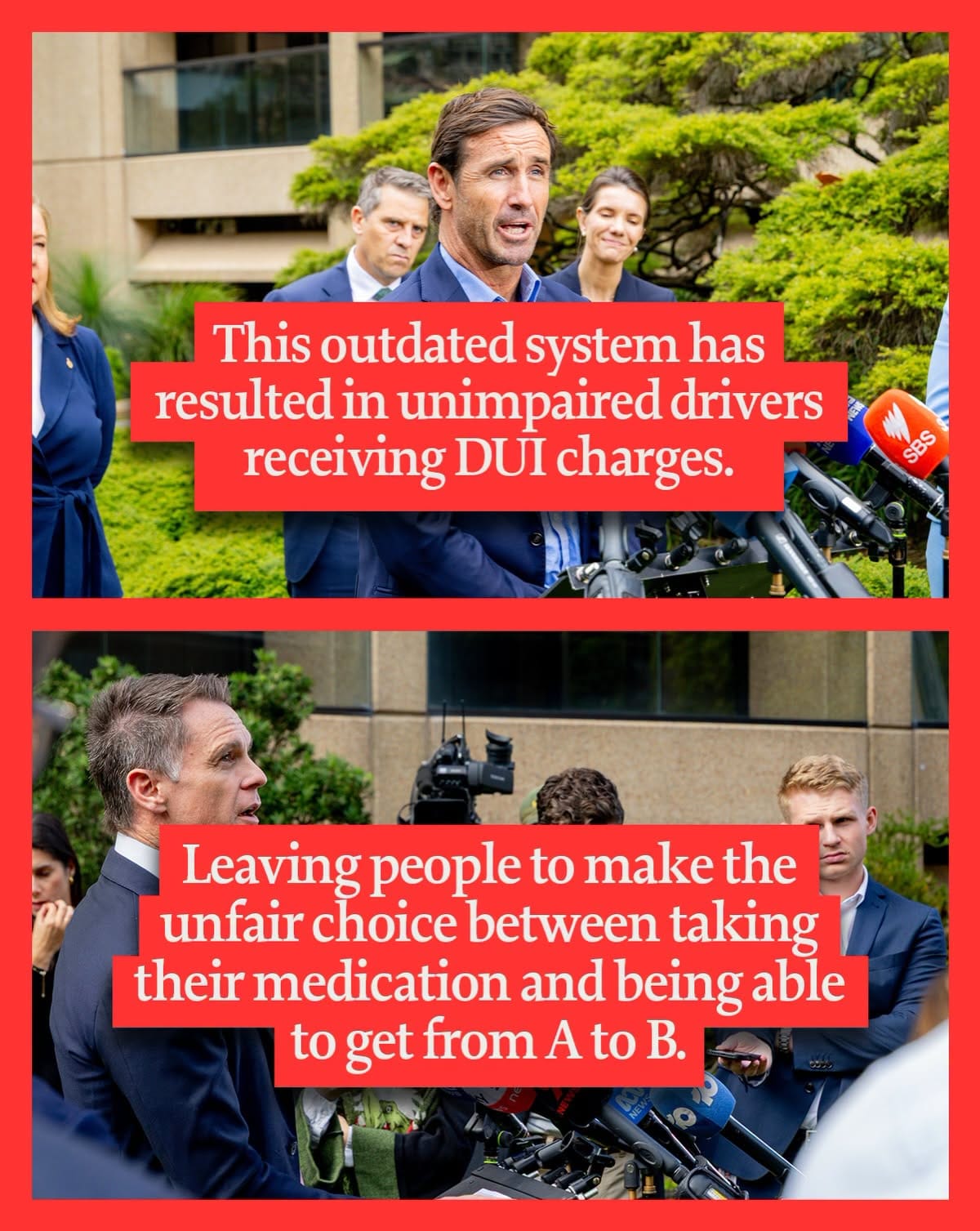
John Graham concedes nobody has modelled what this does to green slips
Ahead of the vote, Graham conceded that "no modelling of cost impacts on car insurance of the reforms has been conducted", the Daily Telegraph revealed on Friday.
Green slips are compulsory. Every registered vehicle in NSW carries CTP insurance, so if insurers reprice the risk, the cost lands on every driver in the state, patients or not.
Opposition transport spokeswoman Natalie Ward said the policy "won't make our roads safer" and asked "who is going to foot the bill if insurers jack up their prices". She said Premier Chris Minns should "come out and guarantee that insurers won't hike CTP prices because of this overhaul".
The Insurance Council of Australia couldn't say what the changes will do to premiums.
"Any implications for insurance premiums will depend on a range of factors and cannot be determined at this stage," a spokeswoman told the Telegraph. "Insurers will continue to assess available data and evidence as it emerges."
Your prescription status travels on the drivers licence you flash at the pub
It has also been revealed that registered patients will have their prescription status displayed on their digital driver's licence as a licence condition.
Graham confirmed the detail in parliament. Registration won't appear on the physical card, but on the digital licence it will be "shown discreetly as a licence condition code, such as a letter, with details only visible if the code is selected". He said the register sits inside existing licensing systems, won't be linked to number plate recognition cameras, and "cannot be used for unrelated purposes". Police will see registration status only, not a patient's medical condition.
Roads Minister Jenny Aitchison said access to the patient register itself will be limited: "Access to the patient register will be configured so users only see the information necessary for their role."
What the government hasn't addressed is that a digital licence isn't only shown to police. It's the state's accepted proof of age and identity, handed to bouncers, bottle shop staff, clubs and real estate agents every day. The condition code sits on the licence screen, and one tap shows what it means. For a patient who registered to protect their licence, that's a medical detail now travelling with their ID.
The prescription code isn't the only new job the licence in your pocket is about to take on. In a separate bill introduced the same Thursday, the Minns government moved to plug NSW driver licence and photo card images into the Commonwealth's National Driver Licence Facial Recognition Solution, joining Western Australia and South Australia on the national face matching system.
The government says that one is aimed at organised crime, flagging a stolen identity when licence details exposed in a data breach get used, and Minns argued the laws have to keep up because "criminal syndicates are exploiting encrypted technology, the dark web and layers of intermediaries to distance themselves from the violence they commission". The wider package also lets police order devices unlocked in organised crime investigations and pull unredacted toll camera images, starting with the Sydney Harbour Bridge and Tunnel.
The two bills landed within days of each other. If both pass, the licence in a NSW pocket will carry a patient's medical status, feed a national face matching database and sit beside new powers to trace a driver's movements.
Independent Tania Mihailuk: no safe level of impairment behind the wheel
Tania Mihailuk, the ex Labor MP for Bankstown who entered the upper house on One Nation's ticket in 2023 and now sits as an independent, told Thursday's debate she would vote against it, and was careful to separate the patients from the policy.
"I do not want to belittle in any way people that rely on medical cannabis," Mihailuk said, noting many of the state's users are managing serious long term and chronic conditions, including terminal cancer.
"My basis for this position, though, is simple: No level of impairment when driving a motor vehicle is a safe level of impairment."
Her argument is that the thresholds have no settled science behind them. Unlike alcohol's 0.05 limit, there's no accepted measure tying a THC number to how affected a driver actually is.
"Parliament should be reluctant to legislate numerical impairment thresholds unless they are supported by clear, settled and broadly accepted scientific evidence," she said.
She also pointed out the carve out treats cannabis patients more gently than every other medicated driver: "If a person is caught driving while impaired using a prescribed schedule 4 or schedule 8 drug, there are no exemptions or warnings when they rightfully have the book thrown at them."
On the warning letters: "The purpose of our road safety laws is to prevent harm before it occurs, not after repeated detections."
Rod Roberts: a 5,000 driver study the government won't release until after the vote
Independent MLC Rod Roberts, a former detective who also sat as a One Nation member until 2023, opposed the bill, and put the sharpest question of the night on the record: where is the evidence?
Roberts reminded the house that Graham, then in opposition in October 2022, promised a review by the Centre for Road Safety and independent research before any change to the law. The department has since confirmed the centre's study of more than 5,000 drivers was completed in August 2025, and that it will be released at a road safety conference in October, months after the house votes on the bill.
"If that study is the review that the Minister promised, he should table it," Roberts said. The advice of the government's expert working group is staying hidden too, with a written answer confirming it went through cabinet and "will not be made public".
"They will legislate first and find the evidence afterwards," Roberts said. He also pointed at the bill's own carve outs, arguing bus, taxi and heavy vehicle drivers are excluded because their risk is judged too high: "If it is too high for them, why is it not too high for drivers of normal motor vehicles?"
One Nation itself has no vote on the bill. All three MLCs elected on its ticket, Mark Latham, Rod Roberts and Tania Mihailuk, now sit as independents. The party's record on the question is in Hansard, though: when the last exemption bill came before the house in October 2022, Roberts, still in the party then, spoke against it, and the house voted it down 29 votes to 6.
The party's most patient friendly move came in South Australia, where its then MLC Sarah Game introduced a Medicinal Cannabis Defence Bill in 2023: a complete defence for prescribed patients where police can't establish impairment. Her model, taken from Tasmania's law, needed no register and no threshold number. Game, who has since left the party, said the government should back it "to ensure patients are not stripped of their licence through no wrongdoing of their own". Across both states the record points the same way as Thursday's speeches: patients shouldn't be punished when nobody can show they were impaired.
Trauma surgeons wrote to Chris Minns while the Coalition pushed for a review
The Liberals and Nationals oppose the bill and called for it to be sent to the STAYSAFE road safety committee before any vote. Opposition Leader Kellie Sloane said the bill "has profound implications for every family that uses our roads".
Royal North Shore Hospital's director of trauma services, Dr Geoff Healy, was among the doctors who wrote to Minns urging him to drop the legislation.
"Basically 100% of my time is looking after people that are in the worst accidents in NSW," Healy said. "I really fear for our general population that they're going to be put at increased risk of major injuries with a process that is not scientifically backed up."
Coalition speakers put the road toll on the record during the debate: 355 deaths on NSW roads in 2025, up from 327 the year before, with 211 people already killed this year against 201 at the same point last year.
The bill's supporters read the safety evidence the other way. Legalise Cannabis MLC Jeremy Buckingham, who backed the government's bill, told the house that "sometimes Parliament gets the chance to fix a problem of its own making", and cited evidence to the state's cannabis inquiry that jurisdictions which introduced medicinal cannabis did not record an increase in overall crash rates.
If the bill passes, the scheme won't switch on straight away. Implementation is expected to take up to six months, with the government aiming for the end of 2026 or early 2027, and the legislation carries a statutory review after 12 months, with the results tabled in both houses of parliament.
The final vote comes when the Legislative Council next sits.