WA Labor's devastating report card: Cook's administration fails 52 of 65 targets
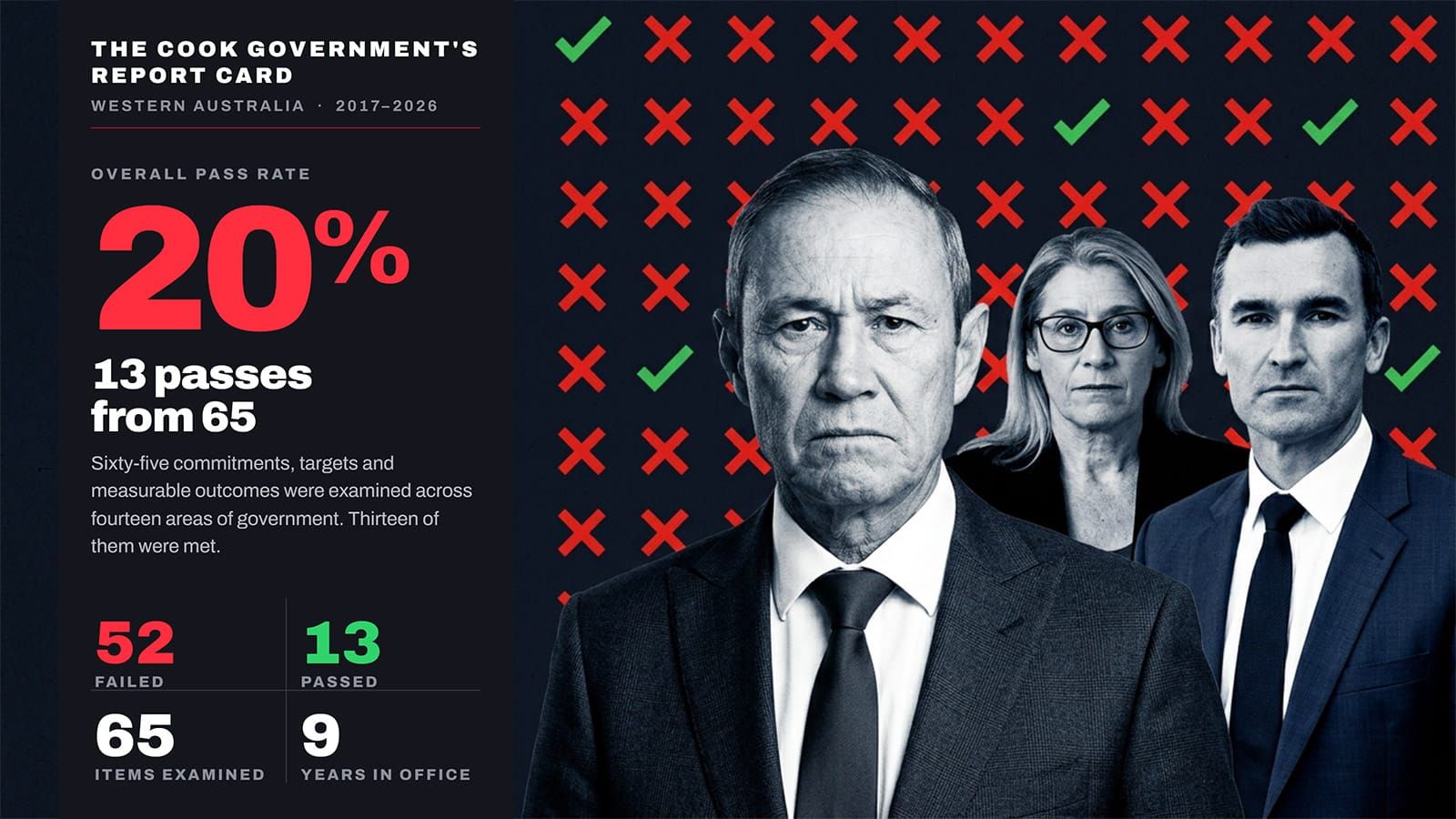
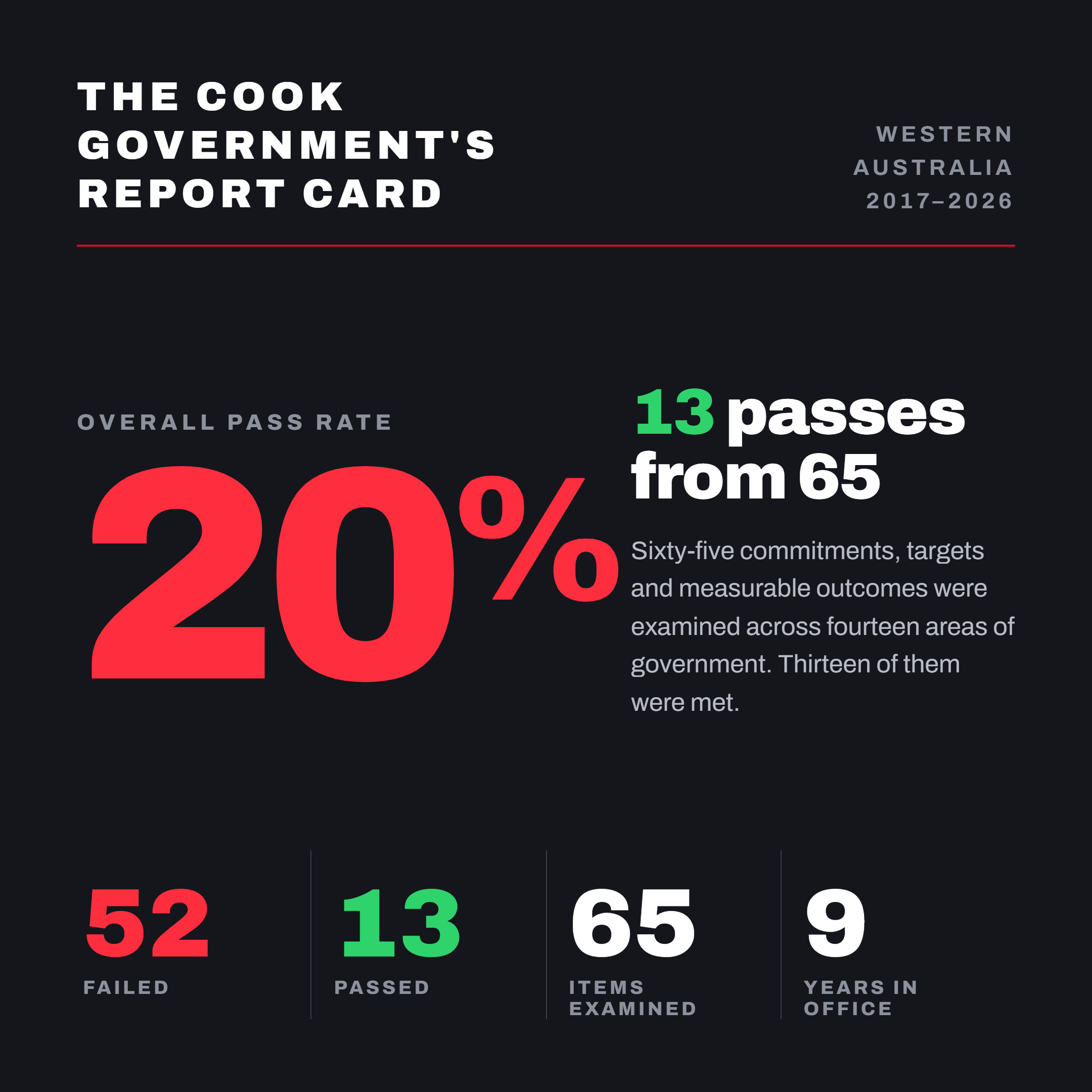
After nine years in office, the Cook Labor Government faces a devastating audit of 65 core commitments across health, transport, housing, and public safety. Built directly on official budget papers and Auditor General reports, the evidence reveals a dismal 20% pass rate, failing 52 key targets.
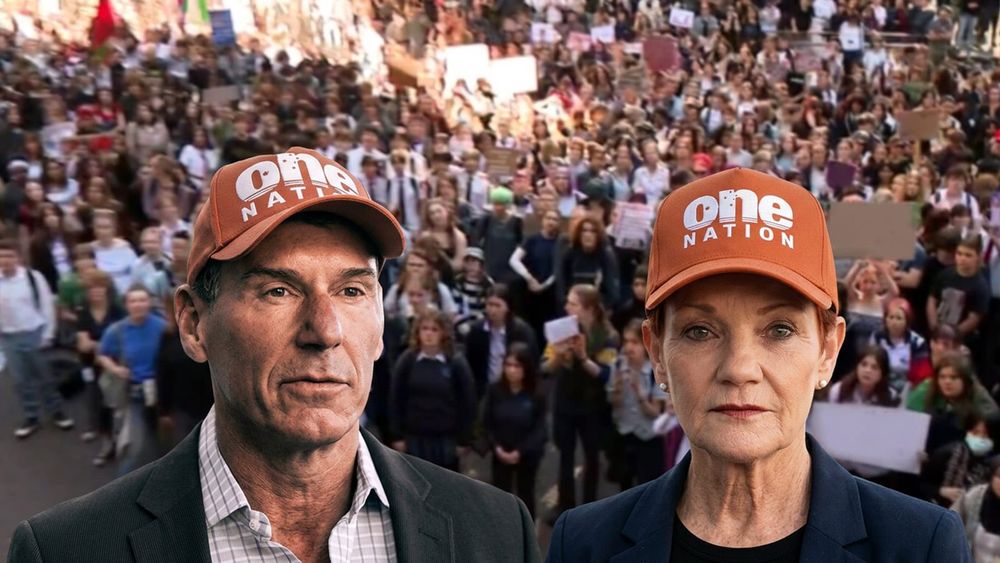
Image: One News Australia Illustration. Over nine years in office, the Cook Labor Government has accumulated a dismal 20% pass rate on its report card, failing on 52 out of 65 key commitments and targets across crucial portfolios including health, housing, Metronet, and energy.
Western Australia votes in Secret Harbour on Saturday, nine years into a Labor government. This is the full working file on the Cook Government's record, covering 65 items across health, transport, housing, cost of living, policing, education, waste, energy, immigration, fishing, social policy and the conduct of this campaign. Every item is scored a pass or a fail against what the Government promised or set as a target, and the material is drawn from Auditor General reports, WA Police statistics, Budget papers, Hansard, Australian Bureau of Statistics data and the Government's own statements.
Nine years in government, the full working file
65
items on the record
52
commitments and targets the Government failed
13
it met
14
areas of government examined
20%
Overall score
13 out of 65
commitments and measures passed, every item in the file is scored
$261m
community sport funding the department did not assess or approve
$989.9m
health payments through a pathway the Auditor General found had weak controls
$12.7bn
what the Government now puts Metronet at, against about $4bn in 2017
$400m
the Bullsbrook facility, 500 beds, barely used
1. Health
This section covers ambulance ramping, two Auditor General reports, the state of hospital maintenance and the elective surgery waiting list.
1.1
Ambulance ramping
✘ FailAMA WA ramping snapshots, May and July 2026
May 2017466 hours
May 20265,383 hours
Same month, nine years apartMore than elevenfold
July 2026 v Cook's 2017 benchmark5.75 times
Ramping is what happens when an ambulance reaches a hospital and cannot hand its patient over, so the crew waits outside the emergency department with the patient on board and cannot answer the next call. In May 2017, the year Labor took office, ambulances were ramped outside WA hospitals for 466 hours. In May 2026 the figure was 5,383 hours, the worst May on record and more than eleven times the 2017 figure. July 2026 reached 5,924 hours, the worst month of this year and 11% above June, working out at an average of more than 191 hours of ramping every day. The highest monthly total ever recorded was September 2025 at more than 7,200 hours, the last of three consecutive record months in July, August and September that year. Shadow Health Minister Libby Mettam has attributed the fall against last winter to a mild flu season rather than to better management, describing it as sheer luck rather than good governance.
“These shocking statistics add up to a massive failure by the Barnett Liberal Government to manage our health system.”Roger Cook, then shadow health minister, 12 February 2017
On 12 February 2017, three weeks before the election that put Labor into office, Roger Cook was shadow health minister and issued a press release headed that the Barnett Liberals had failed on health with record ambulance ramping, record waitlists and no plan for healthcare in Western Australia. It said Health Department figures showed ambulances were ramped outside Perth hospitals for 1,030 hours in January that year, against a previous worst January of 980 hours in 2015.
The release referred to horror stories of sick people waiting for hours for ambulances to arrive, and promised that WA Labor's Putting Patients First policy would free up hospital beds, treat patients in a timelier manner and reduce waitlists. The July 2026 figure of 5,924 hours is 5.75 times the number he called a massive failure, and the elective surgery waiting list he promised to reduce is at item 1.4.
1.2
The $989.9 million health payments audit
✘ FailTabled 19 August 2026
Payments$989.9m
No segregation of duties30%, $24.4m
Insufficient records17%
WA Auditor General, Report 1: 2026-27. Of the payments tested, 30% worth $24.4m could not show two separate people were involved, 17% had insufficient information to support that the payment was valid, and five payments totalling $153,836 were approved by officers without the delegation to approve them. The manual payment form was editable, which the Auditor General found significantly increases the risk of fraud.
Their answerWA Health says no fraudulent activity has been identified, has accepted the findings, locked the editable form from 1 July 2026, and says the pathway is under 10% of non-salary spend for metropolitan health entities. Remediation deadlines run to December 2027.
1.3
Hospital maintenance, the Barnes-Fong review
✘ Fail15 January 2026
Portfolio$7.6bn
Reactive maintenanceAbout 75%
Master plansNone for RPH or QEII
An independent review by former senior bureaucrats Michael Barnes and Neale Fong into how WA Health manages a $7.6 billion hospital portfolio found about 75% of maintenance in North and East Metropolitan Health Services was reactive rather than preventative, against a Queensland target of 65% planned. It found severely limited data with no system-wide view of hospital condition, preventative maintenance run off outdated spreadsheets, and no master plans for Royal Perth or QEII.
Their answerHealth Infrastructure Minister John Carey accepted all recommendations and announced $50 million for three ageing hospitals, of which about $20 million was spent or contracted at the time of publication.
1.4
Elective surgery waiting list
✘ FailWA Health’s own dashboard, July 2026
Cases on the list29,920
Over boundary4,697
Category 2, 90th percentile202 days
WA Health’s own monthly dashboard records 29,920 cases on the elective surgery waiting list at the end of July 2026, of which 4,697 were over boundary, meaning they had waited longer than the time clinically recommended for their urgency category. Category 2 cases, which are clinically recommended within 90 days, had a median wait of 52 days and a 90th percentile wait of 202 days, so one in ten of those patients waited more than twice the recommended time. In the metropolitan area the 90th percentile wait for Category 3 was 382 days, against a clinical recommendation of 365 days.
Their answerThe Government points to a record number of elective surgeries delivered and says overdue patient numbers have fallen 21% since January 2024.
1.5
Flu vaccination target
✘ FailTheir own dashboard, 24 August 2026
Whole population28.9% against 40%
65 and over59.8% against 65%
Under 1224.7% against 30%
Launching the Be Wise, Immunise campaign on 30 April 2026, the Government set three public vaccination targets and promised weekly reporting of progress against them. Roger Cook said at the time: “We’ve set ambitious targets to help drive up vaccination rates.” All three have been missed. The Government’s own Winter WAtch dashboard, with data correct as at 24 August 2026, records 28.9% of the whole population vaccinated against a 40% target, 59.8% of adults aged 65 and over against a 65% target, and 24.7% of children aged six months to 12 years against a 30% target.
The programs behind the targets were costed at $8.4 million for the free influenza program, $6.6 million for the needle-free FluMist vaccine for children, $7.6 million for the RSV infant program and $2.5 million to extend RSV immunisation to older adults.
Their answerThe Government notes that the Australian Immunisation Register is a dynamic dataset and that figures for earlier weeks can be revised as records are updated.
1.6
Older adults stuck in hospital awaiting aged care
✘ FailTheir own Winter WAtch dashboard
July 2026 daily average423
In 2023144
Fiona Stanley has783 beds
The Government's Winter WAtch dashboard records a daily average of 423 older adults remaining in hospital through July 2026 while waiting for a Commonwealth residential aged care place, up from 144 in 2023, 177 in 2024 and 254 in 2025, with 357 recorded across 2026 to date. On the same page the Government notes that Fiona Stanley Hospital has 783 beds, a comparison it drew itself.
Their answerThe Government attributes the delays to the Commonwealth managed aged care system and says it is working with aged care providers to ease the pressure through its Time to Think beds.
1.7
Bunbury mental health observation area
✔ PassCompleted 30 July 2026
BedsSix, with ensuites
Fast-track bays10
Operating24 hours, 7 days
The first element of the Bunbury Regional Hospital redevelopment was completed on 30 July 2026, delivering a mental health observation area with six bedrooms, private ensuites, two fully accessible rooms, lounge and dining areas and a courtyard, operating around the clock with admissions of up to 72 hours, alongside an upgraded fast-track area with 10 bays designed to assess and discharge non-complex patients within two hours. This covers the delivery of that one element, and the redevelopment as a whole is recorded at item 2.5, where the cost has risen 186% above the original commitment.
1.8
Extra public hospital beds through acquisition
✔ PassAnnounced 6 November 2025
Mt Lawley beds197
New public bedsUp to 100
TheatresEight
The Government moved to bring St John of God Mt Lawley Hospital into public hands, a 197 bed facility expected to add up to 100 beds and eight operating theatres to the public system, and separately brokered a deal for Bethesda Health Care to take over Mount Hospital from Healthscope, with the stated rationale that buying capacity adds beds faster than building them.
Section 1, Health subtotal2 of 825%
2. Infrastructure and transport
Here we set out what Metronet was costed at against what it has cost, how the Karnup station promise has travelled since 2013, and where two hospital projects stand.
2.1
Metronet cost
✘ FailTheir own answer in Parliament, June 2026
Costed in 2017About $4bn
Government's own figure$12.7bn
Total cost to taxpayers$14.7bn
On 17 June 2026 Hon Michelle Hofmann asked the Government three questions on notice: what the original estimated total cost of Metronet stage 1 was, what the current known total cost is, and whether further costs are expected. The answer, given by parliamentary secretary Hon Samantha Rowe on behalf of the Transport Minister, addressed only the current figure, stating that stage 1 delivered significantly more projects than were committed to at the 2017 election and that the total infrastructure spend was $10.7 billion, made up of $5.33 billion in state funding and $5.45 billion from the Commonwealth.
The original estimate was not provided. Metronet was costed at about $4 billion when Labor won office in 2017, and by April 2025 the state's rail network was reported as costing taxpayers almost $14.7 billion, with the Government maintaining that a 20 year signalling contract worth $1.6 billion and a further $600 million for future maintenance should not count against a Metronet price tag it puts at $12.7 billion.
Rita Saffioti has given her own like-for-like figure, telling the ABC: “In relation to like-for-like, it's about $3 billion, initially we costed it at $3 billion, to about $5.5 billion.” Individual projects include the Ellenbrook line at $1.65 billion, elevated tracks at Victoria Park and Cannington at $1.04 billion, Byford at $797 million and the Thornlie loop, which more than doubled to $1.1 billion.
Their answerThe Government says stage 1 delivered significantly more than was committed to at the 2017 election, including more stations and more level crossing removals, and points to construction industry cost increases across the period. Rita Saffioti has defended the increases by saying that against what the state received from the Commonwealth, and against what other states are paying, Metronet is much more affordable.
2.2
Metronet delivery
✘ FailFive years from the 2017 election to the first opening
Election2017
First opening2022
Years with nothing openFive
Every major stage opened late, and five years after the 2017 election not a single line or station had opened.
2.3
The $1.6 billion in undisclosed Metronet increases
✘ FailAuditor General Report 21, 2025
Signalling program cost$2.59bn
Radio Systems Replacement$119.8m to $437.6m
Estimated to complete15.9 years
The Auditor General examined High-Capacity Signalling, the Metronet program that re-signals the rail network, in the 2025 Transparency Report on Major IT Projects, Report 21. Its current estimated total cost is $2.587 billion and it is estimated to take 15.9 years to complete, making it the largest of the ten IT projects reviewed.
In a case study headed on the difficulty of tracking projects from year to year, the Auditor General set out that before 2021 the Budget papers separately disclosed Radio Systems Replacement with initial approved funding of $119.80 million and Automatic Train Control with $7.4 million, that the 2021-22 Budget merged them into an HCS Program of Works costed at $449 million, and that most of that reported cost was for Radio Systems Replacement and was significantly more than the $119.80 million initially approved.
By the 2024-25 Budget papers the program showed $667.03 million, of which Radio Systems Replacement was $437.64 million. The Auditor General concluded that reporting projects in the Budget papers as a larger program of works reduces transparency for the public and Parliament on individual project costs.
2.4
Karnup train station
✘ FailGiven a timeframe on 2 August 2026
Promised2013
Waiting13 years
Works start2028
First promised in opposition before the 2013 election, renewed before 2017, 2021 and 2025, and first given a timeframe on 2 August 2026. Of the $156m cost, $10m has been committed, half is to come from land sales that have not happened, and the remaining $78m depends on a Commonwealth contribution the Government concedes is not locked in. Construction is not due to start until 2028, fifteen years after the promise.
Their answerThe Government says it could not secure federal funding because the former Coalition government funded Lakelands station instead, paying 80% of that project. Rita Saffioti says the time is right now that nearby housing developments are being finalised, while conceding “It was always on the agenda. The timing, of course, we brought forward.”
2.5
Bunbury Hospital and Yanchep
✘ FailAnnounced October 2021, now stated at $572m
Promised Oct 2021$200m
Now$572m
Above the original$372m, up 186%
Bunbury Regional Hospital was announced in October 2021 as a $200 million redevelopment and a key election commitment, described at the time as the biggest undertaken in regional WA. The cost has risen at every stage since: expressions of interest went out in February 2023 at $277.9 million, an additional $173 million in April 2024 took it to $451 million, a further $20.3 million in June 2025 took it past $471 million, and the Government now states the figure as $572 million. That is $372 million above the original commitment, an increase of 186%, and the project is still under construction with only the Mental Health Observation Area and fast-track area completed as at 30 July 2026.
Separately on Yanchep, the McGowan Government announced funding to progress a Yanchep health centre in January 2020, and no hospital funding was allocated for Yanchep in the 2026-27 Budget, while the Government’s own statements record 4,100 new homes across Eglinton and Yanchep, four new schools and a $5.5 million relocation of the police station in the same corridor.
Butler MLA Lorna Clarke said in March 2026 that population growth means the area needs more services. The nearest emergency department is about a 30 minute drive away. The $600 million Yanchep hospital with 250 beds and a 24-hour emergency department that has been announced for the area is a Liberal commitment made on 8 June 2026 which depends on winning the 2029 election, so it is not a Labor promise and is not scored as one here.
2.6
The “longest locally made water pipeline” claim
✔ PassGovernment media statement, 15 June 2026
Official claimLargest diameter
Alkimos trunk main1.6m internal, 33.5km
Golden Pipeline760mm, 566km
The Government's media statement of 15 June 2026 describes the Alkimos trunk main as the largest diameter water pipeline made in Western Australia, at 1.6 metres internal diameter across 33.5 kilometres, manufactured by Steel Mains in Kwinana from Pilbara iron ore and Cockburn cement as part of the $2.8 billion Alkimos Seawater Desalination Plant project. C.Y. O'Connor's Goldfields pipeline is far longer at 566 kilometres but was built from 760 millimetre main, less than half the diameter, so the claim about diameter stands. Rod Caddies challenged what he described as a claim by Reece Whitby to be delivering WA's longest locally made water pipeline, pointing to the Goldfields scheme.
2.7
Patronage on the new northern stations
✘ FailThe West, April 2025
Forecast in planning5,200 a weekday
ActualAbout 1,900
Share of forecastAbout 37%
The new stations at Yanchep, Eglinton and Alkimos were carrying about 1,900 average weekday passengers against the 5,200 forecast when the project was in planning. Across the whole network, train journeys peaked at 65.7 million in 2011-12 and had fallen to 61.5 million by 2018-19, the last full year before COVID.
Their answerRita Saffioti said the Government was happy with patronage, that the three stations sit at the end of the line, that more people use them than use many existing stations, and that housing is being built around them every day so numbers will grow, while pointing to strong growth on the airport and Ellenbrook services.
2.8
The promise to build railcars in Western Australia
✘ FailABC, April 2024
Local content claimed50%
Components made overseasAbout half
Bellevue described asAn assembly plant
Reviving local railcar manufacturing was a plank of Labor's election pledge, and 246 C-series railcars are being built under the program with the fleet due by 2029. About half the components are made overseas, and the Metronet agency itself describes the Bellevue facility as an assembly plant rather than a manufacturing hub. Noise-proofing contractor Pyrotek states that the train shells are built in India and the air-conditioning units in Germany, and when pressed on which parts were made overseas Rita Saffioti could not say. Curtin Economics Centre research fellow Professor Mike Dockery called the investment a risky way to allocate taxpayers' money and said it would probably turn out to be a very expensive white elephant with a very poor return.
Their answerSaffioti said local content has gone from 2% to 50% in a few years, that starting a manufacturing business from zero is hard, and that the capacity to build railcars in WA will train young people and serve for generations.
2.9
Metronet stations opened
✔ Pass23 stations since 2017
Stations opened23
Lines deliveredAirport, Ellenbrook, Yanchep
Railcars246 ordered
The Government states that 23 Metronet stations have opened since 2017, with the Forrestfield airport link, the Morley to Ellenbrook line and the Yanchep extension all now carrying passengers and the final station at Midland opening in February 2026, so that whatever the cost and the delays recorded at items 2.1 and 2.2, the network was built and it is running.
2.10
The Alkimos water pipeline
✔ PassHalfway, June 2026
Trunk main33.5km
Laid so farMore than 17km
Pipe made inKwinana
More than 17 kilometres of the 33.5 kilometre Alkimos trunk main had been laid by June 2026, using nearly 1,600 sections of steel pipe manufactured by Steel Mains in Kwinana from Pilbara iron ore and Cockburn cement, with completion due in 2027 as part of the $2.8 billion desalination project, and the Government says the larger diameter reduces pumping energy and cuts emissions 21% against a smaller pipeline.
Section 2, Infrastructure and transport subtotal3 of 1030%
3. Housing, homelessness and population
The Government set its own homelessness target in its own strategy, and these items measure what has happened since, alongside social housing delivery and a $400 million facility that has sat almost empty.
3.1
Halving homelessness by 2028
✘ FailTheir own strategy
Target18.2 per 10,000
201636.4
202136.6
The Government's own strategy, All Paths Lead to a Home, commits to halving the 2016 homelessness rate of 36.4 per 10,000 people to 18.2 by 2028. At the 2021 Census it had risen to 36.6. Rough sleeping more than doubled, from 1,083 people to 2,315, Indigenous rough sleeping went from 48.8 to 100.7 per 10,000, and WA now has the highest proportion of rough sleepers of any state or territory.
3.2
Social housing delivery
✘ FailFrom their own Budget
Planned since 20219,800 homes
Delivered4,000
Short5,800
The 2026-27 Budget records 9,800 homes planned since 2021 with 4,000 delivered. It allocates $452 million for a further 165 social housing dwellings plus refurbishment of 215, and $1 billion under the Housing Australia Future Fund for 1,426 homes.
3.3
Housing waiting lists
✘ FailBankwest Curtin Economics Centre and Department of Housing and Works
General waitlistAbout 20,700
Five-year rise38%
Priority waitlist1,462 to 6,300
The general social housing waiting list sits near 20,700, up 38% in five years, while the priority waiting list rose from 1,462 in 2018 to 6,300 in 2024, an increase of 330%. In 2024-25, 25,918 West Australians accessed specialist homelessness services.
3.4
The Bullsbrook facility
✘ FailABC, 14 April 2026
Cost$400m
Beds500
Use since 2022Almost none
A $400 million, 500-bed facility completed in 2022, returned to Commonwealth ownership in 2023 and largely idle since, used for bushfire evacuees and in May 2026 for hantavirus quarantine. On 14 April 2026 the Government began considering turning it into a prison.
Their answerThen Corrective Services Minister Paul Papalia said Shelter WA considered the site unsuitable for rough sleepers because it is “in the middle of nowhere, effectively”, adding “conversely, that might make it a good place for a prison.” Prison Officers' Union secretary Andy Smith said it is not a suitable property.
3.5
Population growth as the explanation
✘ FailFrom the Government’s own migration service
Reconnect WA$195m
Visa subsidies$11m for 1,100 workers
Asked Canberra for10,000 places
The Government attributes housing and infrastructure pressure to population growth while funding a suite of programs to attract more skilled workers from overseas, all documented on its own migration website. The 2023-24 Budget carried a $47.6 million workforce package including an $11 million Construction Visa Subsidy Program offering up to $10,000 a head to attract up to 1,100 skilled migrants to building and construction, $2.4 million to promote skilled migration and visa advisory services, and a $4.25 million Skilled Migration Job Connect program paying individual migrants up to $7,500, later raised to $10,000, toward skills assessments and licensing.
These sit alongside the $195 million Reconnect WA program, which the Government says includes international advertising campaigns to attract overseas skilled workers, backpackers and international students. The State asked the Commonwealth to lift its nomination program to 10,000 places for 2023-24, and Roger Cook personally chaired the Skilled Worker Attraction Government Steering Committee as Deputy Premier. The Government’s own words are that the construction subsidy exists to accelerate housing construction and build capacity to keep up with population growth.
In October 2025 Roger Cook went further and wrote to the Prime Minister asking him to reconsider a federal plan to cut Western Australia’s State Nominated Migration Program from 5,000 places to 3,400, a reduction of about 32%, saying “we need more workers, and that’s why we need the government to stand by us and continue to make sure we’ve got a strong skilled migration program”.
Asked about the circularity of importing workers to build homes for a growing population, he conceded a chicken and egg element and said “we need more schools, we need more hospitals and we need more workers, we get more workers and we need more homes and skills and hospitals, this is part of the challenges of growth”.
Over the same period the state’s population passed three million at the end of 2024, having grown by about 300,000 since COVID against average net overseas migration of around 25,000 a year, while the Bankwest Curtin Economics Centre found that across eighteen months the total number of new rentals rose by 694 units as the population grew by about 120,000, median weekly rent reached $740 after rising 76% since 2020, and the share of West Australian households considering their housing unaffordable passed half, an increase of 91% in two years.
Their answerThe Government points to these being targeted skilled visa programs for construction, health, teaching and hospitality rather than general migration, and to the Commonwealth setting migration levels within which the State only nominates. Bankwest Curtin Economics Centre director Professor Alan Duncan, whose figure of 694 new rentals appears above, draws the opposite conclusion from it, saying the rental shortage cannot be blamed on immigration because there are not enough houses overall, and federal minister Anne Aly has warned against blaming migrants for housing and congestion.
Section 3, Housing, homelessness and population subtotal0 of 50%
4. Cost of living
These items deal with the power credit that was withdrawn, what household tariffs have done since, and the public sector positions cut in the last Budget.
4.1
The $400 power credit
✘ FailRemoved in the 2025-26 Budget
Paid since2020
Scrapped2025-26 Budget
Surplus forecast$2.4bn
The Household Electricity Credit was paid automatically to every Synergy and Horizon residential customer from 2020, was removed in the 2025-26 Budget and was not revived in 2026-27, against a forecast surplus of $2.4bn following a $3.5bn surplus in 2025-26.
Their answerThe Government points to targeted relief instead, including a $100 fuel payment to 2.1 million licence holders, no-interest battery loans of up to $10,000 for low and middle income households, and the Hardship Utility Grant Scheme. Stephen Dawson told the Council WA power prices remain lower than other mainland states.
4.2
Household tariff increases
✘ FailSynergy’s own published rates
From 1 July 2026119.2419c a day
Usage rate33.2621c a kWh
Increase2.75%
Synergy’s published Home Plan A1 rates, effective 1 July 2026, are a daily supply charge of 119.2419 cents and a usage rate of 33.2621 cents per kWh, both including GST. Against the previous year’s 116.05 cents and 32.3719 cents, that is an increase of 2.75% on both components. Synergy states on the same page that supply and usage rates for Home Plan A1 are set by the Government, which places responsibility for the increase with the Government rather than the retailer.
4.3
Public sector growth and the 1,500 cuts
✘ FailPublic Sector Commission workforce reports, 2017 to 2024-25
FTE when Labor took office110,662
FTE in 2024-25140,679
Growth under Labor+30,017, or 27.1%
Positions now being cut1,500
The 2026-27 Budget cuts 1,500 public sector positions for $445 million in savings over four years, alongside a 5% reduction in consultants, advertising and travel spending worth $50 million.
The Public Sector Commission's own reporting puts public sector full time equivalent staff at 110,662 in 2017, the year Labor took office, and at 140,679 in 2024-25, an increase of 30,017 positions or 27.1% on a headcount that reached 179,490, so the 1,500 positions being removed amount to about 1.1% of the workforce and about 5% of the growth added since 2017. The sector grew by 7,380 FTE in 2024-25 alone, which is nearly five times the number now being cut.
Their answerThe Commission's report states that over the last five years the Government set a series of insourcing policies to return jobs to the public sector, which added to the size of the sector, and that at June 2025 the public sector employed 11.1% of the Western Australian workforce, against a range of between 10.2% and 11.0% recorded since 2015.
4.4
The budget position
✔ Pass2026-27 Budget
Surplus 2025-26$3.5bn
Mining royalties$11bn
Worth of the GST deal$6.6bn
Net debtDown to $34.5bn
Western Australia recorded a $3.5 billion surplus in 2025-26 and forecasts $2.4 billion for 2026-27, its eighth consecutive surplus, with net debt falling from $39 billion to $34.5 billion.
Mining royalties reached $11 billion in the same year, more than four times the forecast surplus, and the e61 Institute records that royalties now raise more than payroll tax and stamp duty combined and that a swing in the iron ore price between US$60 and US$115 a tonne, both within the historical range, is worth about $5 billion a year or 10% of state revenue.
The Commonwealth Grants Commission, the federal body that works out how the GST is split between the states, estimates that Western Australia benefits by $6.6 billion this year from the 2018 GST agreement compared with the standard formula, Michael Brennan and Matthew Maltman of the e61 Institute describe that $6.6 billion as the difference between a nation-leading surplus and a large deficit, and the 2018 agreement was legislated in Canberra by the Coalition rather than by any Western Australian government, with the Cook Government's $1 million campaign to keep it recorded at item 8.8.
This is scored a pass because the surpluses and the fall in net debt are real and no other state has matched them, and the qualification that belongs beside it is that on the Grants Commission's own numbers and the e61 analysis the position rests on the iron ore price and a federal agreement rather than on decisions taken in Perth.
Their answerTreasurer Rita Saffioti says Western Australia will double down in its fight to protect the 2018 agreement and ensure the state is not punished for its economic success, and the Government points to eight consecutive surpluses and net debt falling by $4.5 billion in a single year.
4.5
Cost of living measures delivered
✔ PassFrom 1 July 2026
Fuel payment$100 to 2.1m
Student assistanceUp to $250 a child
Sunday transportFree
The 2026-27 Budget delivered a $100 fuel payment to 2.1 million licence holders, student assistance payments of up to $250 a child, free public transport on Sundays, capped public transport fares, $13 million in rent relief, stamp duty exemptions on homes under $600,000 and first home owner grants lifted to $10,000.
Section 4, Cost of living subtotal2 of 540%
5. Law and order
The police recruitment commitment is measured here against what was delivered, and recorded crime across the electorate is measured per head of population rather than in raw counts.
5.1
950 extra police officers
✘ FailTreasurer's 2025-26 Budget speech
DueMid-2024
Delivered863
Short87
Labor promised 950 additional officers by mid-2024. The Treasurer's 2025-26 Budget speech records 863 added, 87 short of the commitment and two years past the deadline.
Their answerPolice Commissioner Col Blanch said the force could not compete with more flexible employers despite offering part-time positions, and pointed to attrition alongside about 1,700 applications from international recruits.
5.2
Violent crime in the electorate
✘ FailWA Police district crime statistics to June 2026
Assault, non-family+18.5% vs WA +8.3%
Drug dealing+38.2% vs WA +17.1%
All drug offences+57.2% vs WA +39.1%
Recorded offences per 100,000 people in Mandurah District, which covers the whole Secret Harbour electorate, across four complete financial years to June 2026. Non-family assault rose more than twice as fast as the state, and drug dealing rose more than twice as fast as the state. Over the same period burglary, robbery, motor vehicle theft, graffiti and recorded sexual offences all fell in the district.
5.3
Road safety cameras
✔ PassGovernment figures, August 2026
Great Southern82% fewer offences
Mid West72% fewer
Seatbelt deaths23% to 13.8%
Safety camera trailers in the Great Southern produced an 82% reduction in the overall rate of offending between June 2025 and July 2026, including 85% fewer mobile phone offences and 83% fewer speeding offences, with the Mid West recording a 72% reduction. The Government says seatbelt related fatalities fell from a ten year average of 23% to 13.8% statewide, and two more trailers were based in Bunbury from August 2026 under an $80 million road safety package.
Section 5, Law and order subtotal1 of 333%
6. Education
These items cover how many transportable classrooms are in use across public schools, and where the free kindergarten commitment stands.
6.1
Portable classrooms
✘ FailDepartment of Education data
Buildings3,935
Classrooms3,096
As atMarch 2025
The Department of Education recorded 3,935 demountable and transportable buildings on public school sites, containing 3,096 classrooms.
6.2
Free kindy for four-year-olds
✔ PassAnnounced August 2025, began Term 1 2026
Committed$33.8m in 2025
Planned start2027
Actual startTerm 1, 2026
Free full-time kindergarten was a $33.8 million commitment at the 2025 election, and in August 2025 the Government announced the pilot would be brought forward a year to start in Term 1 of 2026 at five schools: Roleystone Community College, Halidon Primary and Banksia Grove Primary in the metropolitan area, with South Kalgoorlie Primary and Dalyellup Primary in the regions. The trial doubles kindergarten from five days a fortnight to five days a week and remains non-compulsory.
The 2025-26 Budget carried $28.9 million for implementation, minor infrastructure, curriculum resources and early childhood workforce measures, with a further $4.9 million committed in the 2024-25 Mid-year Review to establish an Office of Early Childhood. An expression of interest process was opened for more schools to join in 2027, with statewide rollout to be informed by the trial.
Section 6, Education subtotal1 of 250%
7. Waste and FOGO
The Waste Authority narrowed what may go in the FOGO bin in July, and these items trace that decision through to fortnightly red bin collection in Rockingham.
7.1
The narrowed FOGO list
✘ FailWaste Authority, 10 July 2026
Changed10 July 2026
Now excludedPet waste, tea bags, pizza boxes
Councils27 with three-bin FOGO
The Waste Authority quietly published narrowed rules on 10 July 2026 for the FOGO bin, which stands for Food Organics and Garden Organics and takes food scraps and garden waste so they are composted rather than sent to landfill. The narrowed list excludes pet waste, tea bags, paper towels and pizza boxes, and leaves only unpackaged food waste, garden waste and certified compostable liners. The City of Rockingham is one of 27 councils running three-bin FOGO, which puts this inside the electorate.
Their answerThe Environment Minister defended the exclusions against council and resident backlash on 7 August 2026.
7.2
Red bin collection frequency
✘ FailWaste Authority strategy and Auditor General Report 3
State targetAll Perth and Peel by 2025
ProgramBetter Bins Plus: Go FOGO
Auditor GeneralReport 3, Aug 2020
The three-bin FOGO rollout is a state program. Better Bins Plus: Go FOGO delivers a headline commitment in the Government’s own Waste Avoidance and Resource Recovery Strategy 2030 for a consistent three-bin kerbside collection system across all local governments in the Perth and Peel regions by 2025, and the Waste Authority funds councils to adopt it. The Auditor General examined the strategy in Report 3 of August 2020 and found state and local waste planning inadequate, that few local government entities were likely to meet state waste recovery targets, that only 7% of WA local governments published a waste plan, and that the State was not providing enough support to reach a 50% increase in waste recovery by 2030.
Rod Caddies argues the state gave the order and councils carried it out, while Roger Cook is shown calling it a council issue. The City of Rockingham cut red bin collection to fortnightly when it introduced FOGO in June 2025 and told the ABC it did so in line with WA Waste Authority guidelines, and on 23 June 2026 the council voted to keep fortnightly collection after a special electors meeting sought a return to weekly, giving as its reason that weekly collection would send more waste to landfill and raise disposal costs through escalating State levy charges.
7.3
The weekly red bin campaign
✘ FailRockingham residents to the ABC and Yahoo News
Red bin cut toFortnightly, 140 litres
Council vote to keep it23 June 2026
Landfill diversion39% to 57.8%
Rockingham residents are on the record in mainstream reporting rather than only in campaign material. Father of two Daniel Prowse told the ABC that with a two-year-old in nappies the bin was “always fly-ridden, absolutely stunk and just had maggots”, and Clare Lee said her bins were overflowing well before collection. Long-time resident Simon Brown said the first principles of local government are roads, rates and rubbish and that the council is failing on rubbish, adding that he had never seen so many crows.
Campaigner Kim Amer told Yahoo News that the 140 litre fortnightly service had brought an influx of blowflies, maggots and crows, that young mothers were being pushed to use cloth nappies, and that residents could not open their doors without blowflies coming in.
7.4
Landfill diversion in Rockingham
✔ PassCity of Rockingham figures
Diversion before39%
After four months57.8%
FOGO processedMore than 95%
Since FOGO began in Rockingham in June 2025, diversion of waste from landfill rose from 39% to 57.8% in the first four months, and the city says more than 95% of the FOGO it collected was processed rather than dumped, so that on the stated environmental objective of the program the numbers moved.
Section 7, Waste and FOGO subtotal1 of 425%
8. Energy
This is the largest section, drawn mostly from one Legislative Council debate, and it covers the emissions figure, the deferred energy plan, what business is paying and how much generation has actually been built.
8.1
The emissions cut the coal exit actually delivers
✘ FailWA Hansard, 13 November 2025
Cut to global emissions0.08%
Cost of the coal exitNever published
Whole-of-system planDeferred to 2027
One Nation MLC Rod Caddies told the Legislative Council on 13 November 2025 that he had asked the Government how much Western Australia's actions would change global emissions, and told the house: “In the answer I received, I was told that shutting down our coal plants will hopefully reduce our global emission by 0.08%.” He repeated the figure in summing up, saying that reducing emissions by 0.08% is not worth ruining the economy for.
The Government has committed to leaving state-owned coal-fired power by 2030, which Energy Minister Stephen Dawson told the same debate is faster than any other state, and the figure of 0.08% came from the Government's own answer. It has never published what that exit will cost, it has deferred until 2027 the whole-of-system plan that would show how the replacement generation gets built, as recorded at item 8.2, and it delivered 76 megawatts of new large-scale renewable generation across five years, as recorded at item 8.4, so this entry is scored on the distance between the benefit the Government states and the cost it has not.
Their answerStephen Dawson told the debate that the Government has invested more than $6.4 billion in the energy system since 2017, that more than 9,800 megawatts of renewable energy, storage and gas projects are underway, and that the transition is needed because the coal stations are reaching the end of their lives and the economics of coal no longer stack up.
8.2
The energy plan deferral
✘ FailWA Hansard, 13 November 2025
Due by statute27 Sep 2025
Gazetted out to30 Sep 2027
Last plan2020
Steve Thomas told the Council the statutory whole-of-system plan review was due on 27 September 2025, and that days beforehand the Government gazetted an extension to 30 September 2027, recorded at paragraph 4.5A.2 on page 413 of a 966-page document. He said the Coordinator of Energy emailed a select number of businesses rather than announcing it. That would make seven years since the last plan while coal closures proceed.
8.3
What business is paying for electricity
✘ FailWA Hansard, 13 November 2025
Household increasesAbout 2.5% a year
Business contractsUp 25% to 45%
Contestable threshold50,000 kWh a year
Steve Thomas told the Legislative Council that residential and small users in the non-contestable market have had increases written into the Budget at about 2.5% a year, while businesses in the contestable market, meaning those large enough to shop around for a supplier rather than being placed on a government-set tariff, which is anyone using more than 50,000 kilowatt hours a year, renew their contracts every two years. He said every contestable contract he had seen in the previous eighteen months had risen by between 25% and 45%, so that a business on a $100,000 energy contract faced an increase of about $40,000.
He described that increase compounding through the food chain as the farmer running a cold store, the wholesaler and the supermarket each absorb the same rise and pass it on, and he said one producer had shut down a production line because the energy cost made a vegetable uncompetitive against imports, while the household increases the Government quotes, recorded at item 4.2, are the ones it sets and the contestable increases sit outside the price it publishes.
Their answerThe Government points to more than $6.4 billion invested in the energy system since 2017, to the two Synergy batteries at Kwinana and a $400 million expansion of the Warradarge wind farm, and says a renewable system backed by storage and gas is the lowest cost energy mix in the long run.
8.4
76 megawatts of new renewables in five years
✘ FailWA Hansard, 13 November 2025
2021, 2022, 2023, 2025Nothing delivered
202476 megawatts
Coal exit2030
Greens MLC Brad Pettitt tabled a graph in the Legislative Council showing no new large-scale renewable generation delivered in 2021, 2022, 2023 or 2025, and a single 76 megawatt project, Flat Rocks, in 2024. Warradarge stage 2 follows in 2026 and Kings Rocks in 2027. Collie A closes in October 2027 and the last Muja units in 2029.
Their answerStephen Dawson told the Council the Government has invested $6.4 billion in the energy system since 2017, has batteries at Kwinana and a $400 million Warradarge expansion under construction, and says more than 9,800 megawatts of renewable, storage and gas projects are underway.
8.5
Muja 6 and Bluewaters
✘ FailAnnounced 1 December 2023, reversed September 2025
Muja 6 retirementDeferred past the election
Griffin coal subsidyMore than $250m
Bluewaters434MW, 10 to 15% of supply
Muja C Unit 6 was scheduled to retire in October 2024. On 1 December 2023 the Government announced it would instead be placed on reserve outage mode from 1 October 2024 until 1 April 2025, available to the market operator on three days’ notice, which carried it through the summer and past the 8 March 2025 state election before the arrangement ended. On Bluewaters, the market operator had assumed the 434MW plant would be unavailable from 2027-28 because a state subsidy keeping its coal supplier Griffin solvent, costing taxpayers more than $250 million over four years, was due to expire in June 2026 and would not be renewed.
In September 2025 that assumption was quietly reversed and Bluewaters was certified back into the capacity market, where generators are paid about $250,000 for every megawatt they can reliably supply at peak. Energy Minister Amber-Jade Sanderson then said the commitment had always been to exit state-owned coal only, and that any assertion Bluewaters was part of the coal exit commitment was wrong. Roger Cook had said in July 2025: “There have been some tired arguments from cynics that we won’t have enough generation to close coal. They are wrong.”
8.6
Regional power reliability
✘ FailWA Hansard, 13 November 2025
Library search196 pages of outage articles
PeriodTwo years
Compensation$150
Hon Julie Freeman told the Council that a Parliamentary Library search of newspaper articles on power outages over two years returned 196 pages. She described country towns losing the supermarket, EFTPOS, the doctor's surgery with insulin warming in the fridge, the pool and the phone towers within hours of an outage, and running a diesel generator to keep a farm business operating.
8.7
Green steel walked back
✘ FailAnnounced 9 November 2025
Cook pledged it9 Nov 2025
BHP contradicted it11 Nov 2025
Unanswered in Parliament12 Nov 2025
On 9 November 2025 Roger Cook pledged that the use of local green steel would be written into major government projects, including three hospital builds due by 2029. Two days later, standing beside him, BHP iron ore boss Tim Day said green steel would not be viable within five years, and when asked whether that meant not until after 2028 he answered “No”, adding on a ten year horizon that “I couldn’t commit on a time.
No one knows that.” BHP is a partner in the Kwinana pilot plant that aims to begin operating in 2028. The next day the member for Cottesloe, Sandra Brewer, asked Health Infrastructure Minister John Carey in the Legislative Assembly how the Government would complete construction using WA-made green steel at Royal Perth by 2028 and Peel Health Campus by 2029, given no WA green steel mills are being built.
Carey answered by referring to the opposition’s record on Royal Perth in 2008, Mullewa Hospital and Perth Children’s Hospital. Asked again whether he stood by the Premier’s statement, he called green steel “a fantastic aspiration and ambition”. Cook later said “there may be hospitals which don’t incorporate WA green steel at this point in time”, and suggested green recycled steel would satisfy the procurement requirement instead.
8.8
The GST billboards
✔ PassCampaign launched November 2025
Campaign cost$1m
Billboards inCanberra
GST at stake$7.4bn a year
The Cook Government launched a $1 million advertising campaign in the first week of November 2025 carrying the message that WA's GST is working for Australia, running on billboards in Canberra, in east coast newspapers and on social media, with a second set of advertisements inside WA asking West Australians to enlist in Team WA and make submissions to the Productivity Commission review of the 2018 GST deal. WA received $7.4 billion in GST revenue in 2024-25 and the Government says losing the arrangement would cost the state close to $6 billion a year. Rita Saffioti said the gloves are off in defending WA's share, while Roger Cook said he knew Anthony Albanese backed the deal and would seek his reassurance in Canberra.
8.9
Gas prices, up 157% since 2020
✘ FailAEMO 2025 WA Gas Statement of Opportunities
Contract price, Q3 2020$2.87 a gigajoule
Contract price, Q2 2025$7.37 a gigajoule
Increase157%
Spot peak, June 2023$10.02 a gigajoule
The Australian Energy Market Operator records in its 2025 WA Gas Statement of Opportunities that the average domestic gas contract price in Western Australia reached $7.37 a gigajoule in the June quarter of 2025, which is 157% above its low point of $2.87 a gigajoule in the September quarter of 2020. The spot price, which is gas bought as needed rather than under a long term contract, rose from $2.13 a gigajoule in May 2020 to a peak of $10.02 in June 2023 and sat at $6.57 in September 2025, which AEMO describes as nearly three times the May 2020 low.
AEMO also reports that gas-reliant industries told it they could reduce or cease operations at around $10.00 a gigajoule, a level the spot price already reached in June 2023, while they would expand operations at around $4.30, and Anthony Spagnolo told the Legislative Council that in 2019 the then Premier was promoting cheap gas as the advantage that would draw industry to Western Australia and that prices in the Dampier to Bunbury pipeline had more than doubled since then.
On top of the commodity price, the Economic Regulation Authority approved a 33% increase in usage charges on the Dampier to Bunbury Natural Gas Pipeline from 1 January 2026, under which pipeline owner Australian Gas Infrastructure Group will draw just under $2.5 billion in revenue from 2026 to 2030 against $1.54 billion over the previous five years, an increase of about $960 million. The pipeline runs almost 1,600 kilometres from the Pilbara to Bunbury and supplies most of the state's gas.
That pipeline decision was made by an independent regulator rather than by the Government, and the drivers it gave were inflation and interest rate rises since 2022, while transmission accounts for only about 5 to 10% of a household gas bill and the Government sets a ceiling price for household users, so the 33% rise on the transmission component is worth roughly 2 to 3% on a household bill rather than a third more.
Their answerThe Government points to its domestic gas reservation policy, which requires major new export projects to keep the equivalent of 15% of production for the local market, and to new supply coming from the Scarborough project from late 2026. The Prime Minister has described the WA scheme as very effective and Resources Minister Madeleine King has called it nation-leading, while the delivery against that 15% target is recorded at item 8.12.
8.10
The Griffin coal subsidy
✘ FailABC, 7 July 2025
Cost to taxpayersMore than $250m
OverFour years
Due to expireJune 2026
A state subsidy scheme kept Griffin, the coal supplier to the privately owned Bluewaters power station, solvent at a cost to taxpayers of more than $250 million over four years. The scheme was due to expire in June 2026 and the Government said it would not be renewed, while Griffin has since fallen roughly a billion dollars further into debt despite the funding, and the market operator's assumption that Bluewaters would be unavailable from 2027-28 rested entirely on that subsidy ending.
8.11
The transmission blueprint with no money attached
✘ FailBlueprint launched 18 September 2025
Launched18 Sep 2025
New fundingNone announced
VenueCrown Perth
Energy Minister Amber-Jade Sanderson launched a blueprint for new and upgraded transmission across the South West Interconnected System on 18 September 2025, describing it as the backbone that would allow coal-fired generation to be phased out and WA to become a renewable energy powerhouse, with no additional funding announced alongside it. Greens leader Brad Pettitt said the plan offered no certainty and that there is almost no large-scale wind and solar coming onto the system, while opposition energy spokesman Steve Thomas said none of the Government's transition plan works on its current parameters and that it needed to announce its transmission direction at least two years earlier.
Their answerSanderson said the state was going through a staged process on transmission, and that expanding the grid would let more renewable projects connect and would give them timeframe certainty.
Section 8, Energy subtotal1 of 128%
8.12
The domestic gas reservation policy
✘ FailWA parliamentary inquiry, 2024
Policy target15% of exports
Actually deliveredAbout 8%
Woodside PlutoAbout 3.4%
Western Australia's domestic gas reservation policy, introduced in 2006, requires major new gas export projects to keep the equivalent of 15% of their production for the local market. A WA parliamentary inquiry found in a 2024 interim report that companies had delivered only about 8% on average relative to exports, with considerable variation between producers. The DomGas Alliance, which represents Alcoa, Wesfarmers and Yara, reported that Woodside's Pluto LNG project had supplied about 3.4% of its production to the domestic market, and its spokeswoman Mia Davies put the figure at less than 3%.
Commitments are secured through state agreements, leases and approval conditions that are not disclosed publicly, and a DomGas spokesman said the State lacks any strong compliance mechanism and that meaningful transparency is severely lacking in the WA system, while the Australian Energy Market Operator forecasts a shortfall of 11 terajoules a day by 2030, widening to 82 by 2035 and 478 by 2045.
Their answerAnthony Albanese has called the WA scheme very effective and said the national policy builds on the success of the WA model, Resources Minister Madeleine King has described it as nation-leading and a wise example of good planning, and Woodside says flexible application over the life of a project rather than a fixed annual percentage is a key element that should be replicated nationally, adding that discussions with the WA Government about modernising the Pluto arrangement are ongoing.
9. Immigration and public sector jobs
This item deals with the decision to allow temporary visa holders to hold permanent public sector employment from July.
9.1
Visa holders made eligible for permanent public sector jobs
✘ FailCommissioner's Instruction 48, effective 1 July 2026
Effective1 July 2026
Existing staff affectedMore than 1,000
Citizen priority in the ruleNone
Positions being cut1,500
Until 1 July 2026 a temporary visa holder could not hold a permanent job in the Western Australian public sector, however long they had worked there and whatever work they were doing. Commissioner's Instruction 48, published on 9 January 2026 and in force from 1 July 2026, removed that bar, and the Public Sector Commission says the change brings the public sector into line with the private sector rules that cover most Western Australian workers.
More than a thousand people already employed in those roles are affected, and they are not new arrivals being recruited from overseas but existing staff on fixed term and casual contracts. The United Workers Union ran the campaign for the change and covers health, disability support, early childhood education, cleaning and security, and it says permanency gives those workers paid leave, guaranteed hours and protection from a contract simply not being renewed.
The instruction defines eligibility for a permanent job as the right to work through citizenship, residency or a relevant visa, which places a visa on the same footing as citizenship. Clause 2 then sets the order in which permanent vacancies must be filled, being surplus employees being redeployed first, then fixed term and casual employees eligible for permanency under their industrial instruments, and then suitable applicants in recruitment pools, and nothing in that order refers to citizenship or residency.
The practical effect for residents is that an existing fixed term employee on a visa now sits ahead of an outside applicant who is an Australian citizen, because the visa holder is in the second priority group and the outside applicant is in the third. Rod Caddies told Parliament that in budget estimates the Commissioner conceded citizens and permanent residents would not be prioritised for these permanent positions, and the instruction reads that way. This is scored a fail because the Government widened who may hold a permanent public sector job in the same year it began removing 1,500 of them, recorded at item 4.3, without writing any priority for citizens or permanent residents into the rule.
Their answerThe Public Sector Commission says the change aligns public sector rules with the private sector standards that already cover most Western Australian workers, and that permanent appointment still requires an individual assessment of merit against the suitability requirements of the job. The United Workers Union claimed the change as a win, saying visa holders had worked for years doing the same work as permanent colleagues without the same security.
Section 9, Immigration and public sector jobs subtotal0 of 10%
10. Fishing
A parliamentary inquiry into the demersal fishing ban took submissions until early August, following the largest petition in the state's history.
10.1
The demersal closure and the compensation that has not arrived
✘ FailABC, 26 August 2026
Set aside for buyback$20m
Paid after nine monthsSeven fishers
Boats off the water36
On 3 December 2025 the Government announced that the West Coast zone from Kalbarri to Augusta would close permanently to commercial fishing for demersal species, meaning the fish that live close to the sea floor such as dhufish, snapper and baldchin groper, from 1 January 2026 with a compulsory buyback, that boat-based recreational demersal fishing would face a 21-month recovery closure until September 2027, that the Kimberley, Pilbara and South Coast would take a 50% commercial catch cut, and that trawling for demersals would end permanently in the Pilbara, supported by a $29.2 million package including a $20 million compulsory adjustment scheme to buy out commercial licences.
Nine months on, the ABC reported on 26 August 2026 that a government spokesperson confirmed only seven fishers had received compensation, that Fisheries Minister Jackie Jarvis had ended the arrangement with the barrister negotiating on the Government’s behalf and taken negotiations in-house, and that about half the displaced fleet had hired a Melbourne law firm to act for them.
Kalbarri fisher Phil de Grauw, who has fished there for 40 years, said 30 wet-line boats and six shark boats had been forced off the water and that fishers were “fighting tooth and nail to get the correct compensation”, while WA Fishing Industry Council chief executive Manue Daniels said it had been nine months without income and that it was unacceptable for people to be unable to pay their bills for that long. Former Dongara fisher James Oliver, who leased his fishing units rather than owning them, receives nothing at all, having been paying $33,000 a year in leases and fees, and said “three weeks’ notice by a government that’s meant to look after you, morally it was all wrong”.
Asked in Parliament in March about lessees, Jarvis answered that commercial fishers who lease a licence renew annually and “are encouraged to consider market conditions, including sustainability concerns, when choosing to enter such commercial arrangements”.
A separate parliamentary inquiry into the impact of the closure took submissions until 3 August 2026, following a petition signed by more than 34,000 people that was described as the largest in the state’s history.
Their answerThe Government says the closure follows scientific stock assessments showing dhufish, pink snapper and red emperor are severely depleted, with Roger Cook saying the species are on the verge of extinction in some parts of WA and Jackie Jarvis saying “these tough measures are the only way to give our fish the best chance of recovery”. On the delays, a government spokesperson said the third-party negotiator arrangement was concluded so that remaining negotiations could progress efficiently, and that several licence holders had requested amounts well above the market value of their entitlements, with work under way to validate those claims.
Section 10, Fishing subtotal0 of 10%
11. Social policy
Western Australia replaced the Gender Reassignment Act 2000 with a new gender recognition process that took effect on 30 May 2025. This section sets out what that law does, what it does not do, and what the record shows about prison placement.
11.1
The gender recognition law and women's prisons
✔ PassReforms in force 30 May 2025
Review recommended change2018
Reforms in force30 May 2025
Self-identification in WANo
In WA women's prisonsNil, October 2025
The Law Reform Commission of Western Australia recommended replacing the Gender Reassignment Act 2000 in its 2018 review, the McGowan Government announced it would legislate in December 2022, the Bill was introduced in 2024 and the changes came into effect on 30 May 2025, which abolished the Gender Reassignment Board and moved applications to the Registry of Births, Deaths and Marriages.
Western Australia does not have gender self-identification, because although Attorney General Dr Tony Buti said the changes mean applicants no longer need surgery or other reassignment procedures to change their sex or gender on their birth record, an applicant must still provide a statement from a doctor or psychologist certifying that they have received appropriate clinical treatment in relation to their sex or gender, and non-binary was added alongside male and female.
Asked in the Legislative Council on 15 October 2025 by Hon Philip Scott how many transgender women were housed in female prisons in Western Australia, the Department of Justice answered through Hon Matthew Swinbourn with a single word, “Nil”, and said placement of all prisoners takes account of safety, dignity and welfare alongside the safety of other prisoners and staff, with no dedicated self-identification policy for prison placement and each prisoner assessed case by case.
In the one contested case, the State Administrative Tribunal, which reviews decisions made by WA government agencies, directed that a prisoner who transitioned to female while held in a men's prison be transferred to a women's prison while she pursues a discrimination complaint, the Cook Government appealed, Justice Craig Bydder granted the Department a stay on 25 July 2026 and heard the appeal on 19 August 2026 with his decision reserved, and Department of Justice lawyer Adam Sharpe told the court “there is no right for a female prisoner to be held in a female prison”, arguing that the prisoner's gender recognition and amended birth certificate did not automatically confer a right to transfer, while her barrister Rachael Young said the chief executive continues to record her as male on departmental systems and her lawyers say she has been the victim of multiple sexual and physical assaults in prison since her transition.
This entry is scored on delivery of the law the Government said it would pass, which took seven years from the review that recommended it and is now in force, while the Northern Territory became the first Australian jurisdiction to ban transgender women from women's prisons in October 2025 and Western Australia has not legislated either way.
Their answerThe Government says the reforms remove a surgery requirement that Western Australia was alone in imposing in those terms, that a clinician's certificate is still required, and that prisoner placement is decided case by case on safety, dignity and welfare. In the contested case the State is arguing in the Supreme Court against the transfer, and the decision is reserved.
Section 11, Social policy subtotal1 of 1100%
12. Campaign conduct
The rest of this file measures promises against delivery, and conduct cannot be measured that way, so these five entries are scored on three tests and an entry fails if it meets any one of them. The first is whether an independent body has made a finding against the conduct. The second is whether the party in government used an advantage of incumbency that no other candidate in Secret Harbour is in a position to match. The third is whether the candidate or the Government declined to answer for it publicly. Legality is a separate question, it is stated in every entry, and on the record so far none of this is unlawful.
12.1
The sport and recreation pork-barrelling audit
✘ FailAuditor General Report 11, tabled 21 March 2024
Total funding$297.6m
Assessed by the department$36m
Not assessed by the department$261m
Projects474
Between 2020-21 and 2022-23 the Department of Local Government, Sport and Cultural Industries paid out $297,552,071, or almost $298 million, across three sport and recreation funding streams. The department assessed and approved one of those streams, the Community Sporting and Recreation Facilities Fund, worth around $36 million across 204 projects, and the Auditor General found sound and transparent practices were applied to it.
The department was not involved in assessing or approving the other 474 projects, which received $261 million through the WA Recovery Plan and 2021 election commitments. On those, the Auditor General concluded that “the practices used by Government to select, assess and approve these projects were not transparent and therefore the public and Parliament cannot be assured public money has been fairly and equitably awarded to communities”, and that the department's own funding guidelines did not apply to the money.
Measured against the first test at the top of this section, this fails because the finding belongs to the Auditor General, who is an independent officer of the Parliament, and it is that $261 million of the $297.6 million was handed out through a process she could not call transparent.
12.2
Selling time with ministers at $500 a head
✘ FailWA Labor event page, 12 August 2026
Tickets$500 and $100 a head
Cap on what can be raisedNone
Ministerial Code on fundraisingSilent
WA Labor published an event page for a Georgia Tree fundraiser in Kingston, Canberra on Wednesday 12 August 2026 at $500 a head, with a second event reported days later at $100 a head.
Nothing about it breaches Western Australian electoral law, because under the 2023 amendments to the Electoral Act 1907 a political contribution of more than $2,600 must be declared to the Electoral Commission within seven days outside an election period and by the end of the next business day during one, and those amendments capped what parties, candidates and third party campaigners may spend on campaigning without capping what they may raise.
The Ministerial Code of Conduct 2023, written after the 1992 Royal Commission into Commercial Activities of Government, does not use the word fundraising or the word donation anywhere in its 41 pages, and while it requires ministers to register gifts and hospitality within ten days, to declare conflicts of interest and not to solicit or accept any benefit in respect of the exercise of their discretion, it sets no rule at all about ministers attending events at which people pay to spend time with them.
Measured against the second test at the top of this section, this fails rather than failing any test of legality, because what is being sold is time with ministers, which no candidate outside government is in a position to offer, and because there is no limit on how much can be raised that way, with what those events raised across the campaign recorded at item 12.5.
Their answerWA Labor published the event page itself, contributions above the threshold are declared to the Electoral Commission under the rules that apply to every party, and paid fundraising events are used by parties across the parliament.
12.3
The Georgia Tree funding claims
✘ FailABC, 2 August 2026
Rockingham TAFE$5m
Lakelands Youth Park$1m
Nine schools$3m
The ABC reported on 2 August that Georgia Tree claimed to have secured $5 million for a Rockingham TAFE expansion within 20 days of preselection, that $1 million for the Lakelands Youth Park was announced through a video on her campaign page rather than an official channel, and that of $3 million for nine schools at least $600,000 had already been pledged by Paul Papalia last year. Her own words were “I'm proud that I've secured funding for local public schools across Secret Harbour.” Roger Cook said: “obviously we're taking advantage of a by-election to highlight what we are doing for this community, and to highlight how effective Georgia Tree is in representing this community.”
Measured against the second test, this fails because the money was announced through the candidate's own campaign page rather than an official channel, some of it had already been announced by another minister, and Roger Cook said in terms that the Government was taking advantage of a by-election, none of which is available to a candidate outside government.
Their answerNotre Dame's Professor Martin Drum called it a very fine line, and the ABC reported that no rules were broken.
12.4
The candidate refusing questions
✘ FailAt the Karnup announcement, August 2026
Days refusingTwo consecutive
Answered byThe Premier
Date2 August 2026
At the Karnup announcement Georgia Tree declined to take questions from journalists for a second consecutive day, with Roger Cook saying “We need to keep moving, sorry about that” and “Georgia's been more available in this election campaign than any other candidate.” Basil Zempilas called it odd and said Labor had been embarrassed into the announcement.
Measured against the third test, this fails because the candidate declined to take questions from journalists for a second consecutive day at a funding announcement made on her behalf, and the Premier answered for her.
12.5
Who is funding the Secret Harbour campaign
✘ FailWA Electoral Commission disclosures, August 2026
Raised since 1 May$1.6m
Share of all WA donations78%
From paid access eventsAbout half
WA Labor raised $1.6 million between 1 May and mid-August 2026, capturing 78% of all political contributions disclosed in Western Australia over that period, according to an analysis of WA Electoral Commission disclosures by Peter Milne of Boiling Cold. About $1.2 million of it came from corporate donors, and roughly half of everything raised since 1 May came from cash-for-access events at which companies pay to spend time with senior elected members. A levy on the taxpayer-funded salaries of Labor’s 78 elected members across the WA and federal parliaments yielded a further $206,000 in fifteen weeks.
The largest single donor was the government affairs consultancy Anacta Strategies, with twelve donations totalling $81,502, followed by fertiliser manufacturer Perdaman on $73,700, with the Chamber of Minerals and Energy on $25,300, Woodside on $19,250, Chevron on $18,700 and Fortescue on $16,638, alongside property developers Aigle Royal and Fini Group and the gambling company Sportsbet.
Woodside gave $12,100 in the week before the analysis was published. Labor’s candidate Georgia Tree left the office of federal Resources Minister Madeleine King to join Woodside earlier in 2026, and lives more than 60 kilometres from the electorate she is contesting. Peter Milne records that none of this breaches any rule, and the point of the analysis is that a governing party can raise money by selling access to the ministers who make the decisions.
Measured against the second test, this fails because 78% of every disclosed political contribution in the state going to the party in government, with about half of it raised by selling time with senior elected members, is an advantage of incumbency that no other candidate in Secret Harbour is in a position to match.
Their answerBoiling Cold states plainly that it does not suggest the Labor Party or any of its financial supporters has done anything that is not in accordance with the law, and notes that every party raises money from paid access events. Anacta Strategies said none of the money it donated was on behalf of clients.
Section 12, Campaign conduct subtotal0 of 50%
13. Referendum
This entry sets out how the suburbs in this electorate voted in the 2023 referendum, taken from the Australian Electoral Commission's own results file. It is scored on one test, which is whether the position the Labor Party took matched the position its own voters took.
13.1
How this electorate voted on the Voice referendum
✘ FailAEC final figures, 14 October 2023
Eight local booths67.0% No
WA63.2% No
Brand / Canning69.2% / 76.3% No
On 14 October 2023 Australians voted on whether to change the Constitution to create an Aboriginal and Torres Strait Islander Voice to Parliament, an advisory body that would have made representations to the Parliament and the executive on matters affecting Indigenous Australians. It was defeated nationally and in every state, with Western Australia recording 63.2% No on the Australian Electoral Commission’s final figures. Across the eight ordinary polling booths covering the suburbs of this electorate the vote was 3,757 Yes to 7,611 No, or 33.0% Yes and 67.0% No, so the seat rejected it by better than two to one and ran about four points ahead of the state.
Secret Harbour voted 67.7% No, Port Kennedy East 70.1%, Lakelands 68.6%, Madora Bay 67.2%, Golden Bay 65.1% and Singleton 64.1%, while the two federal divisions covering the area went further again, with Brand at 69.2% No and Canning at 76.3%.
Measured against the test at the top of this section, this fails because the referendum was put by a Labor federal government and carried the Labor Party's support, and Western Australia rejected it 63.2% to 36.8% while the suburbs of this electorate rejected it by better than two to one. The ABC reported on the night that the problems the Yes campaign had in the state's agricultural heartland following what it called the Cook Government's bungled reforms to Aboriginal cultural heritage were readily apparent, with most of the Midwest and Wheatbelt lining up solidly behind No, and that heritage law is recorded at item 15.7.
The arguments madeOpposition Leader Peter Dutton put the national No case on the night as a rejection of division by ancestry, saying “the Australian public rejected the proposition to divide us on the basis of ancestry or race and that is a great thing for our country”, and that all Australians see themselves as equal whether they arrived six months ago or have 65,000 years of ancestry here. Supporters of the Voice argued it offered constitutional recognition and a direct mechanism to address gaps in health, education and incarceration, and several remote and regional Indigenous communities in Western Australia, including parts of the Kimberley, voted heavily Yes.
Section 13, Referendum subtotal0 of 10%
15. Delayed and abandoned projects
These are commitments that were made and then ran late or were dropped, set against three projects that moved quickly over the same period.
15.1
Digital SmartRider ticketing
✘ FailAuditor General Report 21, 2025
Estimated cost$68.04m
Unfunded10%
Estimated to complete8.5 years
A digital SmartRider ticketing system was announced in 2023 and was meant to be complete by the middle of 2024, and as at November 2025 it had not been delivered. The Auditor General reviewed it in the 2025 Transparency Report on Major IT Projects, Report 21, recording a current estimated total cost of $68.04 million against approved funding of $61.28 million, leaving 10% unfunded, and an estimated 8.5 years to complete, with variances of 10% or more against both the original cost and the original funding.
On governance the Auditor General found that SmartRider had gaps in its framework including limited reporting and oversight over most of the project's life cycle, that the entity was unable to provide comprehensive cost and time information because of poor planning and a lack of key foundational planning documents, that risks, costs and delivery were not proactively managed, and that controls improved only after internal audits were undertaken.
15.2
Common Ground in East Perth
✔ PassAnnounced 15 July 2020, opened 1 April 2026
AnnouncedJuly 2020
Build due to start2021-22
OpenedApril 2026
The McGowan Government announced Western Australia's first Common Ground on 15 July 2020, a supported housing building for people sleeping rough, promising at least 70 self-contained apartments and saying construction was expected to start during the 2021-22 financial year. The construction contract was not awarded to ADCO Constructions until July 2023 and work began late that year, roughly two years behind the start date the Government had given.
Construction was declared complete on 24 November 2025 and the building opened as Kaalak on 1 April 2026 with 112 apartments, half of them held for people who had been sleeping rough, at a total cost of $70 million including $8 million from the Commonwealth, and it is supported housing of the kind the Government's own homelessness strategy at item 3.1 relies on.
Their answerThe Government points to a construction market in which costs and labour shortages hit every builder in that period, and to a finished building of 112 apartments against the at least 70 it originally described.
15.3
Surrogacy and reproductive technology law reform
✘ FailAllan Review March 2019, Act assented 18 December 2025
Review deliveredMarch 2019
Bill passedDecember 2025
In forceMid-2027
The independent review of the Human Reproductive Technology Act 1991 and the Surrogacy Act 2008 by Associate Professor Sonia Allan was handed to the McGowan Government in March 2019. It made 122 recommendations and called on the Government to urgently repeal provisions that stopped single men and male same-sex couples from accessing surrogacy. The Government tabled its response in August 2021 and committed to introducing new legislation. In August 2023, four and a half years after the review, it still would not name a date for a bill, saying only that it was working through the usual process required to prepare legislation.
The Assisted Reproductive Technology and Surrogacy Bill passed on 3 December 2025 and received Royal Assent on 18 December 2025. The Department of Health says the Act is not expected to commence until the middle of 2027, and until it does the 1991, 2008 and 1985 Acts it replaces all remain in force. That is eight years from a review that called the change urgent to the day the new law actually operates.
Their answerThe Department of Health says the roughly eighteen months between Royal Assent and commencement is an implementation period in which subsidiary legislation, guidelines and operational supports are developed with service providers.
15.4
The Aboriginal Cultural Centre
✘ FailSite announced 15 August 2022
Site announcedAugust 2022
Committed$104m
Construction startNone announced
The Aboriginal Cultural Centre was given a site at the Terrace Road carpark in Perth, overlooking the Derbarl Yerrigan or Swan River, when Premier Mark McGowan announced the location on 15 August 2022. The Commonwealth pledged $50 million in the October 2022 Budget and the State matched it, and the combined commitment now stands at $104 million for planning, engagement and design.
Four years on the project still has no construction start date and no published completion date, the design tender was only released in June 2025, the architectural firm Hassell was appointed to carry out concept design in October 2025, and the project is still described on the Government's own site as being in the phase where ideas, narratives and themes start to take shape, while the State's bicentenary material treats 2029 as an opportunity to progress the centre towards a milestone rather than as the year it opens.
Their answerThe Government says the centre is being designed with Aboriginal communities across Western Australia and that the engagement is deliberately long, and it describes the $104 million as covering planning, engagement and design rather than construction.
15.5
The axed convention centre upgrade
✘ FailCancelled 6 November 2025
Project cancelled$1.6bn
Planning already spentAbout $35m
CompensationNot disclosed
On 6 November 2025 the Government cancelled the planned $1.6 billion redevelopment of the Perth Convention and Exhibition Centre precinct and redirected the money into a $1.5 billion fund for three hospital projects in Perth and Mandurah, which is the same announcement that produced the hospital bed purchases recorded at item 1.8, and by that point about $35 million had already been spent on planning the precinct, with more than $500 million of rail and road works still required before construction could begin, while Roger Cook said the State had worked closely and constructively with the leaseholders over two years but that the investment could not be justified as value for money, and the Government has not disclosed what, if anything, it will pay them.
Their answerRoger Cook said taxpayers are not liable for the axed tourism project.
15.6
What was fast-tracked instead
✘ FailWA Hansard and Government announcements
Karnup waited13 years
Burswood racetrackPromised, then started
Perth BearsNever promised
While the projects above ran late, three others moved quickly. A Burswood racetrack and amphitheatre was promised before the March 2025 election and construction began, and the Perth Bears rugby league club and a State Development Bill advanced without having been promised at all. Rod Caddies made the same point about the racetrack when the Karnup station announcement landed, saying the Government started construction on a racetrack before it even considered delivering the station.
This fails because the projects that moved were ones the Government had not promised, while Karnup station at item 2.4 has been promised at four elections since 2013 and is not due to start construction until 2028, the SmartRider ticketing system at item 15.1 is 8.5 years from completion on the Auditor General's estimate, and the Aboriginal Cultural Centre at item 15.4 has no start date at all.
15.7
The Aboriginal Cultural Heritage Act
✘ FailLaw for four and a half months
In force from1 July 2023
Repeal announcedAugust 2023
Repealed15 November 2023
The Aboriginal Cultural Heritage Act 2021 was Labor’s response to Rio Tinto’s destruction of the Juukan Gorge rock shelters in May 2020, and it took full effect on 1 July 2023 after two years of preparation. Landowners, farmers and industry objected immediately that it was complex, costly and placed unworkable obligations on ordinary property owners, and within about five weeks, in August 2023, the Government announced it would be repealed. The repeal took effect on 15 November 2023, returning Western Australia to the Aboriginal Heritage Act 1972 with amendments. The 2021 Act was in force for four and a half months.
Their answerThe Government said the amended 1972 Act would still prevent another Juukan Gorge, and that it had listened to the community response, with the replacement framework keeping stronger protections for the most significant sites while removing the obligations on smaller landholders that had caused the backlash.
Section 15, Delayed and abandoned projects subtotal1 of 714%
Sources
Every figure in this file is linked to its source in the entry where it appears. Those sources are the Office of the Auditor General WA, WA Parliament Hansard, WA Government Budget papers and media statements, WA Health and its published dashboards, the WA Police Force, the Public Transport Authority, Metronet, the Economic Regulation Authority, Synergy, the Waste Authority, the City of Rockingham, the Department of Housing and Works, the Australian Electoral Commission, the Australian Bureau of Statistics, the Australian Medical Association (WA), the Bankwest Curtin Economics Centre, the ABC and Boiling Cold.
Independent · Reader funded
If this reporting matters to you, help keep it going.