Treasurer Jim Chalmers doesn't need to challenge Anthony Albanese for the leadership. He needs a vacancy. Polling of Labor voters says that if the Prime Minister ever stood down, Chalmers is who they'd want next, well clear of anyone else in the cabinet. On Wednesday he backed the Big Build royal commission his leader had spent months rejecting, in a move that carries almost no risk for him and a great deal for the Prime Minister.
The inquiry Chalmers praised is a Victorian one. It can compel former premiers Daniel Andrews and Jacinta Allan. It can't examine a single decision made in Canberra. What it does is bracket Anthony Albanese with the two Labor figures whose handling of the scandal it will now examine, and leave him as the most senior person in his party still arguing the inquiry shouldn't happen. He has reasons to resist it. The corruption ran on right through his first term, his government scrapped the construction watchdog in 2022 and kept funding the projects, and every day of public hearings is a day that record gets read back to him.
There's a team logic to it as well. The royal commission is going to hurt the Labor brand no matter what it finds, and the move that limits the damage is to give the story heroes and villains who all wear the same colours: Daniel Andrews and Jacinta Allan as the rot, Ben Carroll and Jim Chalmers as the ones who cut it out. If voters can be convinced the problem was a few bad names in Labor rather than Labor itself, the brand survives the hearings. The one senior figure that script has no role for is the leader still saying the inquiry wasn't needed.
47% of Labor voters can't name a successor to Albanese and Chalmers leads the rest
Labor voters were asked who the party should select to replace Anthony Albanese if he stood down as Prime Minister. The most telling answer wasn't a name. Shown a list of the government's most senior figures, 47% still couldn't pick one, a verdict on the bench as much as on the leader.
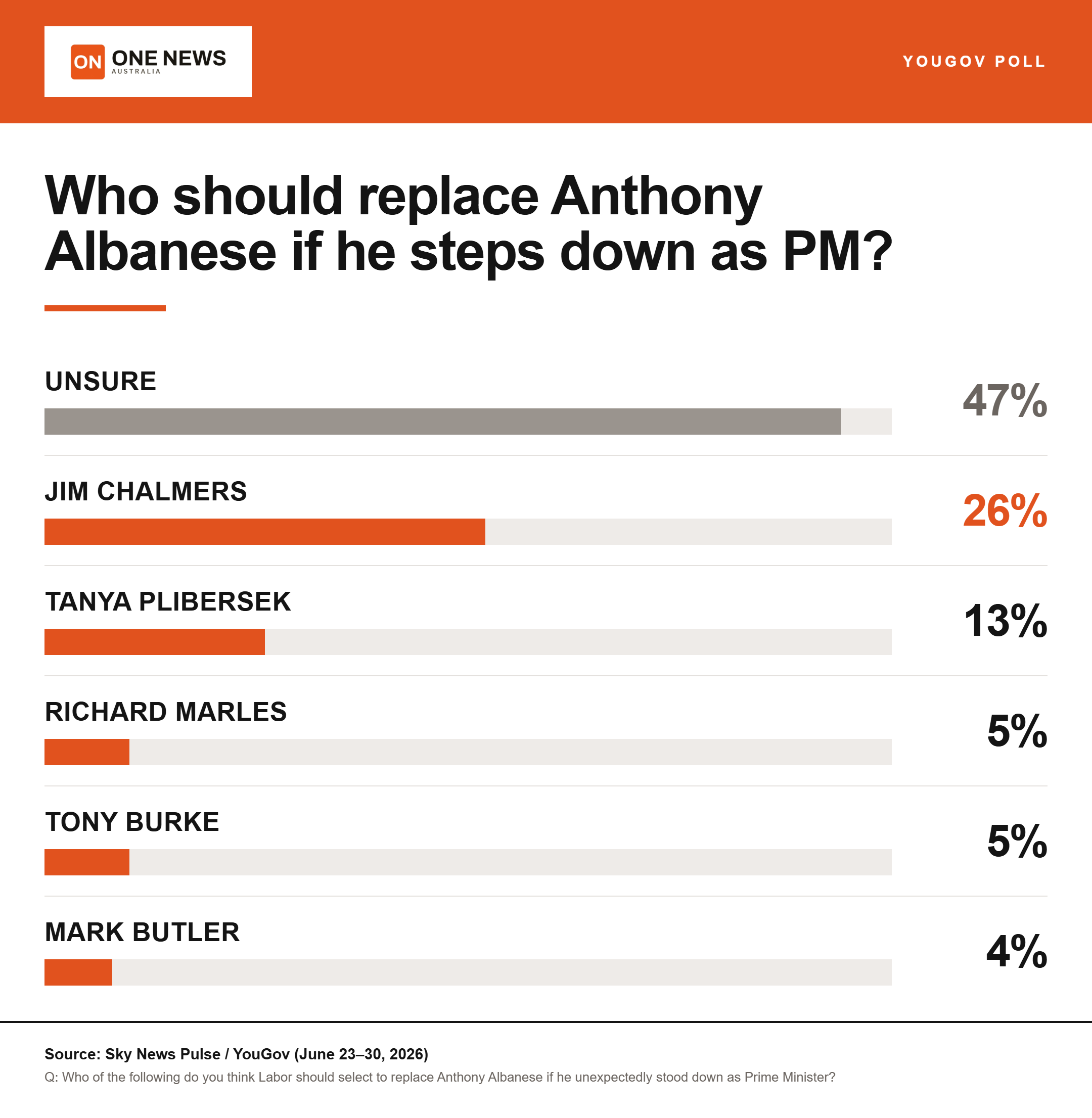
Among those who did name someone, Chalmers was well clear of the field on 26%, double Social Services Minister Tanya Plibersek on 13%. Deputy Prime Minister Richard Marles and Home Affairs Minister Tony Burke managed 5% each, and Health Minister Mark Butler 4%. The survey was conducted by News24 Pulse and YouGov between 23 and 30 June.
Read together, the two findings are the whole problem for Anthony Albanese. Nearly half his own voters can't say who should follow him, and the man who leads what's left of the field is the one who broke ranks with him this week.
Chalmers praised the royal commission Albanese spent months rejecting
Chalmers called new Victorian Premier Ben Carroll "outstanding" and "pragmatic", singling out "that decisiveness when it came to the announcement of the Royal Commission". He said federal Labor supported it because "it's consistent with our zero tolerance at the federal level for corruption".
As One News reported this week, that's the same inquiry Albanese knocked back in February, when he said the 2014 trade union royal commission "cost a lot of money, achieved nothing".
Here's what the Treasurer endorsed. Carroll's royal commission is established under Victorian law, by a Victorian premier, with terms of reference going to a Victorian cabinet. It can examine state ministers, state departments, and the contractors, subcontractors, labour hire firms and unions working on state projects. A federal minister's decisions sit outside it.
Chalmers didn't have to say anything about the royal commission. The word he reached for, decisiveness, is the precise quality, on the precise issue, that his own leader has been accused of lacking for two years.
Whatever the intent, the effect is to put Anthony Albanese on one side of a line and the Treasurer on the other. Jacinta Allan refused a royal commission for two years and it helped end her premiership. Daniel Andrews presided over the Big Build years the inquiry will examine. Albanese publicly backed Allan's refusal. Ben Carroll ordered this one within an hour of being sworn in, and Chalmers called him decisive for it.
His own Treasurer, the new Victorian Premier and the Victorian Opposition have now all backed an inquiry he still opposes.
There's also a precedent that runs against him. After the Bondi terror shootings last December it was NSW Labor Premier Chris Minns who moved first on a royal commission while Albanese baulked, and as The Australian noted this week, public pressure eventually pushed the Prime Minister into calling a national inquiry that absorbed the state one.
The corruption got worse on Albanese's watch and Watson blames government inaction
The Prime Minister's stated reason is that royal commissions don't work. While the 2014 inquiry ran, he argued in February, "John Setka and these elements were increasing their influence, not decreasing it". He points instead to the administrator appointed over the union in August 2024, and argues Victorian authorities should be left to do their job.
There's a second answer sitting in the record. The corruption Geoffrey Watson SC documented didn't begin with this government, and his report dates the Setka era from around 2012, well before Labor took office federally in May 2022. But it didn't stop in 2022 either. It ran until the administrator arrived, and Watson's verdict on that stretch is blunt: "it got worse, not better". One of the eight factors he lists as having wrecked the union is "the governmental inaction on the CFMEU".
In the middle of that period, federal Labor removed the industry's watchdog.
Labor scrapped the construction watchdog in 2022 then paid $2.2 billion into the Big Build
Abolishing the Australian Building and Construction Commission, the industry watchdog, was a Labor commitment at the 2022 election, and the Parliamentary Budget Office costed it to take effect from 1 July 2022. As The Australian has noted, Labor hasn't replaced the watchdog since, nor considered a national royal commission.
Federal money kept flowing to the projects. Canberra committed $2.2 billion to the Suburban Rail Loop, and in November last year the Prime Minister added more to cover a funding shortfall. The Age has reported that 11 of Victoria's biggest infrastructure projects, all receiving federal funds, are the subject of 56 active allegations of fraud, corruption, theft and criminal behaviour.
Chalmers pointed to his government's record when he backed the inquiry, citing "the steps that we've taken to crack down, for example, on the CFMEU" and Infrastructure Minister Catherine King's work "making sure that we get value for money when it comes to government-supported projects".
Tim Wilson says federal Labor is just as caught up in CFMEU corruption as Victoria
Opposition Treasury spokesman Tim Wilson, who has campaigned on the CFMEU for years, wants an inquiry that would reach further. "I think it's time we had a royal commission, a federal royal commission, into CFMEU corruption, not just one in Victoria," he said on Wednesday.
"The Prime Minister should call one. He should follow the lead of Ben Carroll because federal Labor is just as much caught up in CFMEU corruption as the state government through projects like the Suburban Rail Loop."
Chalmers has endorsed the Victorian inquiry. He hasn't called for the federal one.
Chalmers backed down for Albanese on super and tax but won't budge on the royal commission
The Treasurer and the Prime Minister have had their differences before. Until this week they were settled privately, or settled in public with Chalmers giving way.
In October last year Albanese instructed him to abandon his plan to tax unrealised superannuation gains on balances above $3 million. The Australian Financial Review reported that the Treasurer "initially resisted" before accepting "the edict of his boss", and described the overhaul that followed as "a spectacular and humiliating climbdown for the treasurer". One source familiar with the events told the paper the Prime Minister's message was: "Jim we can't carry on with this thing the way it is, but you find a solution, not me."
Two months before that, according to the same report, Albanese had gone to "great lengths to temper expectations" coming out of Chalmers' three day economic roundtable. And when the Treasurer did win an argument, persuading Albanese to rejig the stage three tax cuts in late 2023, he won it inside the cabinet room.
The paper described a relationship that's competitive but without rancour. A Labor insider quoted in the same piece put it more bluntly: "This is a wake-up call for Jim."
On Wednesday he broke that pattern, and he hasn't walked it back.
The Treasurer has his own reason to want a new subject. Voters rated his May budget good by 22% and bad by 47%, the worst net verdict recorded on a federal budget since 1993, in polling conducted by Pyxis for The Australian. It carried the abolition of the 50% capital gains tax discount and the curbs on negative gearing that One News covered as a return to the pre 1999 settings.
Peter Malinauskas praised Anthony Albanese's authority three days before Chalmers defied it
The other name routinely floated as a future Labor leader spent Sunday taking himself out of it. South Australian Premier Peter Malinauskas told News24's Sunday Agenda he wouldn't move to federal politics.
"No, because I feel as though I'm making a contribution to the federation by getting South Australia firing in all cylinders."
Pressed on whether he'd reconsider if senior Labor figures urged him to succeed the Prime Minister, he said no again. "I look at the federal frontbench and I see a suite of talent, a suite of genuine leadership capability."
He then went further and praised the man he's supposed to be circling. "I think the party's in pretty good hands with Anthony and with the Prime Minister," Malinauskas said. "You've seen his authority very much on display over the course of the last few days, and long may that continue."
That was 26 July. Three days later the Treasurer publicly defied him. Malinauskas doesn't appear in the successor polling at all, for the simple reason that he sits in the South Australian parliament and not a federal one.
Victoria votes on 28 November, and the royal commission will be running through the campaign. Its terms of reference go to Ben Carroll's first cabinet meeting. Wherever they end up reaching, they'll be written in Melbourne.