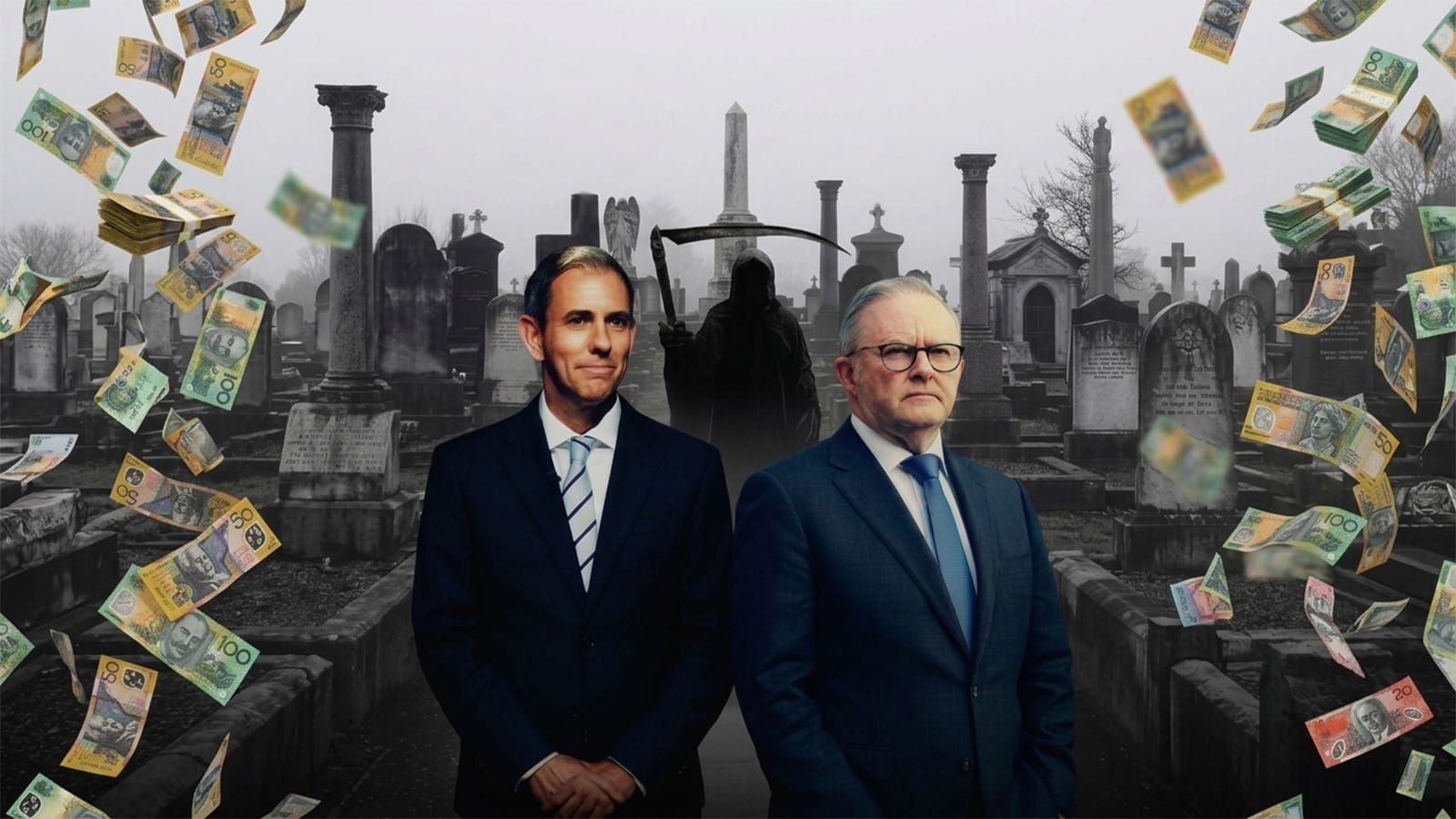
Treasurer Jim Chalmers told parliament his capital gains overhaul was "the most ambitious tax reform package for a quarter of a century". The Act he pushed through in June runs to 73 pages, rewrites how every share portfolio, investment property and family heirloom in the country is taxed, and never once uses the word death.
The same Act plants a frozen tax bill on everything you own at 30 June 2027. The bill doesn't fall due when the law starts. It falls due at what the legislation calls a "realisation event", and nothing in those 73 pages says a death in the family isn't one of them.
Tax professionals spent the winter asking Treasury to confirm the frozen bill waits until a family actually sells. The law, as passed on 26 June, doesn't say so. And this is a Treasurer who has already proven he understands the politics of taxing the dead: he scrapped one measure critics called a death tax just 8 days before this law was given royal assent.
Every asset you own gets a frozen tax bill on 30 June 2027
Capital gains tax is the tax on the profit you make on an asset, and since it began in 1985 it has worked on one principle: you pay when you sell, because that's when the money exists. Hold a share portfolio for 30 years and the taxman waits 30 years for his cut.
Chalmers' law keeps the tax and removes the certainty about the waiting. From 1 July 2027 the 50% capital gains discount is abolished for individuals and replaced with an inflation adjustment, plus a minimum tax rate of 30% on gains for most taxpayers, whatever they earn.
Age pensioners and other income support recipients are carved out of the minimum rate, but not out of losing the discount. To draw the line between old gains and new ones, the Act treats every asset you hold on 30 June 2027 as sold that night at market value and bought back the next morning. No money changes hands. The paper gain is locked in and, in the Act's own words, "disregarded (and deferred) until the income year in which the realisation event happens".
The government does hold one concession back. Investors who buy newly built homes can choose to keep the old 50% discount, and new builds and affordable housing are carved out of the deemed sale entirely. That's the answer Labor reaches for when it's accused of hitting ordinary owners. It does nothing for the family that already owns the shares, the rental or the house, because the carve out follows the new dwelling, not the taxpayer.
The gain built up before 1 July 2027 keeps the old 50% discount when the tax finally lands. Growth after that date gets the new rules. Law firm Corrs Chambers Westgarth puts the mechanism plainly: the notional gain is "deferred until an actual realisation event that occurs later".
The government's own budget material promises that "the CGT reforms will only apply to gains arising after 1 July 2027". Read the Act and you see what that promise is worth. The old gains aren't spared, they're deferred. Every dollar of profit built up before that date is still owed. The only question is what pulls the trigger, and that's the question the Act doesn't answer.
| The question | How it's worked for 40 years | What Chalmers' law does |
|---|---|---|
| When is your tax bill worked out? | The day you sell. That's when you have the money to pay it. | On 30 June 2027, whether you sell or not. The taxman pretends you sold everything that night and bought it back the next morning. Nothing is really sold and no money changes hands. |
| When do you actually pay it? | When you sell, out of the money from the sale. | The bill sits there frozen until what the Act calls a "realisation event". That means any change of ownership, not just a sale. The Act never says whether a death is one. |
| How much of your profit is taxed? | Half of it, on anything you've owned for more than a year. | All of it, on growth after 1 July 2027, with a small allowance for inflation. The half price deal is gone. |
| What rate do you pay? | Your normal tax rate. Earn little, pay little. | At least 30%, even if you earn almost nothing. Age pensioners escape the 30% floor, but they still lose the half price deal. |
| What about the profit you've already made? | Left alone. You're taxed on it only if and when you decide to sell. | The government says it's protected. It isn't. It's only postponed, and every dollar of it is still owed by somebody. |
The word missing from all 73 pages is death
Since 1985 the rule on dying has been simple. Death is not a taxable event. Under Division 128 of the tax law, your assets pass to your estate and your family, the tax bill travels with the asset, and nobody pays anything until the family chooses to sell. That rule is why Australia can say it has no death duties: the Commonwealth and every state abolished them more than 4 decades ago, and every government since has left the grave alone.
Chalmers' Act doesn't abolish that rule. It does something stranger. It ignores it. One News searched the full text of the Act: death is never mentioned, deceased estates are never mentioned, Division 128 is never mentioned, and the rollover that protects couples transferring assets in a divorce is never mentioned. The Act doesn't even define "realisation event" afresh. It leaves the term to pick up its existing meaning elsewhere in the tax law.
That silence is doing a lot of work, because section 977-5 of the tax law defines a realisation event as any CGT event, bar three narrow exceptions. A CGT event is any change of ownership, not just a sale for cash. Dying transfers ownership. So does a divorce settlement.
So when the owner of a frozen gain dies, the Act's machinery meets the inheritance rules with no instructions. If a death counts as the realisation event, the frozen gain lands in the deceased's final tax return, with no sale, no proceeds, and a bill the grieving family has to find cash for. Advisers have warned that a widow could be forced to sell down the very portfolio her husband left her, just to pay tax on shares nobody sold.
Adviser analyses of the final law say the old inheritance protection should still carry the tax bill through to the family. The Act doesn't say that. Treasury hasn't published a word saying it either. Australian families are being asked to plan their estates on a guess.
Chalmers already scrapped one death tax. This one stayed
Chalmers knows exactly how a death tax plays with voters, because he's already retreated from one. His 12 May budget slapped a 30% minimum tax on testamentary trusts, the structures written into wills to pass wealth to children. Farmers and family businesses called it a tax on dying. On Thursday, 18 June, he folded.
"Income from all types of testamentary trust will be exempt from the minimum tax," Chalmers announced, in a retreat that, together with a matching concession for small business, cost the budget $475 million over 4 years.
The government sold that retreat as proof it listens. It's proof of something harder. Chalmers designed a tax that fell on families at the moment of a death, took it to a budget, defended it for 5 weeks, then abandoned it because it couldn't survive contact with the public. He wasn't persuaded to be generous. He was wrong, and the reversal is his own admission of it.
That's what makes the rest of the Act so hard to defend. The principle he conceded on testamentary trusts, that a family shouldn't be handed a tax bill because someone died, is the principle the deferral trap runs straight through. It reaches further than the trust measure ever did, to every family with a share portfolio or an investment property, and it stayed in the bill. The whole package was law 8 days after the backdown. The death tax with a headline died. The one nobody had noticed was given royal assent.
Chalmers told parliament the grandfathering of negative gearing "ensures that taxpayers who made investment decisions under the existing rules will not be affected by the changes". No equivalent assurance appears anywhere in the Act for what happens to a frozen capital gain when its owner dies.
What changes for your family the day you die
Here's the state of play under the law as written, asset by asset. The left column is the world every will in Australia was drafted for. The right column is the world those wills now operate in.
| The life event | Until 30 June 2027 | From 1 July 2027 |
|---|---|---|
| You die owning shares or an investment property | No tax. Your family inherits, and pays only if and when they sell. | Every asset carries a frozen tax bill from 30 June 2027. The Act never says the bill waits for your family. Advisers warn it can land in your final tax return. |
| Your family sells an inherited asset | One tax bill, with the 50% discount on the whole gain. | Two bills. The old gain keeps the discount. Growth after 1 July 2027 gets no discount and a 30% minimum rate. |
| A divorce settlement moves an asset between spouses | Rollover relief. The transfer itself is tax free. | The Act is silent on whether the transfer sets off the frozen bill. |
| The family home | Exempt as the main residence. | Still exempt. But if the estate owes tax on other assets and holds no cash, selling the home can be the only way to pay. |
| Jewellery and heirlooms bought for more than $500 | Taxed only if and when they're sold. Family treasures pass down untouched. | Carry a frozen taxable gain valued at 30 June 2027, with the same unanswered death question as everything else. |
| Assets owned since before CGT began in 1985 | Never taxed. | Growth after 1 July 2027 is taxed, for the first time in 40 years. |
| An asset sitting on a paper loss | Losses offset your gains while you're alive. | The loss is frozen too. If it lands in a final tax return with nothing to offset, it dies with the taxpayer, while the estate pays on every dollar above the frozen value. |
One portfolio, one death, two tax bills
Put numbers on it and you see why advisers are alarmed. Take a retired couple with a share portfolio bought in 1998 for $150,000 and worth $1,150,000 at 30 June 2027. Their frozen gain is $1,000,000. On the reading advisers are warning about, this is what the husband's death would set off.
The figures are illustrative, using the top marginal rate of 47% including the Medicare levy, and they are exactly the kind of arithmetic the government has declined to publish. What they describe is a death and an estate sale that the law taxed at nothing for the last 40 years, until the family chose to sell.
| Step | What happens | The bill |
|---|---|---|
| 30 June 2027 | Shares bought in 1998 for $150,000 are deemed sold at their market value of $1,150,000. Nothing is actually sold. | A frozen gain of $1,000,000 |
| The husband dies in 2028 | On the reading advisers warn of, the frozen gain lands in his final tax return. The 50% discount applies, leaving $500,000 of taxable income. | Up to about $235,000 |
| The estate sells in 2029 for $1,250,000 | The $100,000 of growth since 1 July 2027 is taxed under the new rules: no discount, a 30% minimum rate, with CPI indexation shaving it slightly. | About $30,000 |
| Total | More than a fifth of the portfolio is gone before the widow sees a dollar of it. | About $265,000 |
The experts told him the law had holes. It passed anyway
None of this ambushed the government. The Tax Institute told the Senate inquiry the bill contained "material technical gaps, unresolved interactions and areas of uncertainty", with core design elements "deferred to legislative instruments". In plain English, parliament passed the tax and left the rules to be filled in later by the minister's pen. CPA Australia warned the legislation risks creating a more complex and uncertain tax system.
One News reported in June that the bill's grandfathering promise dissolves on a death or a divorce, with a jointly owned property losing its protection on the departing share. The Act that emerged from the Senate fixed none of it.
The deemed sale happens on 30 June 2027, 11 months from now. From the next morning, every estate in the country inherits the question Chalmers' 73 pages never answer. Until Treasury or the courts supply the missing word, what happens to your family when you die is governed by a law that couldn't bring itself to say it.