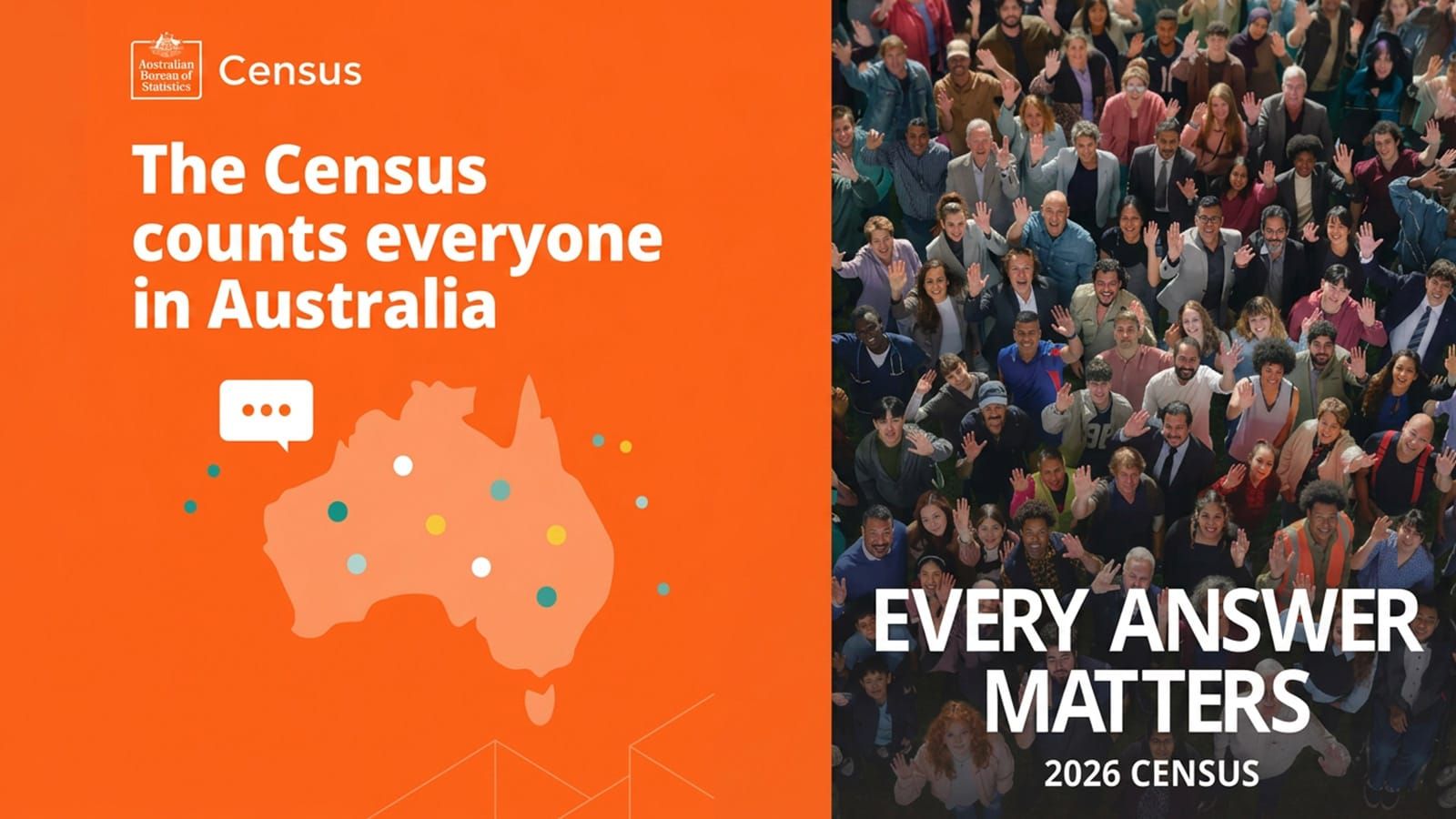
The Australian Bureau of Statistics, the federal agency that produces the country's official statistics, has started posting Census instructions to households across Australia ahead of Census night on Tuesday 11 August, and everyone in the country that night has to be counted.
The Census is compulsory. It runs under the Census and Statistics Act 1905, and if you don't fill in your form the ABS can serve you a written direction to do it. Ignore the direction and you can be prosecuted and fined up to $364 for every day you hold out. Knowingly putting false information on the form is a separate offence carrying a fine of up to $3,640.
Almost nobody ends up there. The ABS expects about 85% of forms to be completed online, says the average household takes around 30 minutes, and lets you start as soon as your instructions land, provided you know where you'll be sleeping that night.
Here's what the Census is, who goes on your form, what's new this year, which questions you're allowed to leave blank, and what happens to your answers once you hit submit. The ABS has also put out its own 1 minute explainer, below.
What the Census actually is, in plain English
The Census is a head count of everybody in Australia on one particular night, taken every 5 years. It isn't a poll or a survey of a few thousand people. It's the only exercise that tries to reach every household in the country, which is what makes it the thing governments reach for when they're deciding where the next school, hospital, bus route or aged care facility goes.
It asks about the people under your roof and about the house itself, in more detail than most people expect. Add every household's answers together and you get the most detailed picture of the country that exists.
The ABS says the information is used by governments, councils, charities and businesses to plan services down to the suburb level. Its own examples include Playgroup Australia working out where and when to run playgroups, and Street Side Medics deciding where to send mobile clinics for people sleeping rough.
Census night is Tuesday 11 August, and you don't have to wait for it
Census night is Tuesday 11 August 2026. The form asks about where you were and who you were with on that night specifically.
Most households are getting a letter in the mail with instructions to complete the form online. Some letters carry a unique 16 digit Census number and a temporary 9 character password. Others tell you how to get a Census number online. Either way you log in on the ABS website and work through the questions.
Some households will get a paper form with a Reply Paid envelope instead, and some people in remote areas or sleeping rough will be helped through it by Census field staff. If you've subscribed to Census updates through myGov, a message with a link to your household's form lands in your myGov inbox.
Emily Walter, the Census national spokesperson, says there's no reason to sit on it.
"Once you receive your instructions, you can complete your Census straight away if you already know where you'll be on Census night," Walter said.
If you get a letter but want paper, you can request a form. If you get paper but would rather do it online, the instructions are printed on the form. The paper form has room for 6 people, so bigger households either do it online or ask for a second form.
Who goes on your form, and who doesn't
Include everyone who spends Census night at your address. That means you, your partner, your children including babies, adult family members, housemates, boarders, and any visitor who sleeps there on the night, including international visitors, visa holders, permanent residents and anyone with no fixed address.
It also includes people who usually live with you and will be back on Wednesday 12 August without being counted anywhere else, such as a shift worker who's at work overnight.
People who are overseas on Census night don't complete a Census at all. If someone at your address is filling in the household form, they get marked as away but usually living there.
Away, visiting or travelling on 11 August
The rule is simple: you're counted wherever you sleep that night. The ABS covers every scenario, and these are the ones that catch people out.
- Staying with friends or family: you go on their household form. If you'd rather your answers stayed private from the people you're staying with, call the Census Contact Centre on 1800 181 227 and ask for your own Census number or a paper form.
- Travelling in Australia: you complete the Census wherever you're staying, whether that's a hotel, a caravan park or someone's spare room. This applies to overseas tourists too.
- Home but alone: if you're the only one there on the night, only include yourself.
- Nobody home: tell the ABS, either through the online form, by calling 1800 181 227, or by letting the field officer know when they knock.
- You own an empty property: holiday houses, investment properties, deceased estates, places under construction and vacant blocks all need to be reported as unoccupied, or the ABS will keep chasing the address for a form.
What to have ready, including where everyone lived 5 years ago
The form moves quickly if the details are in front of you and drags if they aren't. For every person in the house on the night you'll need their name, sex recorded at birth, date of birth and age, whether they're of Aboriginal or Torres Strait Islander origin, and their marital status.
Two questions catch people out. On top of your current address, the Census asks where each person was living 1 year ago and 5 years ago, so anyone who's moved around lately has some digging to do.
Then comes the cultural set: country of birth, citizenship, ancestry, religion, languages used at home, the countries their parents were born in, and the year they first arrived in Australia if they were born overseas.
After that comes the health and work block. It asks whether the person needs help with self care, moving around or communicating, and whether they have a long term health condition. Then it wants their education and qualifications if they're 15 or older, their work both paid and unpaid, their total personal income, and whether they've served in the Australian Defence Force.
Last are the questions about the property itself, how many registered motor vehicles are kept there, and what you spend on rent or the mortgage. There's also a short set of questions about anyone who normally lives with you but will be away on the night.
What's new in 2026: gender, sexual orientation and 4 ancestries
The biggest change is a new topic. For the first time, everyone aged 16 and over will be asked about their gender and their sexual orientation, sitting alongside the existing question about the sex recorded at birth. Nobody under 16 is asked either question, and both carry a "prefer not to answer" option.
The ancestry question has been widened from 2 responses to 4, so people with mixed backgrounds can record more of it. Given how contested the make up of modern Australia has become in public debate, that change alone will produce a set of numbers worth watching when the data lands.
The rest of the changes are smaller. Liver disease has been added to the list of long term health conditions. Electric bikes now get their own answer in the question about how you travel to work. The labour force question has a new option for people looking for full time or part time work. Income brackets have been updated. One question has gone: the number of children a woman has given birth to, which the ABS says returns in 2031.
The questions you're allowed to leave blank
Not every question demands an answer, and 3 parts of the form are optional.
Religion is the long standing one. The religious affiliation question has been asked since the first national Census in 1911 and answering it has always been voluntary. It's used for things like planning places of worship, faith based aged care and chaplains in hospitals and prisons.
The new gender and sexual orientation questions can be answered with "prefer not to answer".
Then there's the one almost nobody notices. Question 65 asks whether you agree to your name, address and every other answer on the form going to the National Archives. The ABS calls it the Census Time Capsule, preserved for 99 years and opened in 2125 for genealogists and historians. It's optional, and the default is no: if you tick nothing, your name identified information isn't kept. For children, you only answer yes if the parent or guardian has specifically agreed.
Think about that one before you tick it. The ABS says the transfer can't be reversed once it happens, and nothing in the capsule can be accessed, altered or retrieved before 2125. Nobody alive when the form is filled in gets to change their mind.
The $364 fine, and how the ABS actually gets there
The fine is real, but the ABS has to work through several steps before it can get there.
If you don't submit a form, the ABS contacts you to encourage you to take part. If you still don't respond, you can be served a direction in writing, which is a formal legal instruction to complete the Census. Failing to comply with that direction is the offence, and the daily penalty only comes into play from there.
Worth knowing how rarely it gets that far. In a public statement about the 2021 Census, the ABS said there had been no fines issued at that point, and that the formal refusals process has historically covered only a small share of the people who didn't respond.
The $3,640 penalty for false or misleading information is a separate matter. That's worth remembering before anyone writes a joke religion or a made up job on the form.
What the ABS does with your name and address
Names and addresses don't stay on your answers. During processing the ABS strips them out and stores them securely and separately from each other. Under the privacy statement, names are kept for up to 18 months after the Census, until the end of February 2028, and addresses for up to 36 months, until the end of August 2029. Both are then securely destroyed.
On sharing, the ABS says it doesn't hand information that could identify you or your household to other government departments or to direct marketing companies. It also says Census information isn't used for compliance or enforcement activity, except for offences under the Census and Statistics Act 1905 itself. The one carve out it names is the Data Availability and Transparency Act 2022, which allows sharing for a limited set of purposes under governance rules and only with the written approval of the Australian Statistician, the official who runs the ABS.
The data sits on Australian based infrastructure, and the ABS says the online form uses the strongest encryption technology available. Confidentiality is backed by the secrecy provisions of the Census and Statistics Act 1905 and by the Privacy Act 1988.
Two details worth knowing before you dial or answer the door. The 1800 181 227 help line is run by Services Australia on behalf of the ABS, not by the ABS itself. And some households get contacted again afterwards for the Post Census Review, a follow up survey the ABS uses to check the quality of the count, so a later approach isn't automatically a scam.
If you want your own information, a correction, or you want to complain about how it's been handled, the ABS Privacy Officer takes email at privacy@abs.gov.au and post at Locked Bag 10, Belconnen ACT 2616.
The ABS is also using data you never typed into the form
The Census isn't only built from what households write down. The ABS also uses administrative data, meaning information that government agencies and other organisations already collect running their day to day operations, to improve how complete and accurate the count is.
Its stated limit on that is narrow: the data is used for statistical purposes and for running the Census, never for compliance or enforcement. Administrative data also stays out of the Census Time Capsule, so it never goes to the National Archives.
The ABS will never ask you for bank details
Big national exercises attract scammers, so the ABS has published a plain list of things it will never do.
It will never ask for your bank details or credit card information, never ask for money or donations, never ask for a password, and never ask for identity documents or your tax file number. It won't offer prizes or incentives for filling in the form, and it won't contact you out of the blue on Facebook or X asking for personal details.
Genuine contact comes as a letter in the mail, a myGov inbox message, a paper form with a Reply Paid envelope addressed to Reply Paid 93909, Dandenong VIC 3175, or a visit from Census staff. Every Census staff member carries an ABS identification card and wears it at all times while working. The ABS says it isn't currently aware of any scams tied to this Census, and asks people to report anything suspicious to it and to Scamwatch.
Face to face help at Woolworths, libraries and community centres
From early August the ABS is running Census Pop-up Hubs, which are staffed desks and stalls in public places where you can ask questions, pick up a paper form or get someone to sit with you while you fill it in. They're going into shopping centres, select Woolworths stores, local libraries and community centres.
"Pop-up Hubs are an important part of our local engagement approach, making it easy for people to get in-person support to complete their Census," Walter said.
"Hubs will be located in public places like shopping centres, ensuring they're accessible for local communities."
Alongside the hubs there are fill in the form sessions, where staff walk you through the questions, and information sessions explaining what the Census is and why it matters. Some of both are run in languages other than English. The ABS has an interactive map where you type in an address, suburb or postcode and it shows what's on within 5 kilometres, with new locations still being added. In remote communities, Census staff are visiting from July to September, and where possible they're people who live there.
Phone help is on 1800 181 227. Braille and large print forms are available through the same number.
Why the count is worth money to your state
The half hour you spend on a form for a statistics agency ends up moving real money.
Census results feed the official population figures that sit underneath a lot of federal decisions. The Australian Electoral Commission works out how many seats in the House of Representatives each state and territory gets using population statistics supplied by the Australian Statistician under the Census and Statistics Act 1905. The Commonwealth Grants Commission, which advises on how the GST pool is carved up between the states, builds its assessments on population data updated off the last Census.
An undercounted suburb is a suburb that looks smaller than it is when the funding and planning decisions get made for the next 5 years. That's the practical case Walter makes for taking half an hour over it.
"For us to return high quality Census data to the community, it's important everyone fills in their Census fully and accurately," Walter said.
When the 2026 results come out
Nothing is published straight away. The ABS plans to release 2026 Census data in 3 phases starting from June 2027, with each phase going deeper than the last. A preliminary Census dictionary, the document that explains what every variable means, was released in July 2026.
Frequently asked questions
Is the Census actually compulsory, or just strongly encouraged?
Compulsory. Everyone in Australia on Tuesday 11 August 2026 must be included on a Census form, including people on Norfolk Island, Christmas Island and the Cocos (Keeling) Islands. The exemptions are narrow and cover foreign diplomats and their families who aren't Australian citizens or permanent residents.
Can I fill it in before 11 August?
Yes, as soon as your instructions arrive, provided you already know where you'll be on the night. You answer for Census night either way.
How long does it take?
The ABS says about 30 minutes for the average household.
What should I have ready before I sit down?
Names, dates of birth, marital status, country of birth and citizenship for everyone in the house, plus where each of them lived 1 year and 5 years ago, their income, and your rent or mortgage figure.
What if I don't have internet, or I'm not confident online?
Ask for a paper form, ring 1800 181 227, or walk into a Pop-up Hub and have someone help you through it in person.
Do tourists and backpackers have to do it?
Yes. Anyone in the country on Census night gets counted, including international visitors and visa holders.
Do I have to answer the religion question?
No, it's optional and always has been, and "no religion" is one of the tick boxes.
Do I have to answer the gender and sexual orientation questions?
They're put only to people aged 16 and over, and each one lets you decline.
I don't want the people I'm staying with to see my answers. What do I do?
Ring the contact centre and ask to fill in your own form. Match the name, date of birth and sex recorded at birth used on the household form so the ABS can link you up, then answer everything else yourself.
What happens if two forms come in for the same person?
The ABS keeps whichever form has the most complete information about that person, which is why it's worth answering as much as you can on a separate form.
My house will be empty on Census night. Do I still have to do anything?
Yes. Tell the ABS the address is unoccupied, otherwise it will keep following up for a form. The same goes for holiday homes, investment properties and vacant blocks.
Will the tax office, Centrelink or the police see my answers?
Not in any form that identifies you, according to the ABS. The one disclosed exception is a data sharing scheme that needs the Australian Statistician's written approval.
Has anyone ever actually been fined?
The ABS said none had been issued for 2021 as at its statement on the subject. The power exists, but it only bites after a written direction has been ignored.
What if I make a mistake on the paper form?
Rule a line through the wrong answer and write the correct one underneath. Use a black or blue pen and write in capital letters.
There are more than 6 people at my address. What then?
The paper form only fits 6. Either complete the Census online or request a second paper form.
Can I get a form in another language?
Yes, and the interactive map flags which sessions and hubs have in language help. Braille and large print versions come through the same phone number.
What's the National Archives question about?
It's the Census Time Capsule. Your form gets locked away and opened in 2125 for family historians. Leaving it blank counts as declining.
Can I change my mind about the time capsule later?
No. Once it goes across it's locked, and nothing comes back out before 2125.
Who answers the 1800 number?
Services Australia runs the Census Contact Centre on behalf of the ABS.
How do I make a privacy complaint?
Email the ABS Privacy Officer at privacy@abs.gov.au. The same office handles requests to see or correct your information.
When do we see the results?
In 3 phases from June 2027, so the first numbers are about 10 months off.