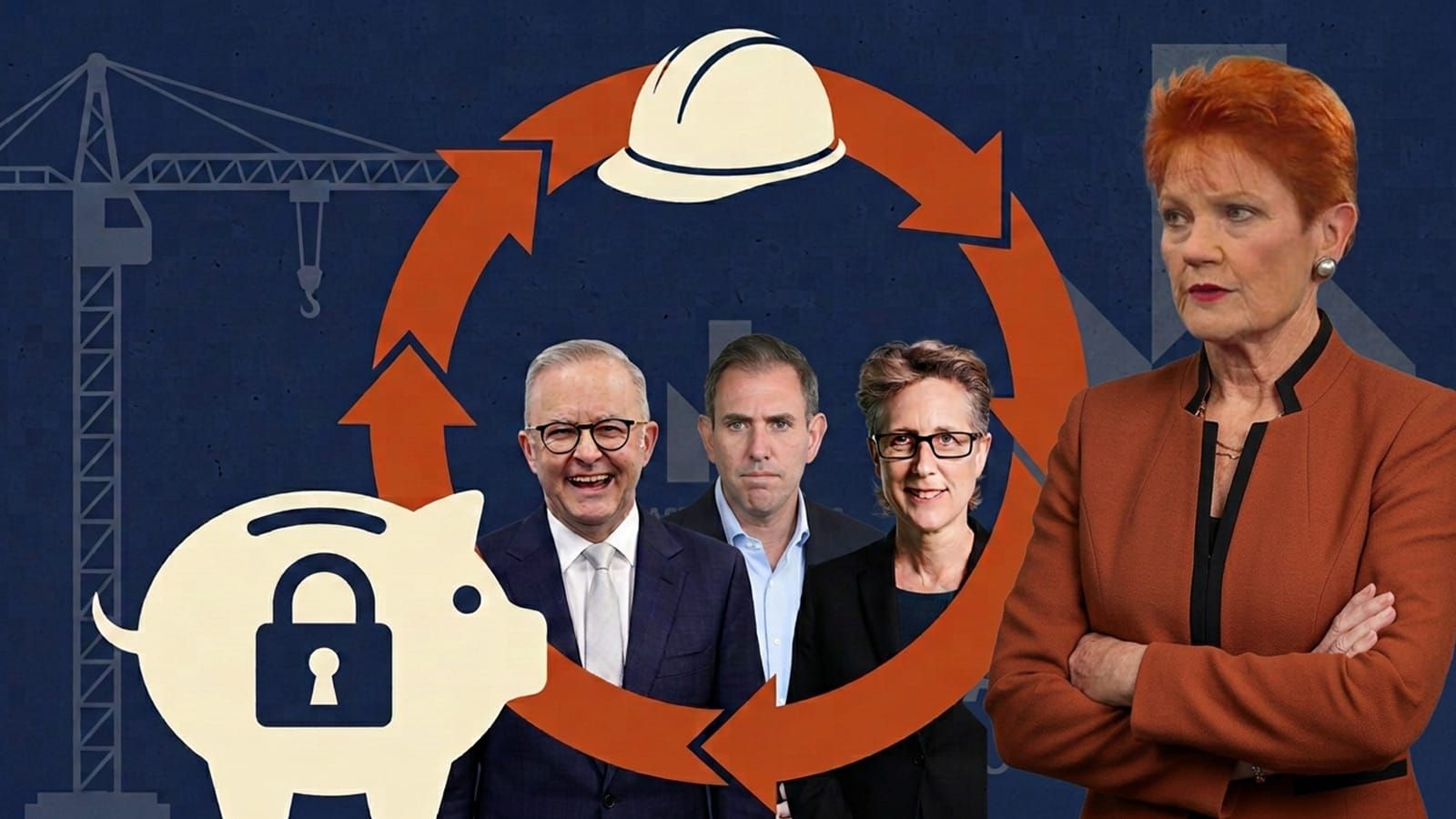
The ACTU lied, declaring on 17 August that Pauline Hanson had "called for an end to universal superannuation", and launched an aggressive campaign to stop her. Hanson had already posted the direct opposite in writing the day before, while Treasurer Jim Chalmers declared the next election a "referendum on super".
What the mainstream coverage completely ignored is the underlying racket: the very unions running that campaign extract millions from super funds every single year, paid directly out of everyday members' retirement accounts. Cbus alone funnelled $1,373,368 to unions and employer groups in the year to 30 June 2025.
None of it is illegal, and every dollar sits published on the funds' own websites simply because mandatory disclosure laws force them to put it there. It is the raw financial paper trail that almost no Australian taxpayer has actually read.
It’s Pauline Hanson here. Jim Chalmers is full of shit.
— Pauline Hanson 🇦🇺 (@PaulineHansonOz) August 18, 2026
One Nation doesn’t support scrapping super, we just think people should be able to use their super when in financial distress instead of losing their home.
Labor would rather you end up homeless.
We don’t expect you to… pic.twitter.com/d4vwxIt4bW
Labor and unions launch a dishonest scare campaign against superannuation choices
The ACTU claimed Hanson wants to abolish super, but she had already put the exact opposite in writing the day before.
ACTU assistant secretary Joseph Mitchell claimed in the union movement's 17 August media release that "super is not their ideological plaything, it's hard-earned money for retirement", and that "unions won't let One Nation or the Liberals take it away".
Hanson had already posted her explicit position on 16 August, and it directly contradicts the union narrative:
"I'm not calling for an 'end' to compulsory super as the media has falsely claimed, but Australians should be able to access their money more easily if they need it for a house, medical needs or other costs. Your superannuation belongs to you. It does not belong to the government and it does not belong to the super funds."
Hanson explicitly states the system is broken and that she would review the 12% super guarantee. Reviewing a broken system and abolishing it completely are two entirely different things, and abolition is the exact lie she exposed.
One Nation treasury spokesman Barnaby Joyce confirmed withdrawal caps and eligibility rules are still being drafted. The ACTU is waging an aggressive fear campaign against a policy that does not even exist yet, while Chalmers weaponises it for an election. We covered the full breakdown in our earlier report.
Federal law installs union bosses directly on super boards to control your money
Section 89 of the Superannuation Industry (Supervision) Act mandates that these funds maintain equal numbers of employer and employee representatives on their governing boards. In practice, union elites systematically nominate the employee half.
AustralianSuper operates with 12 board directors. Five are nominated directly by the ACTU, five by the Australian Industry Group, and two sit as independents. The union movement is not outside lobbying these massive funds for influence; it appoints the powerful insiders who actively run them. Industry funds like Cbus, HESTA, and Hostplus sit under the exact same compulsory rule, embedding union nominated directors on each of those boards.
Boardroom kickbacks: How Cbus redirects member savings straight into union accounts
Cbus publishes the disclosure list only because regulation 2.10 of the SIS Regulations forces its hand, revealing the stark figures for the year to 30 June 2025.
| Who got paid | What for | Amount |
|---|---|---|
| CFMEU, three branches | Directors' fees | $261,617 |
| Australian Workers Union | Directors' fees, sponsorship | $232,211 |
| Master Builders Australia | Directors' fees, sponsorship | $172,481 |
| Electrical Trades Union | Sponsorship | $145,255 |
| AMWU | Directors' fees, consulting | $135,149 |
| Plumbing Division, CEPU Victoria | Directors' fees | $113,022 |
| Total to industrial bodies | Full year total | $1,373,368 |
Cbus states the reality plainly in its mandatory disclosure: "directors instruct Cbus Super as to where they wish to have their fees paid." Board fees do not have to stay with the director; they can go straight to the nominating union.
Every single cent comes directly out of member fees. A construction worker's compulsory retirement account is what bankrolls the CFMEU's $261,617 payout. That same disclosure reveals Cbus blew $24,737,893 on promotion, marketing, and sponsorship in those same 12 months.
Labor's national executive banned donations and affiliation fees from the CFMEU construction division in July 2024 after placing the union into administration. Victoria's Labor government announced a royal commission into the construction sector on 20 August 2026, led by former South Australian chief justice Christopher Kourakis, with the CFMEU and government department involvement firmly targeted in its scope. Yet the super money never stopped flowing, with Cbus funnelling $261,617 to CFMEU entities in the year to 30 June 2025.
Master Builders Australia grabbed $172,481 in total, and its $122,843 in directors' fees is more than any single union entity on the list, exposing the entire arrangement. Both sides of the bargaining table extract money from the exact same pool of worker savings, and neither side gets to keep draining it if workers are finally allowed to take their money out.
The two lobby groups that attacked Hanson are funded by account member fees
Within 24 hours of Hanson speaking out, Super Members Council chief executive Misha Schubert claimed early access "makes you poorer and costs all taxpayers through a higher age pension bill", while Association of Superannuation Funds of Australia chief executive Mary Delahunty branded the proposal "extremely damaging".
What they failed to disclose is who pays their salaries. Cbus alone funnelled $1,776,401 to Industry Super Australia for advertising and fund promotion in a single financial year, alongside another $613,734 to the Super Members Council in direct memberships. That is over $2.3 million draining out of one fund into lobby group coffers.
Across the wider sector, Liberal senator Andrew Bragg's analysis of the first full year of mandatory disclosure uncovered $16 million flowing to unions and $21.5 million to Industry Super Australia and the Super Members Council in 2022 to 2023. He explicitly exposed AustralianSuper, Cbus, HESTA, Hostplus, TWUSuper, and First Super as funds channelling more than $1 million each directly to unions.
The very organisations aggressively telling Australians this policy would harm them are directly bankrolled by the super funds that lose complete control of the cash if reforms pass.
The super laundering scheme: How your super money flows directly into Labor coffers
Unions funnelled more than $6.5 million into Labor Party coffers in 2023 to 2024, according to official Australian Electoral Commission disclosures. Affiliated unions also hold 50% of all delegates at Labor state and national conferences, giving them half the votes on its rules and policy platform on top of the money.
The industry funds control the massive asset manager as well. IFM Investors is owned by industry funds through Industry Super Holdings and controls US$201.7 billion in global assets. Greg Combet led the ACTU, served as Labor climate change minister, chaired IFM, ran the Albanese government's Net Zero Economy Agency, and currently chairs the $230 billion Future Fund. While no regulator has alleged any legal wrongdoing by him, this career trajectory stands on the public record as a blueprint of industry power.
The high cost of locked super: Everyday Australians pay for a system that rejects them
The law forcefully extracts 12% of a worker's wages and locks it somewhere they cannot touch, even as Roy Morgan counted 1,606,000 mortgage holders sitting at risk of mortgage stress in June, representing 30.3% of all borrowers. Two 30 year olds earning median incomes fall roughly $154,000 short of securing an average Sydney apartment.
A significant portion of the deposit they are blocked from raising sits trapped inside their mandatory super account right now. The powerful insiders telling them to keep their hands off their own money are paid continuously out of that exact same account, and have been drawing from it for years.
Labor plans to raid your super money to fund its massive $52 billion annual net zero agenda
Industry super fund manager IFM Investors calculated the cost directly in its own published blueprint, demanding $12 billion every year for electricity and another $40 billion a year to decarbonise the rest of the economy, totalling $52 billion annually until 2050. That exact document explicitly highlights that superannuation "can be a significant source of capital" to bankroll the plan.
Anthony Albanese branded the $4.4 trillion national super pool "a national asset" that must work "not just for individuals and for retirees, but for the nation", while Jim Chalmers actively rewrites APRA performance tests that penalise funds for holding poor investments to clear what he calls unnecessary obstacles. Labor also rewrote the Future Fund mandate in November 2024 to prioritise net zero and housing projects, placing former ACTU secretary Greg Combet in charge as chairman, detailing a sequence we mapped out in our July report.
On 10 August Labor moved to ban borrowing for residential property inside self managed super funds, which currently hold $1.06 trillion or 23.8% of the total retirement pool, shutting down the single independent slice of wealth that Canberra cannot directly dictate.
The industry fund network has already turned tax funded programs into pure profit. IFM Investors acquired a massive stake in NDIS plan manager My Plan Manager, turning a $26.8 million stake bought in 2019 into a 2023 sale worth more than $400 million, which we originally exposed back in June.