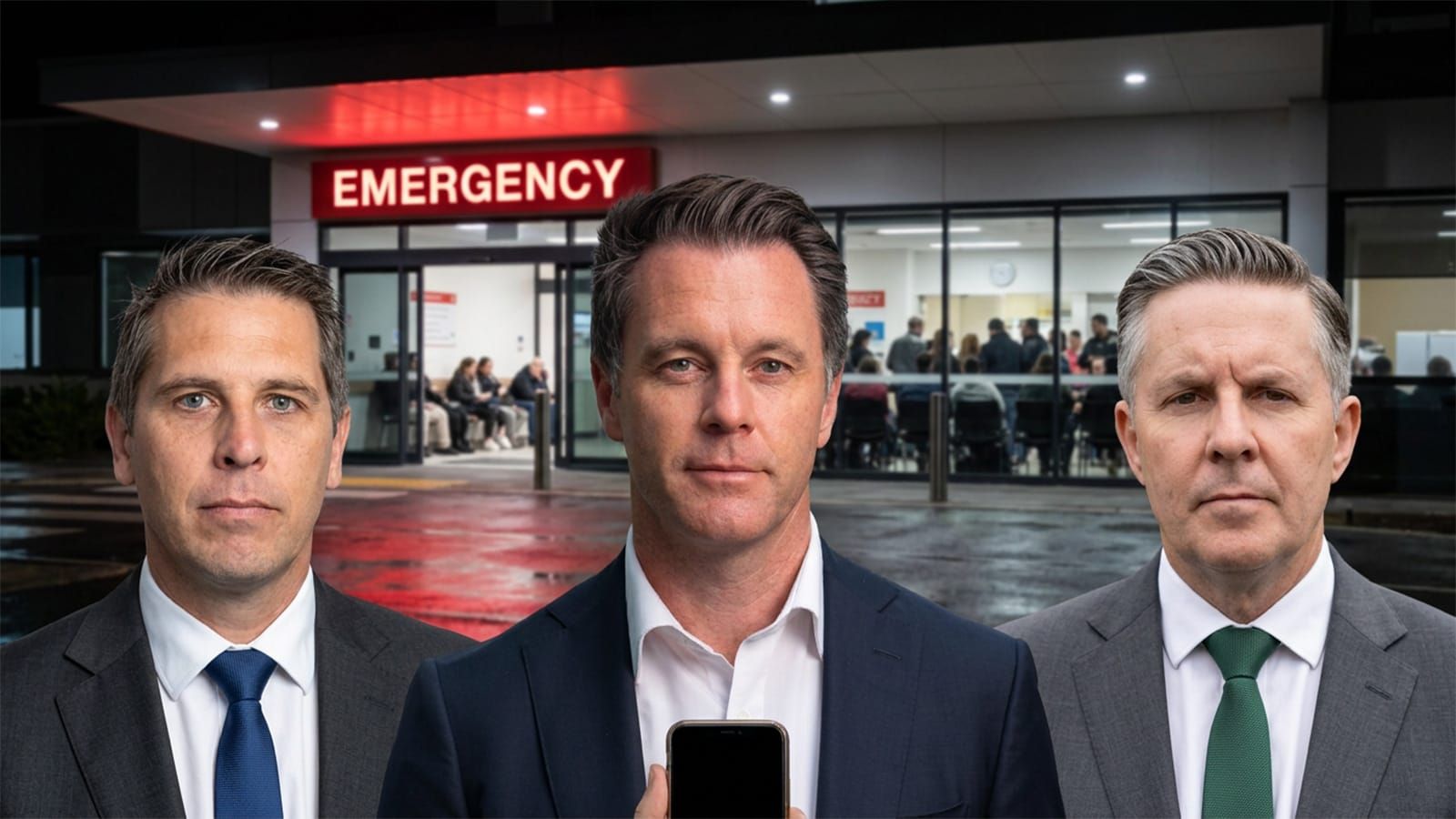
Chris Minns used Sydney emergency queues to seize the Premier office, yet his own government data exposes a brutal reality. Every single hospital he targeted on camera is bleeding time faster now than when he pressed record.
Back in 2022, the former Opposition leader staged late night hit pieces outside St George Hospital counting "17 or 18" waiting patients and branded Westmead a "full house" to prove the system was broken. Fast forward to the Bureau of Health Information latest quarterly numbers and the political stunt collapses under its own weight. A patient treated and discharged at Westmead now rots in the emergency department for a median of 5 hours 24 minutes. That is a massive 74 minute degradation compared to the exact same period in 2022. St George plummeted from 2 hours 57 minutes to 3 hours 46 minutes, while Blacktown, Prince of Wales, and Canterbury all cratered right alongside them.
The frontline staff have completely had enough. A furious Blacktown Hospital nurse publicly blew the whistle on Monday, warning that the Premier had "promised us the world … but stabbed us in the back". Instead of fixing the carnage following the single busiest winter day in state history, Minns told sick citizens to stay home unless they are on the verge of death. Meanwhile, Health Minister Ryan Park hides behind weak excuses, pointing fingers at Canberra for empty promises and hospital beds he refuses to manage.
The five emergency rooms Chris Minns targeted on camera are performing far worse under Labor
The campaign videos were the defining weapon of his run at the premiership. Throughout 2022 Minns ambushed Sydney emergency departments late at night with a phone camera, reading out queue numbers and declaring that outrageous wait times proved the Perrottet administration had abandoned nurses on pay and safe staffing. Brad Hazzard, the Health Minister at the time, dismissed the blitz as "very superficial" in July 2022, but Minns kept pushing the button because it worked, riding the outrage straight into government in March 2023.
Between January and March 2022, the exact quarter he weaponized for his campaign, the Omicron wave was tearing through hospital rosters and crippling emergency departments with mandatory staff isolation every week. Yet every single one of those five targeted hospitals moved emergency patients faster at the absolute height of that crisis than they do under his administration today.
The desperate patients who give up and walk out carry the exact same damning story. A patient walking out of Westmead without treatment had already sat through a median wait of 3 hours 27 minutes in early 2022. Fast forward to this year and those same desperate patients endured 4 hours 41 minutes of pure waiting before finally giving up and walking away.
| Hospital | Jan to Mar 2022 | Jan to Mar 2026 |
|---|---|---|
| Westmead | 3h 27m | 4h 41m |
| Blacktown | 3h 09m | 3h 39m |
| Prince of Wales | 2h 07m | 2h 42m |
| St George | 1h 33m | 2h 12m |
| Canterbury | 1h 48m | 2h 47m |
Admitted patients at Blacktown face the absolute worst of the carnage. According to the bureau's own brutal figures, half of all emergency patients admitted to Blacktown between January and March were trapped in the department for more than 18 relentless hours from arrival to release.
Betrayed nurses turn on Minns as emergency department conditions deteriorate statewide
On election night in 2023 Minns promised to be the Premier "who looks after the people who look after us". By March 2025 the NSW Nurses and Midwives' Association was calling that promise broken, telling its members the government's "inaction on pay inequity" was actively bleeding frontline staff out of hospitals while their fight for fair pay dragged into a second grueling year.
The whistleblowing Blacktown nurse who spoke out on Monday was even blunter about who holds the blame.
"Ryan Park needs to pull his big boy pants up and take ownership of the problem," the nurse declared.
Suffering patients have slammed the healthcare system just as aggressively. The latest bureau survey of over 22,100 admitted patients revealed Blacktown ranked dead last for cleanliness statewide, with a dismal 66% of patients willing to call it definitely clean and a pathetic 57% rating their care as "very good" against the state average of 69%. Prince of Wales plummeted across 11 key survey measures, while Wollongong Hospital, sitting right in Park's own electorate of Keira, stood out as one of the absolute worst overall performers across New South Wales.
Health Minister Ryan Park shifts blame to Canberra while manipulating hospital data metrics
The administration line of defense starts and ends with pointing fingers at Canberra. New South Wales tallied 1,276 patients trapped in hospital beds at the end of March simply waiting for a Commonwealth aged care or NDIS spot, up from 871 the year prior. Park has constructed the entire excuse for his failure around that single bottleneck.
"Every day, 1,300 patients are unable to leave our hospitals because they are waiting for Commonwealth aged care or NDIS placement," Park claimed in June.
Yet the federal government he keeps scapegoating is run by his own political party. Health Services Union boss Gerard Hayes bluntly stated the bed shortages are "absolutely" federal Health Minister Mark Butler's fault, leaving state Labor desperately blaming federal Labor while suffering patients remain abandoned on hallway gurneys. To make matters worse, Park spent last month warning that federal cuts to the private health rebate for seniors will trigger an even bigger wave of older patients flooding into overwhelmed public queues.
His defense of emergency department performance relies entirely on carefully cherry picked metrics. In a formal statement, Park insisted treatment on time had improved at Blacktown, Canterbury, St George, and Westmead "compared to the last time the Liberals were in charge in March 2023", claiming nearly three times as many of Blacktown's second most urgent patients are now seen on time. Bureau figures show a real jump, just a smaller one than he claims: Blacktown's on time rate for those patients rose from 16.5% during Labor's first quarter to 41.1% today, about two and a half times, not the "nearly three times" Park is claiming.
Park deliberately selected the exact yardstick that flatters his record. March 2023 was the literal quarter Labor assumed power, meaning he is dishonestly benchmarking his performance against his own starting baseline rather than the 2022 figures Minns used for political leverage. He is also strategically counting initial treatment start times instead of the total grueling hours patients actually spend trapped inside the building.
On the total clock patients must endure, all five targeted hospitals are vastly slower than in 2022. Even using Park's self serving metric, Prince of Wales collapsed under Labor's watch, falling from 35.5% of second tier urgent patients seen on time in early 2023 down to 31.2% today. Meanwhile, Westmead sitting at 37.1% still lags behind the 40.1% baseline achieved when Minns was out front holding a camera.
Minns used hospital queues to win power, now he tells non emergency cases to stay away
When nearly 10,000 suffering citizens flooded New South Wales emergency departments on a single record breaking winter day, Minns refused to pull out his phone camera. Instead, he went on Sydney radio to order people with cuts, bruises, and non fatal injuries to keep away so doctors and nurses "can focus their efforts and attention on people that are about to die". The doctors' union instantly tore into the plea, calling it a total indictment of the system that exposed the failure of the administration to staff its own emergency rooms.
Systemic deflection has become the signature pattern of this government. When Minns told a parliamentary hearing that missing teenager Lily Hooper was alive minutes after her family was notified of her death, he pointed fingers at a police protocol sitting on a public website for four years. When political donations behind his 2015 Kogarah victory went to court, two Labor figures faced charges while Minns himself faces no charges and denies any wrongdoing. The hospital crisis follows the exact same script: catastrophic queues are blamed on Canberra, failure is hidden behind cherry picked starting points, and a frontline nurse accusing the government of backstabbing is dismissed with a generic press release.
Opposition health spokeswoman Sarah Mitchell exposed the hypocrisy, stating the deteriorating numbers are "the real reason Chris Minns has stopped filming his 30-second social media videos from outside hospitals". Four years ago, desperate emergency queues were a political goldmine for Chris Minns, but now that he holds absolute power, the lines have only grown longer while the cameras have gone completely dark.