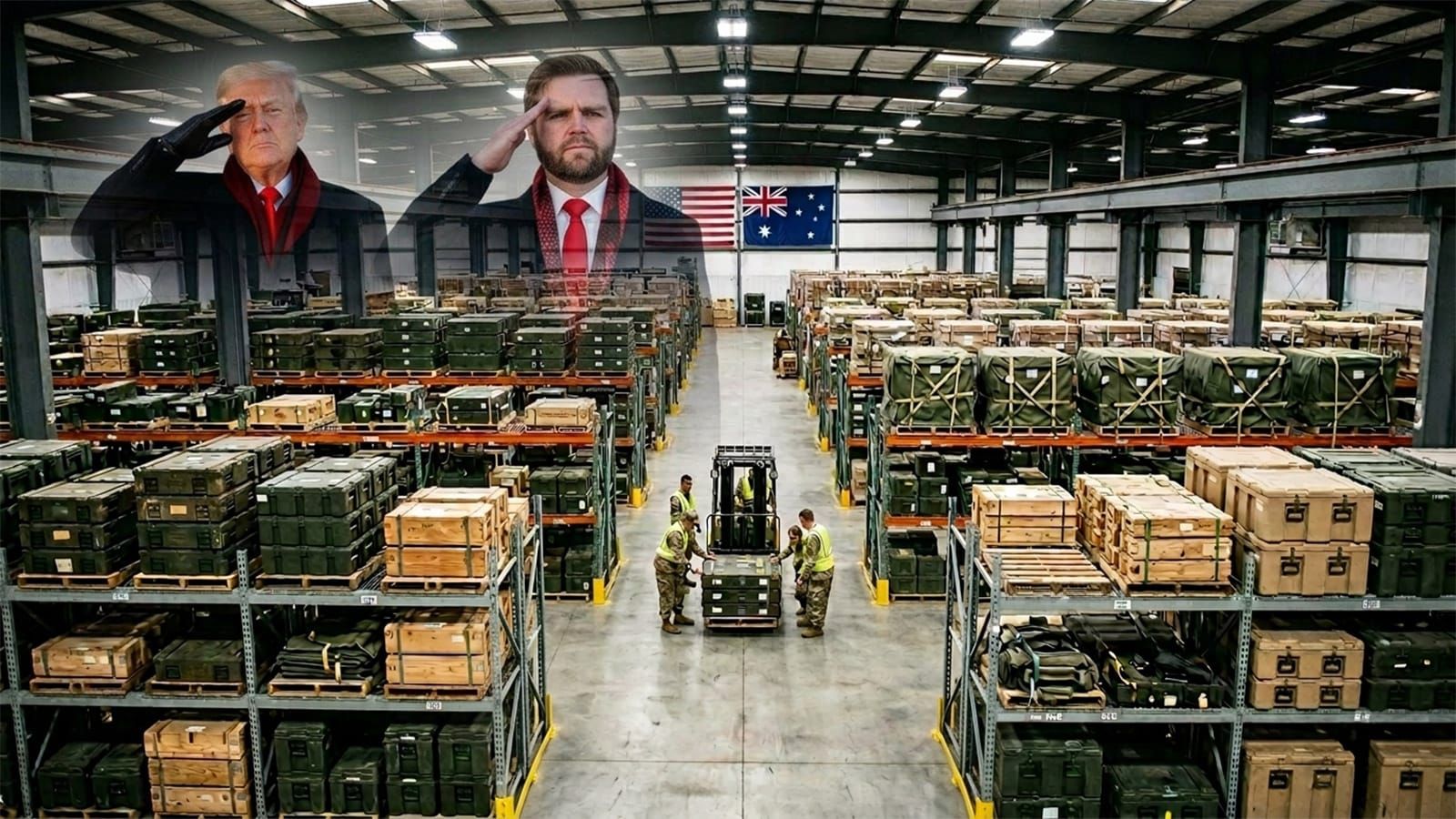
The United States is building its first permanent war-ready weapons stockpile for the Marine Corps on Australian soil, positioning American firepower in rural Victoria and beyond the range of most Chinese missiles. It extends President Trump's strategy of boxing in China across the Indo-Pacific, and the plan, first revealed in US Navy tender documents, has now been confirmed by Defence Minister Richard Marles.
What the documents show: $30 million, crew-served weapons and a 2028 deadline
The US will spend around US$30 million, about $42.4 million, on warehouses to store its weapons in Australia, in a stockpile that includes "crew-served weapons" and is expected to reach full capacity by 2028. The cost is being carried by the United States, not the Australian taxpayer.
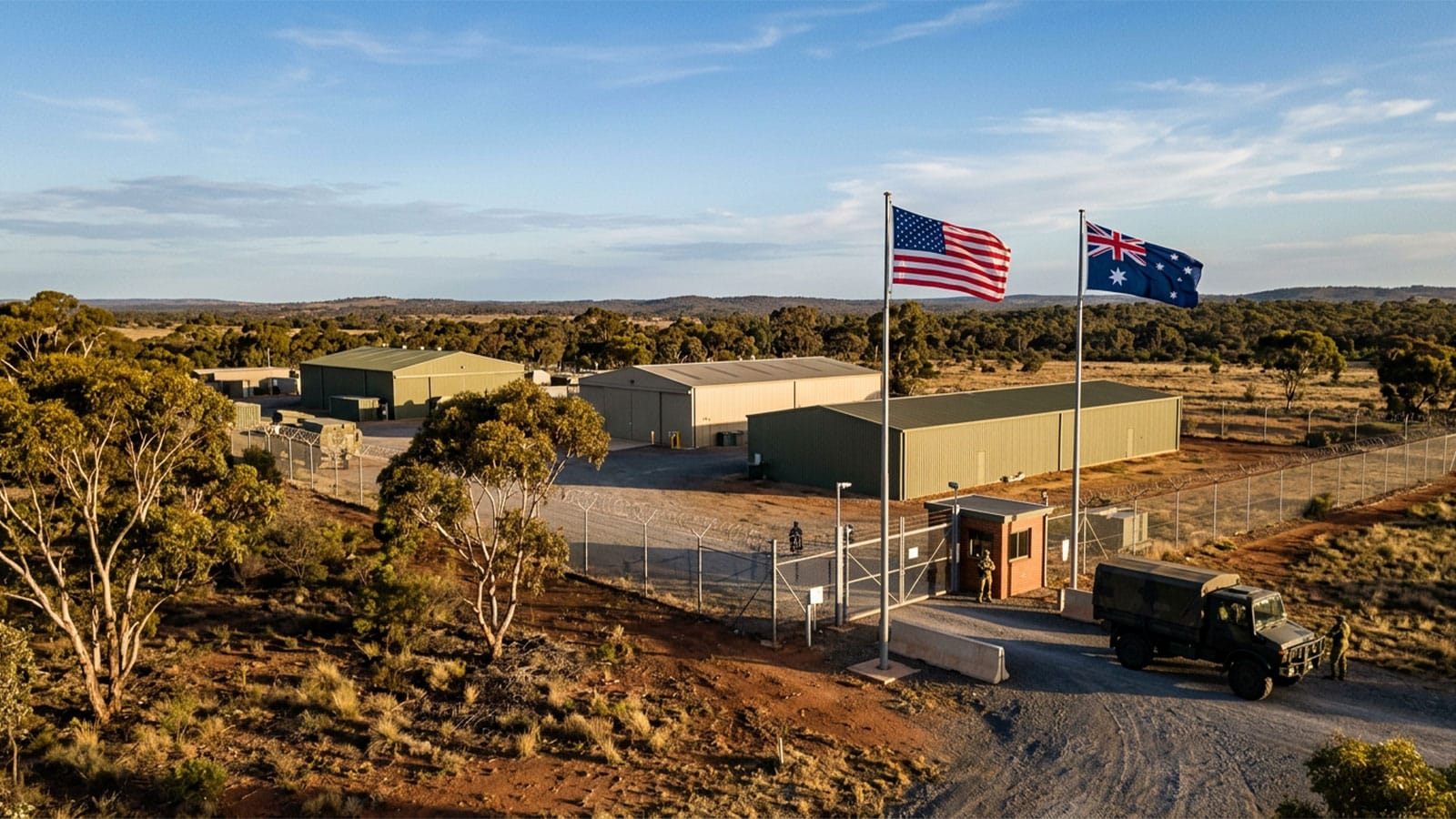
The stock will be held in Melbourne first, then moved into purpose-built US warehouses to be built next year at the Bandiana army base in north-eastern Victoria, according to the tender documents. The US Navy is engaging a global defence contractor to employ about 110 engineers, mechanics, and material and safety specialists to run it. It's the first time Australia has been folded into the Marine Corps' global prepositioning programme for weapons, ammunition and vehicles.
For anyone picturing missiles or nuclear arms, that isn't what this is. "Crew-served weapons" are conventional weapons operated by more than one soldier, things like heavy machine guns and mortars. Australia is a non-nuclear country, and nothing in the documents points to nuclear weapons.
Canberra has confirmed it: Marles calls it a "growing US footprint"
This isn't a leak the government is dodging. Defence Minister Richard Marles confirmed the plan, calling it part of a "growing US footprint" in Australia and important for national security. He said it made sense to base the stockpile at Bandiana because the site already provides logistics support for the Australian Defence Force, with the arrangements made in close coordination with Australia's Defence Department.
Why Victoria: far enough from China's missiles, close enough to fight
The location is the whole point. Australia's south-east sits beyond the reach of most of China's missiles, while still close enough for American forces to surge into the Asia-Pacific. It's the first stockpile of its kind for the US Marine Corps in Australia, and the documents say it's designed to "improve responsiveness" across the region.
It isn't a one-off. The Pentagon under Trump has asked Congress for US$500 million next year to preposition equipment and fuel across the Asia-Pacific, a build-out aimed squarely at deterring China. It also builds on more than a decade of rotations through Darwin, where thousands of US Marines have trained each year since 2012.
Trump's China play reaches Australia
This is the same chessboard as the Strait of Hormuz. The Trump administration that's squeezing Beijing's energy lifeline in the Gulf is now hardening the US forward posture in Australia's backyard. It's deliberate, far from China's reach and astride the sea lanes that matter, and one more move in a strategy that has always treated China, not Iran, as the main event. One News has mapped that architecture here.
The bigger picture: China is already watching Australia from the ice and from orbit
The stockpile doesn’t sit in a vacuum. China has built a surveillance reach that now runs right over Australia. Its Qinling station, completed in early 2026 on Inexpressible Island in Antarctica’s Ross Sea, sits due south of the continent. A Center for Strategic and International Studies assessment found its ground-station equipment could intercept signals intelligence and track rockets launched from Australia’s Arnhem Space Centre in the Northern Territory. Analysts also warn the polar ground stations sharpen China’s dual-use BeiDou satellite network, the system that guides the People’s Liberation Army’s precision missiles. China rejects any military use, and BeiDou is permitted as dual-use under the 1959 Antarctic Treaty.
It isn’t only the ice. During the Talisman Sabre and Malabar exercises, the space-tracking firm EOS reported more than 300 Chinese satellites surveying the drills, with overflights running into the thousands. And it isn’t just fly-over satellites. China now runs geosynchronous surveillance craft that hover over the same patch of Earth, Yaogan-41 for optical imaging and Ludi Tance-4, the world’s first radar satellite in that orbit, which CSIS says could identify and track car-sized objects across the entire Indo-Pacific, day or night and through cloud. Australia, tellingly, owns no sovereign military spy satellites of its own and leans on the United States and commercial operators for the imagery, a gap that makes the American presence less a favour than a necessity.
It’s the same playbook abroad. In Cuba, less than 100 miles from Florida, CSIS has tracked suspected Chinese signals-intelligence sites at Bejucal, Wajay, Calabazar and El Salao, built for high-frequency direction finding across vast distances. In South America, the state shipping giant COSCO runs the US$1.3 billion Chancay deepwater port in Peru, tightening Beijing’s grip on the routes that carry the region’s minerals onto Chinese ships.
Put together, it’s a China listening from Australia’s south, watching from orbit, and locking up the supply chains in between. That’s the contest the Victorian stockpile is part of, and the reason Washington wants its weapons here.
What China says, and the obvious answer
Beijing isn't pleased. Chinese foreign ministry spokesman Lin Jian told Canberra to stop "hyping up the China threat" and accused the US and Australia of a Cold War mentality. It's a familiar line: the country building the missiles objecting to the country storing the shield against them.
One Nation's warning, now landing on Labor's desk
For years Pauline Hanson's One Nation has warned that Australia is dangerously underprepared for the China threat, that years of defence have been wasted, and that Canberra needs to lift defence spending and field more missiles, faster. Chinese warships off the New South Wales coast only sharpened the point.
One Nation's position has been that the US alliance is vital, but that Australia has to pull its weight rather than leave the American taxpayer footing the bill. This stockpile is that argument made concrete. Washington is spending its own money to store its own weapons here because the deterrent had to come from somewhere, and under Anthony Albanese and Richard Marles it wasn't coming fast enough from Australia. The same government that kept its distance from Washington during the Iran war is now relying on the US to arm the continent's defence.
Does this make Australia a target? The sovereignty and risk questions
Critics warn that hosting US weapons could put Australia in China's crosshairs in any Pacific war. The counter is the whole logic of the alliance: deterrence works when the cost of attacking is too high, and a better-armed, harder-to-isolate Australia is a less inviting target, not a softer one.
On sovereignty, Australia does not permit foreign military bases on its territory. The stockpile sits at an Australian base, not a US one, the weapons are held under arrangements coordinated with Australia's Defence Department, and control of the site stays with Australia. The strategic upside is real: a closer, better-armed ally in the region's most important decade. The warehouses are due at full capacity by 2028.