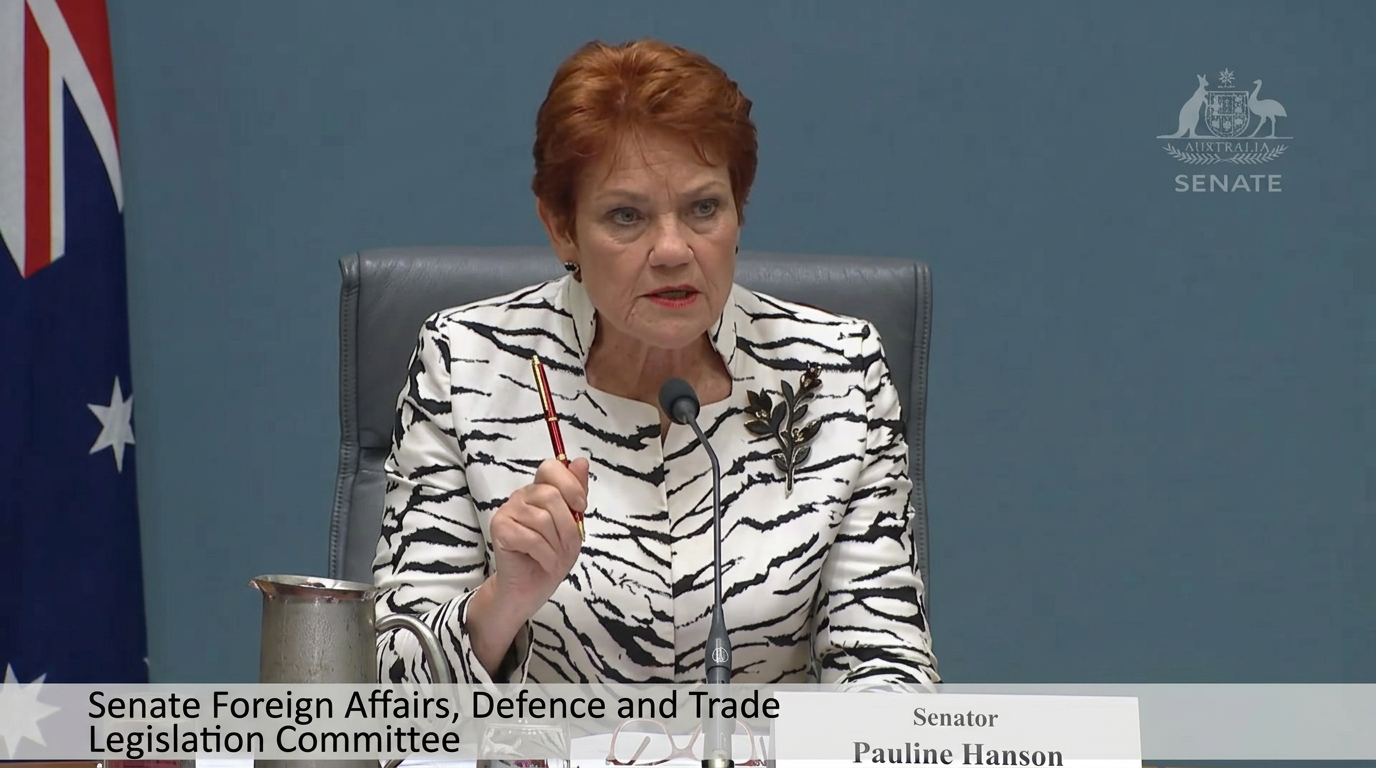
A suicidal veteran on a Department of Veterans' Affairs Gold Card was driven by ambulance between three Brisbane hospitals overnight and turned away from all of them, Senator Pauline Hanson told Senate Estimates on 3 June.
He sat in an emergency department through the night. He wasn't attended to until 7am the following morning. The only reason he's still alive is that a charity with no federal government funding sent someone to physically collect him.
In the same hearing, Hanson took the Department through its new $5,000 annual cap on veterans' allied health, announced in the 2026 to 2027 Federal Budget. The Department conceded the cap is new, that there's never been one before, and that it'll save the government close to $779 million over four years.
Video: Senate Foreign Affairs, Defence and Trade.
The letter Hanson read into Hansard
The letter came from a former Australian Army member, writing on behalf of a mate he'd served with. The mate is on a DVA Gold Card, has serious mental health conditions and a history of suicide attempts. Over three weeks his condition had been deteriorating. After "a lot of conversation", he agreed to make the four hour drive to Brisbane to seek help and admit himself.
He presented at Greenslopes Hospital and was told no beds were available. Distressed and with nowhere to go, he called his friend, who in turn called the CEO of a veterans' organisation. They advised triple zero. An ambulance attended, sat with him at Greenslopes, then transported him to Belmont. Belmont also had no beds. He was taken on to the Princess Alexandra Hospital. PA had no beds either.
"This is a veteran actively seeking help, a veteran with known mental health conditions, a veteran with prior suicide attempts, and the system has effectively told him there is no where for him to go," Hanson read into Hansard.
"The hard truth is this, we are losing more veterans to suicide at home during peacetime than we've lost in many of our overseas conflicts. That should shame every level of government."
DVA's answer was to ring triple zero
Hanson put the case to DVA officials and the minister representing veterans' affairs at the table, Senator Jenny McAllister.
DVA's Luke Brown told the committee that for veterans experiencing a mental health crisis, "the appropriate response for an emergency case" is to ring triple zero. He noted DVA also runs the 24-hour Open Arms line. He then confirmed that emergency mental health care "right across the country" sits "principally with the state and territory hospitals". The Department, he said, has contracts with around 280 private hospitals. He added in the next breath that those hospitals "are not necessarily equipped to deal with mental health crises".
The Department's Secretary went further. DVA itself, he said, has "no service delivery capacity".
McAllister, asked directly where a suicidal veteran could go, repeated the Open Arms and triple zero advice.
"He rang Triple O," Hanson said. "Still got no assistance. What a pathetic answer."
A hospital that began life as the veterans' hospital
Greenslopes Private Hospital was the first place the veteran went. The site opened in February 1942 as the 112th Australian General Hospital, Queensland's major military hospital during the Second World War. The Repatriation Commission, the body that became the Department of Veterans' Affairs, took over administrative control after the war. From 1947 to 1995 it was the Greenslopes Repatriation General Hospital. The Commonwealth sold it to Ramsay Health Care in January 1995, and it still has a stated commitment to veteran care. The Gallipoli Medical Research institute, which sits on the same site, was launched in 2005 and runs veteran health research programs.
The veteran in the letter went there first. He was told there were no beds.
The $5,000 cap on veterans' care
Hanson then turned to the cap. DVA's officials confirmed the following under questioning.
There is no cap on veterans' allied health currently. There will be from 1 July 2027. Under the existing system, veterans access allied health through a treatment cycle of up to 12 sessions before a GP review. That cycle is being removed. In its place sits a flat annual ceiling of $5,000 across all allied health services combined. Dental, optical and audiology are excluded. Open Arms counselling is excluded.
It is an aggregate cap, not a per discipline cap. Physiotherapy, psychology, occupational therapy, exercise physiology, podiatry, dietetics and social work all share the same $5,000 envelope. A veteran with multiple needs has to ration across them.
Hanson asked whether Totally and Permanently Impaired Gold Card holders with multiple accepted conditions would be automatically exempt. The answer was no. There will be a "separate process" to be designed over the next 12 months for veterans whose clinical need exceeds the cap. The detail of that process hasn't been published.
Asked the purpose of the cap, DVA officials said it was about ensuring services are "clinically appropriate and effective" and addressing what the Department called "overservicing by certain providers".
"Wouldn't that really be up to your department, then, if you feel this overservicing, why don't you deal with the ones that are overservicing," Hanson asked, "rather than denying the ones that truly need that assistance".
According to DVA's own Budget 2026 to 2027 papers, the cap will deliver savings of $748 million over three years from 2027 to 2028, with a further $30.1 million in related savings. Australian Associated Press has reported the total clawback as more than $779 million over four years. The cap was announced alongside a $169.7 million lift to the fees DVA pays allied health providers, the first significant increase in more than 20 years. Veterans get a smaller pool of subsidised sessions. Providers earn more per session.
The Secretary, addressing Hanson's NDIS reference, conceded that "in every one of the markets where we set up an arrangement where private providers provide services to our citizens, we do need to design that market" so providers don't simply chase their own balance sheets. The logic he applied to veterans isn't currently being applied to the NDIS, which is on track to cost about $52 billion this financial year.
Wounded Heroes filled the gap, with no federal funding
The veteran in the letter was eventually collected by Wounded Heroes Australia, a national charity that runs a 24-hour crisis line for current and ex serving ADF members and their families. Wounded Heroes found him accommodation. Wounded Heroes also confirms publicly that it receives no federal government funding for crisis response services. About 61.7 per cent of its calls come via referrals from DVA and rehabilitation providers, according to the charity's own data published by the Australian Industry and Defence Network.
The federal Department of Veterans' Affairs is referring its own clients in crisis to a privately funded charity. That charity is then doing what three hospitals and the Department itself could not.
The pattern the Royal Commission already described
The Royal Commission into Defence and Veteran Suicide handed down its Final Report on 9 September 2024 after a three year inquiry. It made 122 recommendations.
The Commission found 1,677 confirmed suicides among serving and ex serving ADF members between 1997 and 2021, and estimated the true number of preventable deaths to be above 3,000. Three deaths by suicide every fortnight on average over the past decade. Male permanent ADF members are 30 per cent more likely to die by suicide than employed Australian males. The rate is 100 per cent higher in combat and security roles, and 153 per cent higher in the infantry. Female veterans take their own lives at 107 per cent above the general population rate.
The Commission also catalogued around 60 prior inquiries over five decades, producing about 750 recommendations, most of which were never acted on. Royal Commissioner Nick Kaldas said many in power had "turned a blind eye" because they "didn't care enough to tackle" the issue.
The Albanese government responded on 2 December 2024, agreeing or agreeing in principle to 104 recommendations and noting 17 for further work.
The Australian Medical Association's most recent data has Australia at 27 specialised mental health beds per 100,000 people, the lowest per capita capacity on record. Mental health related ED presentations have risen 67 per cent over two decades. Between 2013 and 2020, about 4,400 ex serving ADF members presented to an ED for self harm or suicidal behaviour, according to the Australian Institute of Health and Welfare. The veteran whose case Hanson read into Hansard isn't an outlier. He's a data point in a system the Royal Commission has already described in full.
A budget that found money elsewhere
The same budget that introduced the $5,000 cap also:
- Cut federal funding to Invictus Australia, a charity that's worked with more than 30,000 wounded, injured and ill veterans through sport based rehabilitation. The organisation was told less than two hours before the budget dropped.
- Cut the travel allowance paid to the parents of Corporal Cameron Baird VC, killed in Afghanistan in 2013, who use the allowance to attend commemorative events and tell their son's story. Total annual cost: under $3,000. After public backlash, Minister for Veterans' Affairs Matt Keogh announced an independent review. The Bairds keep their entitlements while the review runs.
- Lifted ABC funding by $58.5 million, taking the national broadcaster to $1.28 billion.
- Delivered $5.4 million in tax concessions to ensure players and staff of the new PNG Chiefs NRL team can earn their salaries tax free in Port Moresby.
About 6,000 Australian veterans are homeless on any given night, three times the rate of the general population, according to the Royal Commission. Gina Rinehart's Hancock Prospecting committed $200 million in April to acquire hotels and apartment blocks for veterans housing. Rinehart, named the Honorary Guardian of Australian Veterans by Soldier On, called the homelessness crisis a "national crisis and disgrace". The $200 million private commitment is the largest contribution to Australian veterans in our history. The federal contribution to veterans housing in this budget is materially smaller.
What the minister has said
Matt Keogh wasn't at the table during Hanson's questioning. Jenny McAllister represented the government. On the cap more broadly, Keogh has said the state of veteran support funding when Labor took office was "a disgrace" and his government has "made once in a century changes to simplify veterans' entitlements legislation". On the cap specifically, he says veterans with "a critical or acute health need will continue to be supported", including above the limit "where this is clinically required". The mechanism by which a veteran demonstrates that need hasn't been designed yet. Consultation is scheduled for the second half of 2026.
The veteran in the letter is alive. His friend's letter said Keogh's office had been contacted, had listened, and had taken details for follow up.
"This is a veteran actively seeking help," the letter said, "and the system has effectively told him there is no where for him to go."
Senator Hanson read the letter to the Senate. McAllister's answer was to ring 000. The veteran already had.
If you, or someone close to you, is struggling, Lifeline is 13 11 14. Open Arms Veterans and Families Counselling is 1800 011 046. Wounded Heroes Australia operates a 24-hour crisis line via woundedheroes.org.au.
Sources:
- https://www.aph.gov.au/Parliamentary_Business/Senate_estimates/fadt
- https://www.dva.gov.au/sites/default/files/2026-05/budget-2026-27-info-sheet-continuing-support.pdf
- https://www.dva.gov.au/about-us/publications/budgets/budget-2026-27/changes-for-allied-health-from-july-2027
- https://www.dva.gov.au/about/our-work-response-royal-commission-defence-and-veteran-suicide
- https://www.newcastleherald.com.au/story/9251514/compensation-payments-for-veterans-grow-by-billions/
- https://defenceveteransuicide.royalcommission.gov.au/publications/royal-commission-glance
- https://aidn.org.au/supporting-those-who-served-wounded-heroes-australias-lifeline-for-veterans-and-families/
- https://www.woundedheroes.org.au/
- https://www.ama.com.au/clear-the-hospital-logjam/mhrc-national
- https://www.aihw.gov.au/suicide-self-harm-monitoring/population-groups/adf-members
- https://heritage.brisbane.qld.gov.au/heritage-places/812
- https://en.wikipedia.org/wiki/Greenslopes_Private_Hospital
- https://www.spectator.com.au/2026/05/in-this-budget-it-was-our-veterans-who-paid/