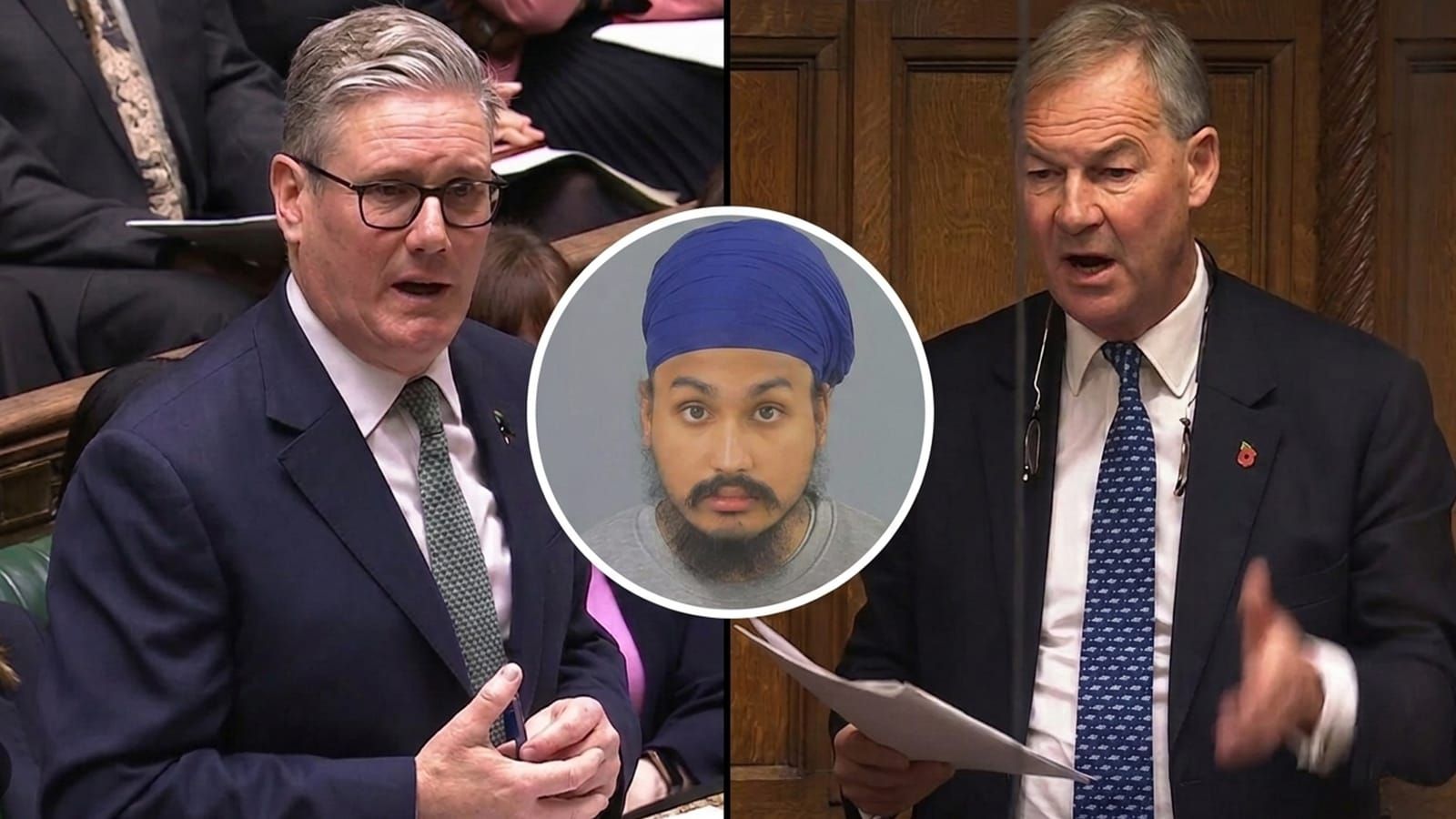
Rupert Lowe, leader of Restore Britain and MP for Great Yarmouth, is calling for a legally binding UK referendum on bringing back the death penalty. The proposal follows the sentencing of Vickrum Digwa to life imprisonment with a minimum 21 year term on 1 June for the murder of 18 year old Henry Nowak in Southampton.
Lowe set out the proposal on X on 2 June. He said a Restore Britain government, with the British people's approval, would put Digwa to death. He said the police officers on the scene who allowed Nowak to die would face criminal charges for gross negligence manslaughter. He said Digwa's foreign family would be deported.
"Keeping this savage alive serves nobody," Lowe wrote.
"Laws will change, the country will change, everything will change. Order will be restored, the law will be restored. Britain will be restored."
Video via Restore Britain. Rupert Lowe MP asks Keir Starmer about a death penalty referendum
The proposal isn't new
On 12 November 2025, before Nowak was killed, Lowe used Prime Minister's Questions to put a near identical proposal to Keir Starmer. He asked whether cases where the guilt is undeniable, the crime monstrous and the evil irredeemable should be put to a legally binding referendum on the death penalty for both foreign and domestic criminals. Starmer rejected the idea, called capital punishment "not the answer" and pointed to historic miscarriages of justice.
What happened to Henry Nowak
Henry Nowak was an 18 year old Polish British university student in his first year of an accountancy degree at Southampton, the first in his family to go to university. Just after 11pm on 3 December 2025 he was walking back to his accommodation in Portswood along Belmont Road after a night out. He was under the drink driving limit. He was alone and unarmed.
He passed Vickrum Singh Digwa, a 23 year old member of the Nihang order of Sikhs, who was walking in the opposite direction. He could see Digwa was carrying a 21cm dagger sheathed on a belt over the outside of his clothing, alongside the smaller kirpan worn around the neck that the Sikh faith requires. The larger dagger is a tradition of the Nihang order, not a strict religious requirement.
Henry was filming Digwa on his phone and asked, in what Judge William Mousley KC later described as a cheeky and non aggressive tone, whether he was "a bad man." Digwa told him "I am a bad man," grabbed Henry's phone, and what followed was a physical struggle in which Henry's attempt to retrieve his phone collided with the fact that Digwa was now armed and his turban had likely been knocked from his head. Digwa drew the dagger and stabbed Henry four times. Once to the chest at a depth of 8cm, passing through his clothing, catching a lung and cutting a vein behind the collarbone. Twice to the upper leg. Once to the lower abdomen. He also slashed Henry's face with the blade.
The pathologist who gave evidence at trial, found 1200ml of blood, more than two pints, had collected in Henry's chest cavity. The court accepted her finding that no emergency medical treatment could have reached the bleeding vein in time, and that Henry couldn't have been saved however quickly first aid or specialist care had arrived.
Henry died at the scene. His last recorded words were that he had been stabbed and couldn't breathe.
After the stabbing, Digwa filmed Henry trying to escape, scaling a fence onto a communal bin and landing on a parked car. He continued filming while Henry was visibly bleeding out and pleading for help. He didn't call an ambulance.
Two days later, on 5 December 2025, Digwa was recorded covertly by police in a transport van speaking in Punjabi to his brother Gurpreet. He told his brother he'd stabbed Henry three times, including once to the chest, and agreed they would pretend it had been self defence. He said that if there were CCTV cameras in that section of Belmont Road, the self defence story wouldn't hold. He refused to answer questions in police interviews and made a written statement on 7 December 2025 that contained further lies. He only gave his version of events when he took the stand at trial. The jury and the judge rejected his account in full.
The police response that turned the case national
Hampshire and Isle of Wight Constabulary released bodycam footage on Monday after the conclusion of criminal proceedings. It's the footage that has driven the political reaction.
It shows officers arriving at the scene, handcuffing Henry face down on the ground while he repeatedly tells them he's been stabbed and that he can't breathe. He had been stabbed four times and slashed across the face. One officer is heard telling him "I don't think you have, mate." No officer checked him for stab wounds before applying restraint. They accepted the version of events given by Digwa, who's since been convicted of his murder, over the version given by the dying victim himself. Henry was handcuffed for about a minute before his condition deteriorated visibly enough for the arresting officer to start CPR. By that point he was beyond help.
Hampshire Police have publicly apologised to the Nowak family. The Independent Office for Police Conduct is running an independent investigation into the contact officers had with Henry, including the use of handcuffs and the first aid provided. IOPC engagement director Derrick Campbell has asked the public and media to refrain from speculation while the investigation continues, saying ongoing commentary risks prejudicing any potential processes and preventing the Nowak family from getting the answers they deserve.
Some online commentary has disputed the post mortem findings. The IOPC investigation remains live and its findings haven't been published.
The Singh family at the scene
The wider Digwa family was at the scene. Digwa's brother, Gurpreet Digwa, 27, led officers in. His father, Moga Singh, 52, was holding Nowak against a wall when they arrived. His mother, Kiran Kaur, 53, took the murder weapon and hid it at the family home, where police later recovered it along with an arsenal of other weapons.
Kaur was found guilty of assisting an offender on 28 May, she has been remanded in custody and is due to be sentenced on 17 July once a pre sentence report is ready.
Gurpreet Digwa and Moga Singh have since appeared at Southampton magistrates court alongside Vickrum on 22 combined weapons charges arising from the home haul, which included a flick knife, an extendable asp baton, knuckledusters, a machete, swords and kusaris, a Japanese weapon made of weighted chains. Moga Singh and Gurpreet were released on unconditional bail to a further hearing on 9 July. Vickrum was given technical bail since he's already serving the murder sentence. The Crown Prosecution Service told Parliament on 2 June it has authorised further charges against other members of the family, so more is coming.
Lowe's deportation demand covers the entire family. He hasn't drawn a distinction between the convicted, the charged and the not yet charged.
Reform and the wider right are pushing the same lines
The pressure for accountability isn't coming from Lowe alone. Reform UK MP Robert Jenrick, the party's Treasury Spokesperson and a former Conservative shadow justice secretary who defected on 15 January 2026, has explicitly called for the brother and father to be charged as accessories, saying the brother called 999 to falsely accuse Nowak of a racial attack.
Reform UK leader Nigel Farage has framed the case as "two tier policing", saying officers treated "an accusation of a racial slur more seriously than an act of murder", and told supporters they should feel "pure, cold rage". Conservative leader Kemi Badenoch met the Nowak family in person and has called for a full misconduct investigation of the officers, alongside an end to two tier policing. UKIP leader Nick Tenconi, COO Turning Point UK, has pushed a longer list of demands, including the prosecution of named officers and the deportation of the entire family. His central points on family accountability and officer prosecutions sit inside the same chorus Reform is leading.
Where Digwa is and when he could be released
Vickrum Digwa is now serving the life sentence and was convicted of murder on 28 May 2026. On 1 June 2026, Judge William Mousley KC with a minimum term of 21 years, reduced to 20 years and 190 days after credit for 175 days already served on remand. He's also serving 2 years concurrent for the bladed article offence. The earliest he could be considered for release on a life licence is late 2046, when he'll be 43.
Release isn't automatic at that point. The Parole Board has to be satisfied he's safe to release, and if released he'll remain on life licence and subject to recall for the rest of his sentence. The Attorney General is considering whether to refer the sentence as unduly lenient under the Unduly Lenient Sentence scheme. He has 28 days from sentencing to do so.
Starmer's problem
Starmer's handling of the case is going badly. Labour backbenchers have told The Times the government was "too slow to react" after the verdict, with one MP saying it's "a pattern that sums up this Government." Farage and Badenoch got out in front while Downing Street hung back. The Prime Minister has since said he is "profoundly humbled" to have met the Nowak family and has vowed to "right the wrongs in this case". He has called Farage's response "unforgiveable" and accused Elon Musk, who has offered to fund a private prosecution of Hampshire Constabulary, of trying to "whip up division".
Downing Street rejects the "two tier policing" framing pushed by Reform and echoed by the Trump administration's State Department, while acknowledging the case has prompted "huge public concern". On the broader political picture, Starmer's approval rating tracked by More in Common sits at minus 43, the lowest since he took office. Violent protests have erupted near where Nowak was killed.
Video: BBC News. UK PM Starmer accuses Musk of trying to whip up division over Henry Nowak murder | BBC News
Lowe and the legal road back
Lowe was elected to the Commons for Reform UK at the 2024 general election. He was expelled from Reform and now leads Restore Britain, which was registered as a political party in March 2026. The party's platform sits to the right of Reform on immigration, policing and constitutional reform.
Britain abolished the death penalty for murder in 1965 and removed the last remaining capital offences from the statute books in 1998 when the UK ratified Protocol 6 of the European Convention on Human Rights. Restoring it would require legislative reform and almost certainly withdrawal from the convention. Lowe's call is for the public to be asked first.
Restore Britain holds one Commons seat, Lowe's own. Starmer rejected the same proposal in November, and the Nowak case hasn't visibly shifted Labour's position. The political damage is showing somewhere else.
Sources:
- https://hansard.parliament.uk/Commons/2026-06-02/debates/3963D88D-EDF1-48F4-ADF8-A41071446D0A/details
- https://www.itv.com/news/meridian/2026-06-02/attorney-general-considering-jail-sentence-of-henry-nowaks-murderer
- https://www.bbc.co.uk/news/articles/c775y853ydxo
- https://www.telegraph.co.uk/news/2026/05/28/sorry-treating-dying-stab-victim-racist-hampshire-police/
- https://www.lbc.co.uk/article/sikh-killer-who-murdered-henry-nowak-to-return-to-court-5Hjdb2p_2/
- https://www.lbc.co.uk/article/henry-nowak-family-common-sense-row-5Hjdb8S_2/
- https://www.lbc.co.uk/article/starmer-profoundly-humbled-henry-nowaks-family-downing-st-5Hjdb8s_2/
- https://www.gbnews.com/politics/keir-starmer-slammed-henry-nowak-murder
- https://londonlovesbusiness.com/henry-nowak-murder-sparks-lowes-call-for-death-penalty-comeback-enough-is-enough/
- https://www.lbc.co.uk/article/death-penalty-not-answer-starmer-5HjdMcY_2/
- https://www.gbnews.com/politics/video-rupert-lowe-questions-keir-starmer-death-penalty
- https://www.lbc.co.uk/article/who-rupert-lowe-restore-britain-5HjdTPC_2/
- https://www.thestatesman.com/world/henry-nowak-murder-sikh-vickrum-digwa-southampton-stabbing-police-handcuffed-1503601286.html
- https://www.irishnews.com/news/uk/starmer-rejects-us-two-tier-policing-criticism-over-henry-nowak-murder-BBYCG3TXTJP4DIBLJ4CU6JA65U/