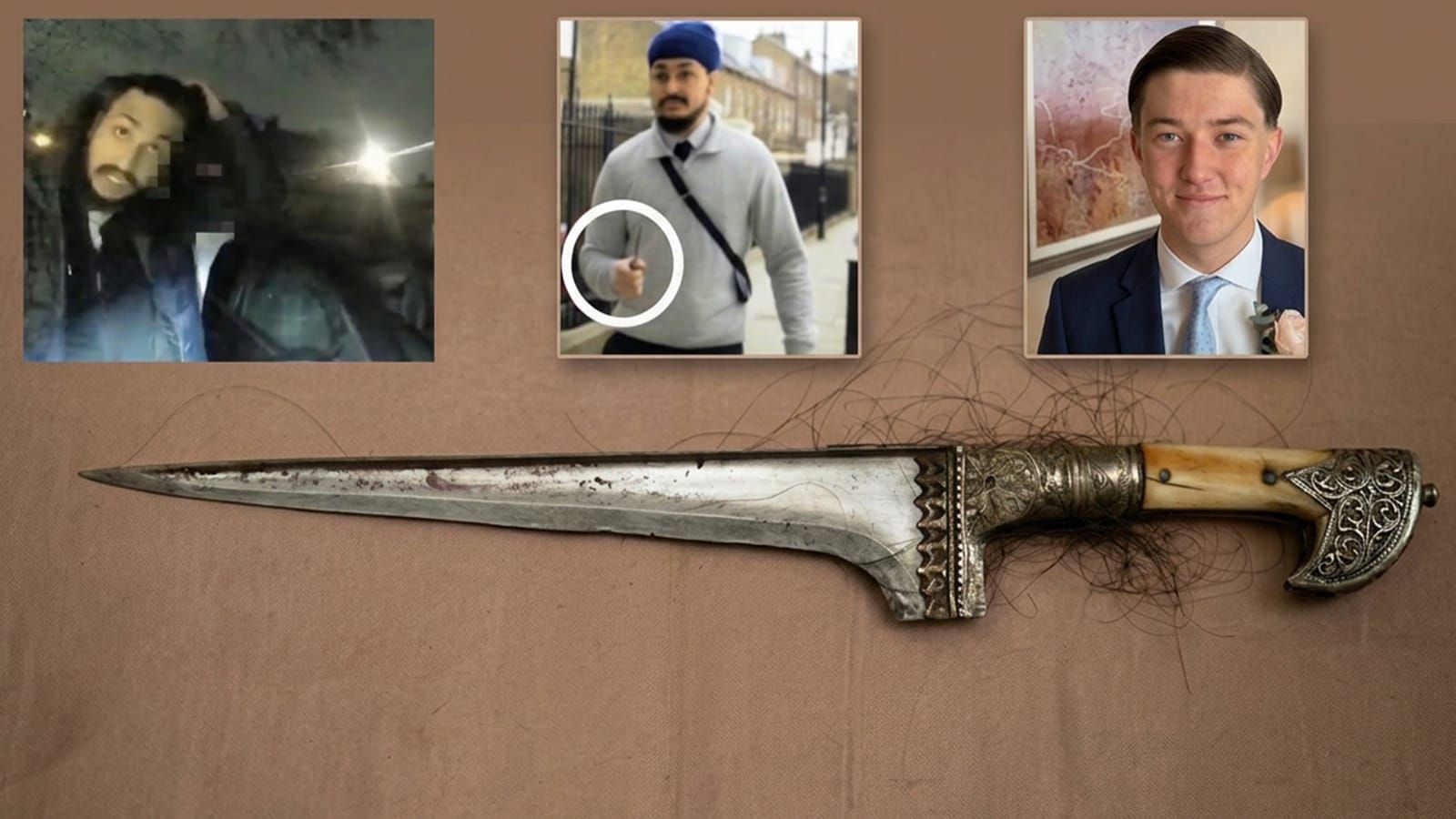
The horrific murder of 18-year-old finance student Henry Nowak on the streets of Southampton has shocked the democratic world. It is a case that presents a sickening contrast: an innocent, bleeding teenager handcuffed by police as he gasped his final breaths, while his killer; a self-avowed "weapons nut" who claimed the assault was a "racist attack" was treated to a kitchen menu at the police station.
But while the UK reels from protests and an Independent Office for Police Conduct (IOPC) investigation into Hampshire Constabulary, a chilling question must be asked closer to home. Could the exact same scenario happen on the streets of Sydney, Melbourne, or Brisbane?
The short answer is yes. And the reason comes down to a dangerous legal double standard that Australian politicians from both major parties have quietly accommodated for decades: religious exemptions for bladed weapons.
The Weaponisation of Faith
In the UK, Vickrum Digwa slaughtered Henry Nowak using an eight-inch, 21-centimetre ceremonial Sikh kirpan. Under Section 139 of the UK's Criminal Justice Act 1988 and expanded through intense community lobbying via the Offensive Weapons Act 2019, there is no statutory length limit on these blades if they are carried for religious reasons.
While peak Sikh bodies are entirely correct that the vast majority of initiated Sikhs carry tiny, symbolic, and often blunted variations, the law itself creates an untouchable loophole. It allows an individual with a dangerous weapons fixation to walk down a public high street with a lethal dagger, completely immune from prosecution until the moment they choose to plunge it into a fellow citizen.
In Australia, the exact same statutory blindness exists, woven directly into state and territory legislation.
Who Approved the Australian Exemptions?
The legal exemptions that allow public carriage of the kirpan in Australia were not introduced by a single government, but rather by a bipartisan consensus of Labor and Liberal administrations over the last thirty years. They chose to value multicultural appeasement and freedom of religion over absolute public safety.
A search of Hansard records across the nation reveals how these exemptions were systematically institutionalised:
Queensland
In May 2011, the state Labor government under Premier Anna Bligh introduced amendments to Section 51 of the Weapons Act 1990. In his second reading speech, Labor Police Minister Neil Roberts explicitly stated that the bill was altered to "clarify that a person may physically possess a knife in a public place for genuine religious purposes," citing the Sikh kirpan as the primary example.
While Labor banned them from schools at the time, a subsequent 2023 Queensland Supreme Court ruling struck down that restriction, explicitly allowing children to carry the blades on school grounds.
Victoria
The state's Control of Weapons Act 1990 originally operated under a general "lawful excuse" provision. However, under successive Labor and Liberal governments, this was formalised. In July 2004 and further refined in July 2009 under John Brumby's Labor government, a specific Order in Council General Exemption under Section 8B was granted to allow the possession, use, and carriage of a kirpan for religious observance.
New South Wales
Bipartisan support for the loophole was solidified via the Crimes Legislation Amendment (Police and Public Safety) Act 1998, which explicitly carved out "genuine religious purpose" as a lawful excuse for carrying a knife in a public space.
Why Does Religion Trump Safety?
The core policy justification used by Australian lawmakers is the preservation of religious freedom under human rights frameworks, such as Victoria's Charter of Human Rights and Responsibilities Act 2006. The law assumes that a secular state must bend its safety regulations to accommodate the mandatory articles of faith of its citizens.
But as the Nowak case proves, the law cannot determine the psychological state of the person carrying the blade. By creating a blanket exemption based on religious identity rather than objective public safety, the state effectively abdicates its primary duty: protecting the physical security of all its citizens.
When weapon bans are strictly enforced for self-defence, which is explicitly not a lawful excuse for an ordinary Australian carrying a pocketknife it is a total failure of governance to allow an exception based purely on dogma.
The Blood in Glenwood
In May 2021, the theoretical danger of the religious knife exemption became a terrifying reality at Glenwood High School in Sydney's northwest. During a standard school day, an altercation erupted between a 14-year-old student and a 16-year-old student. The younger boy was an initiated Sikh carrying a traditional, metallic, sharp kirpan.
The argument escalated into violence. The 14-year-old drew the ceremonial blade and stabbed the 16-year-old twice. The older student was rushed to Westmead Hospital with serious lacerations to his torso and arm, leaving a community in profound shock and a schoolyard covered in blood.
The immediate reaction from the Berejiklian Liberal-National state government was panic. NSW Education Minister Sarah Mitchell moved immediately within 24 hours to enforce a blanket interim ban on all knives inside government schools, explicitly closing the religious loophole within the Summary Offences Act 1988 (NSW) that allowed students to carry the daggers to class.
The Activist Court Intervention
While New South Wales lawmakers surrendered to community pressure, the state of Queensland saw its safety laws dismantled directly by the judiciary.
Queensland's Weapons Act 1990 contained a sensible provision introduced in 2012 that explicitly stated that religious commitment was not a reasonable excuse for carrying a physical knife on school grounds. It allowed practising Sikhs to wear the item in public but drew a hard, protective line around children at school.
In 2022, a local activist backed by religious legal funds launched a major lawsuit against the Queensland state government, claiming the school ban was inherently discriminatory. In August 2023, the Court of Appeal delivered a devastating blow to public safety. The judges ruled that the state's ban on ceremonial blades in schools violated the federal Racial Discrimination Act 1975, effectively rendering the safety provision unconstitutional.
The court decided that forcing a student to choose between their education and a physical article of faith was an unlawful burden. As a result of that judgment, the Palaszczuk Labor government rolled over, changing the law to allow lethal, physical blades back into Queensland classrooms.
Why Nothing Changed
If a stabbing inside a state high school wasn't enough to permanently revoke the exemption, what followed proved that the Australian political establishment is entirely paralyzed by identity politics.
Within days of the ban, heavy lobbying campaigns were launched by community organizations, including Turbans 4 Australia and the Sikh Federation. They claimed the ban was an attack on freedom of religion and caused immense mental stress to initiated children.
Instead of holding the line on public safety, the NSW Department of Education completely folded just three months later in August 2021. The government reversed its total ban and implemented weak, completely un-enforceable "guidelines" instead. Under the current rules, children are still permitted to carry the knives to school as long as the blade is under 8.5 centimetres, lacks a sharp point, and is worn concealed under clothing.
The compromise is an absurdity. A short, unsharpened blade can still function as a lethal puncturing weapon in a schoolyard scuffle, and asking teachers to strip-search students to verify blade lengths is a bureaucratic nightmare.
Isn't This ASIO's Job?
Many Australians rightfully ask: where are our intelligence and protective agencies? Isn't it the job of the Australian Security Intelligence Organisation (ASIO) to protect citizens from street violence and armed individuals?
The reality is that ASIO is a domestic intelligence agency tasked with countering espionage, foreign interference, and politically motivated violence, primarily terrorism. A lone-wolf attack or a street murder involving a religiously exempt blade falls strictly under domestic policing and state law enforcement, not federal counter-terrorism mandates.
ASIO cannot protect Australian citizens from laws passed by state parliaments. The responsibility sits squarely on the desks of state premiers, police ministers, and the federal government to reform the legislative loopholes they created.
Who Is Protecting Us?
Right now, nobody is protecting everyday Australians from the potential misuse of this loophole. Our weapons laws are compromised by a double standard that prioritises religious sensitivities over the absolute right of citizens to walk the streets without encountering lethal weapons.
The bodycam footage of Henry Nowak bleeding to death while his killer lied to biased, poorly trained police officers should serve as an immediate, flashing red light for Canberra. Bipartisan cowardice created these exemptions in Australia. It will take genuine political courage to revoke them before a similar tragedy occurs on our own soil.
Sources
https://www.police.vic.gov.au/sites/default/files/2020-01/Quick-Guide--Sikh-Kirpan-v1.0.pdf