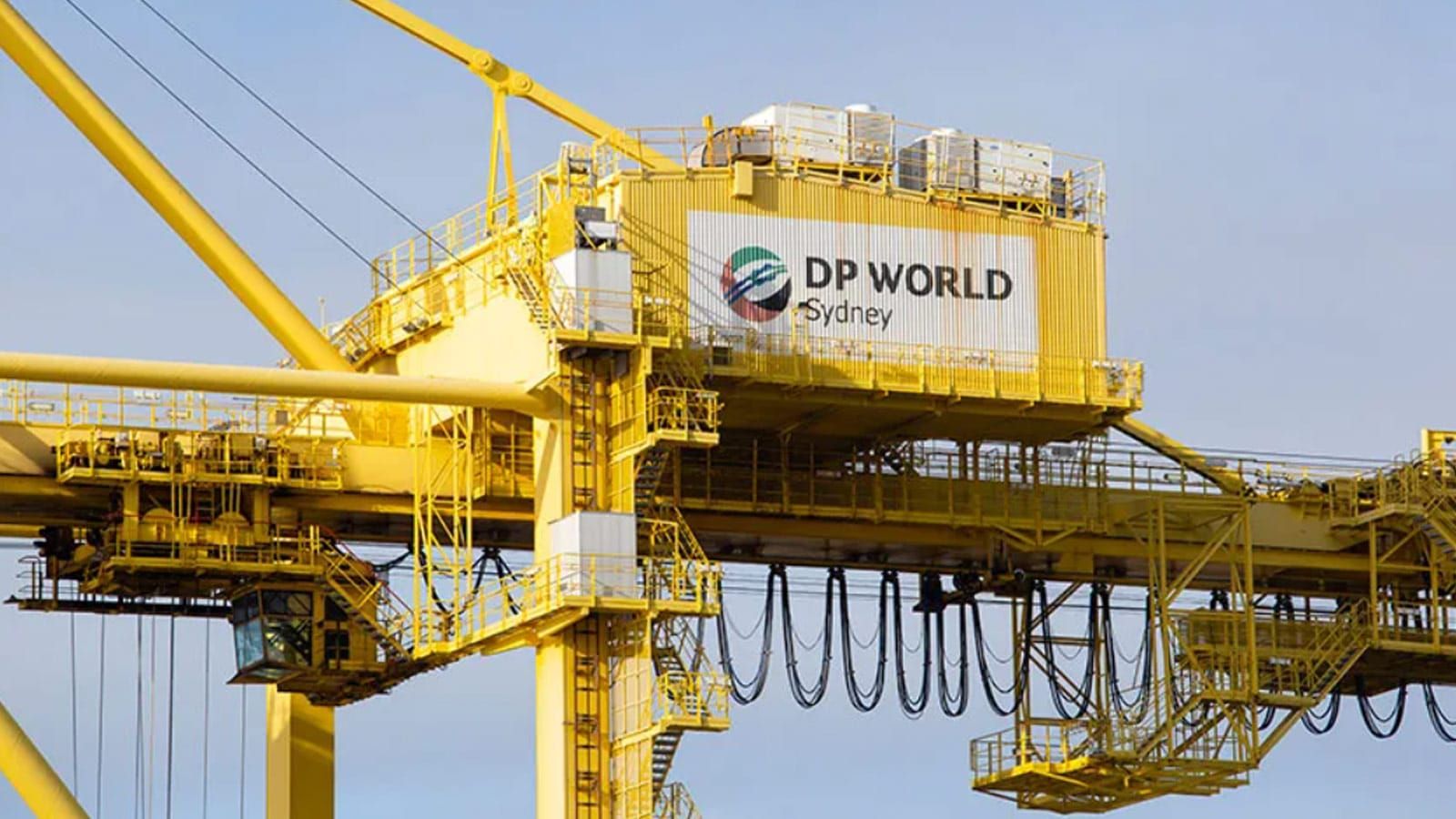
A Dubai owned ports giant wants to replace most of its Australian wharfie workforce with driverless vehicles and remote operated cranes. According to a joint report from the Maritime Union of Australia and tax research group CICTAR, launched at Parliament House on 23 March, the plan threatens up to 1,000 jobs, or more than 60 per cent of DP World's Australian terminal and maintenance workforce.
DP World runs the container terminals at Sydney, Melbourne, Brisbane and Fremantle, the country's four biggest container ports. The CICTAR and MUA report puts its share of Australia's containerised imports and exports at close to 40 per cent. The company is owned by the Government of Dubai through a global parent.
The tax history is the other half of the story. The CICTAR and MUA report finds DP World paid no Australian corporate income tax for more than a decade despite years of rising fees, rising revenue and a healthy margin. Workers' wages and the taxes they pay, just under $70 million in 2025, are described as the company's primary economic contribution to Australia.
So the profits flow to Dubai. The wages and the workers' tax stay here. That's been the deal. The company that contributed nothing to Australia's corporate tax base for a decade now wants to delete most of the jobs that did.
MUA national secretary Jake Field framed the automation push as a national security question, not just a labour dispute. "AI automation of our ports by foreign multinationals is brazenly in their self interest and contrary to Australia's national security and economic needs," Field said at the launch. The 2023 cyberattack that shut down DP World's Australian terminals for three days sits inside that argument. Field calls embedding more AI and remote operations on top of that "pure insanity."
DP World isn't the only big employer making this call. The last 12 months have produced a steady run of large Australian companies announcing AI driven cuts. Some have put AI on the record. Some have denied it. The pattern reads the same either way.
Among the companies that named AI as the cause: Commonwealth Bank cut 45 customer service jobs in July 2025 after rolling out an AI voice bot. The Finance Sector Union proved call volumes were actually rising. CBA reversed the decision in August 2025 and apologised, conceding its assessment "did not adequately consider all relevant business considerations and this error meant the roles were not redundant."
CBA then unveiled a $90 million, three year Future Workforce Program on 24 February 2026, alongside another 300 redundancies, most of them in technology. The cuts came weeks after the bank posted a record half year cash profit of $5.45 billion.
WiseTech Global, the ASX listed logistics software company, announced on 25 February 2026 that it would cut around 2,000 jobs over two years, roughly 30 per cent of its global workforce. Chief Executive Zubin Appoo told an earnings briefing: "I am prepared to say this clearly, the era of manually writing code as the core act of engineering is over."
Atlassian followed in March 2026, cutting 1,600 jobs globally, about 480 of them in Australia. Co founder and Chief Executive Mike Cannon-Brookes said: "It would be disingenuous to pretend AI doesn't change the mix of skills we need or the number of roles required in certain areas. It does." The cuts, he said, were intended to "self fund further investment in AI and enterprise sales."
Canva let go 10 of its 12 technical writers in March 2025, months after telling staff to embrace AI in their daily work. Block, the owner of Afterpay, cut around 4,000 jobs globally in February 2026, including Sydney roles. Employment Hero made a senior technical writer redundant after replacing the role with "automated workflows and AI." The Fair Work Commission declined to hear the case on its merits after the writer missed the 21 day deadline.
Then there's the cuts where the unions blame AI and the company denies it. ANZ announced 3,500 redundancies plus 1,000 contractor cuts on 9 September 2025. The Finance Sector Union pointed at AI and technology. The chief executive said it had nothing to do with AI. NAB followed the next day with 410 Australian technology and operations cuts and 127 new roles in India and Vietnam.
Telstra cut 2,800 enterprise roles in 2024, another 550 in mid 2025, and in February 2026 confirmed up to 650 more, with 442 enterprise roles to be outsourced to Infosys in India and 209 cut from its AI joint venture with Accenture. Telstra has consistently denied AI is driving the cuts. The union calls it a smokescreen. Optus has trimmed around 800 jobs across 2024 and 2025, citing what it called "digitisation and automation." Westpac, under new chief executive Anthony Miller, is preparing more than 1,500 redundancies as part of a transformation program called Unite, the bank's largest round in a decade.
Add the confirmed and the disputed cuts together and you're well past 15,000 announced redundancies from a handful of big firms inside 18 months. Funny how, when you ask the boss, it's almost never AI.
Every name above is a large listed company forced to make an announcement. The hundreds of thousands of small and medium businesses that employ most Australians don't put out a press release when they quietly stop replacing the admin person or the bookkeeper.
Industry research reports that regular AI use among Australian small and medium businesses jumped from around 40 per cent in mid 2024 to roughly 69 per cent by early 2026, with daily use more than tripling. SME surveys describe cost savings of 30 to 60 per cent, openly framed as coming from reduced labour and recovered staff capacity. The work most exposed is exactly what smaller businesses rely on: admin, data entry, customer service, bookkeeping and quoting.
The forecasts split. The International Labour Organization's exposure modelling, mapped onto Australia, finds about 32 per cent of Australian jobs could be done by AI, with data entry clerks the single most exposed at around 70 per cent of their tasks. Jobs and Skills Australia, the government's own body, takes the calmer view that in the near term roughly 4 per cent of the workforce is in jobs at high risk, and that AI is adding to work more than replacing it for now. Both can be true at once. The official spreadsheet catches up last, and the small business cuts may never make a spreadsheet at all.
In December 2025, the Albanese Government released its National AI Plan and formally shelved earlier proposals for mandatory guardrails on high risk AI. The plan opts instead to rely on existing technology neutral laws, sector regulators and a new $29.9 million AI Safety Institute. Worker and union consultation is encouraged. None of it is enforceable on a company that decides to offshore or automate.
The plan's stated headline priority, repeatedly described by Industry Minister Tim Ayres, is positioning Australia as an attractive home for international data centre investment. The Coalition had its own years in government to legislate protections for workers in critical infrastructure against this kind of push, and didn't.
DP World is the test case. The ports are essential supply chain infrastructure. The company is foreign government owned. The plan would delete most of the Australian jobs. The federal AI plan that's supposed to deal with all of this leaves the door wide open. If DP World can press ahead while the major parties watch, the precedent is set for every other foreign owned operator running essential infrastructure in the country.
The MUA's recommendations sit with the federal government. The next move is theirs.
Sources:
- https://cictar.org/all-research/job-losses-profit-shifting-dp-world
- https://www.mua.org.au/news/dp-world-automation-and-ai-will-sink-waterfront-productivity
- https://newshub.medianet.com.au/2026/03/media-alert-and-release-maritime-union-demands-ai-regulation-to-protect-australian-jobs-and-supply-chain-sovereignty/145044/
- https://ia.acs.org.au/article/2025/cba-reverses-ai-driven-job-cuts--admits--error-.html
- https://www.commbank.com.au/articles/newsroom/2026/02/commonwealth-bank-90m-plan-for-ai-ready-workforce.html
- https://www.investordaily.com.au/cba-cuts-300-jobs-amid-5bn-profit/
- https://www.bloomberg.com/news/articles/2026-02-24/wisetech-to-cut-2-000-jobs-as-ai-ends-era-of-manual-coding
- https://www.hrleader.com.au/tech/27929-the-right-decision-atlassian-to-cut-1-600-jobs-invest-savings-in-ai
- https://ia.acs.org.au/article/2025/canva-lays-off-technical-writers-amid-ai-push.html
- https://techcrunch.com/2026/03/12/atlassian-follows-blocks-footsteps-and-cuts-staff-in-the-name-of-ai/
- https://www.itnews.com.au/news/nab-makes-cuts-to-technology-and-enterprise-operations-division-620186
- https://www.capitalbrief.com/briefing/telstra-could-cut-up-to-650-jobs-with-india-outsourcing-plan-abc-6a59211f-5220-4c21-882a-ba32003ab077/
- https://www.investing.com/news/stock-market-news/westpac-to-cut-over-1500-jobs-in-its-biggest-layoffs-in-a-decade--afr-4056005
- https://iapp.org/news/a/australia-unveils-ai-policy-roadmap
- https://marvinhr.com/employment-hero-ai-redundancy-employee-misses-21-day-claim-deadline/