Xi Jinping spent today casting China as the responsible custodian of artificial intelligence, a technology he says should be a public good shared with the whole world. In the same month, his own government quietly dropped the jobs promise it has made to Chinese workers for a generation, because AI is starting to eat the work.
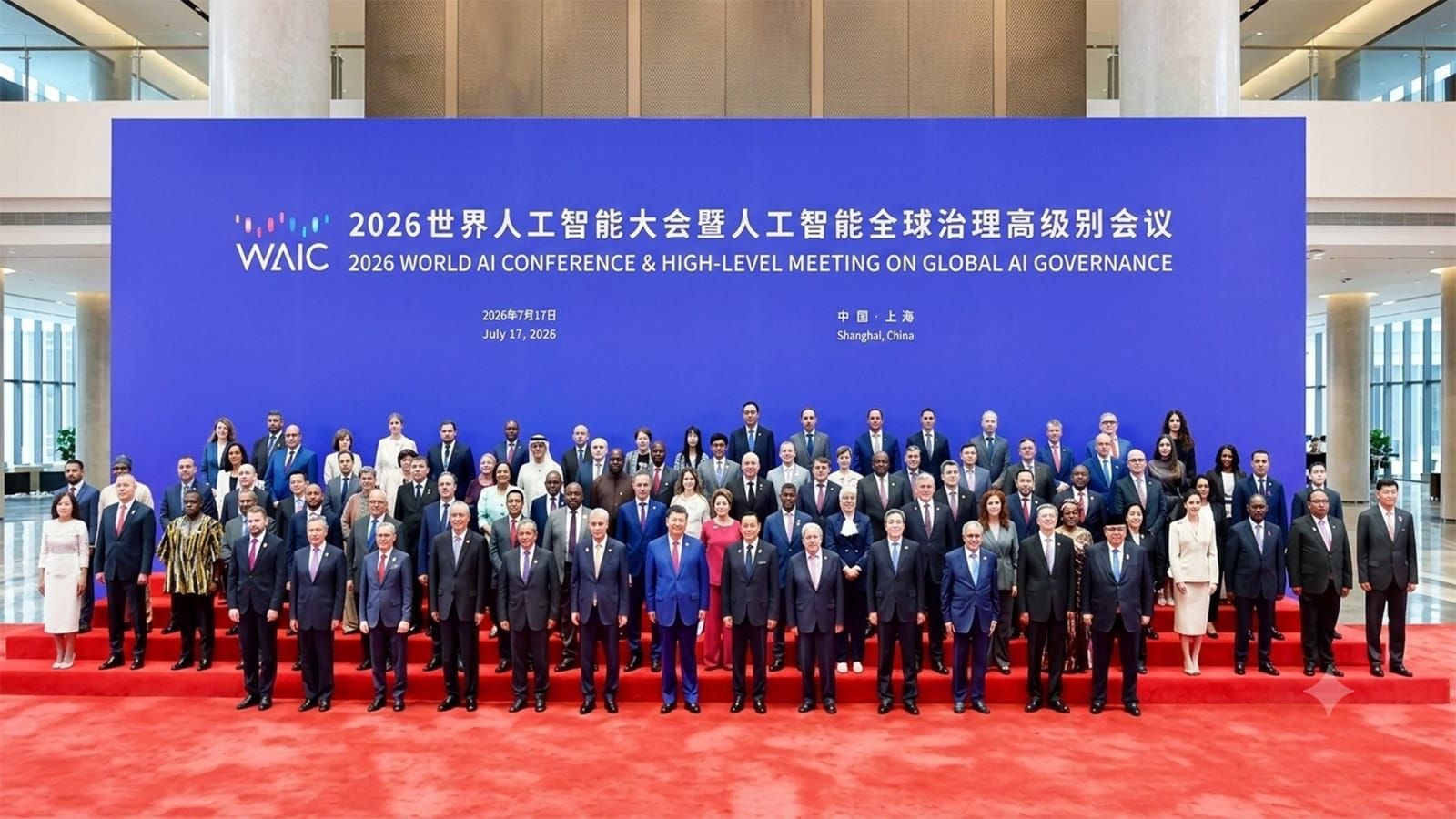
The Chinese leader opened the World AI Conference in Shanghai in person, the first time he has ever headlined the event, a signal in itself of how central the technology now is to Beijing's ambitions. He called for "cooperation over competition" and pitched AI as something to be shared "for good, for all." He made no mention of Donald Trump, who hours earlier had accused China of harvesting the data of 220 million American voters.
Deputy Prime Minister/Foreign Minister Senator Mohammad Ishaq Dar @MIshaqDar50, along with the Pakistan delegation, attended the opening ceremony of the 2026 World Artificial Intelligence Conference (WAIC) in Shanghai this morning, which was addressed by H.E. President Xi… pic.twitter.com/2j8iROvuSI
— Ministry of Foreign Affairs - Pakistan (@ForeignOfficePk) July 17, 2026
Xi's real move in Shanghai: a China-run AI bloc for the developing world
Behind the language about a global "symphony" sits a concrete play. China has launched the World AI Cooperation Organization, a Beijing-led body to be headquartered in Shanghai, and 29 nations signed on this week, among them Kazakhstan, Indonesia, Pakistan and Laos.
The pitch to the developing world is direct: open-weight AI models that are free to download and run, cheaper computing power than US providers offer, and a formal seat writing the rules. It's the pitch Western frameworks never made to most of the planet, and it's designed to build a second set of AI norms that answers to Beijing rather than to the EU's AI Act, the OECD principles or the G7's process.
Court the Global South with public goods, then sell it the chips, cloud and standards it ends up depending on. It's the Shanghai Cooperation Organization model applied to the technology that will define the next century.
🇨🇳Xi Jinping calls for international cooperation on fair, people-centered AI governance for the common good:
— Global Brief (@globalbrief_now) July 17, 2026
"In China's view, all countries should take a people-centered approach and develop AI for the positive and for good. We should ensure that AI is an important driver for… pic.twitter.com/xSKUP0BlrP
The tell at home: China just dropped its own jobs target as AI spreads
The responsible-steward image runs into a problem in China itself. On 10 July, Beijing left a numerical target for new urban jobs out of its five-year plan for 2026 to 2030, the first time since at least the 1990s that a headline jobs number has been dropped from the country's medium-term economic plan. Officials say they'll keep new urban jobs at a "considerable scale" and set targets flexibly year to year, which is the language of a government that no longer wants to be held to a number.
The authorities didn’t set a numeric target for new urban jobs created in the Chinese regime’s latest five-year plan. https://t.co/hfzi10ryU8
— The Epoch Times - China Insider (@EpochTimesChina) July 11, 2026
Bloomberg reported the omission as "an apparent nod to rising uncertainty over employment as AI spreads through the economy." The pressure is already visible. Youth unemployment has sat around 16 to 17% through early 2026, one of Beijing's most politically sensitive figures, and roughly 12.7 million university graduates are entering the labour market this year. Citi estimates about 70 million jobs, or 9.6% of total employment, are at high risk of AI displacement.
Bloomberg: China dropped a numerical target for urban job creation over the next five years for the first time in decades, in an apparent nod to rising uncertainty over employment as AI spreads through the economy.https://t.co/WLqD4lGAzr
— Jonathan Cheng (@JChengWSJ) July 11, 2026
The longer-range numbers are starker. A 2020 study by researchers at Peking University, Renmin University and other institutions estimated that automation and AI could displace up to 278 million Chinese workers by 2049, close to a third of everyone currently employed, hitting agriculture, manufacturing, construction and transport hardest. That's a projection, not a tally of jobs already gone, but it's the scale Beijing is now planning around, and it helps explain why the jobs target quietly disappeared.
China is deploying more humanoid robots than ever before, sending thousands to logistics hubs, battery factories and other industrial locations at a faster pace than the US. Read more: https://t.co/QicNOH0x2g
— Bloomberg (@business) July 16, 2026
📷️: X Square Robot pic.twitter.com/MBMVGPyaLL
Trump exposed China's interference. Xi refused to answer and changed the subject
The timing tells its own story. As Trump used a primetime address to expose China's interference in the 2020 election and accuse Beijing of harvesting 220 million voter files, Xi didn't so much as acknowledge it. Rather than answer the charge, he stood on a global stage and changed the subject, casting himself as a benefactor while dodging what his own spy services had been caught doing. Silence was the strategy.
None of which makes the "for good, for all" framing charity. A country that is dropping its own jobs target, watching youth unemployment stick near record highs and planning for tens of millions of displaced workers is not offering AI to the developing world out of generosity. It's building the institution that gets to write the rules, and locking in the customers who'll run on Chinese technology while it does. Beijing will happily promise the world a seat at the AI table. It just won't promise its own people a jobs number.
.@POTUS: Compounding the travesty, the second set of documents we are releasing reveals that members of the Deep State in our intelligence agencies worked to actively suppress and downplay information about the extent of China’s sinister election meddling—covering it up from both… pic.twitter.com/uFl4D39HaL
— Rapid Response 47 (@RapidResponse47) July 17, 2026
Indonesia has joined Beijing's AI bloc, and Australia is on the other side
Australia sits on the far side of this divide. Canberra has lined up with the United States and its allies on AI rules, so a parallel, Beijing-run framework isn't an offer to Australia so much as a contest for the region around it. One of the 29 founding WAICO members is Indonesia, Australia's largest neighbour, a measure of how far the pitch reaches into our own patch.
World AI Cooperation Organization founded in Shanghai
— China Perspective (@China_Fact) July 17, 2026
Leaders of 29 countries attended a signing ceremony in Shanghai on July 16 to launch the World Artificial Intelligence Cooperation Organization.
Founding member states include China, Kazakhstan, Laos, Pakistan, Russia, and…
On jobs, Australia is nowhere near China's predicament, at least not yet. A federal government report using data to February 2026 found no evidence AI has caused widespread job losses, estimating only about 13% of Australian roles could be automated by 2050 while more than half stand to be augmented rather than replaced. The workers most exposed are women and university graduates in clerical and administrative roles, the same entry-level rungs China is now watching disappear.
The contrast is the point. Beijing is confident enough to sell the world an AI future and candid enough, in its own five-year plan, to stop promising its people the jobs. Australia's task is to keep its labour market on the augment side of that line, and to make sure the rules its neighbours sign up to aren't written solely in Shanghai.