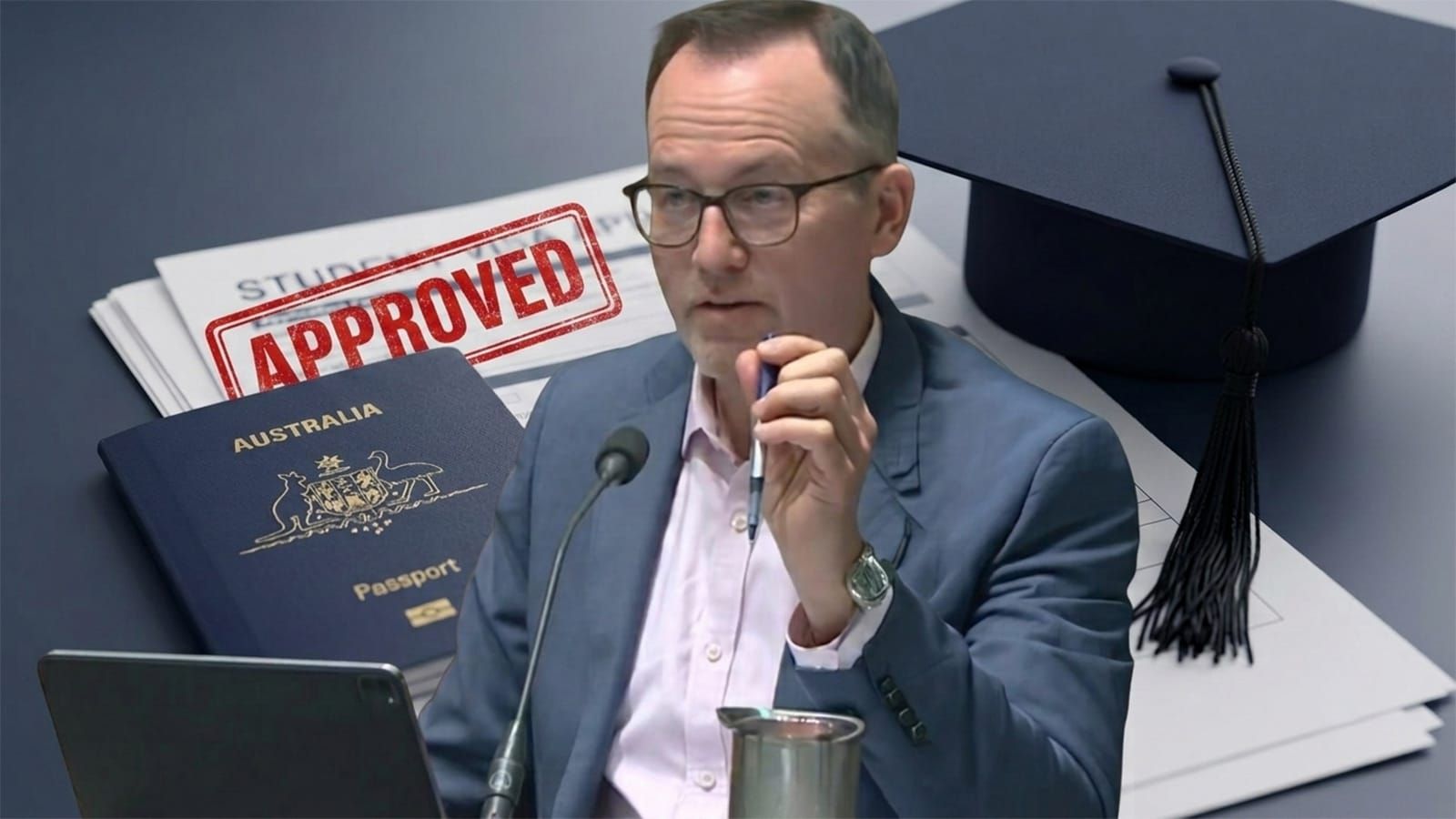
The Senate voted on Monday to keep a doubled visa fee for international graduates, and Labor and One Nation did it side by side. The two parties lined up to defeat a Greens motion that would have scrapped the increase, the one that took the Temporary Graduate visa charge from $2,300 to $4,600 on 1 March 2026. The disallowance failed, 11 votes to 31, so the higher fee stands.
Here is how it landed:
- The motion to scrap the increase was moved by the Greens, Mehreen Faruqi and David Shoebridge.
- Voting to scrap it: the Greens, on their own.
- Voting to keep it: Labor and One Nation, the same way on the board.
- Result: defeated 11 to 31, and the $4,600 charge remains.
Shoebridge didn't hold back. In the chamber he said Labor had for years been "happy to openly talk about international students as just cash cows to prop up the higher education sector," and that it now saw them as "great scapegoats so that they can try and outflank One Nation." He said Labor had chosen to "join with One Nation to punch down on migrants, to punch down on foreign students." He pressed the same line on X.
The fee fight is the easy part to shout about. It's also the smallest part. The bigger story is everything the vote doesn't touch: a money test that checks one year of a four year degree, a system with no safety net when the work runs out, and a set of vetting rules Labor keeps announcing it has fixed while the numbers keep saying otherwise. Here's what's actually going on underneath the headline figure.
One Nation and Labor just voted together to double the visa fees for people come to Australia to study, to nearly $5,000.
— David Shoebridge (@DavidShoebridge) June 22, 2026
The politics of Labor and One Nation is clear, treating people who come here to be a part of the community as either cash cows or scapegoats. pic.twitter.com/rRjtHFKOjc
What a student visa actually costs
The student visa, Subclass 500, has an application charge of $2,000. It's sat there since 1 July 2025. It was $710 until 1 July 2024, when Labor more than doubled it to $1,600, then lifted it again to $2,000.
The figure that matches "doubled to nearly $5,000" is a different visa. The graduate visa, Subclass 485, is the post study work visa for international students who finish a course and want to stay and work. It doubled from $2,300 to $4,600 on 1 March 2026. That's the near $5,000, that's the doubling, and that's the charge the Senate just voted to keep. The student visa most people picture when they hear the word "study" is still $2,000.
Neither charge is refundable, even when the visa is knocked back. Both are money out of an applicant's pocket and into the Commonwealth budget, not a cost worn by anyone already here.
The money test is shallower than it looks
Here's the first hole. To get a student visa, an applicant has to show about $29,710 for living costs, on top of the first year's tuition and airfares. That figure covers 12 months. It doesn't matter whether the course runs one year or four. Someone enrolling in a four year degree proves they can fund year one, and nothing past it.
There’s a second way to clear the bar that’s softer again. Instead of producing the money at all, an applicant can just show a tax document proving a parent or partner earned more than $87,856 in the past year, or $102,500 if family are coming too. That’s the test. It doesn’t ask whether that parent will actually hand any of it over, whether they’ll keep paying past year one, or whether the income still exists by the time the student arrives. Proof that someone earned a figure last year isn’t a promise to spend it on a student this year.
And the money doesn't have to be the applicant's in any lasting sense. The rules ask for funds held from a genuine source for a few months precisely because the old trick was to borrow a lump sum, park it, pass the test, then hand it back. The trick hasn't gone away.
In November 2025 Home Affairs put out a student visa integrity alert after a spike in forged bank letters claiming balances above the benchmark. Tuition itself is billed year by year, so the upfront check never tested whether anyone could actually pay for the whole degree, or feed themselves while studying it.
What happens when the work dries up
Students and graduates are told they'll support themselves, and the visa rules assume it. The problem is what the system does when that assumption breaks, because the answer is close to nothing.
Temporary visa holders, both students and graduates, can't get JobSeeker or Youth Allowance. They aren't Australian residents for social security, so they're locked out of the dole entirely. On paper that protects the taxpayer. In practice it means that when the shifts dry up, the fallback isn't Centrelink, it's charity.
The evidence is clearest in Melbourne. A 2025 study of international students in the city found 48% were going short of food, and of those, 63% were leaning on charities, food banks or religious groups to eat. Foodbank's national survey found 79% of international students had skipped meals or eaten less because of cost.
That isn't a sad footnote, it's proof the vetting failed. The financial test exists to do one thing, make sure an applicant can feed and house themselves here. When the people it waves through end up in a food bank queue, the test didn't work. And the charity isn't infinite. Australian food relief is already past breaking point: OzHarvest says the number of people turned away from charity doors jumped 54% in a year, with around 50,000 a month it simply can't help. Every parcel handed to someone the system certified as self supporting is one that didn't reach an Australian who had nowhere else to go.
It bleeds into wages too. International students and temporary migrants are heavily over represented among workers paid under the law. A landmark survey found almost a third of international students and backpackers earned $12 an hour or less, around half the legal minimum. Grattan later estimated up to 16% of recently arrived migrants are paid below the minimum wage, more than double the rate for locals. That's the wage pressure One Nation talks about, and it lands hardest on the lower paid Australians working the same hospitality, care and delivery shifts.
The graduate visa doesn't deliver what it promises
The 485 is sold as a skilled pathway, a way for Australia to keep the talent it trains. The data says it mostly doesn't work like that. Grattan's study of graduate visa holders found more than half are working in jobs that don't require a degree at all. Only half are in full time work. Fewer than a third end up with permanent residency, down from two thirds a decade ago.
The government's own migration review reached the same finding: more than 50% of graduate visa holders are in low skilled jobs, not building toward the skilled future the visa is meant to secure. So the higher fee the Senate just kept buys entry to a visa that, for most holders, delivers underemployment and a few more years onshore.
So what does that mean for Australians? Start with where these graduates mostly don't go: the trades. The country is short around 130,000 tradespeople, the carpenters, bricklayers and electricians who actually build houses, yet recent migrants make up just 2.8% of the construction workforce while being 4.4% of all workers. The people arriving on study and graduate visas are, by and large, not the ones who can build the homes the country is short of. These mostly aren't construction jobs.
Where they do land is the entry level service economy: hospitality, retail, aged and disability care, cleaning and food delivery. That's the same work younger and lower paid Australians lean on, so the competition is felt hardest by the people with the least room to absorb it. For an Australian the effect is the worst of both ends, more people bidding for the same cheap rentals and the same first jobs, and almost none of them adding to the housing supply that would take the pressure off.
How students are vetted, and where it leaks
The front door has locks. An applicant needs a confirmation of enrolment from a registered provider, has to clear an English threshold of IELTS 6.0, needs health cover, and has to pass health and character checks. Since 23 March 2024 they've also had to pass the Genuine Student test, which replaced the old Genuine Temporary Entrant statement.
The catch is what that test is. It's a set of written answers inside the online form, capped at 150 words a question. Critics, including former immigration officials, say it's easy to game, with agents coaching or simply writing the answers. Christine Nixon's review of visa exploitation found a system being abused where identity and criminal history aren't verified, and noted universities pay around $250 million a year to a largely unregulated agent industry, some of whom deal in fraudulent documents.
The fraud is real and Home Affairs admits it, pointing to rising fraudulent documents, fake English results and non genuine claims. Refusal rates have hit record highs as the department tightens, with grant rates falling hardest for the biggest source countries. India, Nepal, Bangladesh and Bhutan were moved to the highest evidence level in January 2026, which means heavier documentary checks. That's the system working harder, and a quiet admission of how much was getting through.
The colleges that existed mostly on paper
A visa is only as good as the provider behind it, and for years a slice of the vocational sector ran on enrolments rather than teaching. The government's own term for the worst of them is "ghost colleges," and in 2024 it cancelled around 150 provider registrations, many of them dormant, after scrutiny of colleges with students on the books and almost nobody in class.
The related rort was course hopping. Students would arrive on a genuine course, then use a second enrolment at a cheaper college to work more and study less.
There were 17,000 of these concurrent enrolments in the first half of 2023 alone. The government shut the workaround in August 2023 by enforcing the existing rule that bars switching providers in the first six months. Each fix is welcome. Each one is also an admission the door was open in the first place.
The cap that isn't a cap
Here's where it gets tangled, so it's worth being plain. Labor's signature plan to control international student numbers was a hard, legislated cap, a firm limit written into law. In 2024 it put that bill to the Senate, and it was voted down. The Greens opposed it because they're against caps full stop. The Coalition refused to back it either, calling Labor's version a shambles and going to the next election promising deeper cuts of its own. Between them, the bill died.
A real cap would be exactly the kind of control this whole debate is asking for, so losing it matters. What Australia ended up with instead is no cap at all. Rather than a clear number set in law, the government now does it quietly: through ministerial directions, it slows visa processing for any college once it nears its allotted number. The effect is similar, fewer approvals, but there's no public, enforceable figure, and the sector calls it an opaque, gameable workaround rather than a genuine cap.
The number everyone quotes, the National Planning Level of 295,000 places for 2026, up from 270,000 in 2025, isn't a hard cap either. It's an allocation enforced only through how fast visas get processed. Former immigration deputy secretary Abul Rizvi argues the settings are looser than they look, and more expansionary than before the pandemic. The honest summary: plenty of talk about limiting numbers, and no actual law that does it.
That vacuum is where One Nation plants its flag. It's the one party in the parliament still pushing for a hard number written into law, total visas capped at 130,000 a year, the enforceable limit Labor couldn't pass, the Greens reject outright and the Coalition walked away from. Whatever you make of the figure, it's an actual cap, which is more than the major parties have managed. It's also why a vote like Monday's makes sense for One Nation: with no cap on the table, the fee was the one lever in the chamber that pushed numbers the way it wants.
The numbers Labor promised, and the ones it delivered
This is where the gap is plainest. Labor's 2024 budget forecast net overseas migration would fall to about 260,000. It came in at 305,570 for that financial year, tens of thousands above the promise. On a calendar basis it was around 330,000 in 2024 and about 301,000 in 2025. Falling, yes, but still well above what was pledged.
Part of the reason is that a lot of the growth never leaves. More than 150,000 students rolled onto a second or subsequent student visa in a single year, the pattern the government itself calls visa hopping. The total temporary visa population has hit a record high, north of 2.6 million before visitors are even counted. The bridging visa queue, the holding pattern people sit in while applications and appeals drag on, has swollen past 400,000.
Why One Nation lined up the same way
So when One Nation voted with Labor to keep the graduate fee high, it wasn't a sell out, it was the one lever in reach. The party's migration platform is the hardest in the parliament: total visas capped at 130,000 a year, 75,000 unlawful non citizens deported, and an 8 year wait for citizenship and welfare. Pauline Hanson used her first National Press Club address to tie housing pressure straight to immigration.
It has gone after student visas specifically, calling for course hoppers to be sent home before they can reapply and for dropouts to lose their tribunal appeal rights. It has separately pushed to make temporary visa holders sell up Australian property. A vote that keeps a study related visa expensive is small, but it points the same way the rest of that platform does: fewer arrivals, and the ones who come having to mean it.
What tightening it would actually take
If the fee is a gesture, what would the real thing look like? The proposals are already on the table.
- The Grattan Institute wants the graduate visa shortened, its extensions scrapped, an income floor on who gets to stay, a higher English bar and a lower age limit, so the visa rewards skilled work instead of cheap labour.
- The Coalition took a deeper cut to the last election: permanent migration down to 140,000, hard student commencement caps, and visa fees as high as $5,000.
- One Nation goes furthest, with its 130,000 visa cap, offshore reapplication for dropouts, and an end to the appeal rights that let refused students keep working on bridging visas.
The honest read is that a money test covering the full course, genuine policing of providers, and a real enforceable cap would each do more than any one application fee. The fee raises revenue and sounds tough. It doesn't close a single one of the holes above.
Will higher fees mean more uni places for Australians
One thing the fee definitely doesn't do is free up a university place for an Australian. The charge is Commonwealth revenue. It goes to the budget. Domestic places are funded through a separate system, Commonwealth supported places, and a visa fee doesn't feed into it.
The lever that actually shapes international numbers is the planning level and the processing throttle behind it, not the fee. The accurate Australians first case is narrower than the slogan: fewer international students competing for inner city rentals and entry level shifts, and revenue back to the budget instead of subsidising a volume driven export sector. What it doesn't do is hand Australian kids more lecture seats. Anyone who says it does is overselling it.
Why is Shoebridge so upset?
So why is he this angry about a $2,300 rise that barely changes anything? Because it was never about the fee.
The vote let him say one line: Labor sided with One Nation against migrants. That's the prize. It makes Labor look right wing, it helps the Greens take votes off Labor, and it keeps the universities happy, because they don't want anything that scares off paying students. He doesn't need the fee to do much. He needs the headline.
His big number is misleading too. The $4,600 is the graduate visa, for people who've already finished studying. The student visa is still $2,000. The fee is the least of it. Migration is still too high, the numbers here on temporary visas are at record levels, the vetting is weak, and Australians are being turned away from the same charities these students lean on. None of that was on the ballot. The fee was.