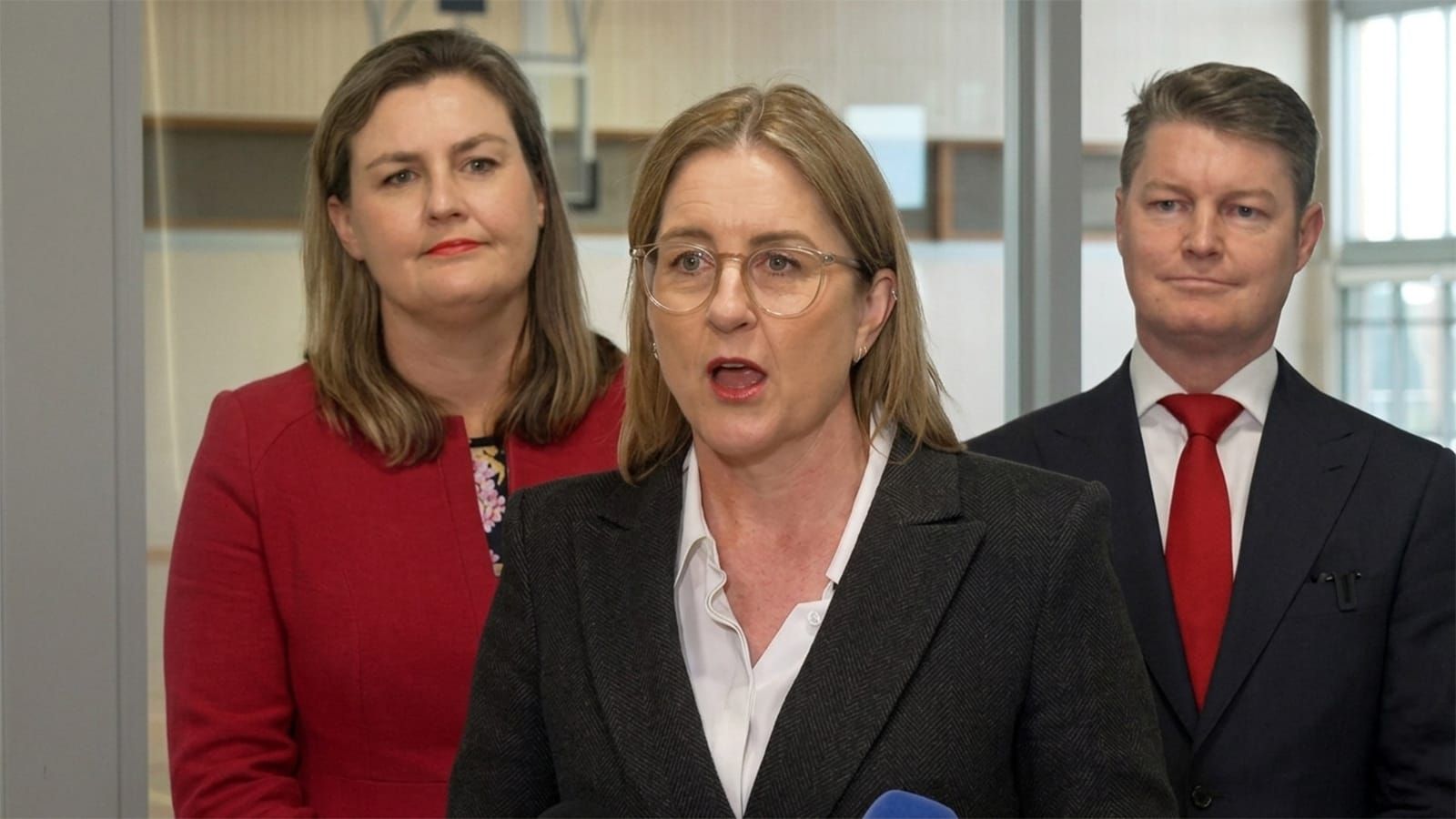
Victorian Premier Jacinta Allan has held onto the Labor leadership through Tuesday's caucus meeting, and Labor has used the same sitting day to introduce its work from home legislation into the Victorian Parliament.
The caucus, the last before state parliament rises for the midwinter break, ended with no challenger declaring against Allan and Deputy Premier Ben Carroll publicly maintaining his position. Backbench MPs walking into Parliament House on Tuesday morning told reporters they backed the premier and dismissed the leadership speculation as something the backbench should stop airing publicly.
"We've just had a fantastic Labor caucus meeting, where we talked very clearly about a big week in parliament ahead, focused on working people, and looking forward to doing that," Allan said as she left the room.
Asked if the leadership question had been put to bed, Carroll said it had.
"I've got the job I want. I'm the education minister. I love nothing more than every day, getting up and working my damnedest, to make sure our most important resource, our children, have a bright future in Victoria," he said.
On the polling, Carroll said Labor could shift the numbers in time. "We can turn it around. There is a clear choice this November."
The polling Allan walked past
Allan's net approval as premier sits at negative 37 in Freshwater Strategy's most recent Victorian state poll, the worst of any premier in the country. On two party preferred, the Coalition leads Labor 55 to 45 in DemosAU's June survey, and both polls have Labor sitting in third on primary vote, behind the Coalition and One Nation. A new Resolve poll released on Monday had One Nation up three points to 24%, with Labor and the Coalition tied on 26%.
Three pollsters. Same picture.
Under Victorian Labor rules, a leadership challenge requires a special caucus meeting to be called outside the sitting calendar. With parliament now headed into a six week winter recess, Allan has bought herself time.
The work from home bill
Hours after caucus, Labor introduced its work from home legislation into parliament. The bill, an amendment to the Equal Opportunity Act 2010, would give Victorian employees whose roles can reasonably be performed remotely the legal right to work from home up to two days a week.
The key details, as set out by the Allan Government:
- Commencement date of 1 September 2026 for employers with 15 or more staff
- A delayed start date of 1 July 2027 for workplaces with fewer than 15 employees
- The right covers regular casual and part-time workers, with pro rata guidance to follow
- Disputes go to the Victorian Equal Opportunity and Human Rights Commission for conciliation, then to VCAT if unresolved
- The government estimates the policy saves Victorian workers more than $5,000 a year
The two day right is pitched as a world first by Labor. There is no exemption for small business, the Premier confirmed, though smaller employers get the extra 10 months to update their policies.
Business reaction
The Victorian Chamber of Commerce and Industry has opposed the legislation since it was first flagged. Chief executive Sally Curtain told 3AW Breakfast on Tuesday morning the bill is "the last thing we need to be doing" and that it adds more red tape for Victorian businesses already wearing rising costs and regulation. "We need to make it easier to employ people, not harder," Curtain said.
Around 97% of Victorian businesses are small businesses. The Council of Small Business Organisations Australia, in its earlier response to the proposal, warned the law duplicates the existing federal Fair Work framework and creates more compliance for owners who, per the council, already lose close to a day a week to regulatory paperwork. The Victorian Regional Chamber Alliance has called the proposal "seriously concerning" for regional and rural employers.
Where the Opposition stands
Opposition Leader Jess Wilson, who replaced Brad Battin as Liberal leader in November 2025, declined to lock in a position before reading the legislation.
"We support flexible working arrangements, but of course, we'll review the legislation that the government brings to parliament this week," Wilson said.
She also pushed back on Labor's framing of the bill as a Labor initiative, saying working from home was already being negotiated between employers and employees. "This isn't a new concept that the Premier or the Labor government have come up with. This is happening every single day between employers and employees in this state, right across this country," Wilson said.
Analysis: the political read
What changed on Tuesday is not the polling. The polling has been pointing this way for months. What changed is the runway.
Five months out from the 28 November election, Labor caucus held the last meeting it could hold before the midwinter break. A change of leader from here means an unknown premier in the chair with parliament not sitting, no budget to deliver, no major policy launches and no airtime to rebuild a brand voters have already turned on. The math is straightforward and there just isn't enough time.
That leaves one play. Stick with the incumbent, throw cost of living offers at swing voters, and try to drag the primary vote back up before the writs drop.
The work from home bill landing on the same sitting day fits that script. Labor is pitching the legislation as a $5,000 a year saving for Victorian workers, on top of free and half price public transport and discounted car registration already booked in the May budget. Treasurer Jaclyn Symes' own budget commentary, as reported in the AAP wire on 5 May, noted there were no major cost of living measures left in reserve after Allan's pre budget announcements.
That last line matters, because the bigger number on the state's books is not what voters get back. It's what the state owes.
The debt under the campaign
Victoria's net debt sat at $163.7 billion at the end of 2025-26 and is forecast to climb to $199.3 billion by mid 2030, according to independent analysis of the May budget papers. Gross debt is projected to reach $244 billion by 2030, with the Victorian auditor general previously projecting it at $228 billion by 2028. The interest bill alone rises from $8.9 billion in 2026-27 to $11.8 billion by 2029-30, roughly $32 million a day.
Victoria carries the lowest credit rating of any Australian state at AA, downgraded two notches during the lockdown years, and is on track to overtake NSW as the most indebted state in outright dollar terms despite being around 25% smaller. Net debt has grown 230% since 2019-20, when it sat at $49.7 billion.
None of that gets fixed by a work from home bill. The bill isn't designed to. It's designed to shift the political conversation off polling, leadership and debt, and onto an entitlement that polls well.
Whether that holds for five months is the question Labor caucus quietly answered on Tuesday morning. The answer was that they have to try.
The November deadline
The state election is scheduled for Saturday 28 November 2026. Labor has been in government in Victoria since the 2014 election, and for all but one term since 1999. The party is now seeking a fourth consecutive four year term with its primary vote in the low to mid 20s across three pollsters, its premier carrying the worst net approval of any state leader in the country, a workplace bill freshly tabled on day one of the last sitting before recess, and a state balance sheet that will not look any healthier between now and the writs.
If the bill passes the current sitting before the midwinter break, the new statutory right switches on for employers with 15 or more staff on 1 September, less than three months before Victorians vote.