The left-wing newspapers that spent the weekend telling Australia that Pauline Hanson's support is slipping were reporting on a poll they paid for themselves. The poll was conducted by Resolve Strategic, a private research company founded by Jim Reed, a pollster who spent years at Crosby Textor, the firm that ran the Liberal Party's election research for decades. And it was published with no breakdown of who was surveyed, which states they live in, or how they've voted before.
Nine's papers report on a poll that Nine pays for
The poll is called the Resolve Political Monitor. It has run roughly every month since April 2021 in The Sydney Morning Herald and The Age, two of the country's biggest newspapers, both owned by Nine Entertainment, the same company that owns the Nine television network. Nine commissions the poll, which means Nine pays Resolve to conduct it exclusively for its mastheads, and Nine's journalists then write the news stories about what it found.
This month's edition surveyed 2,252 voters between 6 and 11 July. It put One Nation's primary vote at 26%. The primary vote is the share of people who say they'd put a party first on their ballot, and it's the number that decides how many seats a party can win. That 26% is down 3 points on June, and the fall is what produced headlines like The Age's "The varnish has come off".
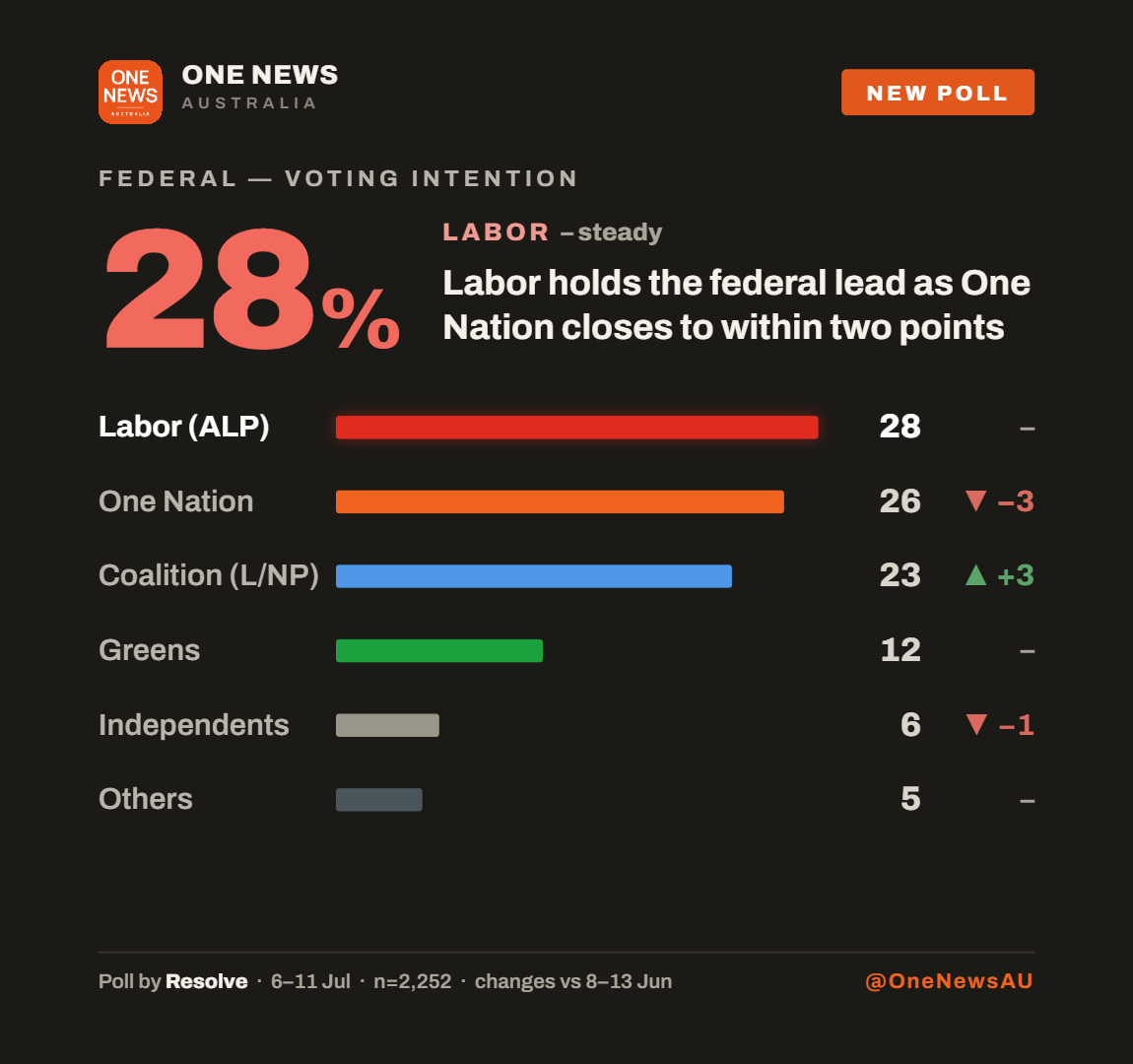
Here's what those headlines left for the fine print. At 26%, One Nation is still ahead of the Liberal National Coalition on 23%, still within 2 points of the Labor government on 28%, and still polling four times the 6.4% it won at the May 2025 election. The Greens sit on 12%.
Jim Reed learned his trade inside the Liberal Party's campaign machine
Resolve Strategic isn't a household name, so here's who's behind it. Reed launched the company in August 2019. Before that, his own website says, he was Group Director of Research and Strategy at C|T Group, the firm better known by its old name, Crosby Textor. That company was founded by Sir Lynton Crosby, the campaign strategist behind John Howard's election wins and Boris Johnson's two London mayoral victories, and Mark Textor, who was the Liberal Party's internal pollster for decades. In plain terms, the man who runs the poll learned his trade inside the Liberal Party's campaign machine. He describes himself as a veteran of 20 general elections as a party pollster.
Within a year of Resolve opening its doors, Crikey reported the new firm had collected "more than $1 million in limited tender government contracts". A limited tender is a contract handed out without an open competition. The work included social policy research for the Department of the Prime Minister and Cabinet under the Morrison government.
The public record backs that reporting. AusTender, the federal government's public register of contracts, shows a $541,750 limited tender contract for social policy research, arranged through the National COVID-19 Crisis Commission for the Department of the Prime Minister and Cabinet between April and June 2020. The supplier is listed as "Reed, James Alan T/A Resolve Strategic", which at that point was Reed trading under his own name. Labor's Murray Watt, then a senator and now a minister in the Albanese government, posted the contract notice in June 2020 and asked whether the Prime Minister was "using public funds for political polling".
Some winners from #COVIDー19. Former Crosby Textor/Liberal Party pollster Jim Reed gets a sweet $541k to do polling for PM’s Dept. Is PM using public funds for political polling? pic.twitter.com/Ra05klCWbd
— Senator Murray Watt (@MurrayWatt) June 4, 2020
None of this proves the numbers are wrong. Resolve says its monitor was the most accurate public poll at the 2022 federal election, and its debut record was genuinely strong. The problem sits elsewhere: when the numbers move and the headlines follow, readers have no way to check why.
2,252 strangers stand in for 18 million voters, and Resolve won't say who they are
No pollster rings every voter in the country. A poll works by asking a couple of thousand people and treating their answers as a miniature of the whole electorate, about 18 million enrolled voters. Resolve finds its respondents through commercial online panels. These are pools of people who've signed up with market research companies to answer surveys, usually in exchange for points or small payments. The answers are then weighted, meaning they're mathematically adjusted so the sample's mix of ages, genders and locations matches the census. With 2,252 people, the margin of error is just over 2%, so any number in the poll could be about 2 points higher or lower just by chance.
All of that only works if the people in the panel actually resemble the country. If the pool skews towards the inner city or the regions, towards the young or the old, or towards one side of politics, the numbers bend, and weighting can only partly straighten them. Which is why the next part matters.
Resolve doesn't say which panel companies supply its respondents. It doesn't publish crosstabs, the detailed tables that show how the results split by state, age, gender and how people voted last time. State results aren't released with the national poll, they arrive weeks later as combined samples, and results for individual seats are never released at all. Around 5% of this month's respondents said they were undecided, and they were simply left out of the published figures.
None of that breaks any law, because no law covers it. The polling industry's answer to exactly this problem is the Australian Polling Council, a body set up in 2020 whose members promise to publish a methodology statement for every public poll: where the sample came from, how the questions were worded, how the weighting was done. YouGov, Essential, DemosAU, Fox & Hedgehog and Pyxis, the firm that conducts Newspoll, are all members. Resolve is not. Membership is voluntary, and Resolve hasn't volunteered.
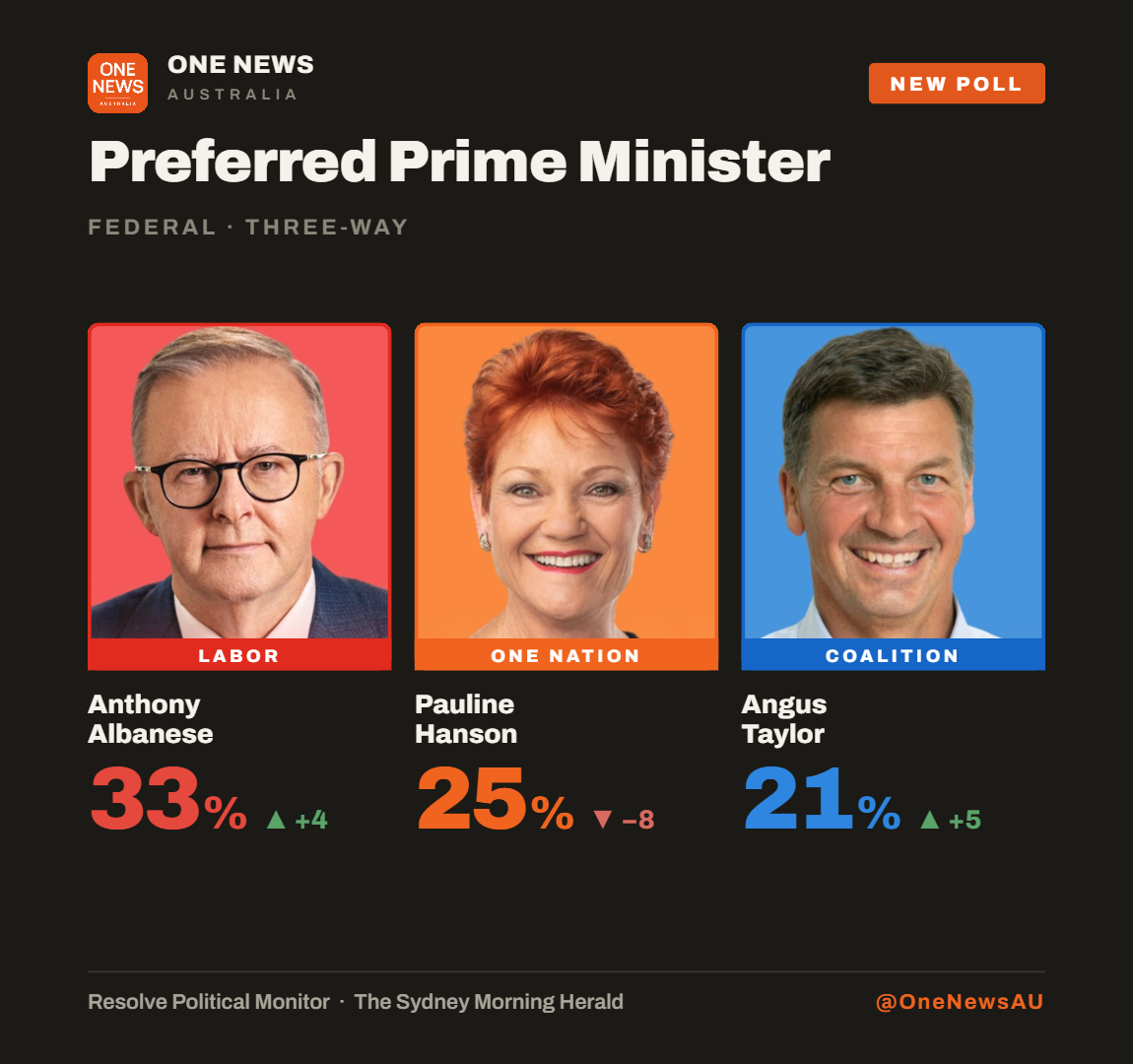
William Bowe, an independent election analyst who has run the Poll Bludger site for two decades, spotted another gap in this month's report. The poll measured Hanson's personal likeability for the first time and published the flattering half: 45% of voters rated her positively, a higher score than Anthony Albanese's 39%. Her negative rating, Bowe noted, "is not provided in the report".
The same poll found voters siding with Hanson on 8 of her 13 Press Club positions
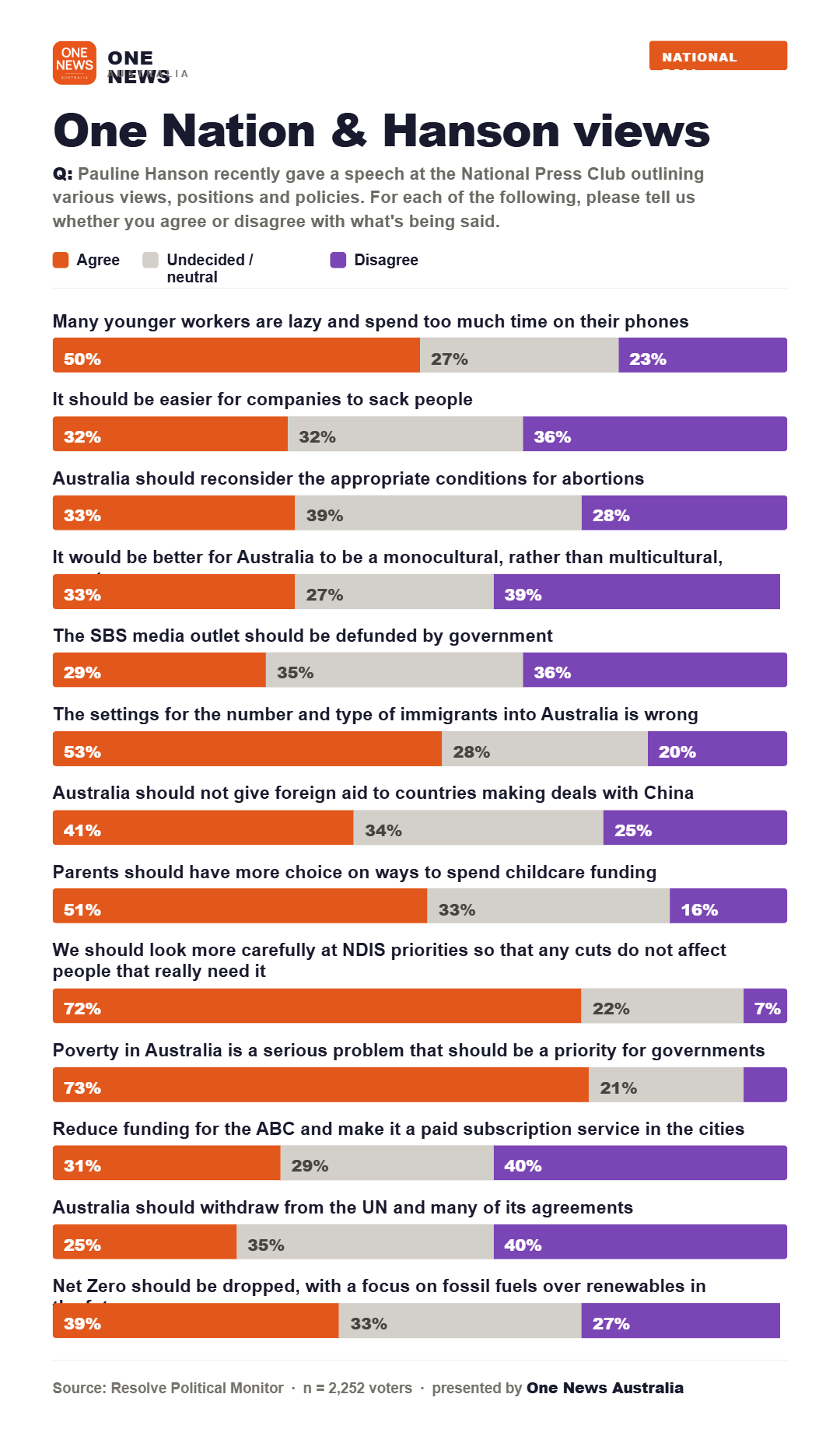
Buried beneath the slump headlines was the poll's other finding. Hanson recently gave a speech at the National Press Club, the televised address in Canberra where political leaders set out their agenda to the press gallery. Resolve read 13 of her positions back to its 2,252 respondents and asked whether they agreed or disagreed. Agreement won on 8 of the 13, and across all 13 the average ran 43% agree to 26% disagree.
- The settings for the number and type of immigrants are wrong: 53% agree, 20% disagree
- Look more carefully at NDIS priorities so cuts don't hit people in real need: 72% to 7%
- Poverty is a serious problem that should be a government priority: 73% to 6%
- Parents should have more choice on childcare funding: 51% to 16%
- Many younger workers are lazy and spend too much time on their phones: 50% to 23%
- No foreign aid for countries making deals with China: 41% to 25%
- Net zero should be dropped, with fossil fuels favoured over renewables: 39% to 27%
- Australia should reconsider the appropriate conditions for abortions: 33% to 28%
Bowe singled out the net zero figure as
"a distinctly more climate-skeptical result than is usual from such questions"
The five positions that fell short were the ones aimed at institutions: cutting ABC funding (31% agree to 40% disagree), withdrawing from the United Nations (25% to 40%), defunding SBS (29% to 36%), making it easier for companies to sack people (32% to 36%) and preferring a monocultural Australia over a multicultural one (33% to 39%).
Why one poll's framing matters to every voter
Published polls do more than measure politics, they move it. They shape which stories get written, how donors and party rooms read momentum, and how parties negotiate preference deals. When a single monthly poll can generate a weekend of "support slips" coverage, the public is entitled to know three things: who paid for it, who ran it, and who was asked. On the Resolve Political Monitor, the answers are Nine, a pollster trained by the Liberals' campaign firm, and a sample nobody outside the company is allowed to inspect.
And the firm itself is barely a firm. "Resolve Strategic" operated as Reed personally, a sole trader, from 2019 until Resolve Strategic Pty Ltd was incorporated in June 2024. Resolve's website names no staff other than Reed, and no LinkedIn profile besides his lists the firm as an employer. One man designs the questions, reads the answers and hands Nine its front page.
One News tracks Resolve alongside YouGov, Newspoll, Essential and DemosAU on the Australian poll tracker, updated as each new federal survey lands.
The next Resolve Political Monitor is due in August. As with every edition before it, the names of the panels that supplied its respondents won't be published with it.